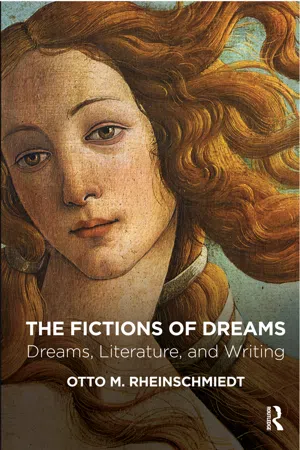
This book examines some of the oldest preserved texts on dreams, such as Artemidorus' Oneirocritica, Sigmund Freud's favourite ancient dream theorist, and dream books by Aristotle, the grandfather of modern dream theory.
- 262 pages
- English
- ePUB (mobile friendly)
- Available on iOS & Android
eBook - ePub
About this book
Information
CHAPTER ONE
Dreams and the universal design of creation
Dreaming can be better understood if we leave aside psychoanalytic thinking for the time being and bring into the equation other models of understanding the world. It is my belief that some of the laws that govern physical reality can illuminate the understanding of aspects of immaterial, invisible reality such as the psyche and its main proponent, dream life.
The universe of matter possesses an internal order, as does the universe of the mind. The dynamical systems of the material world, such as brain function, weather systems, and the formation of planetary constellations, are governed by chaos and principles that order chaos. The same is true for the dynamical system of the mind with its emotional underpinning. The process of dreaming creates order out of the emotional chaos of the mind. Dreaming can be understood as operating on the boundary area between order and chaos.
Another law that governs physical reality is that under certain conditions matter can be created out of fast-moving particles. The process of dreaming seems to resemble nature’s inherent capacity as the maker of matter. The matter of the dream consists of images, symbols, metaphor, and autobiographical fictions, and through the process of dream thinking the psyche creates thoughts that can be thought about, and ideas that serve emotional understanding and become pivotal conceptions, leading to meaningful fictions about the dreamer’s historicity and identity.
* * *
Before we venture into the parallel universes of the strategies of genius, chaos theory, and quantum physics we need to let the fictions of dreams speak for themselves. I wish to make the point that the body and the mind are connected, in order to prepare the ground for a type of thinking that does not draw a clear demarcation line between the physical world and the world of the psyche, and does not preclude the idea that all worlds we live in are governed by the same laws.
Dreams and chronic fatigue syndrome
Some twenty years ago I was asked to run an analytic group in a GP surgery for sufferers of “chronic fatigue syndrome” (CFS). The two-year project was funded by what was then the primary care trust. The group, of eight, displayed the following symptoms: long spells of exhaustion, inertia, a sense of isolation, physical neglect, anxiety, sexual impotence, and a daily struggle to do the most basic chores, such as going out food shopping, cleaning the flat, doing the washing-up. The most common physical trigger for the onset of the condition was a persistent viral infection.
The group members produced dreams in keeping with the syndrome. One patient was chased by a fire-spitting dragon but had leaden legs and could not escape. Another patient dreamt he was thrown into a cement mixer that was emptied out into the concrete foundations of a skyscraper. He slowly went under the grey mass, dying a slow death of suffocation before the concrete set. Another patient dreamt she was a statue made out of marble, admired by onlookers but not able to make herself understood from inside her solid grave.
The dream images revealed, at first sight, somatic states of being, of bodily paralysis and petrification, which was reflected in the group climate, an altogether draining experience. To sit with one patient who is stuck physically is challenging but to be with eight patients who are giving in to heaviness and deadness is somewhat unbearable. Frequently I dozed off, to the amusement and annoyance of my patients, who saw one of their own primary symptoms being displayed in public. Any kind of illness makes this demand to join in with sameness.
The group was mentally animated at times but always operated at a slow-burn tempo, held down by the heightened gravitas of lethargy. Time was dragging, tearing at one’s insides. There was nothing one could do apart from be with the group’s comatose emotional state; truly an underwordly place of death and dying from which there is no escape. The only thing that passed for communication was long lists of symptoms, ailments, and days spent wasting time.
Except for the sudden eruption of one of the patients who felt so exhausted that he had to sit on the floor. Duncan got up, sat on the sofa, and started to have a go at the others, in the high-pitched voice of a mezzo-soprano.
You lazy sods! We’ve been coming here for six months, and nothing’s happening. Always the same boring stories. I’m down already, you’re pulling me down even more.
The group was stunned by the resurrection of one of its own. Duncan sounded like a preacher on a mission. Or more like a dragon spitting fire, as was the case in his dream. Yvonne, always on the verge of melancholy sadness, dared to question the preacher man. Her words seemed to give in to a downward curvature of gravity before they arrived flatly.
What do you want us to do?
Why don’t you ask him?
Duncan pointed at me, as if slapping me across the face.
The group had conjured a wake-up call for the sleeping beauty of “chronic fatigue”, which had been like surrendering to an anaesthetic, as if the aesthetic of aliveness was long gone. The frozen emotional state of the group was melting right in front of our eyes. Talk of physical ailments gave way to talking about the despair of being locked into somatic states of depression.
The patient who had woken the group from its slumber talked about the malignancy of his depressive feelings, about not being able to have a life, not being able to work, and struggling to be in a relationship. Others joined in with the current of emotion, making a plea for the human condition and for the suffering in the world. The woman with the marble statue dream, Yvonne, started to talk about the sadism of her father, a drunkard who had terrorised her family of origin with his violent outbursts. She was the one who first dared to speak up when the group’s preacher man had started on his tirade, spitting the dragon’s fire and lighting the flame of aliveness.
Yvonne behaved as she had done in her family, where, with mixed results, it was she who placated her father, witnessing his red-hot rage cool down to a simmer or him going off into another round of violence. That was the risk. And the great cost was the loss of her childhood innocence. Yvonne’s only way out was to develop a childhood depression, which was an impasse, and after a long period of time of her torment not being relieved by a parental figure, she started to somatise, struck down by one viral infection after the other.
Matthew, the patient with the cement dream, rose out of inertia by saying that he could identify with Yvonne’s terror. Although he was a stunning man, he did not feel manly inside. From as early as four years old he had wanted to be a girl, when he started crossdressing, using his mother’s make-up and wigs, mixing only with girls. When his father found out he beat him heavily.
I will make a man out of you! You pervert!
Matthew carried on regardless, with the clandestine support of his mother, who rather liked having a girl.
At regular intervals he stoically went through the ritual of beatings that seemed to have given his father sexual pleasure. Matthew was not to be moved, but, emotionally speaking, he died of suffocation, as if sinking into liquid cement. He was desperate to leave home in order to live his dream, which he managed to do at the age of sixteen when his uncle took him in, in London, where he was able to find a peer group of like-minded people. The skyscraper dream of adulthood had returned to the foundations of a more liberated life. The skyscraper represented the skyline of London. The suffocation in cement expressed his feeling of still being cemented in, having to live in a male body.
Duncan, the group’s awakener, chipped in, saying that as a child he too was not able to follow his dream. He had been an outstanding footballer in the under-fifteens, where he was spotted by a second-division football club and offered a contract. His father, who previously had taken him to every single match, giving a convincing impression of support and dedication to the cause, changed tack and refused to give his permission, which meant that Duncan was not allowed to move on his own to the Midlands to join the club’s youth development scheme. Following this disappointment he gave up football altogether, and disappeared into deliberately wrecking his body with alcohol and drugs.
The climate in the group had changed. It had moved, from the enclosure of a purely physical narrative and identification, to the beginnings of talking about things embedded in the body, never released before into the conscious mind, nor available to be thought about. During the first six months the group had remained in a cryptic place, a bodily grave, an underworldly claustrum from which it had seemed there was no escape.
It became obvious that the condition that was diagnosed medically as purely physical was, in fact, psychosomatic, whereby emotional conflict had found refuge in the body; a depression of the body, as it were. From the somatisation of internal conflict the group went on to develop a culture in which unbearable feelings could be expressed and thought about. The actual issue was not fatigue but depression. The group evolving out of the physical realm did not, however, take a linear course of development. Naturally it followed chaos theory, always oscillating between bodily identification and emotional understanding, not unlike the nature of light, at once particle and wave.
Yvonne was not content any longer to recoil from life, as she had done in the feeble attempt to fend off her father’s violence, which she had taken inside like a malignant growth, expecting it to resurface at any time. Freeing herself from out of the marble statue of the dream, she discovered the power of assertion, urged on by Duncan, who became increasingly angry with the father of his childhood for having ruined his footballing career, in turn starting to own his dream, in which he was chased by a fire-spitting dragon, unable, being leaden-footed to escape.
As the lead weight of “chronic fatigue” lessened, his fire-spitting self gained momentum, and he reconnected more and more with the life force that had gone underground. But he also recognised that he had lived on the illusion that football would have spared him from the depression that had seized him in early childhood when his mother left the family. In the final furlong of the group Duncan also understood that his father might have been envious of his footballing talent, determined to scoop it out from him, with the intention of ruining the possibility of a career.
When Matthew announced in the group that he had consulted a psychiatrist with the aim of going through with a sex change, Yvonne lost her composure.
Why do you want your willy cut off? The problem is you hate your body! The way your father hated you for being so girlish.
If there had been such a thing, the hair on the back of the group’s head would have stood on end. Matthew was mortally offended, performing a girlish impression of indignation and sulking. Yvonne had, in his mind, metamorphosed into his emasculating father.
Just before time was running out and the group was approaching its two-year life span, Matthew started to come round to the idea that his problem was not being enclosed in a man’s body but self-hatred fuelled by his sadistic father. In fact, on an emotional level, his father had already emasculated him. In his mind there were no pudenda left anyway. And Yvonne, who flourished on finding her power as a woman, remained solidly by Matthew’s side, speaking the unspeakable. In the end he never went through with a sex-change operation, preferring to remain living in a man’s body, a handsome man’s body for that matter, but feeling like a woman in the privacy of his mind.
* * *
Having mapped out aspects of body–mind continuity through a case study of a psychosomatic condition and its inherent dream life, we have seen that the mind has a tendency to create somatic conditions, symptoms, as it were, of unresolved emotional conflict. And somatic conditions, once established and fortified by stubbornly held theories (my body is the culprit, my body lets me down), have an impact on mood and emotional well-being. It is striking, if not mind-boggling, how the way the mind and the body intelligently invent psychopathologies and illnesses, an aesthetic of despair, as it were, in order to avoid the actual crux of the matter; which means that we are inherently steering away from truthfulness and thoughts that seem too unbearable to be conceived of and experienced, except for in dreams, mainly in the shape of nightmares, which remind us of the daemons of the night.
The nightmarish dreams Duncan, Yvonne, and Matthew displayed at the beginning of treatment were in keeping with purely physical notions of, and identifications with, “chronic fatigue”. And yet, within the dilemma of physical enclosure and depression lay its own solution, namely depression of an emotional nature and its origin in unbearable emotional conflict. Duncan’s persecutory dragon had become a companion of assertion, Yvonne’s enclosure in marble had led to her finding the fluidity of emotional life, and Matthew, once imprisoned in a cemented notion of unwanted masculinity, realised he could live in a man’s body but feel feminine inside.
We are now moving on from the mind–body unity that can express a person’s fear of redemption to the other side of the human scale. Instead of creating an illness, the mind creates a fundamental human project; the mind at its most potent location on the mind–matter continuum. The study of strategies of genius shows the ways in which geniuses approach and realise their creative projects, from the world of ideas to their manifestation in the real world. And it is the process of dreaming proper and of conscious dreaming in waking life that is the source of these strategies of genius.
Dreams and the strategies of genius
All this fires my soul, and, provided I am not disturbed, my subject enlarges itself, becomes methodized and defined, and the whole, though it be long, stands almost complete and finished in my mind, so that I can survey it, like a fine picture or a beautiful statue, at a glance. Nor do I hear in my imagination the parts successively, but I hear them, as it were, all at once. What a delight this is I cannot tell. All this inventing, this producing, takes place in a pleasing lively dream. (Mozart, 1878; Sadie, 2006)
Mozart who composed entire orchestral pieces in his mind and then put the music down on paper with few corrections, gave credit to the source of his inspiration, which was dream inspiration; musical dreams, gone solid in the shape of notes. Composition for him was an aesthetic experience during which he utilised the method of conscious dreaming in waking life. Robert Dilts, who, in Strategies of Genius (1994), studied the creative patterns of geniuses such as Aristotle, Mozart, and Einstein, found some ten principles underpinning their productive projects.
- Geniuses tend to have a dominant visual sense (being able to see things in pictures),
- they use numerous links between the senses (synaesthesia),
- they are able to hold multiple perspectives on their works of creation,
- they manage to switch between perceptual positions (me, you, and observer),
- they are able to think simultaneously about the abstract and the concrete (ideas and their practical realization),
- they maintain feedback loops between the concrete and the abstract,
- they show a balance of the cognitive functions (dreaming and reality), dreaming their dreams into solid existence,
- they ask basic questions,
- they use metaphors and analogies,
- and they have a mission beyond individual identity. (Ibid., pp. 277–283)
Have you got the making of a genius? If you analysed a large number of dreams, you would come to the conclusion that they contain all the ingredients of genius. In fact, the underlying process of dream activity, that is, dream thinking, is the very source from which human genius springs. Not surprising, really. Dreams are the stuff we are made of.
Does that mean that we’re all geniuses? Of course not. The only difference between geniuses and us ordinary mortals is that geniuses are able to use the full range of the strategies of genius inherent in the process of dreaming. Geniuses are waking dreamers, they dream their dreams into existence, using all the skills available from lucid dreaming. They are able to re-enter a creative dream at will, and come out of it with the gift of the dream, which is dream inspiration. Not only that. They are able to convert the dream into something visible, which involves reality testing and the ability to put ideas into tangible form, reaching, at its peak, a consortium of the practical, the aesthetic, and the universal design of creation.
Only a handful of us can claim to be geniuses but the aesthetic of dreams allows us to strive for genius in small pockets of our lives. We do have the potential of genius in niche areas of experience. The fact remains we are geniuses by ways of dreaming, in the same way that we are sexually potent both in our dreams and during somatic states of dreaming that are closely linked with the physiology of sexual arousal.
We are now talking about the possibility of something we are not but are striving to be, in an attempt to widen the scope of perception and the possibility of change. The impotent man might dream about rampant sexual encounters, feeling sexy, attractive, and immensely potent. A single mother living in poverty dreams that she is rich beyond measure, raking in money and fame by writing a bestseller. A dreamer whose singing makes the whole family, including cat and dog, cringe with embarrassment dreams about singing a solo part in a Wagnerian opera in front of hundreds of people, eliciting delirious applause. A mouse of a man dreams that he is the alpha lion of a sizeable group of lions, lionesses, and cubs. Such dreams are not necessarily compensatory, nor signs of positive inflation, as the Jungians would have it, nor symptoms of omnipotence, as the Kleinians would have it, but put into place by the dream mind as a reminder of what is possible. Dreams construct possible worlds. They get us away, for one hour and forty minutes per night, from the tedium of ordinary life, run on the tramlines of habit.
But there are pockets of emotional life, under the authorship of dreaming, that give expression to the genius of ordinariness, such as mourning, humour, play, and subject immersion. Grieving is a creative state of mind, as it takes seriously what the individual has lost, but also, in the process of mourning something is built inside whilst the ties are severed from that which is lost. This is a paradox that leads to an aesthetic...
Table of contents
- Cover
- Half Title
- Title
- Copyright
- Dedication
- Contents
- ACKNOWLEDGEMENTS
- ABOUT THE AUTHOR
- INTRODUCTION
- CHAPTER ONE Dreams and the universal design of creation
- CHAPTER TWO The fictions of dreams
- CHAPTER THREE Dreams, literature, and fiction writing
- CHAPTER FOUR The primary human drives
- CHAPTER FIVE The father of modern dream analysis
- CHAPTER SIX Sleep research
- CHAPTER SEVEN A brief history of dream consciousness
- CHAPTER EIGHT The ancient deities of dreams
- REFERENCES
- INDEX
Trusted by 375,005 students
Access to over 1.5 million titles for a fair monthly price.
Study more efficiently using our study tools.
Frequently asked questions
Yes, you can cancel anytime from the Subscription tab in your account settings on the Perlego website. Your subscription will stay active until the end of your current billing period. Learn how to cancel your subscription
No, books cannot be downloaded as external files, such as PDFs, for use outside of Perlego. However, you can download books within the Perlego app for offline reading on mobile or tablet. Learn how to download books offline
Perlego offers two plans: Essential and Complete
- Essential is ideal for learners and professionals who enjoy exploring a wide range of subjects. Access the Essential Library with 800,000+ trusted titles and best-sellers across business, personal growth, and the humanities. Includes unlimited reading time and Standard Read Aloud voice.
- Complete: Perfect for advanced learners and researchers needing full, unrestricted access. Unlock 1.5M+ books across hundreds of subjects, including academic and specialized titles. The Complete Plan also includes advanced features like Premium Read Aloud and Research Assistant.
We are an online textbook subscription service, where you can get access to an entire online library for less than the price of a single book per month. With over 1.5 million books across 990+ topics, we’ve got you covered! Learn about our mission
Look out for the read-aloud symbol on your next book to see if you can listen to it. The read-aloud tool reads text aloud for you, highlighting the text as it is being read. You can pause it, speed it up and slow it down. Learn more about Read Aloud
Yes! You can use the Perlego app on both iOS and Android devices to read anytime, anywhere — even offline. Perfect for commutes or when you’re on the go.
Please note we cannot support devices running on iOS 13 and Android 7 or earlier. Learn more about using the app
Please note we cannot support devices running on iOS 13 and Android 7 or earlier. Learn more about using the app
Yes, you can access The Fictions of Dreams by Otto M. Rheinschmiedt in PDF and/or ePUB format, as well as other popular books in Literature & Literary Criticism Theory. We have over 1.5 million books available in our catalogue for you to explore.