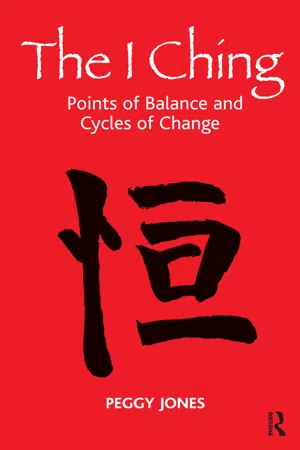
- 268 pages
- English
- ePUB (mobile friendly)
- Available on iOS & Android
eBook - ePub
About this book
Centred on the study of sixty-four 6-line figures (The Hexagrams) representing the yin and yang of the ten thousand things under Heaven, The Classic of Changes or I Ching is one of the oldest books in the world. In this revisioning of the I Ching, the author explores the processes of change and balance as reflected in the hexagrams for the contemporary reader.
Information
The Hexagrams
1. Ch'ien / The Creative, Heaven

Primary Trigrams
- above Ch’ien / The Creative, Heaven
- below Ch’ien / The Creative, Heaven
Nuclear Trigrams
- above Ch’ien / The Creative, Heaven
- below Ch’ien / The Creative, Heaven
In human life, the Creative works to activate, to engender, to inspire. It raises our energy level and expands and extends our capacities. This energy is bright and sharp, often impatient with the requirements or details of a process. In fact, when we or the atmosphere around us are charged with this pure, yang energy, there may be a sense almost of invulnerability, even God-likeness. For this reason, there may well be a considerable degree of resistance to the limits imposed by human life and the conditions of the world. The process of transformation may have its roots in the Creative, but unless our awareness also undergoes an expansion the net result of such a time could be no more than the after-glow of a beautiful fireworks display.
The construction of the hexagram consists of the trigram Ch’ien repeated in both upper and lower positions. Both nuclear trigrams are also Ch’ien. This construction represents the timeless, undivided, unconditioned force of creativity. As such, it is not any thing, and is unable to become some thing without being received, modified, and given form. At that point time enters the picture as the medium, the dimension through which creativity and transformation occur. The Creative is continuous; it does not have a resting state. It is a dynamic constant, the energy of which finds expression in the innumerable finite forms that have arisen since the universe came into being. Thus, it permeates, activates, and is identical with every living thing, every process, every experience. The Creative, seamlessly and dynamically embracing and embraced by the Receptive (see K’un, below), each carrying the seed of the other within, constitutes Life, eternal and unopposed.
As noted above, this hexagram is constructed of six yang lines. While no balance exists in this structure, the powerful dynamic at its heart constitutes the process of life seeking manifestation. We cannot know what came before, or what will follow, whether ‘constructive’ or ‘destructive’. Our part in the overall picture is also an unknown. None the less, when we are gripped by the need to express our creativity – to allow the Creative to express itself through us – it is unlikely to be either easy or comfortable. Whatever the area to which we feel drawn, compromise is not an option and will never satisfy us. We express our humanity and our individuality most fully in the creative act and the lack of a connection to, or channel for, our creativity can be deeply distressing.
Ch’ien is a calendar hexagram representing the fourth month of the Chinese year, May–June. In the northern hemisphere the sun is at its height and the daylight hours are at their maximum. The calendar hexagram that follows Ch’ien is 44, Kou / Coming To Meet, where a yielding line re-enters at the bottom of the hexagram indicating the beginning of the darkening of the light as the year’s cycle turns towards autumn.
The Changing Lines
Dragons are associated with the trigram Ch’ien, and the six places of the hexagram are seen as the six dragons, or steps, that lead to wisdom and the fulfilment of the Tao. Dragons are fabulous and dangerous, wonderful, fascinating, potentially arrogant, and charismatic. They represent the untamed condition of raw energy. The changing lines picture the taming of the dragon in that they reflect the process of transformation from yang to yin. The interaction of the Receptive (see the next hexagram, K’un) and the Creative creates a powerful dynamic; consequently, each of the changing lines represents an exceptional time.
- 9/1st In order for the tremendous potential of the Creative to be realized, it must be channelled through a form, an individual, a life. We could almost say it must open itself to doubt about its own perfection or purity; it must open to the Other. It is when we are most self-assured and confident of our direction and our goals that we are most vulnerable to the entry of radical challenge from the least expected direction – and most in need of it.
- 9/2nd Too much agreement or homogeneity leaves no space for the creativity that derives from variety and challenge. Where a lively dialectic exists, there is the possibility of wholly new ideas emerging. We must be prepared to welcome dissent, passion, argument, and frustration if we wish for new visions to arise and inspire or teach us.
- 9/3rd At the growing edge of our lives there is so much to learn and we have so little experience that we may find ourselves faced with the choice between dissembling, which can require a lot of energy to sustain, and simply throwing ourselves into the moment, admitting our ignorance and accepting guidance when it is genuinely offered. The lack of pretension and freshness of this path, as long as it is not contrived or calculated to elicit a particular response, is unlikely to meet with rejection or rebuff. This is not a counsel for lack of consideration of others; rather, it is for the release of any attachment we might have to our self-image or self-importance.
- 9/4th In the context of this hexagram, the fourth position represents an opportunity for a conscious re-balancing of our priorities. There are times in life when we have little freedom of choice, particularly when we are children; but we rarely imagine or recognize how open the world is to us and how much effect we can have if we are prepared to work hard. The clue is to start now, with quiet determination, to take the first small step and then the next and the next, trusting that the strength to carry on will be there when we need it.
- 9/5th The image associated with this line is that of a dragon flying in the sky. For the Chinese, the dragon represented all things charged with mystery and extraordinary potency. The dragon was one of the four magic animals capable of transformation and was associated with great good fortune. Its abode was the heavens. If we attempt to translate this into human terms it is bound to be difficult, as it reaches beyond all ordinary boundaries and definitions. It suggests a wild and glorious capacity for life, freed from the burden of fear, and limitless in its joy. How we apply this to ourselves is for each of us to discover.
- 9/top While this firm line at the highest point of the hexagram of Heaven has been associated with arrogance, a more thoughtful reading might consider the significance of finding oneself as far from the dark of earth as it is possible to be. There is no further one can go in this direction, the only way forward is down into just the area where our deepest fears reside, the realm of the physical, of earth, of ordinary collective existence. If a person does not know how to let go and be re-absorbed, but insists on always pressing forward, there will be a hard lesson to learn. All things turn into their opposite in time; that is how time and transformation work, and learning this lesson is a first step towards wisdom.
When all the lines are nines: the hexagram will then change into K’un, Earth, The Receptive. By its very nature Ch’ien is a guiding and moving force, but is not itself visible or manifest; its effect is made visible, made manifest through the birth of all forms and creatures out of its union with K’un, Earth, The Receptive.
2. K'un / The Receptive, Earth

Primary Trigrams
- above K’un / The Receptive, Earth
- below K’un / The Receptive, Earth
Nuclear Trigrams
- above K’un / The Receptive, Earth
- below K’un / The Receptive, Earth
K’un is a calendar hexagram representing the ninth month, November–December. In the northern hemisphere it is the season of the year when the days are shortest and growth appears to have ceased. All is quiet. All four trigrams that constitute the hexagram are K’un. There are no light, yang lines. This is the opposite of the month represented by Ch’ien, May–June, where there are no dark, yin lines remaining in the hexagram. (See Hexagram 1, Ch’ien / The Creative, above.)
The relationship of the Receptive to the Creative is best illustrated not by words, but by the Taoist symbol, t’ai chi (Wilhelm, 1989, p. lv), which represents the complementarity of the two within an overall unity: a circle encloses two interlocking embryonic forms, one black, the other white. Within the black lies a white ‘eye’ and within the white lies a black ‘eye’. The Creative and the Receptive, Yang and Yin, interpenetrate each other and are indivisible. Therefore, if we wish to discuss them we should always strive to remember that the separation is artificial, a necessary dualistic trick to enable us to explore the two energies.
If Ch’ien is Life as infinite creative energy, K’un is Life as limitless capacity, boundless receptivity. As the vessel, albeit a limitless one, K’un forms a bridge to the temporal. Everything we can sense or measure, think or touch, space, and the relationships between, and juxtaposition of, objects, animals, people, events, all of this is shaped within the vessel of the Receptive. However, it is the interpenetration of Ch’ien and K’un that gives rise to these forms. The hexagrams, with their undifferentiated and homogenous structure, must effect an exchange for the six foundation trigrams, the representatives of all possible forms, to come into being and, from them, the sixty-two hexagrams that follow.
This hexagram represents a particular energy (which is more like a field or a principle) in its pure state, a state that does not exist in nature, as emphasized above. It cannot exist in human beings either, because human life is conditioned and conditioned life is shaped by the opposites. However, with these provisos in mind, we can consider how the time and conditions reflected in the hexagram might affect our lives. The season represented is late autumn, early winter, a time when the processes of the earth, which is represented by K’un, continue out of sight. When such a time occurs in our lives we must learn to trust the health of the ‘seeds’ that have been planted within us, to be patient with gradual growth and development, to be content, for the time being, with nurturing ourselves and the world in a very grounded way, using our intuition and feelings to perceive where our efforts are best directed, not wearing ourselves out with trying to make something happen.
On the other hand, the lack of differentiation in the hexagram may point to a lack of balance, excessive passivity or an absence of complementarity. Life cannot begin, leave alone thrive, without intercourse and, if we are over-identified with the Receptive position, we may resist the focusing and choosing that is necessary if we are to advance on our particular, individual path.
The Changing Lines
In the context of a time of rest and receptivity, the changing lines introduce an altogether different energy, representing or reminding us of the dynamic process of transformation. In each position, the penetration of a yang line and yang energy into the situation pictured in the hexagram creates an opportunity for greater consciousness and awareness of self and cosmos.
- 6/1st Initial conditions, the beginnings of things, are critical to how events proceed and their outcome. The times require receptivity and complete openness, and the more we can put to one side our ideas about how things should be or what we want from the future, the more ripe will we be to receive fresh ideas or to recognize new possibilities. We forget so quickly that every moment is a ‘first-time’ moment that has never existed before; the seeds we plant today have never been planted before. If we did remember, we would act and choose with more care and more joy. But every moment also offers us a new opportunity to wake up. In the words of Rumi (Barks & Moyne, 1995):The breeze at dawn has secrets to tell you.Don’t go back to sleep.
- 6/2nd All things natural fulfil themselves by becoming what they are. This may seem obvious, but if we reflect upon it further it leads us deeper and deeper into the question of what we truly are. The Zen koan – What is your original face? – leads to the same area of paradox and mystery. When we talk about our personal ‘flow’ or ‘journey’ we are in the same area. How do we know what it is? How do we find it? How do we become, each of us, that which we are?
- 6/3rd The human mind is remarkable; we have no idea how much it is capable of as we only use a fraction of it. The uses we do make of it are potentially more within our control than we are generally aware. Calming the mind, focusing it, expanding its field of awareness, disciplining it, exercising it: we can all learn ways of owning and managing the movements of our minds and increasing our consciousness if we apply ourselves.
- 6/4th This yielding line in a yielding position signifies a time when the energies of Earth are most deeply at rest and impenetrable, a time of contraction and darkness appropriate to the moment. Under these circumstances, if we feel suddenly moved to strong action, we should consider our motives and goals. The attraction of activity and focus is great when there is not much going on; sustained commitment to a particular course requires more than just temporary enthusiasm.
- 6/5th The fifth position holds a particular prominence in the hexagrams, often representing the ideal response to a given set of conditions. In this case, yielding and remaining open is exemplary; however, nothing remains the same for long and when a different – firmer, more clearly defined or determined – course of thought or action is indicated it will be important to recognize how far-reaching the effects of our choice might be. We should not allow ourselves to choose in a superficial or reckless way.
- 6/top Change is inevitable; how we respond to it is infinitely variable. No matter how many times we go through the cycle of beginnings, middles, and ends in life, we will still find ourselves balking at change when it pushes us into the unknown or forces us to accept that which feels unacceptable. Each of us represents a small but unique part of the whole of creation at every moment. The significance of our choices may be unfathomable, but it is not inconsequential.
3. Chun / Difficulty at the Beginning

Primary Trigrams
- above K’an / The Abysm...
Table of contents
- Cover
- Half Title
- Title
- Copyright
- Contents
- ACKNOWLEDGEMENTS
- ABOUT THE AUTHOR
- INTRODUCTION
- The Hexagrams
- APPENDIX A: The Trigrams and the Sequence of Later Heaven
- APPENDIX B: The Lines
- APPENDIX C: Further Comments on the Process of Consulting the I Ching and Instructions for Dividing the Yarrow Stalks
- APPENDIX D: The Sequence of Earlier Heaven and the Tao
- APPENDIX E: The Grid
- REFERENCES
Trusted by 375,005 students
Access to over 1.5 million titles for a fair monthly price.
Study more efficiently using our study tools.
Frequently asked questions
Yes, you can cancel anytime from the Subscription tab in your account settings on the Perlego website. Your subscription will stay active until the end of your current billing period. Learn how to cancel your subscription
No, books cannot be downloaded as external files, such as PDFs, for use outside of Perlego. However, you can download books within the Perlego app for offline reading on mobile or tablet. Learn how to download books offline
Perlego offers two plans: Essential and Complete
- Essential is ideal for learners and professionals who enjoy exploring a wide range of subjects. Access the Essential Library with 800,000+ trusted titles and best-sellers across business, personal growth, and the humanities. Includes unlimited reading time and Standard Read Aloud voice.
- Complete: Perfect for advanced learners and researchers needing full, unrestricted access. Unlock 1.5M+ books across hundreds of subjects, including academic and specialized titles. The Complete Plan also includes advanced features like Premium Read Aloud and Research Assistant.
We are an online textbook subscription service, where you can get access to an entire online library for less than the price of a single book per month. With over 1.5 million books across 990+ topics, we’ve got you covered! Learn about our mission
Look out for the read-aloud symbol on your next book to see if you can listen to it. The read-aloud tool reads text aloud for you, highlighting the text as it is being read. You can pause it, speed it up and slow it down. Learn more about Read Aloud
Yes! You can use the Perlego app on both iOS and Android devices to read anytime, anywhere — even offline. Perfect for commutes or when you’re on the go.
Please note we cannot support devices running on iOS 13 and Android 7 or earlier. Learn more about using the app
Please note we cannot support devices running on iOS 13 and Android 7 or earlier. Learn more about using the app
Yes, you can access The I Ching by Peggy Jones in PDF and/or ePUB format, as well as other popular books in Psychology & History & Theory in Psychology. We have over 1.5 million books available in our catalogue for you to explore.