![]()
1 The political characteristics of the Tokugawa political system1
Comparisons of the West and the Tokugawa Japan
Sixteenth-century Japan and the West
Japan and the West have encountered each other twice through the course of history, first in the sixteenth century and again in the nineteenth. The impact of their first meeting was no less significant than that of their second: the introduction of firearms completely transformed the nature of contemporary Japanese warfare and played a decisive role in the country’s unification. Christianity also began to spread rapidly throughout Japan; within 50 years of its introduction in 1549, there were more than 700,000 Japanese Christians (or more than 5% of the total population), while the current Christian population is under 1 million (or approximately 0.8% of the total population). The Shimabara Rebellion (1637–1638) was the final barrier to the Tokugawa’s unification of Japan. Christians were the final obstacle to be overcome.
This Western influence was still limited enough to be controllable, however, as can be seen from Japan’s ability to successfully implement its policy of sakoku (isolation).2
The nineteenth-century encounter, in which the West sought to bring Japan into international society, was different, however. The West was prepared to use force to achieve its goal, and Japan did not have the means to resist. There had evidently been major changes between their encounters in the intervening period. What were they?
To begin with, it has only been in the past few centuries that the West has become an advanced part of the world in various ways. Prior to this period, the Islamic world had been more advanced than Europe. The forces of Islam invaded the Iberian Peninsula in the eighth century and were only driven out in 1492. Moreover, the Ottoman Empire that lay to Europe’s east only reached its peak under Sultan Süleyman I (1494–1566, reigned 1520–1566) and would continue to expand territorially until the 1680s.
And while the roots of Western society lie in Greek civilization and Christianity, both of these originated outside of Western Europe. The Renaissance – the starting point of the modern West – provided an opportunity for the European rediscovery of Greek civilization, but it had been the Islamic world, not the West, that had preserved this knowledge. Even as the West began to expand eastward; it was not carving out utterly new paths for itself as it did so. Rather, it was merely seeking new ways to the East as worsened relations with Islamic countries severed its existing routes.
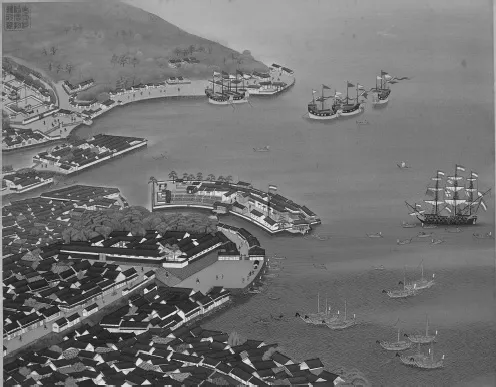
Figure 1.1 Nagasakikō Fukan Saimitsu Ga (Depiction of Nagasaki Harbor). Dejima is in the center. (Circa 1818–1830. From the collection of the Nagasaki Museum of History and Culture.)
This would serve as the prelude to Western global supremacy, however. The West would come to dominate the East for 400 years, beginning with the 1498 arrival of Vasco da Gama (c. 1469–1524) in Calicut. What the West sought at this time, however, was luxury goods like spices, not conquest. Trade took the form of monopolies held by the crown or trading companies (such as the British East India Company founded in 1600 and the Dutch East India Company founded in 1602). Expansion was thus abandoned fairly readily when they encountered strong local resistance or when trade profits were only meager. It was during this period that the first meeting between Japan and the West occurred.
Trade ceased to revolve around luxuries with the coming of the Industrial Revolution, however. Instead, it was believed that if China’s massive population of four hundred million could be persuaded to purchase British textiles to even just a limited extent, it would be sufficient to guarantee eternal prosperity for the industry. This sort of “myth of the China market” spurred on new Western inroads into China. As monopolies had come to be regarded as little more than hindrances by this point, the British East India Company’s monopolization of Indian trade was abolished in 1813 (followed shortly thereafter by the loss of its Chinese trade monopoly in 1833). And so the West came seeking to open Asian markets to Western goods, and it was prepared to use force if necessary, as was seen in the First Opium War (1840–1842). To Japan’s great fortune, it was merely considered a small country on the periphery of China.
Western pluralism
Now, as previously mentioned, Western civilization was neither remarkably old nor remarkably original. It was instead its pluralistic nature, the way it incorporated diverse elements despite the tensions that might lie among them, that was its most distinctive feature. It was this diversity that allowed the West to achieve such rapid development over the course of the sixteenth to nineteenth centuries.
In the first place, Europe, an area roughly equivalent in size to China, has long been divided geographically into a number of countries such as England, France, Spain, Germany, and Italy. It’s actually a bit strange, when you think about it, that, despite the many years that this situation has persisted, Europe has never been completely unified, nor has it become extremely fragmented.
This European pluralism extended from geography to its political structures as well. Feudal assemblies based on the estates of the realm existed in medieval Europe that limited the authority of the monarch. England’s Magna Carta (1215) is a prominent example of such a limit. And although royal authority would later expand, especially beginning in the seventeenth century, strong resistance from the nobility remained. Before long, these feudal assemblies developed into modern legislatures. Institutions equivalent to these assemblies were a rarity in other world civilizations. The concept of the right of resistance, one of the major characteristics of Western civilization, originated with these bodies.
Another example of this pluralism was the relationship between religious and temporal authority. While it was common in most civilizations for one of these to absorb the other, the tense relationship between the authority of the Pope and that of kings served as a major characteristic of the West.
Yet another example would be the strained relationship between Christianity and Greek civilization. Despite being seemingly fundamentally incompatible with one another, neither was able to completely overcome the other; both played major roles in the formation of the Western world.
Simply put, this pluralism became the driving force behind the Western world’s remarkably dynamic character. And this character is responsible in turn for the aggressive nature of Western civilization, the way it seeks to reshape the rest of the world in its own image.
The centralism of the Tokugawa political system
How did the characteristics of the Japanese society of the Edo period (1603–1868) differ from this? At first glance, Tokugawa society would seem to possess a number of qualities reminiscent of the feudal system of medieval Europe. Certainly, many foreigners thought so at the time. But despite these seeming similarities, the concept of feudalism doesn’t particularly suit Edo Japan well in a number of ways.
Under feudalism, a lord provides a reward, such as territory, to his vassals in exchange for their loyalty. The relationship, in other words, is a mutual one under which both parties are obligated to carry out contractual duties. A vassal has no obligation to obey a lord who fails to reward his loyalty. Because of this nature, vassals are independent; the instruments of a vassal’s power, such as his weapons, belong to and are paid for by him. These characteristics, while quite applicable to the Kamakura period (1185–1333), do not suit the Edo period. The lord–vassal relationship needs to be distinguished from the control structure known as patrimonialism, a system under which an entire country is controlled as if it were a single family. Under that system, the lord–vassal relationship is absolute; the lord is not bound by anything resembling a contract, and vassals are dependent. Patrimonialism is a generally an older system than feudalism and was commonly seen in ancient empires and the like. The modern bureaucracies found under absolute monarchies do have characteristics reminiscent of patrimonialism, however, in that the bureaucrats are absolutely subordinate to their monarch and do not possess the means of their own control. Although the Tokugawa political system, or bakuhan system, contained elements of both feudalism and patrimonialism, it was clearly closer to the latter.
The defining characteristic of the bakuhan system, when simply contrasted with the West, was its remarkable concentration of power. The long existing regional powers had been swept away, as had any local warrior clans who could potentially resist the authority of the daimyō, or regional landholding feudal lords. The samurai (bushi) class was reorganized into patrimonial bureaucratic vassal bands (kashindan), completely severed from any ties to the land, and required to live in the vicinity of their lord’s castle. This practice is the reason why, when the modern municipal system was established in the Meiji period (1868–1912), most of the newly created cities were former castle towns.
The shogunate-daimyō relationship was another characteristic of the system. Because Tokugawa Ieyasu (1542–1616), the first shogun, had, like other daimyō, once been a vassal of the Oda and Toyotomi clans theoretically, the shogunate-daimyō relationship was almost one of “first among equals” when the shogunate was first established. An overwhelming gulf soon formed between the two positions, however.
A third characteristic was the relationship between the shogunate and religion. Although Kamakura Buddhism had once served as a source for the creative energies of the masses, most of these sects had become largely powerless by the end of the Sengoku (Warring States) period (c. 1467–c. 1603).3 The only sect to maintain its strength, the Ikkō-shū, had been the greatest obstacle to Oda Nobunaga’s (1534–1582) national conquest. Christianity was also powerful but was restricted by the new shogunate’s isolationist policies as the Sengoku period ended and the Edo period began. Other religions were placed under the strict control of the temple and shrine commissioners (jisha-bugyō) through mechanisms such as the temple registration system (terauke) and religious census registers (shūmon ninbetsu chō).
Finally, the imperial court and nobility, which had frequently served as a nucleus for power struggles in the past, was strictly controlled by the Regulations for the Court and Nobility (Kinchū Narabi ni Kuge Shohatto) of 1615. Their power was drastically reduced, and they also became greatly impoverished.
The Tokugawa political system was thus a centralized one in which domestic forces potentially capable of acting independently of the authority of the shogun and shogunate were minimized to the greatest extent possible.
The shogunate also lacked any external threats. Japanese relations with China had become tense after the Ming dynasty fell and the Qing came to power in 1644; control of the great Chinese empire by a non-Han ethnic group caused fear in Japan that something like the Mongol invasions (1274, 1281) would occur. But while the Qing were initially expansionistic and would ultimately build themselves an empire that could rival the Yuan’s as the greatest in Chinese history, their relations with Japan soon became stable. Japanese relations with Korea, which had been poor after the invasions of Korea (1592–1593, 1597–1598) by Toyotomi Hideyoshi (1537–1598), became calm as well. As relations with the West were tightly controlled through the shogunate’s policy of isolation, the Tokugawa political system was thus essentially free from foreign threats.
As a result of the absence of internal and external threats, the factors that drove Japan to continue to increase its strength disappeared. In the West, the continued development of firearms brought about changes in military tactics and required the maintenance of great standing armies. These armies in turn brought about the large bureaucratic and financial systems necessary to support them. Similar changes had initially occurred in Japan as well, but they came to a halt following the Summer Siege of Ōsaka (1615). Japan had been one of the world’s greatest military superpowers at the end of the Sengoku period and had possessed more firearms than any other country. But by the time of the final years of the Tokugawa shogunate, known as the Bakumatsu (1853–1868), the foundations of the shogunate’s power, despite appearing overwhelming at first glance, had actually become extremely obsolete and fragile. The weapons that were carried by some of the vassals of the shogunate in the campaign against Chōshū in 1864 were not much different from those that were used 250 years before that. The Bakufu’s military supremacy went to nil when new military technology was introduced from the West. In the early seventeenth century, the Tokugawa military government had the power to stop all domestic challenges, but paradoxically this led to the failure in ability to reform themselves from within.
The issue of legitimacy
But authority cannot be measured solely in terms of force. Another aspect, legitimacy, is also important. Legitimacy, simply put, is the moral justification for rule. Rulers will always be greatly outnumbered by those they rule; their rule will therefore not be long-lived if a large number of the ruled come to believe the ruler to be unjust. It will be unstable unless a large number of the ruled accept, either actively or passively, that it has a legitimate basis. So how did the bakuhan system justify its rule?
First, there were significant differences between the hanshu (lords of the domain) of the Edo period and the medieval lords who preceded them. The latter had ruled over territory on the basis of their personal power. But outside of a few domains (han), such as Satsuma and Chōshū, that had existed since the medieval period, many of the Edo period hanshu had the mindset of patrimonial bureaucrats appointed by the shogunate. There was a sense that their domain didn’t actually belong to them; rather, it belonged to the shogunate. This lack of ownership is apparent in other aspects of the system as well, such as the right of the shogunate to control successions. Had the domains been independent political units, the questions of how the hanshu was determined and who the successor would be would have been left to them. Also, when a hanshu was dismissed from his position or transferred to a different domain, he left behind his arms. Leaving behind the most central instruments a hanshu had for wielding power symbolizes just how weak their sense of ruling on the basis of their own strength was. In short, the basis for a hanshu’s rule was that he had been entrusted with it by the shogun. (See Figure 1.2.)
The basis for the shogun’s rule, however, took the form of the title seii taishōgun ...