- 192 pages
- English
- ePUB (mobile friendly)
- Available on iOS & Android
eBook - ePub
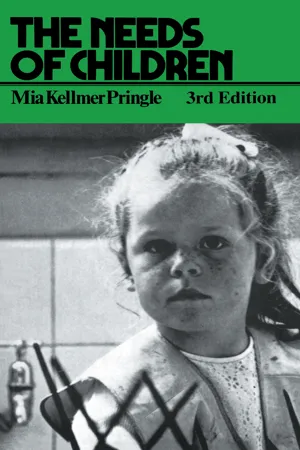
The Needs of Children
About this book
'A compelling book' - Observer '...an exceptionally clear and comprehensive synthesis of current research findings made readily comprehensible to both parents and teachers' - Dr M Levy in the Foreword to the French edition Mia Kellmer Pringle was commissioned by the Department of Social Security: To prepare a comprehensive document about the development needs of all children, about the ways in which these needs are normally met, and about the consequences for emotional, intellectual, social and physical growth and development of children when, for some reason or another, these needs are not adequately met Whilst the central themes of this classic text remain as relevant as ever, over forty new references have now been added and many passages have been substantially updated to reflect current thinking and to take account of new research. The Needs of Children, published in seven countries, continues to be a principal work in its field and a landmark in our understanding of childhood.
Information
1. Some Basic Concepts
Children's physical, emotional, social and intellectual needs must all be met if they are to enjoy life, develop their full potential and grow into participating, contributing adults. At present only physical needs are being satisfactorily met, at least to any considerable extent. Hence, the main emphasis in this book will be on psycho-social needs.
Five basic premises underlie the discussion and these are briefly outlined in this section. They are: that the environment is of overriding importance; that it is the early years of life which are particularly vital to later development; that there are marked individual differences in the extent and pace of children's growth; that vast improvements could be brought about in their emotional, social, intellectual and educational achievements; and that the strategy so successfully used in the health field may well be appropriate also to these aspects of development.
THE NATURE-NURTURE ISSUE
The first premise is that, for all practical purposes of social action and policy, the environment is of overriding importance. Human capacity to learn is such that the new-born child can adapt to widely different environments. Since, to begin with, he has a rather limited range of innate behavioural mechanisms, this very limited capacity makes him entirely dependent on his environment: having only the potential for becoming human, he must needs have a human environment to do so.
This is clearly shown by two phenomena; first, by the extremely circumscribed development of children who lack the necessary sense organs to perceive, communicate and interact with their environment, such as the deaf-blind (Helen Keller being the most famous example of success in overcoming these obstacles); secondly, by the fortunately rare cases of children who spent their early years in extreme isolation: by the time they were rescued, aged six years or more, they had acquired few truly ‘human’ characteristics. The same need for an appropriately nurturing environment is illustrated by the fact that even great gifts, such as the ability to compose music, might not be realised, or even discovered, in a culture without music.
Somewhat less extreme examples of the environment's overriding influence relate to sex-typing – the teaching of the socially expected sex role – which normally begins at birth. One of the first questions asked about a baby is whether it is a boy or a girl and from then onwards parental attitudes and expectations become different according to the answer given: both in major and minor ways, the child will be treated, and expected to behave, differently. Clothes, toys, subtle differences in words, play, hugs, rewards, punishments and parental example, surround the child with a world which clearly distinguishes behaviour expected from boys and girls.
Those psychological characteristics considered appropriate will be developed by about the third year of life; and throughout childhood the ‘assigned’ sex role will be practised in social relations, in play and in fantasy, and be continually reinforced by the responses and expectations of others. Finally, it will be reinforced at puberty by the various physiological changes.
In the past, the consistency and reliability of the sex role performance had been thought to be due to its innate basis. Now many studies have shown the immense influence of psychological and social factors in determining sexual attitudes and behaviour. Furthermore, studies of children born with the same defect of physical sexual development have illustrated that they can be raised either as boys or as girls. With very few exceptions, they grew up to behave in accordance with the sex role to which they had been – almost arbitrarily – assigned (Hampson and Hampson, 1961; Kagan and Moss, 1962; Money, 1963; Maccoby and Jacklin, 1975).
These findings suggest that children learn to behave in ‘masculine’ or ‘feminine’ ways through being treated as such; in other words, the gender role is psychologically determined first by parental and then by wider society's expectations.
This conclusion is in line with other findings relating to educational achievement. These showed the influence of parental attitudes and expectations on scholastic progress (Douglas, 1964 and 1968; Seginer, 1983). Other studies have demonstrated that children ‘demoted’ to lower streams were soon conforming to the lower standards prevailing in them (Lunn, 1970; Brophy, 1983).
There is another developmental area where this is still a controversial issue, namely the question of the relative contribution made to intellectual development by the genes and the environment respectively. This has been debated, with greater or lesser heat, for many years. Following Jensen's much-quoted article, it is still a topical controversy (Vernon, 1979; Eysenck and Kamin, 1981; Taylor, 1981).
The current debate differs in two ways from that which raged in the 1930s. On the one hand, few would now deny that environment plays a part in shaping a child's intelligence, even if they believe heredity to have a much greater influence; the pure environmentalist has been discredited too. On the other hand, more explicit racial implications have now been added to the previous political overtones. This has increased the bitterness of the argument as well as its implications for current political and educational thinking.
Though a belief in the interaction of heredity and environment is the most generally accepted standpoint, available research findings allow a wide range of possible interpretations. The debate about measuring the relative importance of the two is likely to remain rather sterile, since it is doubtful whether conclusive evidence can ever be provided. This situation is only too familiar to the farmer: to obtain a good crop of wheat, he needs not only good seed but also good soil and appropriate moisture, temperature and fertiliser to nourish its growth. However, all of these can be controlled and varied in a way which would be neither acceptable, nor indeed at present possible, in relation to the genetic and environmental components of human beings.
Yet the mistaken belief about reliable measurement is most clearly shown in relation to the I.Q. The credibility of most educational testing – whether concerned with assessing attainments, aptitudes or intelligence – depends largely on a tautology: the validity of the tests is demonstrated by their ability to predict performance at school; yet such performance amounts to an ability to perform well on tasks similar to those in the tests. This has led to the false impression that doing well in tests necessarily means a greater competence in coping, later on, with life in general. Hence there is a ‘grave danger of perpetuating a mythological meritocracy’ (McClelland, 1973).
The solution is not – as some would have it – simply to abandon testing; if for no other reason than that subjective judgements are considerably less reliable. Instead, three changes are required: first, the search for innate factors, such as intelligence, should be abandoned to be replaced by measuring instead improvement resulting from new experiences and from deliberate teaching. Secondly, currently used items, consisting of very artificial word and number games should be replaced by issues and problems occurring in everyday social and occupational life. Thirdly, rate of progress over time should become the yardstick for learning potential instead of the static concept of the I.Q.
Genetic-environmental interaction starts in utero and hence ‘pure’ inborn abilities and characteristics can never be assessed. For example, the development of the nervous system in the foetus and new-born is affected during pregnancy and parturition by adverse conditions, e.g., malnutrition or exposure to certain diseases, heavy manual work, smoking, drug-taking or extreme anxiety. Thus a child may be born with a brain which is incapable of normal development, not because of defective genes but because of pre-natal conditions or birth injury. On the other hand, inborn temperamental differences inevitably affect the environment; for example, a hypersensitive, irritable baby is likely to call out irritability in his mother which in turn only serves to increase his own irritability.
In growth of all kinds, the interaction of powerful genetic forces and powerful environmental forces is at work cumulatively over long periods of development. In optimum environments, genetic factors will appear predominant and environment will appear less important because its influence is roughly constant. In sub-optimum environments, environmental effects will appear more obvious (Clarke and Clarke, 1972).
The weight or influence exerted solely by the nurturing process could only be determined by a study of identical twins who alone are perfectly matched genetically. However, ethical reasons preclude the deliberate and extreme environmental manipulation which would be needed to make possible a systematic exploration of the effects of very different experiences on subsequent development.
There is one well-documented and detailed study of two pairs of identical twins who were reared apart from early infancy and did not meet again until they were in their late twenties (Hudson, 1970). The two girls had been adopted into very different homes and hence their upbringing and education had also been markedly different. By the age of thirty-five, there were even marked physical differences: the one who had had the much easier life was, for example, better preserved, apparently physiologically younger and an inch taller; there were also marked differences in ability, attainments, personality and overt behaviour. The two boys, on the other hand, were adopted by families who were of absolutely the same social and economic status and these twins led extremely parallel lives. By adulthood, the similarities between them were quite striking in almost all areas of development and physically they had repeatedly been mistaken for each other by strangers.
No doubt the controversy regarding the relative contribution of heredity and environment (including the intra-uterine) to children's abilities, attainments and adjustment will continue. That genetic and physical factors play some role, if only in setting limits to potential development, is widely accepted. At the same time, all available evidence confirms that, from a practical viewpoint, the most important element in shaping behaviour and development is the environment in general and other people in particular. Hence, from the point of view of action – whether preventive or remedial – this is where intervention should be concentrated.
Genetics, after all, describes only the raw material on which a particular culture acts. As educational systems evolve, so too do the skills of the individuals within them. Logically, we can set limits to children's capacity to learn only if every permutation of their environment, every method of nurturing and teaching them, has been exhausted. This is a task we have scarcely begun; and which, even in principle, we could never finish (Hudson, 1972).
EARLY EXPERIENCE, DEVELOPMENTAL PACE AND SENSITIVE PERIODS
Longitudinal research is beginning to provide an understanding of the pattern of human growth. Three quite specific features have emerged which have important practical implications for child rearing. First, the development of various basic characteristics does not proceed in equal units per unit of time, i.e., growth does not take place at an even pace.
Secondly, for most aspects, the period of most rapid growth takes place in the early years (i.e., from conception to six years or so) and is then followed by periods of less and less rapid growth with a ‘spurt’ at puberty; for some characteristics there is as much quantitative growth in a single year of a child's life as there is in eight to ten years at other stages in his development.
Thirdly, available evidence suggests that environmental influences have the greatest effect during the most rapid periods of growth. From this it follows that it is experiences and opportunities during the early years of life which are particularly vital to later development. This is the second basic principle adopted in this document.
A few examples are given as illustrations. These are drawn from the Bureau's National Child Development Study (see NCDS User Support Group, 1985); the Berkeley Growth Study (Bayley, 1964); the longitudinal studies of the Fels Institute (Kagan and Moss, 1962); the writer's own research; and the evidence synthesised by Bloom (1964).
Physical development
Height is the most extreme case of the first generalisation referred to above. During the nine months from conception to birth, growth is of the same absolute magnitude as it is during the nine years from three to twelve; and from conception to the age of about two and a half years, half the full adult stature is attained. The brain's weight doubles during the first year of life while during the next nineteen years increasing by only one and a half times (Brierley, 1976). Hence, one would expect that it is pre-natally and during early infancy that the environment has the greatest effect, for better or worse.
Intellectual development
As much development takes place in the first four years of life as in the following thirteen years. It has been estimated that about 50 per cent of intellectual growth takes place between conception and the fourth year, and about 30 per cent between the ages of four to eight years. Unlike physical development, however, it continues well into adulthood, but the pace becomes very much slower after eighteen years or thereabouts.
With regard to vocabulary, by eight years of age, about 50 per cent of the level attained by eighteen years will have been reached. So again, early environmental influences have a marked effect on measurable cognitive functioning. Recent studies suggest that social class differences, affecting language development, emerge during the first year of life and become unequivocal by about the age of three (Kagan, 1971).
Emotional and social development
Precise and objective evidence remains very inadequate in this area. Paradoxically, less is known about the development of normal than of deprived, disturbed or delinquent children. Two aspects of personality have, however, received particular attention, partly because of their central significance in personal relations and partly because they are more readily observable than other characteristics. These are aggressiveness and dependence on others for support and direction.
Differences between boys and girls in the development of these aspects can be noted early and the ‘sex-appropriate’ behaviour becomes well established during the pre-school years. This suggests that for personality development, too, the early years are of great importance.
With regard to behaviour and adjustment, problems are already apparent among children in infant schools, by which age some 14 per cent show considerable difficulties in school (Chazan, Laing and Jackson, 1971; Pringle et al., 1966). The lower the parental occupational status, the lower tends to be the proportion of well-adjusted children (Davie et al., 1972).
Educational development
Available evidence suggests that of a child's general attainment at the age of eighteen, approximately half has been reached when he is about nine years old. However, the capacity to respond to, and benefit from, education inevitably depends on the level of a child's intellectual, language and emotional maturity. Therefore, it is again experience during the pre-school years which has a vital influence on later scholastic progress.
Findings from the National Child Development Study show that even as ea...
Table of contents
- Cover Page
- Title Page
- Copyright Page
- Contents
- Introduction to the Third Edition
- Introduction to the Second Edition
- Acknowledgments
- 1 Some Basic Concepts
- 2 The Needs of Children and How They Are Met
- 3 The Parental and Family Role
- 4 Behaviour Problems and Learning Difficulties
- 5 Consequences of Failure to Meet Children's Needs
- 6 Children Who Are ‘Vulnerable’ or ‘At Risk’
- 7 Concluding Thoughts and Unanswered Questions
- References
- Subject Index
Trusted by 375,005 students
Access to over 1.5 million titles for a fair monthly price.
Study more efficiently using our study tools.
Frequently asked questions
Yes, you can cancel anytime from the Subscription tab in your account settings on the Perlego website. Your subscription will stay active until the end of your current billing period. Learn how to cancel your subscription
No, books cannot be downloaded as external files, such as PDFs, for use outside of Perlego. However, you can download books within the Perlego app for offline reading on mobile or tablet. Learn how to download books offline
Perlego offers two plans: Essential and Complete
- Essential is ideal for learners and professionals who enjoy exploring a wide range of subjects. Access the Essential Library with 800,000+ trusted titles and best-sellers across business, personal growth, and the humanities. Includes unlimited reading time and Standard Read Aloud voice.
- Complete: Perfect for advanced learners and researchers needing full, unrestricted access. Unlock 1.5M+ books across hundreds of subjects, including academic and specialized titles. The Complete Plan also includes advanced features like Premium Read Aloud and Research Assistant.
We are an online textbook subscription service, where you can get access to an entire online library for less than the price of a single book per month. With over 1.5 million books across 990+ topics, we’ve got you covered! Learn about our mission
Look out for the read-aloud symbol on your next book to see if you can listen to it. The read-aloud tool reads text aloud for you, highlighting the text as it is being read. You can pause it, speed it up and slow it down. Learn more about Read Aloud
Yes! You can use the Perlego app on both iOS and Android devices to read anytime, anywhere — even offline. Perfect for commutes or when you’re on the go.
Please note we cannot support devices running on iOS 13 and Android 7 or earlier. Learn more about using the app
Please note we cannot support devices running on iOS 13 and Android 7 or earlier. Learn more about using the app
Yes, you can access The Needs of Children by M. K. Pringle in PDF and/or ePUB format, as well as other popular books in Medicine & Health Care Delivery. We have over 1.5 million books available in our catalogue for you to explore.