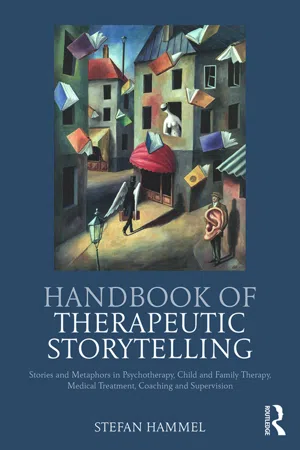
Handbook of Therapeutic Storytelling
eBook - ePub

Handbook of Therapeutic Storytelling

Stories and Metaphors in Psychotherapy, Child and Family Therapy, Medical Treatment, Coaching and Supervision

  1. 306 pages
  2. English
  3. ePUB (mobile friendly)
  4. Available on iOS & Android
eBook - ePub

Handbook of Therapeutic Storytelling

Stories and Metaphors in Psychotherapy, Child and Family Therapy, Medical Treatment, Coaching and Supervision

About this book

The Handbook of Therapeutic Storytelling enables people in the healing professions to utilise storytelling, pictures and metaphors as interventions to help their patients.

Communicating in parallel worlds and using simple images and solutions can help to generate positive attitudes, which can then be nurtured and enhanced to great effect. Following an "Introduction" to the therapeutic use of stories, which closes with helpful "Instructions for use", the book is divided into two parts, both of which contain a series of easily accessible chapters. Part One includes stories with specific therapeutic applications linked to symptoms and situations. Part Two explains and investigates methods and offers a wide range of tools; these include trance inductions, adaptation hints, reframing, the use of metaphor and intervention techniques, how stories can be structured, and how to invent your own. The book also contains a detailed reference section with cross-referenced key words to help you find the story or tool that you need.

With clear guidance on how stories can be applied to encourage positive change in people, groups and organisations, the Handbook of Therapeutic Storytelling is an essential resource for psychotherapists and other professions of health and social care in a range of different settings, as well as coaches, supervisors and management professionals.

Frequently asked questions

Yes, you can cancel anytime from the Subscription tab in your account settings on the Perlego website. Your subscription will stay active until the end of your current billing period. Learn how to cancel your subscription.
No, books cannot be downloaded as external files, such as PDFs, for use outside of Perlego. However, you can download books within the Perlego app for offline reading on mobile or tablet. Learn more here.
Perlego offers two plans: Essential and Complete
  • Essential is ideal for learners and professionals who enjoy exploring a wide range of subjects. Access the Essential Library with 800,000+ trusted titles and best-sellers across business, personal growth, and the humanities. Includes unlimited reading time and Standard Read Aloud voice.
  • Complete: Perfect for advanced learners and researchers needing full, unrestricted access. Unlock 1.4M+ books across hundreds of subjects, including academic and specialized titles. The Complete Plan also includes advanced features like Premium Read Aloud and Research Assistant.
Both plans are available with monthly, semester, or annual billing cycles.
We are an online textbook subscription service, where you can get access to an entire online library for less than the price of a single book per month. With over 1 million books across 1000+ topics, we’ve got you covered! Learn more here.
Look out for the read-aloud symbol on your next book to see if you can listen to it. The read-aloud tool reads text aloud for you, highlighting the text as it is being read. You can pause it, speed it up and slow it down. Learn more here.
Yes! You can use the Perlego app on both iOS or Android devices to read anytime, anywhere — even offline. Perfect for commutes or when you’re on the go.
Please note we cannot support devices running on iOS 13 and Android 7 or earlier. Learn more about using the app.
Yes, you can access Handbook of Therapeutic Storytelling by Stefan Hammel in PDF and/or ePUB format, as well as other popular books in Medicine & Education in Psychology. We have over one million books available in our catalogue for you to explore.

Information

Publisher
Routledge
Year
2018
Print ISBN
9781138617513
eBook ISBN
9780429867200
PART ONE
The stories
Chapter 2
Promoting understanding
Assigning meaning
What meaning does a person assign to his or her life? Goals provide the framework that everyone needs in order to experience their life as meaningful, but a person’s fundamental goals in life may change over the course of his or her lifetime, and may be described by that person in dynamic terms as change (or success) or in static terms as happiness (or health, or peace). Although people pursue a wide variety of different goals, everyone – except those who would rather not be here at all – can say what makes their life worthwhile.
My Aim in Life
The story “My Aim in Life” calls into question the absoluteness of existing life goals, and encourages the listener to formulate his or her own values.
TOPIC:Health, meaning
INTERVENTION:Clarifying goals, externalisation of ambivalence as a dialogue, promoting a searching attitude (example, searching model)
“My aim in life is to leave as much healing and joy in my wake as possible,” I said to a friend.
“That’s a lofty goal,” he said. “I’m happy if I can avoid causing too much harm.”
Renewed Life
The story “Renewed Life” makes it clear that life plans and goals play a vital role in an individual’s happiness, health and life expectancy.
TOPIC:Health, life expectancy, meaning
INTERVENTION:Clarifying goals, promoting a searching attitude, promoting positive expectations (metaphor, positive model)
A number of researchers wanted to find out why salmon die after spawning, so they fished a number of specimens out of the river, fitted them with radio transmitters and placed them back into the sea. And what do you think happened? The animals stayed alive.
Gockle’s Good Luck
The story “Gockle’s Good Luck” reminds us that we cannot always recognise and accept happiness and that some people have reasons of their own for not improving their situation. It also reminds us that we need goals for which we fight and that unexpected success may overtax our capacities. In conversation with parents, for example, the story can be used to make it clear that children and teenagers should not be allowed to become accustomed to taking an affluent lifestyle for granted, and that they need to experience achieving success and possessions through their own efforts. The story can also be used to alert listeners to the fact that they are taking skills for granted and overlooking opportunities for action, even though – or perhaps because – they are present in abundance.
TOPIC:Growing up, meaning, success, upbringing
INTERVENTION:Clarifying goals, finding resources, promoting a searching attitude (metaphor, searching model)
Someone once told me, “When I was growing up my family kept hens and a cockerel named Gockle. The cockerel and the hens ran around in the yard together, scratching and pecking at grains. Once we decided to give Gockle a special treat, and so we picked him up and put him down right in the middle of the box where the grain was stored. That must have been heaven on earth to a chicken! Yet even though Gockle was now standing on thousands upon thousands of tasty grains, he simply looked at us with a surprised expression and did nothing. He did not eat a single grain. Finally we took him outside again, where he scratched and searched for grains like he had before.”
Sacrilege
The story “Sacrilege” illustrates that standing up for your values represents a value in itself. In cases where these values are opposed to the interests of others, it is often necessary to find a balance between defending your ideals in public and taking a less conspicuous approach. The story can also be used to encourage clients not to hide their light under a bushel and to present a self-confident image during interactions with others.
TOPIC:Belief, identity, self-confidence
INTERVENTION:Finding resources, pattern interrupt by the client (example, positive model)
Someone once told me the following story: “When I visited the Pisa Baptistry close to the city’s cathedral, I thought to myself, ‘They’ve turned it into a temple to commerce!’ It raised my hackles to pay to enter a church and then find myself surrounded by hundreds of frantic tourists rushing around and taking photographs of everything. Many kept checking their watches, because a singer was paid to perform every hour in order to demonstrate the building’s wonderful acoustics. Should a church not be a place of prayer and devotion? After climbing up to the gallery, I thought, ‘Surely no one will object if I turn this temple to Mammon back into a house of God.’ It took me a while to screw up the courage, but finally I sang the opening line of a psalm loudly and clearly into the open space, ‘Laudate omnes gentes, laudate dominum.’ The acoustics really were superb. Everything went quiet in the church, and although everyone looked around to find out who was singing, the echoes made it difficult for them to locate me. The security staff searching frantically for the perpetrator also had a hard task on their hands, but by the end of the verse one had spotted me. He waited for me to start singing again in order to catch me red-handed, since it would otherwise have been easy for me to deny my act of sacrilege. I looked around the building in a daze. ‘Thank you,’ said a woman standing next to me. ‘That was wonderful.’ I too felt better after having sung the psalm. When the last echo had faded away, I left the house of God, giving a sly grin to the security guard who was still watching me.”
Perception and interpretation
The communications theorist Paul Watzlawick asked, “How real is real?” (also the title of his book, Watzlawick, 1976) and pointed out that reality is constructed differently by all of us. Anyone who talks about reality must therefore also clarify whose reality is meant and (strictly speaking) at what point in time. Reality is always being reconstructed, even within an individual’s lifetime. The following paradigmatic stories are intended to challenge our fundamental way of interpreting the world and to lay the groundwork for new interpretations.The Creation of the World
“The Creation of the World” makes it clear that all thought systems – and therefore all human ways of interpreting the world – have been devised by humans. We often get the world we think up and believe in; at a personal level, this means that we become what we believe in and what we think, hope and fear.
This rule has far-reaching implications in terms of both our health and our psychological, material, financial and social conditions. We can of course share our individual worlds with others by communicating them verbally and non-verbally, and to a certain extent turn our environment into what we believe it to be. All reality is created on the basis of a communicated and therefore shared world.
TOPIC:Depression, reality
INTERVENTION:Destabilisation through countertheses, finding resources, promoting a searching attitude, trance induction through questions and through stereotype (example, searching model)
Mohammed created a world. Freud created a world. Tolkien created a world. McKinsey created a world. Bill Gates created a world. Can I too create a world?
The German company Tchibo uses the advertising slogan, “Every week a new world”. New worlds are indeed created every week. Most of them are not very original; they swim in the wake of the established worlds and do not gain any traction.
What kind of a world have you created? A philosophical world? A spiritual world? A commercial world? A mathematical world? A social world? An aesthetic world? A material world? A communicative world? A world of fun? An ethical world?
You might be thinking to yourself, “But I haven’t created any world at all!” I don’t believe that for a second. As soon as you look at something – anything – and inadvertently think something new, you start to create a world.
The Cave Dwellers
The story “The Cave Dwellers” demonstrates that what we perceive is determined more by our biology and biography than by objective facts, and that the feedback effects from both our sensory perceptions and our interpretations largely drown out what is allegedly real about the world.
TOPIC:Depression, reality
INTERVENTION:Destabilisation through unanswerable questions, promoting a searching attitude (metaphor, searching model)
She asked her mother, “Mum, mum, mum,
what is real, real, real?”
“What do you mean, what is real, real, real?”
“I mean without this echo, echo, echo.”
“Which echo, echo, echo?
Right here and now is real, real, real.”
“I see, see, see.”
And then she understood, understood, understood.
Glasses
“Glasses” is the transcript of a dream. The aim of the story is to make it clear that we often waste time and energy on maintaining counterproductive ways of seeing and experiencing life. Solutions that involve changing the underlying foundations of our way of thinking may be too close for us to see them.
TOPIC:Belief, reality, self-confidence, trauma
INTERVENTION:Finding resources, clarifying goals, destabilisation through unanswerable questions, metaphorical reframing (metaphor, searching model)
Once I dreamt that the left arm of my glasses was crooked, and I wanted to fix it so that the glasses would fit again. I bent it backwards and forwards twice, and then it snapped off. I held it up to the glasses – it had broken off at the hinge, and could no longer be repaired. What should I do?
I put the glasses on in the hope that they might fit somehow, but they hung diagonally across my face. Everything looked distorted through the lenses, and holding them in place the whole time was extremely uncomfortable. Yet opticians are closed on Sundays. What is the best course of action in a situation like this? I thought for a while. Then I remembered – I’d undergone laser surgery over six months ago to correct my short-sightedness. Why on earth was I still wearing the stupid glasses? And I went about my day without them.
Dot to Dot
The story “Dot to Dot” makes it clear that we construct our own reality, and that different constructions of reality are both possible and admissible. It can be used to encourage clients to be more tolerant, to question their former points of view and to examine new points of view. It also makes it clear that the way in which children see the world and the delusional beliefs of dementia patients (for example) stem from missing information and the use of imagination and emotion to fill the associated gaps.
TOPIC:Belief, compulsion (OCD), delusion, dementia, growing up, reality
INTERVENTION:Destabilisation through unanswerable questions, finding resources, promoting a searching attitude, rhetorical question, trance induction through age regression and through questions (metaphor, searching model)
When I was a small child, I had a colouring book with pictures made up entirely of unconnected little dots. Each dot had a number next to it, and if you joined the dots in the correct order you would discover the picture that was hiding behind them.
I wonder how many pictures might be discovered in these collections of dots if the numbers next to ...

Table of contents

  1. Cover
  2. Half Title
  3. Title Page
  4. Copyright Page
  5. Contents
  6. Foreword
  7. Introduction
  8. PART ONE The stories
  9. PART TWO The methods
  10. Literature
  11. Index