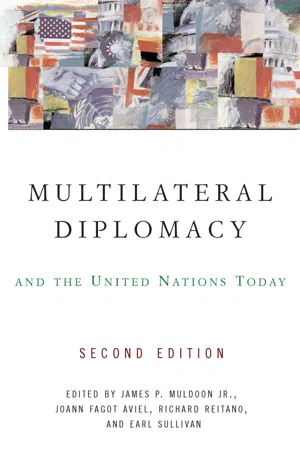
As the world confronts new and ongoing challenges of globalization, international terrorism and an array of other global issues, the United Nations and its key attribute-multilateral diplomacy-are more important now than ever before. With new and updated essays that detail the experiences of a diverse group of practitioners and scholars who work in the field of diplomacy, this new edition covers in even greater breadth and depth the quintessential characteristics of multilateral diplomacy as it is conducted within the United Nations framework. Multilateral Diplomacy and the United Nations Today provides valuable insights from a variety of perspectives on how diplomacy is practiced, making it essential reading for aspiring diplomats, international business leaders, and students of all levels. The contributors to this volume bring a depth and breadth of knowledge and experience to the examination of five areas of multilateral diplomacy: UN diplomacy, crisis diplomacy, international economic diplomacy, UN summits and "citizen diplomats," and non-governmental diplomacy. A thorough revision: of the 24 chapters, eight are new to this edition, and all the others are updated. Includes a diverse range of contributors: veteran diplomats, respected scholars, non-governmental activists. Relevant, timely discussion topics related to the UN. An important supplemental text to any course on the UN, contemporary international relations, diplomacy, and international organizations.
- 352 pages
- English
- ePUB (mobile friendly)
- Available on iOS & Android
eBook - ePub
Multilateral Diplomacy and the United Nations Today
About this book
Information
Chapter One
United Nations Diplomacy
The Evolution of Multilateral Diplomacy
JoAnn Fagot Aviel
The evolution of multilateral diplomacy and organization is closely linked to the evolution of the nation-state system, which can be traced back to the Treaty of Westphalia in 1648 as described in the Introduction. Changes have usually occurred through war or technological innovations. The Napoleonic wars led to the creation of the Concert of Europe, World War I to the League of Nations, and World War II to the United Nations, as the victors in each war attempted to set up a system or organization to preserve the gains they had achieved and prevent future wars. With the end of the Cold War, multilateral diplomacy is currently at another transition point.
At the Congress of Vienna in 1815 occurred the first attempt to institutionalize the regular calling of conferences to help manage relationships among the most powerful states. In Vienna the victors over Napoleon (England, Austria, Prussia, and Russia, joined later by the vanquished France) created the Concert of Europe, an informal agreement to preserve the status quo in Europe. They codified the status and functions of diplomats and established the principle that any member could initiate a call for a conference with the others. Although thirty conferences were called, bilateral diplomacy remained the normal form of negotiation. However, technological progress did lead to the development of other forms of multilateral diplomacy. With the invention of the steamship, for example, individuals and goods began moving from nation to nation with considerable ease and speed, the result being the expansion of commercial and other relations among the nation-states of Europe. This particular development gave rise to Europe’s first institutions for international cooperation, in the form of commissions to oversee river traffic, operate navigational facilities, and settle violations of rules. Later in the century came the International Telegraphic Union (1865) and the Universal Postal Union (1874)—the first of the international institutions with permanent staff, a conference with the power to pass legislation, and an executive council. Both state and nonstate parties sent representatives. This institutionalizing of multilateral diplomacy initiated new forms of collective decisionmaking, such as weighted voting, where each nation’s voting power is determined by the size of its budget contribution.
Advances in weapons technology as well as in communication and transportation led to the organization of peace societies in many countries. Their call for the limitation of armaments and the arbitration of international disputes influenced Czar Nicholas II of Russia in 1899 to call for a conference at The Hague. The twenty-six primarily European states that attended established the first Permanent Court of Arbitration, which, however, consisted only of a list of jurists whom parties to a dispute might select as arbitrators. A second Hague Conference in 1907, which attempted to limit or reduce armaments, was noteworthy for its inclusion of a substantial number of non-European states among the forty-four attending. Delegates at these two Hague Conferences recommended setting up permanent headquarters and holding regular conferences there, and they experimented with such organizational arrangements as chairmen, committees, and roll call votes. For all the efforts to institutionalize the workings of multilateral diplomacy, the domestic dynamics of the nation-state system reinforced internal integration at the expense of transnational ties. When a crisis broke out in the Balkans in 1914, there was no permanent conference or machinery to try to settle the dispute, which quickly escalated into World War I. Its victors, recognizing the need for permanent institutions to stabilize the international system and prevent future wars, set about establishing such bodies after the peace. Among the victorious allies was a non-European country, the United States, which joined the ranks of Great Powers and whose president was a primary drafter of the Covenant of the League of Nations. However although US President Woodrow Wilson saw the need to establish a collective security system, the US Senate did not, refusing to ratify the Covenant. Whenever the Great Powers wanted to get together, they would have to meet outside the League, and the League’s decisions did not have the weight of all the Great Powers behind them. The League’s inability to stop the expansion of the Axis Powers—Germany, Italy, and Japan—in the 1930s and 1940s led to a second world war.
The Allies of World War II, drawing from the experience of the League, developed the United Nations system. This time, though, the coalition did not wait for victory to establish an international organization. The Charter of the United Nations was drafted at conferences attended by the leaders of the United States, Great Britain, the Soviet Union, and occasionally other Allied nations, even as the fighting went on. With victory in sight, the “Big Three,” along with the governments of China and France, invited all nations that had declared war on the three Axis powers to attend a conference in San Francisco and finalize agreements on the draft. It was at this conference in 1945 that the UN Charter was adopted. It was here, too, that conference delegates established a preparatory committee to organize the first meetings of the United Nations’ major organs.
The United Nations is composed of five organs similar to those of the League—the Security Council, the General Assembly, the International Court of Justice, the Secretariat, and the Trusteeship Council—although the founders changed some of the names and rules of procedure. For example the League’s Council had five permanent members representing the principal Allied powers, as does the United Nations’ Security Council. However, whereas decisions of the League required a consensus of all members, in the UN Security Council a consensus is required only of the five permanent members (China, France, Russia, the United Kingdom, and the United States); thus they are given a veto over decisions. The inclusion of a sixth principal organ, the Economic and Social Council (ECOSOC), reflected the increasing importance attached to these issues not only by governments but also by nongovernmental organizations (NGOs), some representatives of which took part in the San Francisco conference as members of the US delegation or as observers. The ECOSOC nominally supervises the many specialized agencies of the United Nations, although most function quite independently and some, such as the Universal Postal Union, are older than the United Nations itself.
With the transformation of the Allied coalition of World War II into two rival blocs, multilateral diplomacy also changed. Instead of being partners in the effort to defeat a common enemy, the major international players now tended to see most issues in terms of their effect on the power of each bloc. Looking back, former Israeli Ambassador to the United Nations, Abba Eban, noted one positive effect of a bipolar world, if not necessarily appreciated at the time: “The Cold War, with all its perils, expressed a certain bleak stability; alignments, fidelities, and rivalries were sharply defined” (Eban 1995, 50). However, the Cold War had a stultifying effect on multilateral diplomacy, which was often forced into a political and ideological straitjacket, writes former Jamaican UN Ambassador Don Mills later in this chapter. Even the admission of new UN members was affected, no new member being admitted from 1950 to 1955 as each side rejected potential members of the other’s voting bloc until a package deal to admit sixteen nations including members from each bloc was negotiated in 1955.
Although multilateral diplomacy successfully managed to keep under control many of the conflicts that attended the decolonization process, almost all issues that the two great military powers (the United States and the former Union of Soviet Socialist Republics) considered important were negotiated bilaterally outside the United Nations system. At the same time, the two sides often used multilateral diplomacy to score propaganda points against the other side by making speeches and passing resolutions condemning the other. However, the United Nations was not just a propaganda forum, since the increasing “Third World” majority in the UN General Assembly was able to focus the UN’s work on the economic and social problems of poor countries.
The UN’s focus has shifted from development activities with the ending of the Cold War. Greater consensus among the permanent members of the Security Council made it possible for the United Nations to increase its peacekeeping and peace-related activities as noted by Ambassador Mills. A recent study reveals that, during the Cold War, multilateral organizations had some effect on preventing or resolving conflicts in about 25 percent of the conflicts that they considered. In 1985-1990, as the Cold War waned, the “success rate” increased to 36 percent (Holsti 1995, 354). During the period 1987-1993, the number of resolutions passed by the Security Council went from fifteen to seventy-eight, the number of peacekeeping missions from five to seventeen, the number of peacekeepers from 12,000 to 78,000, and the number of countries contributing troops to UN peacekeeping missions from twenty-six to seventy-six (Goldstein 1996, 276). However, the immediate post-Cold War era may have seen the peak of UN peacekeeping activity. Failures in Bosnia, Somalia, and Rwanda and budgetary difficulties have made members more reluctant to be involved in peacekeeping efforts. The United Nations was called in to replace regional peacekeeping forces in Sierra Leone in 1999. Of the fourteen peacekeeping missions in 2003, five were in Africa. After the 9/11 terrorist attack in 2001 on the United States, the UN Security Council unanimously passed a resolution condemning the attack and sanctioning a US response. However, after the defeat of the Taliban government in Afghanistan, NATO forces, instead of United Nations forces, were invited to help keep the peace although a UN Assistance Mission does operate in Afghanistan under the direction of the UN Department of Peacekeeping Operations. After the United States failed to obtain UN support for its attack on Saddam Hussein’s government in Iraq, debate has ensued over what the UN role in Iraq should be(www.un.org).
Although UN peacekeeping activity may diminish in the immediate future, multilateral diplomacy will continue to be important. Multilateral institutions such as the World Trade Organization, the International Telecommunications Union, and the International Monetary Fund, combined with the competitive spread of standardized systems and technologies of production, have significantly increased the ease, speed, and security with which goods, capital, and knowledge flow across national boundaries, transforming the international economy and diplomacy itself (Sjolander 1996, 605-608). As interaction across national boundaries increases, so does multilateral diplomacy in order to help manage these interactions and attempt to settle conflicts that arise. Progress on technological fronts allows faster and more frequent contacts among governments as well as among groups within countries. There is a growing realization that when problems that are caused by many actors affect many others—problems of the environment, for example—the attempts at finding a solution should involve everyone. Furthermore, the problems themselves are increasingly complex, overlapping many different issue areas and likely to mobilize a variety of interest groups to influence the actions taken. The existence of many multilateral agreements and organizations raises expectations that decisions about important international actions will be taken within the framework of a multilateral organization or conference (Rourke 1995, 311).
Multilateral negotiation is thus characterized by multiparties, multi-issues, multiroles, and multivalues. The level of complexity is far greater in a multilateral conference than in bilateral diplomacy, as is the level of skill needed to manage that complexity. Application of legislative as well as diplomatic skills is needed because of the importance of knowing how to use the rules of procedure to advance a diplomat’s goals. Sheer numbers also contribute to increasing the complexity. Ambassador Don Mills writes later in this chapter that although the practice and character of multilateral diplomacy at the United Nations is generally the same as it was when there were 50-plus members, the presence today of 191 members has “brought new dimensions and pressures to international affairs and the multilateral organizations, with significant impact on the UN and its agenda.” Among these new dimensions is a greater diversity of issues and actors including nonstate actors, as issues previously thought to be primarily domestic become subjects of international negotiation and issues previously thought to be primarily international increasingly affect domestic interests. Ambassador Mills discusses the wide range of current issues in multilateral diplomacy and describes the new multilateral milieu this way: “The community in which the UN diplomat operates is composed of the representatives of other governments, UN staff at all levels, and representatives of the media and of NGOs.”
The only way for anyone to deal with this complexity is to build coalitions involving states, nonstate actors, and international organizations and to privately develop an informal consensus on how to deal with a problem before presenting a decision for a vote in the formal institutional structures. Later in this chapter Ambassador Sergey Lavrov, drawing on his experiences as Russia’s Permanent Representative to the United Nations, describes some of the mechanisms of collective decisionmaking in the Security Council, where the importance of a consensus among the permanent members results in their meeting informally before decisions are made. Mutual interests among the nonaligned members of the Council have often led them to meet informally as well. If a “group of friends” has gathered around a particular issue such as Afghanistan or the Western Sahara, its members will meet informally before submitting a draft of a resolution to other Council members. To pass a resolution, coalitions in the Council need to involve both permanent and nonpermanent members, but these coalitions change according to the issue.
Multilateral diplomacy involves the art of building and managing these coalitions before, during, and after negotiations on a particular issue. In complex and lengthy negotiations, such as those involved in drafting the UN Convention of the Law of the Sea, coalitions must often be formed not only between nations but also within nations—among ministries dealing with fisheries, defense, the environment, and foreign affairs as well as with nongovernmental organizations and private enterprises. The latter may have already formed coalitions among themselves, some of which may include individual ministries as well as nongovernmental organizations in other countries. After hammering out a unified position in often lengthy negotiations among its members, the coalition often must attempt to change this position in response to other proposals and changing conditions, both domestically and globally, if it is to be successful in meeting its goals. One of the principal challenges for those wanting to pass a resolution or obtain a multilateral agreement is to design the negotiations in such a way that they encourage the creation of coalitions supporting agreement and minimize the possibility of coalitions opposing it. The issues themselves have to be packaged in such a way as to promote linkages and trade-offs among the issues. Ambassador Lavrov points out that tactical flexibility is even more important at the United Nations than in bilateral diplomacy. Ambassador Mills emphasizes that for those who work in the United Nations “ability to speak convincingly at meetings and to prepare statements for oneself or for one’s seniors is essential for diplomats at the United Nations, as are negotiation and arbitration skills, since these are the dominant activity of multilateral diplomacy today.”
Another important skill in multilateral diplomacy discussed by Ambassador Lavrov is the ability to cultivate good relations with the media, especially the US media. Ambassador Mills notes that skill in making use of new telecommunication technologies is also essential. Owing to such technologies, “sovereign” states are less able than before to control the transborder movement of money and of information. Other modern developments add new dimensions to the diplomat’s traditional role as representative of a sovereign state. As the twenty-eight world leaders who composed the Commission on Global Governance point out in their report on the opportunities for global cooperation on issues requiring multilateral action, nation-states and their representatives must deal not only with the problems of an increasingly globalized world on one level, but also with the demands of grassroots movements which may even include demands for devolution, if not outright secession, on another level (Commission 1995, 11). At a time when city and state officials and private citizens themselves are entering into negotiations with foreign governments, businesses, and nongovernmental organizations, diplomacy is also increasingly called for at the subnational level.
Traditionally, international political theory has been concerned with the interaction of nation-states, whose increasing interdependence is said to be a mark of the current international system. States in an interdependent world are still seen by many theorists as well as diplomats as operating as individual actors that can rationally formulate and act upon their national interests. According to this view states are drawn into multilateralism and the construction of interstate institutions or regimes in pursuit of their national interests, and the task of the diplomat is thus seen as protecting the country’s national interests (Cerny 1996, 622-623). However according to a competing view, globalization has gone so far as to render state structures incapable of managing complex issues involving local, regional, national, and transnational relationships, and thus the diplomat must work to construct multilateral institutions and agreements to help manage these relationships (Cerny 1996, 628). Ambassadors Amer Araim, Sergey Lavrov, and Don Mills all agree that today’s diplomat has a dual responsibility: to promote his or her country’s interests and to advance the interests of the global community.
Although not all diplomats may agree that there is a dual responsibility, for those who do, tension can exist over reconciling these two responsibilities, which sometimes conflict, while engaging in multilateral diplomacy. Tension also exists between those who feel that there can be consensus on what would be good for the global community, such as preserving the environment and protecting human rights, and those who are suspicious even of the term global community. The latter vary between those who see the advocating of global goals as a way for the West, especially the United States, to assert its dominance and others, especially conservatives in the United States, who see support for a global community and often multilateral organizations themselves as a way to subvert national sovereignty.
There is currently a crisis for multilateral diplomacy, as influential figures in the dominant power debate the extent to which the United States should make use of it or act unilaterally. The United States is reluctant to pay for multilateral organizations or actions that it cannot control to its satisfaction, and other nations are reluctant to merely acquiesce in actions controlled by the United States. Later in this chapter, Ambassador Amer Araim recounts his experience while a member of the Iraqi delegation to the United Nations with the attempt of the US Ambassador to have him withdraw a resolution on Puerto Rico and his opposition to US policy on Iraq and Palestine. He states that “the second Gulf War represented the total failure of the Organization” and suggests certain reforms which are needed. Ambassador Sergey Lavrov states later in this chapter that there is agreement on the need for reforming the United Nations to meet the challenges of the new millennium, but not on the specific reforms needed. He states, “It will take intense negotiations to reduce these various ideas to a common denominator and reach agreement on optimal approaches to strengthen the UN system.” Although he does not criticize the United States directly, he does criticize unilateralism, pointing out that “a consensus among the UN’s members would be worth much more than any unilateral action since it promotes a global approach to the solution of the modern world’s inescapably global problems.” Multilateral diplomacy will not disappear, since technological and envir...
Table of contents
- Cover
- Half Title
- Title Page
- Copyright Page
- Contents
- Preface to the Second Edition
- Introduction
- 1 United Nations Diplomacy
- 2 The Diplomacy of International Peace and Security
- 3 International Economic Diplomacy
- 4 Nongovernmental Diplomacy
- 5 Multilateralism and the United Nations
- 6 Prospects of Multilateral Diplomacy
- About the Editors
- About the Contributors
- Index
Trusted by 375,005 students
Access to over 1.5 million titles for a fair monthly price.
Study more efficiently using our study tools.
Frequently asked questions
Yes, you can cancel anytime from the Subscription tab in your account settings on the Perlego website. Your subscription will stay active until the end of your current billing period. Learn how to cancel your subscription
No, books cannot be downloaded as external files, such as PDFs, for use outside of Perlego. However, you can download books within the Perlego app for offline reading on mobile or tablet. Learn how to download books offline
Perlego offers two plans: Essential and Complete
- Essential is ideal for learners and professionals who enjoy exploring a wide range of subjects. Access the Essential Library with 800,000+ trusted titles and best-sellers across business, personal growth, and the humanities. Includes unlimited reading time and Standard Read Aloud voice.
- Complete: Perfect for advanced learners and researchers needing full, unrestricted access. Unlock 1.5M+ books across hundreds of subjects, including academic and specialized titles. The Complete Plan also includes advanced features like Premium Read Aloud and Research Assistant.
We are an online textbook subscription service, where you can get access to an entire online library for less than the price of a single book per month. With over 1.5 million books across 990+ topics, we’ve got you covered! Learn about our mission
Look out for the read-aloud symbol on your next book to see if you can listen to it. The read-aloud tool reads text aloud for you, highlighting the text as it is being read. You can pause it, speed it up and slow it down. Learn more about Read Aloud
Yes! You can use the Perlego app on both iOS and Android devices to read anytime, anywhere — even offline. Perfect for commutes or when you’re on the go.
Please note we cannot support devices running on iOS 13 and Android 7 or earlier. Learn more about using the app
Please note we cannot support devices running on iOS 13 and Android 7 or earlier. Learn more about using the app
Yes, you can access Multilateral Diplomacy and the United Nations Today by James P. Muldoon, Jr. in PDF and/or ePUB format, as well as other popular books in Politics & International Relations & Diplomacy & Treaties. We have over 1.5 million books available in our catalogue for you to explore.