Writing in a Technological World explores how to think rhetorically, act multimodally, and be sensitive to diverse audiences while writing in technological contexts such as social media, websites, podcasts, and mobile technologies.
Claire Lutkewitte includes a wealth of assignments, activities, and discussion questions to apply theory to practice in the development of writing skills. Featuring real-world examples from professionals who write using a wide range of technologies, each chapter provides practical suggestions for writing for a variety of purposes and a variety of audiences. By looking at technologies of the past to discover how meanings have evolved over time and applying the present technology to current working contexts, readers will be prepared to meet the writing and technological challenges of the future.
This is the ideal text for undergraduate and graduate courses in composition, writing with technologies, and professional/business writing.
A supplementary guide for instructors is available at www.routledge.com/9781138580985
Writing and technology play a role in most everything we do. If you were to stop reading this textbook for a moment and look around at your surroundings, most likely you would find evidence of writing and technology. Take, for instance, the clothes you are wearing. At several points in the making of those clothes, writing and technologies were used by a number of people. Designers created sketches, which in turn were translated into purchase orders for materials and instructions for sewing. Company employees made plans based on these instructions to hire more sewers and to revise job duties. Machines and sewers worked together to produce the new clothing. Merchandise descriptions on websites were updated. Marketing campaigns were formed. Customer orders were created, and so on and so on.
While writing is itself a technology, when we write, we do so rhetorically and with a number of other technologies, both digital and non-digital. When you write an essay, for instance, you may decide rhetorically that the best way to do so is to rely on an alphabet, on paper, on a computer, on a flash drive, and/or on a software program given your audience and your purpose. All the while you do so, you are also relying on a number of different modes of communication, from thinking spatially to thinking visually. Therefore, in Part 1, you will learn about the various ways that writing, technology, rhetoric, and modes come together when we communicate.
Key Questions
What is technology?
Why is writing multimodal?
Why is writing rhetorical?
What is the difference between digital and non-digital technology?
Key Terms
Chapter 1
semiotics
signs
symbols
language
grammar
morphology
syntax
technology
rhetoric
ideology
Chapter 2
genre
conventions
modes
medium
multimodal
affordances
Chapter 3
digital text
non-digital text
dimension
prototype
materials
texture
CHAPTER 1 Introduction
Contents
Writing and Technologies: Your Past, Present, and Future
Signs and Symbols
Writing Is Technology
What Is a Technology?
Final Thoughts
IMAGE 1.1 antoniodiaz / Shutterstock
Writing and Technologies: Your Past, Present, and Future
Meet Jose Medina, a senior at North University. Jose is majoring in biology and minoring in chemistry. When he graduates, he plans to attend medical school to become a pediatric surgeon. During his senior year, Jose spends a lot of time studying. Not only does he use textbooks and notebooks, but he also uses his computer, his iPhone, and his iPad to research medical practices, take notes on key concepts, study images of the body, and watch videos of surgeries. Jose knows that in the future when he becomes a surgeon, he will be writing with and for several technologies. For example, he might have to write digital patient reports for a central database that nurses, other doctors, the patient, and insurance companies will need to access and utilize to make important decisions about his patients’ health. He might also develop an interactive digital text for a mobile device that represents the latest breakthrough in his medical research, will help other doctors treat patients, and will be used at medical schools around the world to prepare future doctors.
Like Jose, Katrina Carlson is a senior at North University. She is a marketing major and art minor with hopes of working for a publishing firm in London. She also utilizes technology throughout her day to accomplish several writing tasks. In fact, for her capstone project, she is developing marketing materials for a nonprofit organization to send to senior citizens about the free educational events in their area. One of those materials is a brochure. To create her brochure, Katrina uses a sketch book to draw and plan the brochure, a software design program to bring her sketches to life, a class blog to generate feedback on her project from her peers, and a sharing platform that will help her distribute the brochure in print as well as in digital form.
Think About Your Present
Whether or not your major is biology, like Jose’s, or marketing, like Katrina’s, you most likely use technologies to write on a regular basis, too, and not just for academic purposes. Think for a moment about all the different texts you write now for your friends, your family, your job, and your community. Think about the different reasons why you write these and the different reasons why you use technology to do so. Perhaps you use a smartphone to text with friends and family to check in and say hi, to communicate information, to coordinate get-togethers, to answer questions. Perhaps you use a computer and Instagram to share images of what you are doing. In comparing your reasons for writing and your reasons for using technologies to do so with those of your fellow classmates’ reasons, you might find that your classmates have similar or different experiences. Now, imagine what it would be like without those specific technologies you use to write on a regular basis. How different would your life be?
Think About Your Past
Chances are that while growing up you used a variety of different technologies to communicate. Think back to the time you learned to write. What technologies did you use? How did you use these? Where did you use them? How are these technologies different from the technologies you use today to write? As you grew up, the technologies you used evolved over time. As a result, you’ve had to learn to use newer technologies; otherwise, you might have been less successful in communicating effectively.
Think About Your Future
Most likely you will use writing and technologies in college and beyond to accomplish a variety of work. After all, can you imagine a career that doesn’t require writing or technologies? Probably not. In addition to using writing and technologies in your career, you will also likely use them for civil and social purposes in your day-to-day life. For instance, as a community member, you might be tasked with planning an upcoming event in your neighborhood. To make sure the event is a success, you will need to make sure information about the event gets communicated in a variety of ways to a variety of people. You might need to use social media to collaborate and coordinate the event with other neighbors and city officials. You might need to create flyers and posters to advertise the event to ensure people attend. And you might need to create a budget to keep track of the event’s expenses. Doing all of these things most likely will require writing and technologies.
There will be other times in your life, too, when you will need to write and to use technologies to do so. In fact, your life or the lives of your loved ones may even depend on using writing and technologies to communicate in emergency situations. In many areas of the United States, for example, when speaking on the phone is not an option (or even could be dangerous in a situation), you can text 911 to reach emergency call centers to let them know you are in trouble. Likewise, you may need writing and technologies to find help and advice for important life issues and/or to cope with challenges and tragedies. Worldwide, those who battle diseases and addictions such as cancer and alcoholism, and those who survive natural disasters such as earthquakes and hurricanes, find solace in online support groups, which, in order to work effectively, demand the use of writing and technology. While there are a thousand more examples of how writing and technology intersect and can be useful in life, the point is clear: Your future will involve writing, and it will involve technology.
To help you develop the skills and know-how to write with and for technologies, let us start by thinking more deeply about what it means to write in a technological world. You probably have taken a writing class or two. In so doing, you probably learned that writing isn’t just about putting letters and words together to make correctly punctuated sentences. Writing, in fact, is much more than correct grammar.
Signs and Symbols
IMAGE 1.2 Gallinago_media / Shutterstock
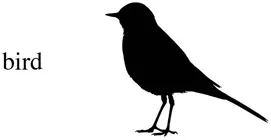
The two images you see above have many differences and similarities that can help us think more critically about what it means to write. The word bird on the left is an image itself much like the image on the right is. If we break down the word bird, we would see that it is made up of letters b, i, r, and d which are images too, images made up of lines—some straight, some short, some long, and some curved. If we break down the image on the right, we would see that it too is made up of lines—some straight, some short, some long, and some curved.
In terms of differences, we can see that the image on the left and the image on the right along with their shapes are different. Their lines have different lengths and curvatures. Some are shorter and others are longer. The images also occupy different amounts of space on the page. Some lines are thicker than others. The one on the right has more black space than the one on the left. There is also a different amount of white space between their different elements.
Despite their differences, the ways in which we create these two images are very similar. If we were to use a pen and paper to create both of these, we might use similar movements of the hands to create them, lifting our pen from time to time as well as pressing our pen from time to time.
So, which one of these two images can we call writing?
Before answering such a question, it may be necessary to distinguish between two important terms: signs and symbols and the study of them. Semiotics is the study of signs and symbols and their uses. Perhaps you learned a long time ago from the people around you that both images above represent a bird. Perhaps you learned that the one on the right is an “image” and the one on the left is a “word.” However, words are images, too. After all, you do use your eyes to read the bird on the left just as you use your eyes to read the bird on the right. Likewise, when you read these two, you develop a mental image of a bird in your mind.
Signs can be thought of as just markers for things that have no meaning. Symbols, on the other hand, are signs that we ascribe meaning to based on what we learn from our environments. Rhetoric scholar Joddy Murray’s work on multimodal composition and images provides one useful understanding of signs and symbols. Drawing from Susanne Langer’s research on symbolism, Murray writes that symbols are our perceptions and interpretations of signs (24).
The physical word “bird” written on paper (or in this textbook, in this case) is a sign. It becomes a symbol only when we interpret and ascribe meaning to it. Of course, the meaning that we ascribe to it is dependent on our experiences in the world at particular times and in particular environments. It could change with time. If you were to write the word “bird” on paper today while studying in your room for this class, you would understand that sign to mean something. In that very act of ascribing meaning to that word, that sign becomes a symbol. Perhaps your meaning of the word “bird” is one that reminds you of the golden finch that lives in the oak tree on your campus. Twenty years from now, after you’ve had many different experiences, when you write “bird” again on a piece of paper, you may have a different understanding, and you may ascribe a different meaning to it. Perhaps, then, the bird will remind you of the robin that visits your backyard every morning.
The answer, then, to the question posed above is that both birds (the one on the left and the one on the right) are writing. When we put three lines together to form a B, one straight, two curved, we know that B represents the second letter of the alphabet and has a distinct sound. We know this because we were taught this by the people in our society. Three lines arranged in a different matter, like this, -/-, for instance, isn’t the same symbol as a B that we have memorized and ascribed meaning to. Organizing symbols in a certain way through the use of letters, words, phrases, sentences, and space helps us to communicate messages to one another using a language. Writing is a human invention and action, and is itself a technology involving a system of symbols. Such symbols could be represented through language, but that doesn’t always have to happen as meaning can be derived using a variety of modes.
Writing Is Technology
While in the previous section of the book and in the pages to come, writing and technologies are spoken about in separate terms—as in the phrase writing and technologies—you should not think of writing as something other than technology. Writing is a technology. However, because there are many other kinds of technologies besides writing, you will see that the word writing and the word technologies are often s...
Table of contents
Cover
Half Title
Title
Copyright
Contents
Acknowledgments
Preface
Part 1 Technology Is Multimodal
Part 2 Technology Is Active
Part 3 Technology Is Narrative
Part 4 Technology Is Embedded
Part 5 Technology Is Connected
Part 6 Technology Is Embodied
Index
Trusted by 375,005 students
Access to over 1.5 million titles for a fair monthly price.
Study more efficiently using our study tools.
Frequently asked questions
Yes, you can cancel anytime from the Subscription tab in your account settings on the Perlego website. Your subscription will stay active until the end of your current billing period. Learn how to cancel your subscription
No, books cannot be downloaded as external files, such as PDFs, for use outside of Perlego. However, you can download books within the Perlego app for offline reading on mobile or tablet. Learn how to download books offline
Perlego offers two plans: Essential and Complete
Essential is ideal for learners and professionals who enjoy exploring a wide range of subjects. Access the Essential Library with 800,000+ trusted titles and best-sellers across business, personal growth, and the humanities. Includes unlimited reading time and Standard Read Aloud voice.
Complete: Perfect for advanced learners and researchers needing full, unrestricted access. Unlock 1.5M+ books across hundreds of subjects, including academic and specialized titles. The Complete Plan also includes advanced features like Premium Read Aloud and Research Assistant.
Both plans are available with monthly, semester, or annual billing cycles.
We are an online textbook subscription service, where you can get access to an entire online library for less than the price of a single book per month. With over 1.5 million books across 990+ topics, we’ve got you covered! Learn about our mission
Look out for the read-aloud symbol on your next book to see if you can listen to it. The read-aloud tool reads text aloud for you, highlighting the text as it is being read. You can pause it, speed it up and slow it down. Learn more about Read Aloud
Yes! You can use the Perlego app on both iOS and Android devices to read anytime, anywhere — even offline. Perfect for commutes or when you’re on the go. Please note we cannot support devices running on iOS 13 and Android 7 or earlier. Learn more about using the app
Yes, you can access Writing in a Technological World by Claire Lutkewitte in PDF and/or ePUB format, as well as other popular books in Languages & Linguistics & Communication Studies. We have over 1.5 million books available in our catalogue for you to explore.