eBook - ePub
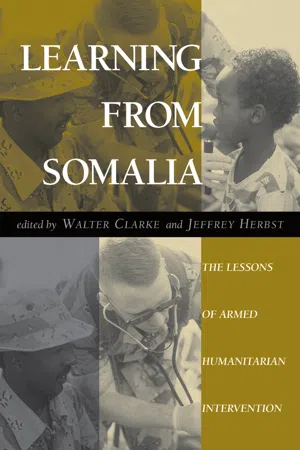
Learning From Somalia
The Lessons Of Armed Humanitarian Intervention
- 288 pages
- English
- ePUB (mobile friendly)
- Available on iOS & Android
eBook - ePub
About this book
This book examines the intervention in Somalia and draws lessons for future peacekeeping operations, analyzing many aspects of peacemaking that are not well understood, including efforts to rebuild the police, the dynamics of the economy, and the performance of European armies.
Information
PART 1
Legal Aspects of Intervention
1
Failed Visions and Uncertain Mandates in Somalia
Walter Clarke
Conventional foreign policy wisdom tells us that the armed multinational humanitarian intervention in Somalia, which began in December 1992, was a humanitarian success in the short term but became a political and military failure after the operations were turned over to the United Nations in May 1993. Like Vietnam long before it, Somalia has become a “syndrome,” held by many to have been a naive attempt to implement benevolent interventionism in a marginal Third World state and doomed to failure. The specter of Somalia has loomed above every world crisis since mid-1993, inhibiting debate and limiting options. In the misery of Bosnia prior to the late 1995 IFOR (Implementation Force [of NATO]) intervention, UN forces under fire or taken prisoner by Serbian forces were expected to turn the other cheek for fear of “crossing the Mogadishu line.” This expression was reportedly coined by former UNPROFOR (UN Protection Force [in the former Yugoslavia]) commander Lt. Gen. Sir Michael Rose to describe the supposed need to maintain absolute neutrality in the face of all provocation for fear of becoming unwilling participants in a civil war.1 With all due respect, General Rose was incorrect in his interpretation of events in Somalia, just as he may have underestimated UN tactical possibilities in Bosnia.
The Flawed Paradigm
Obstinate notions of external force neutrality, coupled with unquestioning respect for state sovereignty where clearly none exists, can effectively negate the potentially beneficial effects of multilateral armed humanitarian intervention. A passive or benign military force in a lawless environment inevitably affects the political dynamic of regions in which it is operating, and the force cannot avoid the political impact of its own presence. A military force committed to the maintenance of abstract political passivity quickly becomes an easy mark for unprincipled local gang leaders and warlords. Inability or unwillingness to discern the essential political dynamics of the country and to effect remedial measures to foster civil society—out of expedience, disinterest, or naive “neutrality”—lie at the root of the world’s failure in Somalia.
With the potential for more state breakdowns caused by ethnic and regional stresses, it must be recognized that Cold War etiquette no longer provides the basis for relations with distressed states. Internationally mandated political action, backed by military force, may be the sole formula to halt or blunt chaos and the endless cycle of violence brought on by complex manmade disasters. Doctrine is not needed for a return to trusteeships or “recolonization”; political-military interventions should normally end when political processes are satisfactorily on the mend.
The first step in planning for a humanitarian peace enforcement-operation must be the articulation of an integrated humanitarian-political-military strategy that responds to the immediate humanitarian crisis while outlining a longer-term process designed to resolve the underlying political issues that may have brought on the crisis in the first place. These actions must be consistent with international values and standards of conduct. In failed-state situations, or when the functions of a state are sharply curtailed or neutralized, with accompanying wide-scale human suffering, the world must be prepared to offer political and military assistance in an imaginative, constructive, and decisive manner. Political solutions are complicated, elusive, and usually long term; international intervention ultimately is sustainable only when there is an agreed political end result of the intervention.
The initial intervening force in Somalia avoided the establishment of a political agenda for its actions. It had no definition of what it hoped Somalia would look like at the end of the intervention. Rather than facilitating the work of the follow-on UN political and military force, the initial intervention force maintained, at least at command levels, an adversarial attitude toward the UN force that would relieve the U.S.-led Unified Task Force (UNITAF). Lacking political purpose, UNITAF focused its tactics on force protection rather than the achievement of strategic goals. Much loss of time, money, and domestic U.S. commitment to multilateral action resulted. The collapse of the subsequent UN political and military efforts was probably rendered inevitable by the narrow construction of the UNITAF mandate.
The Dynamics of the Failed State
Although usually considered a nation with a common language and religion and common social traditions, Somalia has a political history determined by its highly segmented clan structures. Composed of six main clan families, Somalia’s social structure is subdivided into dozens of subclan groups and hundreds of smaller units. There are many mixed cultural zones within regions, especially in larger cities, and most geographical localities have specific clan identifications; the mixed areas tend to be the most heavily contested zones.2 With the disappearance of the state after Siad Barre s retreat from Mogadishu in January 1991, power and leadership naturally drifted to local communities and subclan-level leadership. The two Somali militia leaders best known to the world in 1992 represent specific ethnogeographical interest areas: Mohamed Farah Aideed’s irregular forces were primarily composed of Hawiye Habr Gedr nomadic groups from the Mudug region north and west of Mogadishu; Ali Mahdi Mohamed, not a military leader, was spokesman for the tradespeople and native Hawiye Abgal, who were the majority population in the pre-civil war Mogadishu (Benadir) region.3
The internal population movements, sparked first by the war against Siad Barre and accelerated by the civil war and power struggles that followed, created multiple humanitarian disasters: (1) displaced city dwellers and native rural agriculturalists congregated in the Mogadishu-Baidoa-Bardera “triangle of death”; (2) these unfortunates consequently became hostage to militia leaders who established and maintained control of ports and highways by Habr Gedr militiamen and local surrogates; and (3) refugees and internally displaced persons were blocked by the warlords from returning to their places of residence, which were controlled by victorious nonlocal clan groups. At the time of the initial UNITAF deployment in December 1992, warlords had extended their personal and clan influence into many areas occupied by smaller, weaker, and marginal clan groups. This contentious zone coincided almost precisely with the operational areas of the intervening UNITAF forces, thus setting the stage for confrontations between the warlords and the occupying forces. Reluctant to take on UNITAF, Aideed assembled a force to attack the second United Nations Operation in Somalia (UNOSOM II) just one month after UNITAF’s departure.
What the world generally judged was a clash of personalities and ambitions between Hawiye/Abgal leader Ali Mahdi Mohamed and Hawiye Habr Gedr champion Mohamed Farah Aideed was far more complex. Aideed believed that the collapse of the Somali state provided him and his numerous subclan members with the license to extend their influence from their barren, arid central region into Mogadishu and the rich Shabelle and Jubba valleys. Aideed’s lust for personal power was not tempered by any squeamishness about human rights or the effects of his operations on the innocent. The group that gathered around Ali Mahdi shared his fear and antipathy toward his country cousins, especially his distrust of the Habr Gedr leader. The Mahdi political faction also tended to attract groups fearing the extension of Habr Gedr hegemony over their houses and property in the hinterlands.
Aideed’s force included more aggressive, better-armed but essentially undisciplined militia.4 His force played a significant but not solo role in the final months of the successful struggle against Siad Barre. Aideed opposed UN intervention because he feared that it would ratify Ali Mahdi’s questionable election as president in a UN-supported conference in Djibouti in mid-1991. The fighting between these two groups between November 1991 and March 1992 caused 30,000–50,000 noncombatant deaths and nearly completed the destruction of the city.
Contrary to conventional belief in late 1992, Aideed’s Habr Gedr political base was far from secure. In haste to convert his military force into a political party, Aideed established the Somali National Alliance (SNA) only in October 1992. The post-UNOSOM II split between Aideed and his erstwhile deputy and financier, Osman Hassan Ali ’Ato, demonstrates the intrinsic cleavage between expansionist and pragmatic elements within the Habr Gedr.5 At the time of the initial UNITAF deployment, these internal stresses may have been less clear than they are today, but without political guidelines and objectives, neither UNITAF nor UNOSOM had the option to exploit these vulnerabilities in the interest of the broader Somali community.
The Failure of Diplomacy and Mediation
However one views military intervention, conventional diplomacy and mediation remain the first line of attack in response to likely failed-state situations. During the December 1990-January 1991 battles in and around Mogadishu, which led to the shattering of the central government and the departure of dictator Siad Barre, nearly all foreign diplomatic officials and international agency representatives departed the capital and the country. Apart from the journalists,6 Somalia’s agonies in the following twelve months were witnessed only by representatives of the Médicins Sans Frontières (MSF) and a handful of courageous nongovernmental organizations (NGOs). The UN was conspicuous by its absence. It was only in his final four days as secretary-general that Javier Pérez de Cuéllar informed the Security Council (December 27, 1991) that he proposed to send Undersecretary for Political Affairs James O.C. Jonah to Somalia to explore the opportunities for a cease-fire.7
As the first secretary-general inaugurated in the post-Cold War period, Boutros Boutros-Ghali strongly believed that the United Nations emerged as the “central instrument for the prevention and resolution of conflicts and the preservation of peace.” Somalia was the first opportunity for the United Nations, liberated from its Cold War constraints, and its new leader to act aggressively to restore order to a troubled community.8
In the new secretary-general’s first report to the Security Council on Somalia,9 doctrinal and procedural difficulties that were to plague the UN operation right to the end were already apparent: ( 1 ) Credentials issues - Who represents which group? The United Nations, contrary to usual diplomatic conventions but following standard peacekeeping practice, made no judgments other than to accept the invariably overblown claims of the individual warlords. (2) Venue issues - None of the militias wanted to meet in Somalia. To do so would give a symbolic advantage to one group or another. The preferred sites were Addis Ababa, Nairobi, and Asmara.10 There was no serious consideration of any political track other than accommodation.
The significance of the Jonah visit was not lost on Aideed. To develop tactics to thwart the new UN interest in Somalia, Aideed called a meeting of his coalition at a settlement in the Shabelle valley. Attending were Aideed for the United Somali Congress (USC), Ahmed Omar Jess for the Somali Patriotic Movement (SPM), Mohamed Nur Aliyow for the Somali Democratic Movement (SDM), and Abdi Warsame Isaw for the Southern Somali National Movement (SSNM). This meeting of the “hard core” members of Aideed’s group was to decide strategies and to demonstrate solidarity in the face of the UN-sponsored cease-fire talks that were soon to begin in Mogadishu.11 This meeting established a pattern of opposition to external intervention that Aideed maintained until his death by a stray bullet in Mogadishu in August 1996.
Following the signature of a cease-fire agreement on March 3, 1992, that satisfied the desires of both sides to maintain an armed status quo, the secretary-general requested Mohamed Sahnoun to undertake a fact-finding mission to Somalia. The highly skilled and reputed Algerian career diplomat knew the Horn of Africa well; he had served as deputy director of the Organization of African Unity (OAU) in Addis Ababa for several years. He visited Mogadishu and found that most of the city’s inhabitants had fled into the surrounding countryside, where they lived in the most pitiful conditions. Soon appointed special representative of the secretary-general (SRSG) to Somalia, the Algerian career diplomat brought great sensitivity to the job, and he was the first major foreign actor to attempt to reassemble Somalia. He believed that Somalia’s problems could be resolved through effective diplomacy. His book describes his efforts to rebuild confidence in legitimate political processes by contacting the warlords, intellectuals, and elders—a broad swathe of Somali society.12 Sahnoun made no secret of his belief that “if the international community had intervened earlier and more effectively in Somalia, much of the catastrophe that has unfolded could have been avoided.”13 But just as Ambassador Sahnoun believed that the UN had been too late in bringing to bear its political and humanitarian resources in Somalia, it was also too late to rely on traditional diplomacy and accommodation to solve the crisis.
In the same United Nations Security Council Resolution (UNSCR) that spelled out Sah...
Table of contents
- Cover
- Half Title
- Title Page
- Copyright Page
- Dedication
- Contents
- Preface
- List of Acronyms
- Map of Somalia
- Part 1 Legal Aspects of Intervention
- 1 Failed Visions and Uncertain Mandates in Somalia, Walter Clarke
- 2 The Restoration of the Somali Justice System, Martin R. Ganzglass
- 3 International Peacebuilding and the Dynamics of Local and National Reconciliation in Somalia, Ken Menkhaus
- Part 2 Economic Aspects of Intervention
- 4 Somali Land Resource Issues in Historical Perspective, Lee V. Cassanelli
- 5 Humanitarian Relief Intervention in Somalia: The Economics of Chaos, Andrew S. Natsios
- Part 3 Military Aspects of Intervention
- 6 The Relationship Between the Military and Humanitarian Organizations in Operation Restore Hope, Kevin M. Kennedy
- 7 Foreign Military Intervention in Somalia: The Root Cause of the Shift from UN Peacekeeping to Peacemaking and Its Consequences, John Drysdale
- 8 The Experience of Europearn Armies in Operation Restore Hope, Gérard Prunier
- Part 4 Decisionmaking During Intervention
- 9 U.S. Government Decisionmaking Processes During Humanitarian Operations in Somalia, James L. Woods
- 10 Relations Between the United States and United Nations in Dealing with Somalia, Jonathan T. Howe
- 11 Congress and the Somalia Crisis, Harry Johnston and Ted Dagne
- Part 5 Conclusions
- 12 Rekindling Hope in UN Humanitarian Intervention, Thomas G. Weiss
- 13 The Lessons of Somalia for the Future of U.S. Foreign Policy, Robert I. Rotberg
- 14 Somalia and the Future of Humanitarian Intervention, Walter Clarke and Jeffrey Herbst
- Appendixes
- About the Book and Editors
- About the Contributors
- Index
Trusted by 375,005 students
Access to over 1.5 million titles for a fair monthly price.
Study more efficiently using our study tools.
Frequently asked questions
Yes, you can cancel anytime from the Subscription tab in your account settings on the Perlego website. Your subscription will stay active until the end of your current billing period. Learn how to cancel your subscription
No, books cannot be downloaded as external files, such as PDFs, for use outside of Perlego. However, you can download books within the Perlego app for offline reading on mobile or tablet. Learn how to download books offline
Perlego offers two plans: Essential and Complete
- Essential is ideal for learners and professionals who enjoy exploring a wide range of subjects. Access the Essential Library with 800,000+ trusted titles and best-sellers across business, personal growth, and the humanities. Includes unlimited reading time and Standard Read Aloud voice.
- Complete: Perfect for advanced learners and researchers needing full, unrestricted access. Unlock 1.5M+ books across hundreds of subjects, including academic and specialized titles. The Complete Plan also includes advanced features like Premium Read Aloud and Research Assistant.
We are an online textbook subscription service, where you can get access to an entire online library for less than the price of a single book per month. With over 1.5 million books across 990+ topics, we’ve got you covered! Learn about our mission
Look out for the read-aloud symbol on your next book to see if you can listen to it. The read-aloud tool reads text aloud for you, highlighting the text as it is being read. You can pause it, speed it up and slow it down. Learn more about Read Aloud
Yes! You can use the Perlego app on both iOS and Android devices to read anytime, anywhere — even offline. Perfect for commutes or when you’re on the go.
Please note we cannot support devices running on iOS 13 and Android 7 or earlier. Learn more about using the app
Please note we cannot support devices running on iOS 13 and Android 7 or earlier. Learn more about using the app
Yes, you can access Learning From Somalia by Walter S Clarke,Jeffrey Herbst in PDF and/or ePUB format, as well as other popular books in Politics & International Relations & Intergovernmental Organizations. We have over 1.5 million books available in our catalogue for you to explore.