eBook - ePub
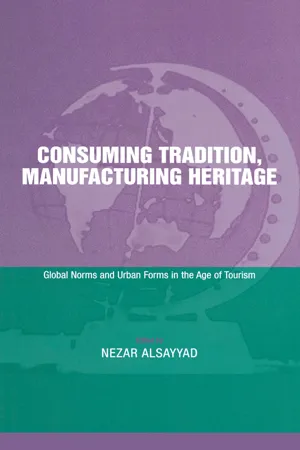
Consuming Tradition, Manufacturing Heritage
Global Norms and Urban Forms in the Age of Tourism
- 320 pages
- English
- ePUB (mobile friendly)
- Available on iOS & Android
eBook - ePub
Consuming Tradition, Manufacturing Heritage
Global Norms and Urban Forms in the Age of Tourism
About this book
From the Grand Tour to today's packages holidays, the last two centuries have witnessed an exponential growth in travel and tourism and, as the twenty-first century unfolds, people of every class and from every country will be wandering to every part of the planet.
Meanwhile tourist destinations throughout the world find themselves in ever more fierce competition - those places marginalized in today's global industrial and information economy perceiving tourism as perhaps the only means of surviving. But mass tourism has raised the local and international passions as people decry the irreversible destruction of traditional places and historic sites.
Against these trends and at a time when standardized products and services are marketed worldwide, there is an increasing demand for built environments that promise unique cultural experiences. This has led many nations and groups to engage in the parallel processes of facilitating the consumption of tradition and of manufacturing tradition.
The contributors to this volume - drawn from a wide range of disciplines - address these themes within the following sections: Traditions and Tourism: Rethinking the "Other"; Imaging and Manufacturing Heritage; Manufacturing and Consuming: Global and Local. Their studies, dealing with very different times, environments and geographic locales, will shed new light on how tourist 'gaze' transforms the reality of built spaces into cultural imagery.
Information
Chapter 5
Colonial Nostalgia and Cultures of Travel: Spaces of Constructed Visibility in Egypt
Egypt must soon be the favourite ground of the modern Nimrod, travel – who so tirelessly haunts antiquity … Thebes will be cleaned up and fenced in. Steamers will leave for the cataract, where donkeys will be in readiness to convey parties to Philae, at seven A.M. precisely, touching Esne and Edfoo. Upon the Libyan suburb will arise the Hôtel royal au Rameses le grand for the selectest fashion. There will be the Hôtel de Memnon for the romantic, the Hôtel aux Tombeaux for the reverend clergy, and the Pension Re-ni-no-fre upon the water-side for the invalids and sentimental – only these names will then be English; for France is a star eclipsed in the East.
(George William Curtis, 1856, Nile Notes of a Howadji)
Is getting to and from the registration desk to the elevators [at the Luxor Las Vegas] by boat along the river Nile any stranger than squeezing the Temple of Dendur into the Metropolitan Museum of Art in New York? Any stranger than traveling to Luxor, Egypt itself?
(Barbara Kirshenblatt-Gimblett, 1998, Destination Culture)
Traditions, Travel and Texts
In this chapter I want to disrupt some conventional appropriations of ‘traditional environments’. ‘Tradition’ is at once an indispensable and an irredeemably compromised term. In one sense, my arguments can be read as merely another elaboration of the ways in which European modernity has ‘invented’ traditions – its own and those of other people. But I also depart from the usual terms of those discussions by connecting the invention of tradition to what Edward Said has identified as the citationary structure of Orientalism, in which successive writers cite and invoke one another, and thereby sustain a canonicized tradition that both invites and legitimates their claims to authenticity and truth.1 I recover these connections between traditions and texts through the cultures of travel that were set in motion by European and North American tourists in Egypt between 1820 and 1920.
Eric Hobsbawm has suggested that ‘invented traditions’ are responses to novel situations – to the anxiety of the new – but this should not be limited to historical change: travelling through space is freighted with its own geographies of uncertainty in which travel writings are strategically implicated.2 In the case that concerns me here, these writings helped to establish a tenacious continuity of disposition and practice whose chains reach beyond the nineteenth into the twenty-first century. More than this, these textualizations were embedded in the appropriation of Egypt as not so much an ‘environment’ as ‘a space of constructed visibility’ within which ‘tradition’ was seen in particular, partial, and highly powerful ways: where some traditions were illuminated, recuperated and privileged, while others were dimmed, marginalized or erased. Here, too, there is a vital continuity between cultures of travel in the past and in the present which becomes visible as a sort of ‘colonial nostalgia’; and for this reason much of what follows is written under the sign of a postcolonialism that I need to clarify in advance.
Colonial Nostalgia and the Colonial Present
It has become commonplace to remark that postcolonialism revisits the colonial past in order to retrieve its impositions and exactions, its erasures and suppressions. Thus, Ali Behdad, in an essay that frames many of my own concerns, has offered an ‘anamnesiac reading’ of Orientalist cultures of travel in the age of colonial dissolution: a critical reading that ‘unmasks what the object holds back and exposes the violence it represses in its consciousness.’ If postcolonialism is thus ‘on the side of memory’, as he has suggested, then it declares its parti pris by staging a ‘return of the repressed’ to counter what he calls ‘the nostalgic histories of colonialism’.3 The inherent violence of the colonial past must not be forgotten; but what makes those histories so nostalgic – and so dangerous – is the seductiveness of colonial power. Hence, Leela Ghandi has argued that postcolonialism
… can be seen as a theoretical resistance to the mystifying amnesia of the colonial aftermath. It is a disciplinary project devoted to the academic task of revisiting, remembering and, crucially, interrogating the colonial past. The process of returning to the colonial scene discloses a relationship of reciprocal antagonism and desire between coloniser and colonised. And it is in the unfolding of this troubled and troubling relationship that we might start to discern the ambivalent prehistory of the postcolonial condition. If postcoloniality is to be reminded of its origins in colonial oppression, it must also be theoretically urged to recollect the compelling seductions of colonial power. The forgotten archive of the colonial encounter narrates multiple stories of contestation and its discomfiting other, complicity.4
Those seductions continue to exercise an extraordinary power at the start of the twenty-first century, which is why I prefer to speak not of the condition of ‘postcoloniality’ but instead of ‘the colonial present’, and why I wish to explore some of the ways in which the fatal attractions of colonial nostalgia are inscribed within contemporary cultures of travel.
To illustrate what I have in mind I offer two late-twentieth-century exhibits. In 1994 Gallimard published a guidebook to Egypt which was translated from French into English the following year and published in the United States by Knopf. Like several comparable texts it exquisitely aestheticizes and commodifies a particular visual economy of travel. The book opens with two double-page, silver-tone illustrations. The first juxtaposes ‘Boats on the Nile’ with ‘Tourists returning from Karnak’; the second depicts ‘Tourists picknicking in a temple’. All of these images were produced in the late nineteenth and early twentieth centuries. Significantly, whenever tourists are shown elsewhere in the text – as in a montage outside Shepheard’s Hotel in Cairo, described in the caption as ‘the epitome of European colonialism’, or posing at the Pyramids – the illustrations are all taken from the last fin de siècle.5
My second exhibit is a tourist brochure produced for Thomas Cook’s 1997–98 season on the Nile.6 ‘In the gracious days of Edwardian cruising’, prospective clients are reminded,
Thomas Cook’s palatial paddle-steamers dominated the Nile. Immaculately maintained and luxuriously furnished, they represented the era’s best in comfort and technology, combining gleaming brasswork and deep-pile carpets with such things as electric light … And life aboard was described as ‘the perfection of human existence.’
The present Nile fleet is advertised as ‘a contemporary version of that grandeur’. Two vessels are singled out for special attention. The first is the MS Eugénie, ‘named after the French Empress who opened the Suez Canal in 1869.’ It was constructed in 1993 ‘in the style of the Belle Époque and bears a nostalgic resemblance to the paddle-wheelers of old.’ In fact, everything about the ship, would-be travellers are assured, ‘is designed to add to its turn-of-the-century allure.’ In particular, ‘the service, provided by 65 crew to 102 passengers, belongs to another age,’ so lavish indeed that the voyage is promised to ‘recall the grand opening of the Suez Canal, when Africa became an island and crowned heads of state sailed majestically through the new waterway – followed by Thomas Cook with a small party of adventurous tourists.’ The second vessel is the MS Prince Abbas, where Thomas Cook has joined forces with the Nile Exploration Company to ‘recreate the spirit of Victorian discovery tours, while incorporating cosseting comforts of modernity.’
On first sight of the delightful Prince Abbas, you are transported through time to years gone by, to the elegance and style of an Agatha Christie film set, to romantic Victoriana. Fashioned with the steam ships of old in mind, this comfortable craft has promenade decks and paddle-wheels to add to the aura of nostalgic authenticity.
‘The door to every cabin and suite opens directly onto the covered decks,’ just as they did in the past, ‘but once inside you are met with all the modern conveniences of a first-class hotel.’ From this privileged vantage point each cabin has ‘a window onto the ancient world’ where passengers can ‘watch the timeless scenes,’ travelling ‘through 5,000 years, past almost biblical scenes – the billowing white lateens of feluccas, blue-gallabeahed men riding yellow camels, black-robed women bearing water pots on their heads.’
These exhibits are colonial nostalgia materialized and made visible, and they represent a visual thematic that needs to be taken with all possible seriousness. In particular, one needs to ask how this visual effect works and, simultaneously, what is hidden from view: what is not reflected in these silver-toned images and what is not seen in these ‘timeless scenes’.
Spaces of Constructed Visibility
To respond to these questions I work with three sets of ideas. In the first place, Henri Lefebvre has suggested there is an intimate connection between what he has called ‘the production of space’ – a concept which now seems much less startling than when it was first proposed – and the systematic grid of power that inheres within modern scopic regimes. His ideas can illuminate some of the ways in which, in the course of the nineteenth and early twentieth centuries, ‘Egypt’ was under construction as a series of superimposed, overlapping and contradictory spaces through the investments and exactions of the ruling dynasty of Muhammad Ali and his successors, the appropriations of a wealthy land-owning class, and the various entanglements of European capitalisms with British, French and Ottoman imperialisms. Thus, ‘modern Egypt’ was being produced as a space of capital accumulation – a space of calculation and exploitation, of surveillance and supervision – in which an identity was forged between the abstractions of Space and the operations of Reason, an identity which appeared as an ‘objectivity’ that was seen as ‘order itself’. There was a palpable intimacy between the production of this spatial order and the disciplining of human bodies: what Timothy Mitchell has called ‘a common economy of order and discipline’.7 There are of course significant connections between the production of this ‘modern Egypt’ and the production of a ‘traditional Egypt’, supposedly lying outside and yet alongside – and accessible from – the modern. But what interests me here is the formation of a visual economy that links political economy to cultural appropriation, and in particular the ways in which ‘Egypt’ was constructed as a particular sort of object.
In the second place, therefore, I draw on John Rajchman’s highly suggestive reading of Foucault’s spatial analytics to sketch the ways in which European and American cultures of travel were involved in staging Egypt as ‘a space of constructed visibility’: as a space within which ‘Egypt’ was made visible in particular ways for a particular audience.8 The geography of this staging was dispersed through multiple sites, both inside and outside Egypt, and worked through a series of discourses and practices that installed a tensile apparatus of power, knowledge and geography. Clearly, ‘traditional’ Egypt was constructed in some measure through politico-economic and geopolitical formations that constituted it as both an obstacle to and an object of ‘modernization’ or ‘development’.9 But what interests me here is the way in which ‘traditional’ Egypt was also produced for travellers and tourists as a space that could be ‘rationalized’: as a space striated by routes and itineraries, triangulated by sights and views, and codified as a series of imaginative geographies through which its landscapes were made visible as a panoramic totality: ‘timeless’, ‘authentic’ and ‘real’.
These productions were not the result of any transcendent logic or design. In the third place, therefore, I suggest that the micro-practices which were involved in the elaboration of these spaces can be brought into view through the actor-network theory developed by Bruno Latour and others. The construction of ‘Egypt’ in these ways was not the pure product of European dictation in which capitalism and colonialism inscribed their marks on an empty surface, filling a blank space awaiting its object. The investment schemes of international banks, the operating strategies of tour companies, and the emerging protocols of archaeology – to name only three of the powerful European agencies involved in the manufacture of ‘Egypt’ – were all immensely important in the formation of these partitioned spaces and in the mobilization and accumulation of the discourses through which they were made visible; but so too were the knowledges, skills and labours of countless local merchants, interpreterguides, boat-owners, sailors and donkey-boys. This is not to oppose the ‘power’ of various capitalisms and colonialisms to the ‘complicity’ or ‘resistance’ of subaltern peoples; rather, actor-network theory allows for a dispersed and distributed understanding of agency by directing attention to the variable powers conferred upon all these actors by virtue of their enrolment in heterogeneous networks. This is to map a complex, foliated space of agency where agency, individual and collective, is always mediated by the spaces in which and through which it takes place. As ‘Egypt’ is constructed in these various ways, divided into the seemingly separate spaces of the ‘modern’ and the ‘traditional’, so some discourses and practices become privileged (‘rational’) whereas others become marginalized (‘customary’)...
Table of contents
- Cover
- Half Title
- Title Page
- Copyright Page
- Table of Contents
- Preface
- The Contributors
- Prologue
- Tradition and Tourism: Rethinking the ‘Other’
- Imaging and Manufacturing Heritage
- Manufacturing and Consuming: Global and Local
- Epilogue
- Index
Trusted by 375,005 students
Access to over 1.5 million titles for a fair monthly price.
Study more efficiently using our study tools.
Frequently asked questions
Yes, you can cancel anytime from the Subscription tab in your account settings on the Perlego website. Your subscription will stay active until the end of your current billing period. Learn how to cancel your subscription
No, books cannot be downloaded as external files, such as PDFs, for use outside of Perlego. However, you can download books within the Perlego app for offline reading on mobile or tablet. Learn how to download books offline
Perlego offers two plans: Essential and Complete
- Essential is ideal for learners and professionals who enjoy exploring a wide range of subjects. Access the Essential Library with 800,000+ trusted titles and best-sellers across business, personal growth, and the humanities. Includes unlimited reading time and Standard Read Aloud voice.
- Complete: Perfect for advanced learners and researchers needing full, unrestricted access. Unlock 1.5M+ books across hundreds of subjects, including academic and specialized titles. The Complete Plan also includes advanced features like Premium Read Aloud and Research Assistant.
We are an online textbook subscription service, where you can get access to an entire online library for less than the price of a single book per month. With over 1.5 million books across 990+ topics, we’ve got you covered! Learn about our mission
Look out for the read-aloud symbol on your next book to see if you can listen to it. The read-aloud tool reads text aloud for you, highlighting the text as it is being read. You can pause it, speed it up and slow it down. Learn more about Read Aloud
Yes! You can use the Perlego app on both iOS and Android devices to read anytime, anywhere — even offline. Perfect for commutes or when you’re on the go.
Please note we cannot support devices running on iOS 13 and Android 7 or earlier. Learn more about using the app
Please note we cannot support devices running on iOS 13 and Android 7 or earlier. Learn more about using the app
Yes, you can access Consuming Tradition, Manufacturing Heritage by Nezar Alsayyad in PDF and/or ePUB format, as well as other popular books in Scienze sociali & Architettura generale. We have over 1.5 million books available in our catalogue for you to explore.