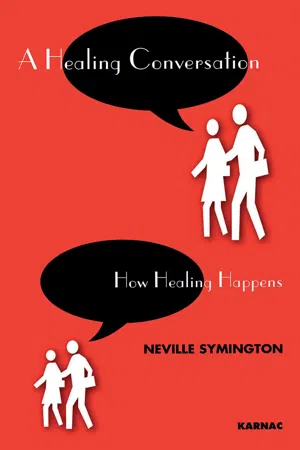
- 160 pages
- English
- ePUB (mobile friendly)
- Available on iOS & Android
eBook - ePub
About this book
How is it that someone can be healed of mental illness through talking with another person? This is what Neville Symington examines in this book. He believes that a person in their innermost being registers the essential character of the other person. The senses detect the outer contours of the personality but a deeper form of knowledge connects directly to the other person's inner being. Healing comes about if the inner world of the one is guided by principles that transcend the particular and this fosters a giving-ness in the one and the other. The egoism in each is then subsumed into a higher unity which results in a new subjective understanding. Personal understanding is a sign that a new ordering of the inner ingredients of the personality has taken place; that the form of being in the one has the capacity to generate in the other this new way of being. The author explores this fundamental reality that underlies human communication and teases out how this brings about healing.
Information
Chapter One
The question: an intellectual solution
The question: How is it that someone who has a problem is able to resolve it through conversation with another?
“I remind myself of the old advice that the doctrines which best repay critical examination are those which for the longest period have remained unquestioned.”
Alfred North Whitehead [1942, p. 207]
This is the question that I want to try to resolve here. It is a question that is so basic that we all take it for granted. Yet I believe that if we attempt to seek an answer to this very basic question, the very attempt can open up great avenues of new thinking and surprising perspectives. I do not know the answer to this question. I am out in the bush at night. I have a torch in my hand, and I point the beam out into the dark. I am stumbling. I cannot see my way very easily; I am surrounded by blackness. I need some support, or else I might fall.
Now I need to explain something about my style of presentation. I put forward various propositions on which I base other statements that I make. These propositions are what I think, and I usually put what I have to say with certainty. I tend not to keep putting in phrases like “I might be wrong, of course” or “Maybe” or “This is what I think at the moment” and so on. Such phrases detract from the object that one is attempting to observe and understand. A constant breast-beating is tiresome and takes attention away from the object of scrutiny. So the situation is that I feel that the propositions I put forward are right but I know that this cannot be so. If I am alive in ten years’ time I am certain that I shall judge that some perspectives are either wrong or inadequate. So I feel what I am going to say is right, but at the same time I know that cannot be so. However, you have full licence to be angry when you hear me assert a proposition with certainty. I do not want to diminish your freedom when that angry feeling wells up in you, but I would be very pleased if you converted that raw feeling into a potent criticism. If you do this, then we shall all learn. There is one other thing I want to mention: that I have given more quotes here than I usually do. My reason is that these are always quotes that have stimulated new thoughts and perspectives in me and may do the same for others too, and some of you may want to follow up on these quotes and read the original works from which they are taken. So let us get going.
The whole of psychoanalysis and psychotherapy is based upon the assumption that it is possible for one person to resolve a problem through talking to another. If this were not the case, then that huge industry that encompasses psychotherapists in their offices honeycombed in crevices, skyscrapers, and unsuspecting terraces of all modern cities in the Western world would collapse, like the Twin Towers, into a heap of miserable rubble. Now I am basing myself on the truth of this assumption: that through communication with another person I am able to solve emotional problems in myself. I am, however, in dark ignorance of why this should be so. The lectures on which this book is based are the first probes into the darkness in the hope of finding the first inklings of an answer to this question. Heaven knows if by the end of them we shall be any closer to satisfying this quest. If any of you know and think it is obvious why a problem can be solved by communicating with another, then you are in the wrong place, and you can leave without giving any offence.
So let us look at the question. So someone has a problem. What do we mean by this? Can I put this into any other words? I think back to when I first approached a psychoanalyst. What impelled me to do so? Is it that I had a problem? That sounds too pale, too intellectual, too tepid an expression. I was suffering. Ah, yes, that is closer to how it was. I was in distress. Even that is too mild. I was in agony, and I had a dim sense that what I needed was to communicate deeply with another person. I remember very well that when I made that decision, I felt through that very decision that I was doing something personal. That very choice laid down something in my personality that has always remained with me. Kierkegaard has given lucid expression to this:
I would say that the experience of choosing imparts to a man’s nature a solemnity, a quiet dignity, which never is entirely lost. There are many who set great store upon having seen one or another distinguished world-historical personality face to face.
This impression they never forget, it has given to their souls an ideal picture which ennobles their nature; and yet such an instant, however significant, is nothing in comparison with the instant of choice. . . . Then has the soul beheld the loftiest sight that mortal eye can see and which can never be forgotten, then the personality receives the accolade of knighthood which ennobles it for an eternity. [1971, p. 181]
There was a freedom in it that was liberating. I inhabited an environment that was hostile to psychoanalysis, that viewed it with suspicion. Rather than be controlled by this attitude, I had decided to make contact with myself. I was going to engage in a close association with another person. I use the phrase “another person” somewhat nonchalantly and, in fact, misguidedly. The phrase suggests that I was a person: but was I? There is a very crucial difference between a statement that I make that is personal and one that is robotic. So I think the situation was that there was a something in me struggling to become a person, but it was smothered behind a whole quantum of stuff that I had just ingested. That something struggling to become a person was smothered beneath a heavy weight of undigested debris. So there was an inchoate sense that I needed to communicate with someone who was a person. But who? I had heard of some shadowy specialists called psycho-analysts and that perhaps one of them might understand what I was wanting to communicate. Of course it is totally absurd to think that a whole professional grouping could have the understanding I needed: in fact, the first one whom I approached and with whom I had an analytic treatment for three years did not have the understanding I required, and I therefore took my leave of him. Understanding of the kind I needed was a rare gem. However, I had some idea that I would be more likely to find it among that group that styled themselves psychoanalysts than among lawyers, accountants, or personnel managers, or, for that matter, doctors, social workers, or counsellors. I had a vague notion that it was among these professionals calling themselves psychoanalysts that I was most likely to find an individual who would help me to alleviate a dire anguish.
Now I did not know the reason for my distress. If it had been absolutely clear to me why I was troubled, then I would not have wanted or even thought of going to speak to someone. If I had known what was distressing me, then I would have acted according to my knowledge. I was far too proud to go seeking help unless I was desperate about the cloud of unknowing that surrounded me. So I think an inherent aspect of my distress was precisely that I did not know the reason for it.
A new friend of mine decided to uproot his family and interrupt his professional life in 1977 and go to California in order to have an analysis with Wilfred Bion. So in his first session he said,
“I do not know quite why I am here, but I think you will be able to understand me and help me.”
Bion replied,
“If you knew why, you would not be here; you would not have wasted time coming here. You came to see me precisely because you do not know why you have come.”
Bion’s reply to my friend seems entirely right to me. It is also for me a reply that is very moving, because Bion had understood the soul of my friend’s suffering. Personal understanding of that deep kind stirs my soul. That understanding of a deep kind is born, I believe, of true compassion. You may retort that many people who arrive at the analyst’s consulting-room do know why they have come. But do they? I think my friend was probably more self-aware than most of us. Not many of us arrive and say that we do not know why we have come for psychoanalysis. Most patients come with a particular complaint. One says that he is coming because relations with his wife are very bad. Another says that she comes because she wants to have a baby and believes that her difficulty in conceiving may be due to emotional reasons. Another comes saying he is devastated because his wife has just left him. Another comes because she is upset because, in a psychiatric assessment, she was diagnosed as being bi-polar. Another comes because he has suddenly become terrified of dying; another comes because he has been enormously depressed and friends have counselled her to approach a psychoanalyst. Yet, after a few weeks of conversation with the psychoanalyst, it becomes clear that these are just the “cover story”. None of these people know why they are consulting the psychoanalyst. They produce a reason because it seems a bit absurd to tumble into the consulting-room and say,
“Oh, doctor, I am here, but I don’t know why.”
There is distress, but at the heart of it is a cloudy darkness. I do not know the wherefore of my distress.
So we reach this very odd conclusion: that the core of our distress lies in the fact that we do not know the reason for it. I think this is what we mean when we use that pale, passionless word “problem” to describe my situation when I decide to visit a psychoanalyst or a psychotherapist. So it begins to look as though the word “problem” may be right after all. I am suffering, yes, that’s true, but . . . the reason for it is obscure, so there is something enigmatic about it, so we call it a problem. We will stick to that word as the best we have, but it does sound a bit intellectual—a bit as if it might be a mathematician speaking, and that with some cunning manipulation of a quadratic equation it could be solved. No, it is not a mere intellectual difficulty. Our emotions are in it here. Our emotions are in distress, and we know not why. We need to embrace the fact that it is a problem that troubles our spirit, that disturbs the heart. That is the meaning we give it when we call it a problem.
Now we move on to the next part of our quest. How is it that I am able to resolve this distress through speaking to another? There seems to be some inherent sense here that the act of communicating with another will help to alleviate the distress, which, according to what we have formulated, means that, in some mysterious way, this communication illuminates the darkness—that if the kernel of the distress lies in our ignorance of its cause, then there seems to be some intuition that talking to another may be able to replace night-time with daylight. How are we to understand this? Is it that the person we speak to will know what we do not know? or is it that the act of communication itself functions as an illuminator? I will take these two possibilities in turn.
The first hypothesis is that the person I speak to will know what I do not know. I think this is the hypothesis that most of us have tucked away inside us. I go to the dentist because I have a pain in one of my lower molars. I believe that he will know why I am having this pain. He looks at the tooth, takes an X-ray, and tells me that I have a large cavity with decay in it and that it will need a filling. So I am right: he does have knowledge that I do not have and is able through it to remedy the trouble. It is the same if I go to a doctor with stomach pains. If, on the other hand, I am in legal difficulties, then I go to a lawyer. He has knowledge that I do not have, and with his help I am able to solve my dilemma. Is it the case, though, that when I go to a psychoanalyst, he knows what I do not know? He knows the cause of my suffering? I think this needs some careful examination.
Now, as it happens, in my psychoanalytic role I do have some general theories as to why someone is suffering mentally. I believe that if, in childhood, some disaster has overtaken me, then I shall later suffer consequences of a mental kind; I have read my Bowlby, and even my Ainsworth, my Fonagy, and my Mary Target, so I believe that if someone has been severely neglected in babyhood, it will have a deleterious effect on the personality. I have read Frances Tustin, who believed that a premature rupture of the infant from its mother wounded the soul of the infant in a way that remained damaging for the rest of its life. I believe that if someone has sustained a loss of someone close to her, she will suffer. I believe that a serious accident will leave someone damaged. I believe that if someone is unable to love, he will suffer. These are general principles. They are abstract. They are truths that are up in the sky. They only acquire meaning when enfleshed in the details of a person’s life experience. A doctor can probably say of most of his patients that they are suffering from an illness, but it is the particular illness that the doctor needs to know in order to offer an effective remedy to his patient. However, even if one of them seems to the psychoanalyst clearly correct in this one particular individual who has come for a consultation, yet . . . it is impossible that he would know the form that this may have taken. This is only possible through unravelling the story.
I am still proceeding on the basis of the first hypothesis. Let us say that the psychoanalyst diagnoses that the patient is suffering because her mother died giving birth to her; he knows that, and also that the patient thinks that this is the source of her difficulties. What is the medicine that the psychoanalyst prescribes? Well, I think we all know that the psychoanalyst does not prescribe a medicine. We also know that if he tells his patient that the source of her difficulties is that her mother died giving birth to her, that also remains a piece of dissociated knowledge that has no curative effect. Very early on Freud discovered that declaring to the patient the hidden cause of his distress was no good. He says that
in the earliest days of analytic technique we took an intellectualist view of the situation. We set a high value on the patient’s knowledge of what he had forgotten, and in this we made hardly any distinction between our knowledge of it and his. We thought it a special piece of good luck if we were able to obtain information about the forgotten childhood trauma from other sources—for instance, from parents or nurses or the seducer himself—as in some cases it was possible to do; and we hastened to convey the information and proofs of its correctness to the patient, in the certain expectation of thus bringing the neurosis and the treatment to a rapid end. It was a severe disappointment when the expected success was not forthcoming. How could it be that the patient, who now knew about his traumatic experience, nevertheless still behaved as if he knew no more about it than before? . . . there was no choice but to cease attributing to the fact of knowing, in itself, the importance that had previously been given to it. [1913c, pp. 141–142]
So the idea that the problem is solved once the clinician has imparted knowledge to the patient seems to have a defect somewhere. We may all smile in a rather superior way and say that we sophisticated therapists all know that the clinician does not just dish out a piece of knowledge to the patient in the same way as a doctor hands out a prescription. Yet are we sure that we are free of this assumption? How many of us are attached to the theoretical position of a Bowlby, a Jung, a Melanie Klein, a Heinz Kohut, a Winnicott? I remember well and with some shame trying to force the medicine of Winnicott upon one of my patients until she finally managed to drill it into my thick head that this was no solution to her problem. I am struck by the fact that instead of trying to grasp the patient’s problem as he or she presents it, many of us act as I did on that occasion, and it does not solve the problem. Freud said the reason was that the patient’s consciousness has no connection to “the place where the repressed recollection is in some way or other contained” (1913c, p 142). I would like to emphasize his words in some way or other contained. I believe that the imagery that words conjure up in our minds are frequently responsible for directing us along the wrong path of thinking. The idea here is that the repressed experience exists in a similar form to that experience within consciousness: just the same, but just blocked off from our consciousness. Sometimes Freud spoke in this way, so the image is of an experience that is just the same as it is in consciousness but blocked off from consciousness by a barrier that was called “repression” when considered objectively and “resistance” when considered subjectively. However, it is clear from these words of his—“in some way or other contained”—that Freud was more open-minded about it. There is in those words some thought that the way in which it is contained in the unconscious may not be in the same mode as occurs in consciousness. But his central point here is that the patient’s problem, the patient’s neurosis, the patient’s distress is not alleviated or resolved through imparting knowledge. I do not think this is absolute, and we shall have to come back to the idea. In the process there is most likely some imparting of knowledge, but this is not the central way in which the problem is resolved. Freud emphasized this point again in his paper on The Unconscious:
If we communicate to a patient some idea which he has at one time repressed but which we have discovered in him, our telling him makes at first no change in his mental condition. Above all it does not remove the repression nor undo its effects [1915e, p. 175]
So where are we? That the core of the patient’s problem is that we do not know the reason for...
Table of contents
- Cover
- Half Title
- Title
- Copyright
- Dedication
- Contents
- PREFACE
- 1 The question: an intellectual solution
- 2 The meaning of emotion
- 3 Emotional development
- 4 Communication and emotion
- 5 Communication and representation
- 6 The case of pseudo-maturity
- REFERENCES
- INDEX
Trusted by 375,005 students
Access to over 1.5 million titles for a fair monthly price.
Study more efficiently using our study tools.
Frequently asked questions
Yes, you can cancel anytime from the Subscription tab in your account settings on the Perlego website. Your subscription will stay active until the end of your current billing period. Learn how to cancel your subscription
No, books cannot be downloaded as external files, such as PDFs, for use outside of Perlego. However, you can download books within the Perlego app for offline reading on mobile or tablet. Learn how to download books offline
Perlego offers two plans: Essential and Complete
- Essential is ideal for learners and professionals who enjoy exploring a wide range of subjects. Access the Essential Library with 800,000+ trusted titles and best-sellers across business, personal growth, and the humanities. Includes unlimited reading time and Standard Read Aloud voice.
- Complete: Perfect for advanced learners and researchers needing full, unrestricted access. Unlock 1.5M+ books across hundreds of subjects, including academic and specialized titles. The Complete Plan also includes advanced features like Premium Read Aloud and Research Assistant.
We are an online textbook subscription service, where you can get access to an entire online library for less than the price of a single book per month. With over 1.5 million books across 990+ topics, we’ve got you covered! Learn about our mission
Look out for the read-aloud symbol on your next book to see if you can listen to it. The read-aloud tool reads text aloud for you, highlighting the text as it is being read. You can pause it, speed it up and slow it down. Learn more about Read Aloud
Yes! You can use the Perlego app on both iOS and Android devices to read anytime, anywhere — even offline. Perfect for commutes or when you’re on the go.
Please note we cannot support devices running on iOS 13 and Android 7 or earlier. Learn more about using the app
Please note we cannot support devices running on iOS 13 and Android 7 or earlier. Learn more about using the app
Yes, you can access A Healing Conversation by Neville Symington in PDF and/or ePUB format, as well as other popular books in Psychology & Emotions in Psychology. We have over 1.5 million books available in our catalogue for you to explore.