![]()
1 Introduction
More than ever, organisations are facing a data avalanche from various sources, be they in electronic or hard copy format. How an organisation manages this ever-increasingly important resource which is data can benefit or hinder its ability to achieve its objectives.
This book has been written as a guide on how to implement, administer and develop a CRM database platform and use data effectively to meet organisational objectives.
It was developed to educate and inform professionals who would like to improve their knowledge of data management and to provide staff who are responsible for managing their organisation’s CRM platform with ideas and practical advice to develop best practices by combining technology, data management and marketing principles.
With the implementation of best practices, a CRM platform can bring benefits to an organisation, including:
• providing an aid to meet business objectives more effectively;
• improving efficiency of the CRM database within the organisation;
• eradicating duplicated work;
• improving workflows within the organisation;
• addressing legal and compliance issues surrounding data within the organisation.
The issues and topics covered in this book will apply to all organisations that use a CRM platform and the data it contains as part of their business activities regardless of the industry sector or the size of the organisation.
This is not a technical book on how databases are designed and does not advocate the use of one database platform or another, but it is a general overview of the tasks and issues involved when managing a CRM platform.
As this book is concerned with databases, it inevitably uses some technical jargon and IT terminology. These terms will be explained as they occur in a way that non-technical users and readers will understand.
Contents of the book
The book is divided into three parts.
Part I: Overview of data and CRM platforms
This part of the book introduces the reader to the concepts and theory behind the practical measures an organisation can implement in order to manage and administer an effective CRM platform.
It includes concepts such as:
• defining data – the difference between data and information;
• the data lifecycle – the stages data goes through, including collection, maintenance, analysis and reprocessing;
• types of CRM platforms – what types of CRM platforms in the marketplace can be implemented in an organisation.
Part II: Implementing a CRM platform
This part covers:
• the factors to consider when developing a CRM platform;
• the project management process of implementing a CRM platform in an organisation.
Part III: CRM data administration data issues and tasks
This part covers issues related to the data within the CRM database, including:
• data quality;
• data capture;
• data plans;
• data security;
• organisation of the data team;
• data migrations;
• data security;
• reports and analysis;
• data legislation;
• mailings;
• data suppliers;
• data storage.
Data scenarios
The book also provides case studies of data scenarios set in a fictitious organisation, Data XYZ PLC, to highlight how an organisation can improve its data practices and better manage its data.
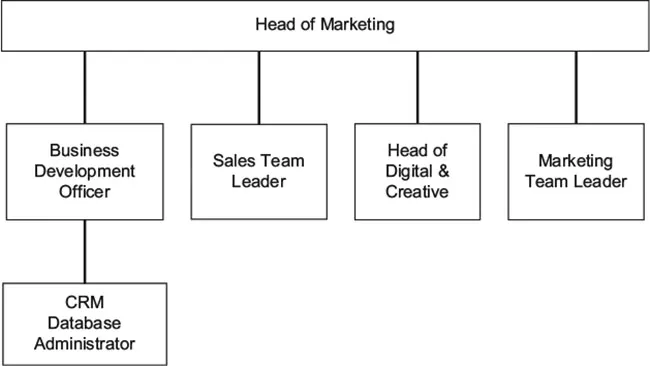
The Data XYZ PLC marketing department comprises four teams:
• business development section;
• digital and creative team;
• marketing team;
• sales team.
The heads of department directly report to the head of marketing and are responsible for the management of their own staff.
The CRM platform is currently situated within the business development section, has an administrator managing the system, and is line-managed by a business development officer (see Figure 1).
![]()
2 Target audience of this book
The target audience of this book includes:
• professionals responsible for administering and managing the CRM platform within an organisation;
• professionals requiring an overview of how to start to implement best data practices when managing a CRM database platform and the data it holds;
• professionals who are thinking about implementing a CRM platform within their organisation and need an overview of what factors should be considered to achieve this;
• professionals who require an overview of how data management is combined with marketing principles to achieve business objectives;
• professionals responsible for implementing data management practices within their organisation;
• professionals requiring an overview of the issues surrounding data within their organisation;
• marketing professionals who wish to gain a better understanding of how the data within the CRM platform can be managed and used more effectively.
![]()
3 Outcomes of this book
After reading this book, the reader should be able to:
• understand the importance of data and data management within a organisation;
• improve and implement data practices in administering and managing the CRM platform in order to efficiently and effectively use the data within the database;
• understand the data tasks and processes involved in the management and operation of a CRM platform in order to meet organisational goals;
• understand how data management principles can be applied to the management of a CRM platform within an organisation.
![]()
Part I
Overview of data and CRM platforms
Part I will cover:
• the data lifecycle;
• defining what data is;
• defining a CRM platform;
• the types of CRM platform that can be implemented within an organisation;
• process mapping within an organisation;
• aspects involved in data management within an organisation.
![]()
4 Overview of data and CRM platforms
This chapter will cover some basic background data knowledge the reader should be aware of before reading this book.
Defining data
The terms ‘data’ and ‘information’ seem to be interpreted by people as having the same meaning and being interchangeable.
A model used to explain the difference between data and information is outlined by DAMA (2009, pp.2–3)1 as Data, Information, Knowledge and Wisdom (DIKW).
Data, as stated by DAMA (2009, p.2),2 can be defined as: ‘the representation of facts as text, numbers, graphics, images, sound or video’.
Information gives that data meaning in some sort of context, as outlined by DAMA (2009, p.2).3
In this case, organisations apply some sort of meaning to the data – for example, 109 could be a transaction number for one organisation, but to another organisation it could mean a user ID.
Knowledge involves understanding and gaining insight into this information, as outlined by DAMA (2009, p.3),4 and will lead to wisdom...