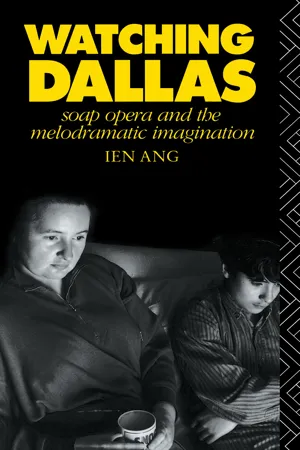
Dallas, one of the great internationally-screened soap operas, offers us first and foremost entertainment. But what is it about Dallas that makes that entertainment so successful, and how exactly is its entertainment constructed?
- 160 pages
- English
- ePUB (mobile friendly)
- Available on iOS & Android
eBook - ePub
About this book
Information
1
DALLAS
between reality and fiction
between reality and fiction
Manipulation or fascination?
Some of the letter-writers dislike Dallas, others find it amusing to watch – at least that is what they say. ‘Hating Dallas’ or ‘loving Dallas’ are only labels people stick on the way in which they relate in general to the programme. These are names for the way in which they experience the programme – an experience which can go either in a negative or in a positive direction. But what is hidden behind those apparently unambiguous labels? In fact no single experience, certainly no experience of something as complex as a long-running television serial, is unambiguous: it is always ambivalent and contradictory. The ‘totalizing’ labels of love and hate conceal this. It is not therefore surprising that in various letters passages can be found in which ambivalences come to the surface – mostly implicit, but sometimes quite explicit, such as in these extracts:
pleasant or not, you are curious as to what is happening to them. For me it is a cosy and sometimes exciting half hour (or how long does it last?) though sometimes I get really annoyed. (Letter 11)
When I saw Dallas for the first time I found it a very amusing serial and decided to follow it. But after a few months it became so tedious that I didn’t find it at all interesting any more. But three weeks ago I just happened to watch it once and now I just have to watch it, however boring I find it. It’s strange because I don’t like watching TV much and so I find this really ridiculous. (Letter 27)
These ambivalent feelings must make us realize that it is difficult to determine what the letter-writers really think of Dallas. Indeed, the search for a total and definitive explanation for the way in which different groups of viewers experience the programme would seem to be particularly frustrating because at a certain moment we have to acknowledge that we are chasing an illusion: such an all-embracing explanation is a rationalistic fiction. We must keep this in mind when interpreting the statements of the letter-writers. What they say about Dallas is no more than a snapshot of their reception of the programme, an attempt to put a diffuse viewing experience into words. And when something is put into words there are always things which remain unexpressed and implicit.
Nevertheless, one thing is certain. Not a single letter-writer is indifferent to Dallas. And they all watch it. How otherwise could they give such detailed descriptions of it? In particular for those who regard themselves as Dallas-haters, this is an awkward absurdity. Letter-writer 31, for example, who describes herself as an ardent opponent of Dallas, nevertheless betrays intense involvement in the vicissitudes of the Ewings. In great detail she describes everything which in her opinion is wrong with the Dallas characters, but paradoxically she even fantasizes on possibilities for their future life. ‘But who knows, perhaps Pamela will start an extramarital affair (I must admit she’s really beautiful); that would be something to smack your lips over’ (Letter 31).
It is as though the attraction of Dallas is running counter to her self-declared hatred. How can we explain this contradiction? Is she perhaps being manipulated by the swanky advertising business surrounding Dallas? She herself explicitly refers to this:
In England, where I was in the summer, there was an absolute craze. Besides badges, mugs, spoons, handkerchiefs, teatowels, T-shirts, tablecloths, etc. of Charles and Diana, you could also buy this stuff with J.R.’s head on and ‘I love J.R.’ or ‘I hate J.R.’ written on it. I nearly bought a badge with the latter on but I realized that I had nearly got caught in the Dallas net. (Letter 31)
It is true: the commercial machinery that has to sell Dallas is going full blast. In the Netherlands too, week after week the popular press writes about the ups and downs of the Dallas stars. Dallas books are on sale everywhere. And there is even a special monthly Dallas strip cartoon. But hadn’t this letter-writer already been ‘caught in the Dallas net’, even without coming into contact with the J.R. badges? Is it not really the case that watching Dallas itself has caught her (in an unpleasant way), in spite of the resistance arising from her commitment to the ideology of mass culture?1
It would be naïve to suppose that the marketing practices of the commercial culture industry have no effect whatever on the involvement of the viewers. How great and what that effect is cannot be established here, however. On the other hand it would be far too easy to ascribe the popularity of Dallas totally to advertising. We must make a distinction between the programme itself as it can be seen week by week on television, and the advertising practices surrounding it. One letter-writer, who says that she likes Dallas, writes the following:
I had read quite a lot about Dallas in Privé, Story and other such magazines.2 In America millions watch it, and that wasn’t expected over here. In short, an awful amount of fuss was made of it. In America there were ‘J.R. hats’, stickers, buttons, posters, etc. And that seemed to me terribly overdone. I don’t know if you ever read gossip magazines, but if you do you know how it is. If you cut your finger, you put a plaster on it, and that’s that. If Larry Hagman or Linda Gray cut a finger, there are great headlines: ‘J.R. (or Sue Ellen) temporarily laid up’ or something like that.
Altogether Dallas didn’t interest me much at first, and when the serial began I didn’t watch it. From my colleagues and other girl friends I did hear that it was amusing, but people tend to say that easily. So for quite a time I didn’t watch it. When it had been going for about half a year, one of my colleagues suddenly said to me (the day after a Dallas episode): ‘Hey, you really must watch Dallas, it’s really fantastic’ She is not the type to fall under the influence of a serial either, so when she said that it had to be worth the effort. (Letter 20)
After that, as she recounted, she was done for: after she had seen the programme once, she didn’t miss a week. A tall story, perhaps too tall. But in any case it makes us aware that the advertising of one’s own social group can be more effective than that of the popular press. The popular press can perhaps fasten the attention of (potential) viewers on the existence of a programme or arouse curiosity for it, but it is improbable that it can have a straightforward and direct influence on the way in which viewing a programme is experienced.3 As one letter-writer says: ‘The women are really as beautiful as the gossip magazines say they are and they have one simple recipe for it. But that’s not the point here’ (Letter 7).
Relatively independent of the competing discourses revolving around Dallas – in the popular press, in advertising, but also by television critics, journalists and other intellectuals – the programme has made its way into the experiential worlds of millions of viewers. There’s no doubt the programme does exercise a certain fascination. Against the background of prevalent notions of ‘good television’, this fascination is itself an ambivalent experience: ‘I find the quality rather bad but it does have a certain attraction’ (Letter 26, my italics). This attraction appears to elude rational explanation. The pleasure of Dallas is presented here as something incomprehensible and against the grain: this is a case of what the German sociologist Dieter Prokop has called ‘the nevertheless fascinating’.4 In other words, the pleasure of Dallas seems to be an enigma.
In this chapter and the next I want to try to unravel something of this enigma. But I do not claim to solve it fully – that would conflict with my conviction that an all-embracing explanation of the way in which viewers experience Dallas is impossible. Instead, I want to use as a starting point the statements the letter-writers who say they like Dallas make about their attitude to the programme. For these statements reveal, albeit obliquely, something about the way in which Dallas is received by these viewers. I shall try to interpret these statements and I shall indicate how they link up with the pleasure these viewers experience from Dallas. But first it is necessary to explain the theoretical perspective on the basis of which I shall be tackling the problem of pleasure.
Consumption, use-value and pleasure
Placing emphasis on the pleasure that people experience from Dallas is not a harmless theoretical (and political) choice. By so doing we are acknowledging that people can have a positive relationship with Dallas – a hedonistic attitude which is at odds with the doctrine that mass culture primarily manipulates the masses. According to Adorno and Horkheimer, for example, the experience of pleasure in mass culture is a false kind of pleasure, even part of the trick of manipulating the masses more effectively in order to lock them in the eternal status quo of exploitation and oppression. ‘Marxists, in particular, have interpreted the fact that people enjoy mass culture as a reason for gloom’, Simon Frith5 asserts in his book on rock music. Stuart Hall even talks of the stubborn refusal of the left to consider pleasure. ‘The project of the left is directed at the future, at the socialism that has still to come, and that is at odds with the direct experience of pleasure here and now. That causes all sorts of mental blocks when theorizing about the problem.’6
Put simply, the current Marxist idea is as follows: because the production of culture is subject to the laws of the capitalist economy, cultural products are degraded into commodities to make as much profit as possible on the market. The exchange value of those products is therefore essential for the producers, leading to a neglect of quality. The capitalist market economy is only interested in the production of surplus value and as such is indifferent to the specific characteristics of the goods: caring only that they are sold and consumed. Mass culture is the extreme embodiment of the subjection of culture to the economy; its most important characteristic is that it provides profit for the producers.
But this is a one-sided presentation of the case. Marx himself stated that ‘a commodity only has exchange value in so far as it is at the same time a use-value, i.e., as an object of consumption; it ceases to have an exchange value if it ceases to have a use-value.’7 In other words, one cannot succeed in selling a commodity if it does not have a certain usefulness. And it is here that the contradictory character of the capitalist mode of production lies. From the standpoint of production the product only features as a commodity, but from the standpoint of consumption the same product features as use-value.
The way in which a cultural product is consumed can therefore not be directly deduced from the way in which it is produced; it is also dependent on all sorts of socio-cultural and psychological conditions. Terry Lovell has explained in a simple and clear way how unmanageable the relation between the commercial and the entertainment value of mass culture can be: ‘There will be no guarantee that the use-value of the cultural object for its purchaser will even be compatible with its utility to capitalism as bourgeois ideology […] For example, the utility of a television programme for a producer who buys advertising time is the ability of that programme to enhance the sale of the advertised product, by giving the producer access to the audience which is watching the programme. But the viewer will be watching the programme for its entertainment value and there is some evidence that these two interests may conflict. A programme which is a best seller and which its audience rates very highly on entertainment value may actually be less effective as a vehicle for impressing advertised products and increasing their sales than a less entertaining programme.’8
But what is the entertainment value that Lovell is discussing here? Both in common sense and in more theoretical ways of thinking, entertainment is usually associated with simple, uncomplicated pleasure – hence the phrase, for example, ‘mere entertainment’. This is to evade the obligation to investigate which mechanisms lie at the basis of that pleasure, how that pleasure is produced and how it works – as though that pleasure were something natural and automatic. Nothing is less true, however. Any form of pleasure is constructed and functions in a specific social and historical context.
How then is the pleasure of Dallas constructed? As a product of the commercial culture industry, Dallas is explicitly offered to the public as an object for pleasurable consumption. The promise of pleasure is the use-value by which the industry tries to seduce viewers to watch Dallas on their television sets. But to achieve this aim the producers have to have a definite idea of what the audience will find pleasurable; they must have a certain self-confidence that their own definition of pleasure will coincide with that of (large sections of) the public. Therefore the strategy of the producers will be directed at the elaboration of what they already know about popular pleasures. Their previous experience in the business will be of assistance to them in this. Hence it is not very likely that the pleasure offered in Dallas will be structurally new, experimental or provocative. It will keep within the guidelines of existing and accepted definitions and routines of popular pleasure. In order to attract a large audience the format of Dallas will therefore tend to accord with easily accessible and current patterns of what is pleasurable and entertaining. This does not, however, mean that the producers will be fully aware of the effectiveness of their product. As a matter of fact, it is only necessary for them to know that the mechanisms work – something they try to discover, for example, by audience ratings and programme testing – not how and why they work. From their pragmatic viewpoint they are not interested in cultural theory.
We, however, do wish to know how and why the mechanisms of pleasure function – we have indeed set ourselves the task, if not to solve the riddle of the pleasure of Dallas, then at least to unravel it to some degree. In The aristocracy of culture’,9 Pierre Bourdieu has explained that popular pleasure is characterized by an immediate emotional or sensual involvement in the object of pleasure. What matters is the possibility of identifying oneself with it in some way or other, to integrate it into everyday life. In other words, popular pleasure is first and foremost a pleasure of recognition. But what do Dallas-lovers recognize in Dallas? This is now the main question confronting us.
DALLAS as television entertainment
But is it really possible to isolate pleasure in Dallas from pleasure in television in general? Could it not be said that pleasure in Dallas is connected not so much with the specific characteristics of the programme itself, as with the pleasure of watching television as such? And would it not be nearer the truth to say that the audience watches Dallas because it has little choice, because television just is not offering anything better?
The consumption of Dallas is ...
Table of contents
- Cover
- Half Title
- Title Page
- Copyright Page
- Contents
- Preface
- Introduction
- 1 DALLAS between reality and fiction
- 2 DALLAS and the melodramatic imagination
- 3 DALLAS and the ideology of mass culture
- 4 DALLAS and feminism
- Notes
- Index
Trusted by 375,005 students
Access to over 1.5 million titles for a fair monthly price.
Study more efficiently using our study tools.
Frequently asked questions
Yes, you can cancel anytime from the Subscription tab in your account settings on the Perlego website. Your subscription will stay active until the end of your current billing period. Learn how to cancel your subscription
No, books cannot be downloaded as external files, such as PDFs, for use outside of Perlego. However, you can download books within the Perlego app for offline reading on mobile or tablet. Learn how to download books offline
Perlego offers two plans: Essential and Complete
- Essential is ideal for learners and professionals who enjoy exploring a wide range of subjects. Access the Essential Library with 800,000+ trusted titles and best-sellers across business, personal growth, and the humanities. Includes unlimited reading time and Standard Read Aloud voice.
- Complete: Perfect for advanced learners and researchers needing full, unrestricted access. Unlock 1.5M+ books across hundreds of subjects, including academic and specialized titles. The Complete Plan also includes advanced features like Premium Read Aloud and Research Assistant.
We are an online textbook subscription service, where you can get access to an entire online library for less than the price of a single book per month. With over 1.5 million books across 990+ topics, we’ve got you covered! Learn about our mission
Look out for the read-aloud symbol on your next book to see if you can listen to it. The read-aloud tool reads text aloud for you, highlighting the text as it is being read. You can pause it, speed it up and slow it down. Learn more about Read Aloud
Yes! You can use the Perlego app on both iOS and Android devices to read anytime, anywhere — even offline. Perfect for commutes or when you’re on the go.
Please note we cannot support devices running on iOS 13 and Android 7 or earlier. Learn more about using the app
Please note we cannot support devices running on iOS 13 and Android 7 or earlier. Learn more about using the app
Yes, you can access Watching Dallas by Ien Ang in PDF and/or ePUB format, as well as other popular books in Media & Performing Arts & Television History & Criticism. We have over 1.5 million books available in our catalogue for you to explore.