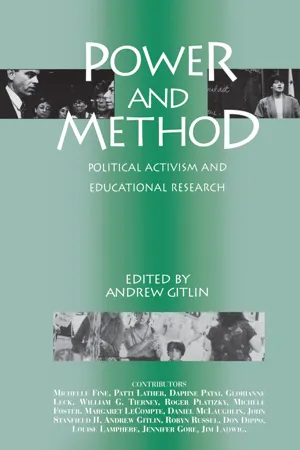
Power and Method demonstrates that political activism can and should be infused into the research process. Contesting the traditional assumptions that have dominated thinking about the nature and meaning of research--validity, objectivity and the researcher/"subject" relationship--the volume showcases alternative methods, enabling scholars to make a difference in the lives of classed, gendered and raced "subjects" and grapple honestly and openly with the way power is woven into the research process.
Committed to the notion that the challenge to redefine the research process faces not only educational researchers, Power and Method includes contributions from scholars in the allied social sciences and the humanities. Responses from researchers working women's studies, anthropology, sociology and literature conclude each section and highlight common and alternative perspectives on the central themes that run throughout the volume.
- 264 pages
- English
- ePUB (mobile friendly)
- Available on iOS & Android
eBook - ePub
About this book
Information
Section One
Perspectives on Power and Method
Feminist
DIS-STANCE AND OTHER STANCES: NEGOTIATIONS OF POWER INSIDE FEMINIST RESEARCH
[F]eminist politics is not just a tolerable companion of feminist research but a necessary condition for generating less partial and perverse descriptions and explanations. In a socially stratified society, the objectivity of the results of research is increased by political activism by and on behalf of oppressed, exploited and dominated groups. Only through such struggles can we begin to see beneath the appearances created by an unjust social order to the reality of how this social order is in fact constructed and maintained.
—Sandra Harding, The science question in feminism
Throughout the 1980s and into the 1990s, feminist researchers have been chatting busily in the kitchen of the social sciences, delighted by the vivid and disruptive possibilities of our scholarship on women’s lives. Voyeurs, often, to the deep and radical transformations washing through the humanities and theoretical work in the social sciences. And dis-stanced witnesses to the breaths of feminist activism still alive. As we sit we worry, collectively and alone, about how best to unleash ourselves from our central contradiction—being researchers and being activist feminists (Crawford and Gentry 1989; Crawford and Marecek 1989b; Fine and Gordon 1989; Flax 1990; Hare-Mustin and Marecek 1990b; Kahn and Yoder 1990; Lykes and Stewart 1986; Morawski 1990; Parlee 1990; Payton 1984; Russo 1984; Smith and Stewart 1989; Unger 1990; Wittig 1985). We document at once the depths of violence and discrimination embedded in the lives of women (Amaro & Rousso 1987; Belle 1990; Blackman 1989; Brown 1987a; Gilkes, 1988; Lykes 1989; D. Smith; and the complex maneuvers by which women deny such oppression (Crosby et al. 1989; Gilligan 1993; Majors 1994; Miller 1976; Taylor 1983). (Harvesting substantial evidence of gender-, race/ethnic-, class-, disability-, and sexually-based oppression, we also know how meticulously women take care, make nice, and rarely, in our research, express outrage at the gendered politics of their lives (Brodbey and Fine 1988).
Many—not all—feminist social researchers report these stories, girdled in by now-stretched-out, but nonetheless intact, notions of neutrality and positivism, reliability, and truth. In narratives parallel to some of the women we study, some of us still smuggle our knowledge of social injustice into a discourse of science that fundamentally contains, and painfully undermines, the powerful politics of activist feminism. As is often the case with moments of social containment, feminists in the social sciences carry weighty evidence for a passionately disruptive transformation of our disciplines. And yet, as relatively new kids on the academic block, we also carry domesticating responsibilities to keep this social science appearing dispassionately detached. And we manage these responsibilities differently. Valerie Walkerdine (1986) narrates this problem when she writes:
I want, therefore, to demonstrate that women, positioned as teachers, mothers, carers and caring professionals … are held absolutely necessary for the moral order: they are responsible. This responsibility places women as at once safe, yet potentially dangerous (the bad mother). It places them as responsible for ensuring the possibility of democracy, and yet as deeply conservative…. My argument is that, quite simply, women of all classes have been placed as guardians of an order from which it is difficult to escape. (63)
Traditional social sciences have stubbornly refused to interrogate how we as researchers create our texts (see Becker 1986; Brodkey 1987; Reinharz 1988; Rosaldo 1989; Semin and Gergen 1990). Most particularly, this is the case for psychologists, where it is presumed that psychological theories and methods simply neutralize personal and political influences. When we write about “laws” of human behavior, our political stances may evaporate. That we are human inventors of some questions and repressors of others, shapers of the very contexts we study, coparticipants in our interviews, interpreters of others’ stories and narrators of our own, is sometimes rendered irrelevant to the texts we publish. While feminists vary in how we manage this treacherous territory, we all manage it.
Donna Haraway (1988) caricatures the epistemological fetish with detachment as a “God trick …that mode of seeing that pretends to offer a vision that is from everywhere and nowhere, equally and fully” (584). Such narrative removal seeks to front universal truths while denying the privileges, interests, and politics of researchers. With Haraway and Sandra Harding (1986), feminist scholars have interrupted the membrane of objectivity across the academy and in their respective disciplines, refusing containment and asking how feminist politics can and do play, explicitly and subversively, in our intellectual lives.
Feminist researchers have clearly gained the most ground in the rethinking of our relationships with “subjects” and of the politics of power that loiter between us. British psychologist Sue Wilkinson (1986) characterizes feminist research in the following way:
First, there is its reflexive and self reflective quality … an emphasis on the centrality of female experience directly implies its corollary: “ourselves as our own sources.” Similarly, du Bois has emphasized the way in which the knower is part of the matrix of what is known; and Reinharz has required the researcher to ask her/himself how s/he has grown or changed in the process of research.
Second, the relationship between the researcher and the researched will evidently be very different from that of the traditional “experimenter” and “subject.” In feminist research, at the very least, both are to be regarded as having the same status: as participants or collaborators in the same enterprise….(13)
An early advocate of advocacy-based research, psychologist Carolyn Payton has long prodded the field about the bankruptcy of its “professional” social commitments. In the 1980s, she wrote:
Please keep in mind that almost two decades ago the APA grappled with the question of the propriety of psychologists as a group advocating social change or taking part in political advocacy, and a process for dealing with such matters are suggested. Yet, here we are in 1983 still denying that we have any responsibility for or obligation to the society in which we live. We behave as if, along with study in this discipline, we inherit a dispensation from considering all matters concerning social consciousness barring those related to guild issues. (1984, 392)
Wilkinson (1986), Tiefer (1990), Payton (1984), and Patricia Hill-Collins, like feminist scholars across disciplines, situate themselves proudly atop a basic assumption that all research projects are (and should be) political; that researchers who represent themselves as detached only camouflage their deepest, most privileged interests (Rosaldo 1989). For instance, Hill-Collins articulates convincingly a political aesthetic that characterizes Black feminist consciousness.
But if feminist research is directed toward social transformations and if practices of “neutrality” primarily laminate deeply conservative interests of the social sciences, then feminist academic researchers face a central dilemma. That dilemma concerns the self-conscious role our politics can play as we pursue, passionately, our intellectual work. To this dilemma, Donna Haraway offers us passionate detachment through which she believes “men are bound to seek perspectives from those points of view which can never be known in advance, that promise something quite extraordinary, that is, knowledge potential for constructing worlds less organized by axes of domination (1988, 585).” Once full detachment has been revealed as illusory and the stuff of privilege, we can dip into the questions of “stances.”
Reflecting on Stances
Studies which have as their focal point the alleged deviant attitudes and behaviors of Blacks are grounded within the racist assumptions and principals that only render Blacks open to further exploitation. The challenge to social scientists for a redefinition of the basic problem has been raised in terms of the “colonial analogy.” It has been argued that the relationship between the researcher and his subjects, by definition, resembles that of the oppressor and the oppressed, because it is the oppressor who defines the problem, the nature of the research, and, to some extent, the quality of interaction between him and his subjects. This inability to understand and research the fundamental problem, neo-colonialism, prevents most social researchers from being able accurately to observe and analyze Black life and culture and the impact racism and oppression have upon Blacks. Their inability to understand the nature and effects of neo-colonialism in the same manner as Black people is rooted in the inherent bias of the social sciences. (Ladner 1971, iii)
Joyce Ladner wrote more than twenty years ago about the inherent racism, bred and obscured, that occurs when researchers elect to stand outside and reify the Self–Other hyphen of social research. Ladner knew then that researchers who sought to invent coherent Master Narratives needed, and created, “Others.” The sharp edges of those works were best secured by the shadowed frays of the Other. The articulate professional voices sounded legitimate against the noisy vernacular of the Other. The rationality of the researcher/writer calmed against the outrage of the Other. These texts sought to close contradictions, and by so doing they tranquilized the hyphen, ousting the Other, achieving dis-stance.
This essay here presumes that all researchers are agents, in the flesh (Caraway 1991) and in the collective, who choose, wittingly or not, from among a controversial and constraining set of political stances and epistemologies. Many deny these choices within veils of “neutrality,” describing behaviors, attitudes, and preferences of Others, as if these descriptions were static and immutable, “out there,” and unconnected to “Self” or political context. They represent these texts as if they were constructed without author(ity). Such texts refuse to ask why one research question or interpretation has prevailed over others, or why this researcher selected this set of questions over others. Such texts render oblique the ways in which we, as researchers, construct our analyses and narratives. Indeed, these texts are written as if researchers were simply vehicles for transmission, with no voice of their own. Such researchers position themselves in dis-stances, as ventriloquists.
Other researchers, in their texts, import to their work the voices of Discarded Others who offer daily or local meanings, which seemingly contrast with and interrupt hegemonic discourses and practices. With “voices” and “experiences” as the vehicles for social representation, these researchers typically claim little position for Self (Scott 1992).
Finally, some researchers fix themselves self-consciously as participatory activists. Their work seeks to unearth, disrupt, and transform existing ideological and/or institutional arrangements. Here, the researcher’s stance frames the texts produced and carves out the space in which intellectual surprises surface. These writers position themselves as political and interrogating, fully explicit about their original positions and where their research took them.
I paint these three stances—ventriloquy, “voices,” and activism—for feminist researchers to roll around, unpack, try on, discard. It seems crucial in the 1990s that social researchers who seek to be explicitly political (e.g., feminists, African Americans, poststructuralists, neo-Marxists), as well as those who refuse to so acknowledge, should consider aloud, and together, the decisions we have made, through leakage and through pronouncements, in our research.
Ventriloquy
Once upon a time, the introduction of writings of women and people of color were called politicizing the curriculum. Only we had politics (and its nasty little mate, ideology), whereas they had standards. (Robinson 1989)
Ventriloquy as a stance relies upon Haraway’s God trick. The author tells Truth, has no gender, race, class, or stance. A condition of truth-telling is anonymity, and so it is with ventriloquy. Dramatizing ventriloquy as an academic stance, I offer a snip of institutional biography from an institution with which I’ve had some intimacy—The University of Pennsylvania.
In 1985, the University of Pennsylvania denied tenure to Dr. Rosalie Tung, then Associate Professor at the Wharton School. While Wharton justified the decision to not tenure Tung “on the grounds that the Wharton School is not interested in China related research,” Tung maintained that her Department Chairman had sexually harassed her and that, after she insisted on a professional and not sexual relationship, he submitted a negative letter to the University’s Personnel Committee, adversely influencing her tenure decision.
Tung brought the case to the Equal Employment Opportunity Commission (EEOC), which undertook an investigation, requesting documents from Penn. When the University refused to provide these documents, the Commission subpoenaed for Tung’s tenure review file as well as those of the five male faculty members who had been tenured just prior to Tung. Penn argued the need to exclude all “confidential peer review information,” and failed to provide (1) confidential letters written by Tung’s evaluators, (2) the Department Chairman’s letter of evaluation, (3) documents reflecting the internal deliberations of faculty committees considering applications for tenure, and (4) comparable portions of the tenure review of the five males. The Commission denied the University’s application for these exclusions.
The case made its way to the Supreme Court. Four years after denial of tenure, in a 9–0 vote, the Supreme Court found against Penn in a decision in which the Justice wrote:
We readily agree with the petitioner regarding that universities and colleges play significant roles in American society. Nor need we question, at this point, petitioner’s assertion that confidentiality is important to the proper functioning of the peer review process under which many academic institutions operate. The costs that ensue from this disclosure, however, constitute only one side of the balance. As Congress has recognized, the costs associated with racial and sexual discrimination in institutions of higher learning are very substantial. Disclosure of peer review materials will be necessary in order for the Commission to determine whether illegal discrimination has taken place. Indeed, if there is a “smoking gun” to be found that demonstrates discrimination in tenure decisions, it is likely to be tucked away in peer review files. (University of Pennsylvania v. EEOC 58 USLW 4096, 1990)
Penn sought relief on the basis of that well-known precedential exemption for questions of confidentiality—United States v. Nixon, with Penn positioning itself with Nixon. Characterizing its First Amendment claim as one of “academic freedom,” Penn argued that tenure-related evaluations have historically been written by scholars who have been provided with assurances of confidentiality. Such provisions of confidentiality, they argued, enable evaluators to be candid and institutions to make tenure decisions on the basis of “valid academic criteria.” Disclosure of documents or names, Penn continued, would undermine the existing process of awarding tenure, and instigate a “chilling effect” on candid evaluations and discussions of candidates. They wrote:
This will work to the detriment of universities, as less qualified persons achieve tenure causing the quality of instruction and scholarship to decline …and also will result in divisiveness and tension, placing strain on faculty relations and impairing the free interchange of ideas that is a hallmark of academic freedom. (University of Pennsylvania, Petitioner v. EEOC, U.S. Law Week 1-9-90, #88-493)
To which the Justices responded:
Although it is possible that some evaluations may become less candid as the possibility of disclosure increases, others may simply ground their evaluations in special examples as illustrations in order to deflect potential claims of bias or unfairness. Not all academics will hesitate to stand up and be counted when they evaluate their peers.
Following the Supreme Court decision, Penn submitted to the EEOC a set of redacted documents from the Tung file in which all names and identifiers were removed from the texts. Penn maintained that if faculty were forced to commit their names to their judgments, that they would cower from “true” evaluations. The University took the terrifying position that only when authorship is obscured will truth prevail among academics.
Penn spoke for (but not with) its faculty. The position taken reminded many of Donna Haraway’s God trick, in which researchers pronounce “truths” while whiting out their own authority so as to ...
Table of contents
- Cover
- Half Title
- Title Page
- Copyright Page
- Table of Contents
- Acknowledgments
- Series Editor’s Introduction
- INTRODUCTION
- SECTION ONE: PERSPECTIVES ON POWER AND METHOD
- SECTION TWO: POWER AND METHOD IN CONTEXT
- SECTION THREE: POWER AND METHOD REVISITED
- Index
- Contributors
Trusted by 375,005 students
Access to over 1.5 million titles for a fair monthly price.
Study more efficiently using our study tools.
Frequently asked questions
Yes, you can cancel anytime from the Subscription tab in your account settings on the Perlego website. Your subscription will stay active until the end of your current billing period. Learn how to cancel your subscription
No, books cannot be downloaded as external files, such as PDFs, for use outside of Perlego. However, you can download books within the Perlego app for offline reading on mobile or tablet. Learn how to download books offline
Perlego offers two plans: Essential and Complete
- Essential is ideal for learners and professionals who enjoy exploring a wide range of subjects. Access the Essential Library with 800,000+ trusted titles and best-sellers across business, personal growth, and the humanities. Includes unlimited reading time and Standard Read Aloud voice.
- Complete: Perfect for advanced learners and researchers needing full, unrestricted access. Unlock 1.5M+ books across hundreds of subjects, including academic and specialized titles. The Complete Plan also includes advanced features like Premium Read Aloud and Research Assistant.
We are an online textbook subscription service, where you can get access to an entire online library for less than the price of a single book per month. With over 1.5 million books across 990+ topics, we’ve got you covered! Learn about our mission
Look out for the read-aloud symbol on your next book to see if you can listen to it. The read-aloud tool reads text aloud for you, highlighting the text as it is being read. You can pause it, speed it up and slow it down. Learn more about Read Aloud
Yes! You can use the Perlego app on both iOS and Android devices to read anytime, anywhere — even offline. Perfect for commutes or when you’re on the go.
Please note we cannot support devices running on iOS 13 and Android 7 or earlier. Learn more about using the app
Please note we cannot support devices running on iOS 13 and Android 7 or earlier. Learn more about using the app
Yes, you can access Power and Method by Andrew Gitlin in PDF and/or ePUB format, as well as other popular books in Education & Education General. We have over 1.5 million books available in our catalogue for you to explore.