"A systematic review of the structure and context of the blockchain-derived economic model... (the book) describes cryptoeconomics in connection with the game theory, behavioral economics and others in simple understandable language."—Wang Feng, founder of Linekong Interactive Group and Mars Finance, partner in Geekbang Venture Capital
Blockchain technology has subverted existing perceptions and is the start of an economic revolution, called, cryptoeconomics. Blockchain is a key component of cryptoeconomics. Vlad Zamfir, a developer of Ethereum, defines this term as "a formal discipline that studies protocols that governs the production, distribution, and consumption of goods and services in a decentralized digital economy. Cryptoeconomics is a practical science that focuses on the design and characterization of these protocols".
This book explains the structures of blockchain-derived economic models, their history, and their application. It uses real-world cases to illustrate the relationship between cryptoeconomics and blockchain.
Blockchain technology solves trust issues. A blockchain application can restrict behavior on the blockchain through a reward and punishment system that enables consensus in an innovative way. The greatest significance of cryptoeconomics lies in guaranteeing safety, stability, activity, and order in a decentralized consensus system. Security and stability are achieved mainly by cryptographical mechanisms. Activity and order are achieved through economic mechanisms.
Cryptoeconomics and Blockchain: Ignighting a New Era of Blockchaindiscusses the most popular consensus algorithms and optimization mechanisms. With examples explained in clear and simple terms that are easy to understand, the book also explores economic mechanisms of blockchain such as game theory and behavioral economics.
What is cryptoeconomics? Vlad Zamfir, a developer of Ethereum, explains this term as “a formal discipline that studies protocols that govern the production, distribution, and consumption of goods and services in a decentralized digital economy. Cryptoeconomics is a practical science that focuses on the design and characterization of these protocols”.
If we leave the concept of cryptoeconomics itself and consider the origin of the word, we can see that it derives from two words: cryptography and economics.
1.1 The Basics of Cryptography
Classical cryptography focuses on writing and transmission of information and corresponding deciphering methods. And modern cryptography originates from a large number of related cryptographic theories that emerged at the end of the 20th century, it is a branch of mathematics and computer science, and at the same time, it refers a lot to an information theory. Modern cryptography focuses not only on the confidentiality of information but also on information integrity verification, non-repudiation of information (i.e., digital signatures), and all information security issues, arising from internal and external attacks that emerge in distributed computing.
The development of modern cryptography has promoted the development of computer science, especially the need for computer and network security. Nowadays, cryptography has been applied in daily life, including ATM chips, computer access passwords, e-commerce, and other spheres.
Blockchain technology applies a lot of cryptographic content in its operation, which mainly includes hash algorithm, key encryption, and digital signature.
1.1.1 Hash Algorithm
Hash functions are often referred to as cryptographic hash functions, for example, message digest functions, which do not necessarily use keys, but are associated with many important cryptographic algorithms. It outputs the input data (usually an entire file) into a shorter fixed-length hash value.
This process is one-way, and the possibility of two different inputs producing the same hash value is very low.
Briefly, the hash algorithm maps strings of arbitrary length to shorter, fixed-length strings. For example, Bitcoin (what is the uses the SHA-256 as a digest algorithm, which gives a 256-bit output for any length of input.
So, what are the applications of the hash algorithm in cryptocurrency?
Cryptographic hash function
A cryptographic hash function has the following characteristics:
– Definiteness: no matter how many times are parsed in the same hash function, if the input is the same, the resulting output is always the same.
– Efficiency of the calculations: the process of calculating hash values is very efficient.
– Anti-preimage attack: for a given output, the input is irreversible.
– The influence of subtle changes: subtle changes in any input can have a dramatic effect on the output of the hash function.
The cryptographic hash function is very important for the security on blockchain and the mining.
Data structure
In cryptography, there are two kinds of data structures which are important for understanding blockchains: linked list and hash pointer.
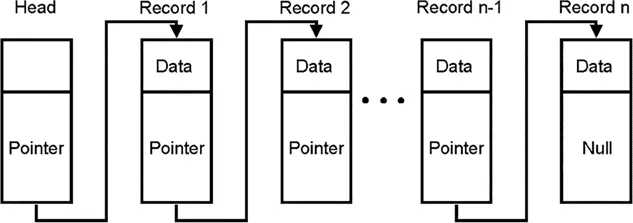
The linked list is a data block that is sequentially connected in order, as shown in Figure 1.1.
A blockchain is essentially a linked list in which each new block contains a hash pointer. The pointer points to the hash of the previous block and all the data it contains. With it, the blockchain has great features that cannot be changed.
So how does the blockchain achieve immutability?
If someone tries to tamper with the data in the block, let’s look at the third feature of the cryptographic hash function: “The effect of subtle changes is that any slight change in the input will have a dramatic impact on the output of the hash function”. So, even if someone tries to rewrite the data in the block subtly, it will also cause a huge change in the hash value of Block 1 stored in Block 2, which will cause changes in the hash value of Block 2. The change, in turn, affects the hash value stored in Block 3. No. 3 affects No. 4, No. 4 affects No. 5…. Eventually, the data on the entire blockchain will change. This way of modifying data by freezing the entire chain is almost impossible. Therefore, the blockchain is considered as immutable.
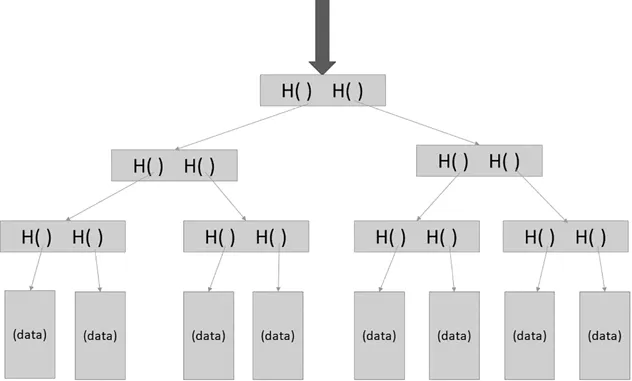
Each block has its own Merkle root. If multiple transactions are included in each block and these transactions are stored linearly, the process of finding a particular transaction in all transactions can become very complicated. That’s why we use the Merkel tree.
As it is shown in Figure 1.2, in the Merkel tree, all individual transactions can be traced back to the same root through a hash algorithm, which makes searching very easy. Therefore, if we want to get a specific data in the block, we can search directly through the hash value in the Merkel tree without linear access.
Mining
The hash algorithm is very important for mining new encrypted blocks, and its working principle is the adjustment of the difficulty value. A random string named “nonce” is added to the hash of the new block and then hashed again. Next, check if it is lower than the set difficulty level. If it is lower, the resulting new block will be added to the chain, and the miner responsible for mining will be rewarded. If it is not lower, then the miner continues to modify the random string “nonce” until the value appears below the difficulty level.
Figure 1.1 Linked List and Hash Pointer Data Structure.
Figure 1.2 Merkel Tree Trace Back Structure.
1.1.2 Key Encryption
Key encryption includes symmetric key encryption and public key encryption.
Symmetric key encryption is an encryption method in cryptography. If you convert one of the numbers, letters, or strings of random letters in the data, the key changes the text or letters in the data in a specific way, such as changing the relative position of the letters (e.g., the word “one” becomes “neo”). As long as the sender and the recipient know the secret key, they can encrypt and decrypt the data and use that data.
Public key encryption, or public key cryptography, also known as asymmetric key cryptography, is another encryption method in cryptography. The biggest feature relative to symmetric key cryptography is that encryption and decryption use different keys. The data obtained by encryption using the encrypted key can only be decrypted by using the decryption key of the user. If you know one of them, you can’t figure out another one. Therefore, if one of the keys is disclosed, it does not harm the other one; that is, the publicly opened key is public key, and the undisclosed key is private key.
In symmetric key cryptography, encryption and decryption use the same key, and perhaps different keys are used for different messages, but they all face the challenge of key management. Since each pair of communicating parties must use a different key than the other group, when the number of network members increases, the number of keys increases quadratically. A more complicated problem here is: how do you create a common key for secure communication when there is no secure channel between the two parties? If you have a channel to create a key securely, why not to use an existing channel. This is really a contraction of the matter who came first? It is just a “chicken or egg contradiction”.
1.1.3 Digital Signature
Digital signatures are the foundation of public key infrastructures (PKIs) and many network security mechanisms (SSL/TLS, virtual private networks, etc.). As it is clear from the name, digital signature is a digitization of ordinary signatures in daily life. The feature of it is that others can easily create signatures, but it is difficult to imitate. Digital signatures can be permanently combined with signed messages and cannot be removed from messages.
A digital signature roughly consists of two algorithms: one is signing using the private key to process the hash value of the message and the other is verification using the public key to verify the authenticity of the signature. Rivest–Shamir–Adleman (RSA) and Digital Signature Algorithm (DSA) are the two most popular digital signature mechanisms.
Let’s imagine in real life, why do we sign, what is the role of signatures, and what are their characteristics?
■ Verifiability: this signature should prove that it is indeed your handwriting.
■ Unforgeability: no one else can forge your signature.
■ Non-repudiation: if you sign your document with your own signature, the validity of the file will not be reclaimed, and you can’t claim that someone else is signing you instead.
However, in real life, no matter how complicated the signature is, there is a possibility of being forged. Because you can’t really verify the validity of a signature with a simple visual aid (such as handwriting identification), it is neither efficient nor reliable.
Cryptography gives us a s...
Table of contents
Cover
Half Title
Title Page
Copyright Page
Table of Contents
Foreword
Preface
Authors
1 What Is Cryptoeconomics?
2 Mechanisms of Consensus
3 Optimized Consensus Mechanism
Trusted by 375,005 students
Access to over 1.5 million titles for a fair monthly price.
Study more efficiently using our study tools.
Frequently asked questions
Yes, you can cancel anytime from the Subscription tab in your account settings on the Perlego website. Your subscription will stay active until the end of your current billing period. Learn how to cancel your subscription
No, books cannot be downloaded as external files, such as PDFs, for use outside of Perlego. However, you can download books within the Perlego app for offline reading on mobile or tablet. Learn how to download books offline
Perlego offers two plans: Essential and Complete
Essential is ideal for learners and professionals who enjoy exploring a wide range of subjects. Access the Essential Library with 800,000+ trusted titles and best-sellers across business, personal growth, and the humanities. Includes unlimited reading time and Standard Read Aloud voice.
Complete: Perfect for advanced learners and researchers needing full, unrestricted access. Unlock 1.5M+ books across hundreds of subjects, including academic and specialized titles. The Complete Plan also includes advanced features like Premium Read Aloud and Research Assistant.
Both plans are available with monthly, semester, or annual billing cycles.
We are an online textbook subscription service, where you can get access to an entire online library for less than the price of a single book per month. With over 1.5 million books across 990+ topics, we’ve got you covered! Learn about our mission
Look out for the read-aloud symbol on your next book to see if you can listen to it. The read-aloud tool reads text aloud for you, highlighting the text as it is being read. You can pause it, speed it up and slow it down. Learn more about Read Aloud
Yes! You can use the Perlego app on both iOS and Android devices to read anytime, anywhere — even offline. Perfect for commutes or when you’re on the go. Please note we cannot support devices running on iOS 13 and Android 7 or earlier. Learn more about using the app
Yes, you can access Cryptoeconomics by Jian Gong,Wei Xu in PDF and/or ePUB format, as well as other popular books in Computer Science & Finance. We have over 1.5 million books available in our catalogue for you to explore.