English Society, 1580-1680 paints a fascinating picture of society and rural change in the late sixteenth and early seventeenth centuries. Keith Wrightson discusses both the enduring characteristics of society as well as the course of social change, and emphasizes the wide variation in experience between different social groups and local communities. This is an excellent interpretation of English society, its continuity and its change.
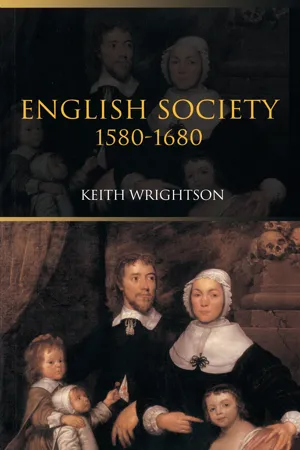
- 288 pages
- English
- ePUB (mobile friendly)
- Available on iOS & Android
eBook - ePub
English Society 1580–1680
Part One
Enduring structures
1 Degrees of people
When sixteenth- and seventeenth-century Englishmen set out to describe their society, they began by making distinctions, by classifying and ranking. ‘We in England,’ commenced William Harrison in 1577, ‘divide our people commonlie into foure sorts.’ A century later the curate of the Kent parish of Goodnestone-next-Wingham, in listing the local population, automatically divided the householders into five social categories.1 This mental habit, of which many more examples could be cited, is of the first significance. It bears witness to the fact that the most fundamental structural characteristic of English society was its high degree of stratification, its distinctive and all-pervasive system of social inequality.
The reality of inequality was displayed everywhere. Massive and very visible distinctions of wealth and living standards impressed themselves on the casual observer who travelled the countryside or walked the streets of the towns. Hierarchical distinctions of status were reflected in styles of address. Rank and power were recognized in dress, in the conventions of comportment which governed face-to-face contacts between superiors and inferiors, in the order in which seats were taken in church, in the arrangement of places at table and in the ordering of public processions. Order, degree, rank and hierarchy seemed self-evident, even natural.
That English society was highly stratified and that such stratification reflected major differentials in the social distribution of wealth, status and power, all historians of the period would agree. Their disagreements derive from their different conceptions of the relative importance of the actual criteria upon which social stratification was based and their varying interpretations of the nature of the relationships between individuals and social groups of different rank. Was English society, as some would assert, essentially a hierarchy of status, based upon the estimation accorded to different social functions, or was it, as others would argue, a hierarchy founded upon the possession of wealth? How far did relative position in this hierarchy affect the experience and opportunities of individuals? Were relationships between people of different social position characterized by vertical ties of patronage and clientage, or by the animosities generated by horizontal class solidarities?
These questions are fundamental to our understanding of the nature of English society in this period and they are not easily answerable. It is easier for the historian to be aware of the system of social inequality than to generalize about it in more than the shallowest manner. Once familiar with the records of the period we can more readily feel its force, almost intuitively, than analyse its characteristics with real precision. Yet such an analysis must be made. In attempting it, we must take care to steer between on the one hand, an uncritical acceptance of contemporary perceptions of the social order and on the other hand, the forcing of the complex historical realities of the time into conformity with our own, perhaps anachronistic, conceptions of the nature of social inequality. We can best approach the problem by asking first a number of simple questions. What were contemporary ideas about social inequality? What do they reveal about the criteria of evaluation upon which social distinctions were grounded? How far do these ideas conform to what we can discover of the actual distributions of wealth, status and power in society? By answering these questions we may arrive at a description of the social order which encompasses both contemporary perceptions of its nature and discoverable historical reality. Such a descriptive analysis can provide a firm foundation. The further and ultimately more fascinating and significant questions of the influence of social position upon the life experience of individuals, and the relationships between social groups can then be pursued as we go on to explore social behaviour and the dynamics of social change in later chapters. For the moment it is enough to begin by establishing the structure of inequality itself, the distinctions which existed between what Harrison called ‘degrees of people’.
Perceptions of the social order
It is a commonplace to assert that sixteenth- and seventeenth-century Englishmen were deeply preoccupied with the problems of order and degree. In their most elevated discussions of the nature of the universe they envisaged a ‘great chain of being’ stretching down from the deity to the very elements, in which each creature, each created thing, had its appointed place. In their accounts of the ‘tree of the commonwealth’ or the ‘body politic’, they presented society as an organism of functionally interdependent, though unequal, parts. Such accounts of society were at once an explanation of social inequality and a scheme of values. They portrayed society as it ought to be, providing a prescription for an ideal harmony in social relations. The scheme of social order thus propounded was the conventional bombast of sermons and homilies, of proclamations and of preambles to statutes. That it was platitudinous is not to say that it was not employed with sincerity often enough, but even its most enthusiastic protagonists knew very well that it was an ideal, an aspiration.
In trying to describe society as it was, or rather as it seemed to them to be (for systematic social investigation was to await a later age) contemporary writers came down to earth more firmly. They invariably put forward a scheme of ranks or degrees, of hierarchically arranged social categories which were intended to simplify the complexity of reality and clearly distinguish the principal social groups. The nature of the actual ranking frequently varied, usually in accordance with the principal concerns of the writer (in general sixteenth-century writers were primarily interested in the polity; those of the seventeenth century gradually turned their attention to questions of national resources and manpower). Despite these variations, however, contemporary analyses of the social order usually have at least two features in common. By and large they present accounts of what is recognizably the same society, though with different degrees of detail and clarity. Again, they tend to show an overlap, even a confusion between different criteria of social rank. The broad structure of society emerges clearly enough, yet the social order was also far too complex to be anatomized in terms of any single criterion. It had burst through the constraints of traditional classifications into functional ‘orders’ and only with difficulty could its component parts be adequately defined.
William Harrison’s scheme of society can provide an example.2 Of the four ‘degrees of people’ distinguished by Harrison, the first degree consisted of gentlemen. Though internally differentiated into the titular nobility, knights, esquires and ‘last of all they that are simplie called gentlemen’, this group was defined in general as ‘those whome their race and blood or at least their vertues doo make noble and knowne’. Next in Harrison’s scheme came the citizens and burgesses of England’s cities, a group defined by their occupations and by their possession of the freedom of their cities. Third came the yeomen of the countryside, defined either as freeholders of land to the value of 40s. a year, or as farmers to gentlemen, and further as possessing ‘a certaine preheminence and more estimation’ among the common people. Finally came a category embracing day labourers, poor husbandmen, artificers and servants, people who had ‘neither voice nor authoritie in the common wealthe, but are to be ruled and not to rule other’.
Harrison’s classification is significant, and not untypical in several ways. Its author was confident about the broad structure of society, yet the sharpness of his focus varied considerably. Distinctions of rank within the category of gentlemen were carefully defined, yet below the level of the yeomanry the internal differentiation of the common people was minimized. Indeed, even when dealing with the middling ranks of society, Harrison was curiously silent about, or made only glancing references to, certain groups which did not fit neatly into his classification: notably the professions. Another striking feature of his account is the multiplicity of criteria employed in the allocation of rank. Gentility, as we have seen, was broadly defined in terms of birth and blood. Yet in his account of different degrees of gentlemen Harrison showed himself very aware indeed of the importance of wealth to the establishment and maintenance of station. Knights, for example, were described as being not born, but made; for their valour in war, their service to the monarch in peace, but ‘most commonlie according to their yearelie revenues or abundance of riches, wherewith to mainteine their estates’ at a level appropriate to ‘a knight’s living’ – though he quickly added that not all gentlemen of sufficient wealth were knighted. Again, gentle status itself could be achieved as well as inherited; by obtaining a university degree, by appointment to governmental or military office, or by any man who ‘can live without manuell labour, and thereto is able and will beare the port, charge and countenance of a gentleman’. With these qualifications Harrison passed from the ideal of gentility as an independent condition conferred by blood to its reality as a status dependent upon a compound of occupation, wealth and life-style in addition to and sometimes independent of birth. He also gave frank recognition to the reality of social mobility, to the fact that the social order’s apparent stability was a condition not of stasis, but of dynamic equilibrium.
These features are equally apparent in the account given of lower degrees in the social scale. Citizens and burgesses were distinguished partly by their distinctive occupations, partly by their legal status as possessors of the freedom of their cities, but even more by the fact that they were of sufficient ‘substance to beare office in the same’, while the wealth upon which their civic position depended might enable some of them, in time, to found gentle families. Yeomen bore a status rather than an occupational designation, yet in the final analysis the ‘preheminence’ and ‘estimation’ which they were accorded among countrymen was a product of their wealth and life-style as substantial farmers who were able to ‘live wealthilie, keep good houses and travell to get riches’ and of their essential, though subordinate role in local administration. They too might see their sons set up as gentlemen. Membership of Harrison’s fourth degree depended upon occupation, lack of wealth and virtual exclusion from positions of authority; of their chances of social mobility he said nothing.
Finally, it can be observed that Harrison was concerned only with adult male rank. The status of women and children was assumed to follow that of their husbands and fathers, while the problem of the relative position of such transitional adolescents and young adults as servants and apprentices was not considered.
Both the broad structure of society described by Harrison and the difficulties he experienced in constructing a consistent scheme of classification in the face of numerous competing criteria of rank are equally evident in other social analyses of the period. Sir Thomas Wilson, writing around the year 1600, divided the English people into nobles, citizens, yeomen, artisans and rural labourers. Of these groups, he was primarily concerned with the first, carefully distinguishing the parliamentary peerage from ‘the meaner nobility’ of knights, esquires and gentlemen, and explicitly placing a variety of professional men – lawyers, officers, graduates and middle rank clergymen – among the gentry.3 Only slightly different was the hierarchy of ‘Ranks, Degrees, Titles and Qualifications’ drawn up by Gregory King in 1695 as part of his famous attempt to estimate the state of national resources as they had stood in the year 1688.4 King followed the gradations of gentility from the peerage down to the level of plain gentlemen much as Harrison and Wilson had done (with the addition of baronets, an order created only in 1611). Thereafter, however, he dropped both the usual division between townsmen and countrymen and such status terms as citizen or yeoman, providing instead a simple ladder of occupations. First after the gentry came a mercantile and professional cluster of ‘Persons in offices’, merchants, lawyers and clergymen. Next came freeholders, farmers, ‘Persons in sciences and liberal arts’, shopkeepers and tradesmen, artisans and officers in the forces, and finally, common seamen, ‘labouring people and outservants’, cottagers and paupers, common soldiers and vagrants.
Like Harrison, Wilson and King viewed wealth as an important determinant of social status. Wilson related gradations of status within the gentry to complementary scales of wealth, and further distinguished the ‘great yeomanry’, who aspired to gentility, from ‘yeomen of meaner ability’, on the basis of wealth. King’s ladder of status conformed, to a large extent, to his estimates of the average family income of different social groups, while his fundamental distinction was that between those ‘increasing the wealth of the kingdom’ (that is, those whose incomes exceeded their annual living expenses) and those decreasing national wealth. Nevertheless both also recognized that the social hierarchy could not be reduced simply to a succession of economic categories. Relative wealth, though a necessary, was not a sufficient condition of social standing. While very much aware of the great wealth of some leading citizens, Wilson would not accord them the gentility which he granted professional men. Again, the lesser yeomanry were distinguished from copyholders, who held land from manorial lords, on the basis of their superior mode of land tenure, though Wilson was aware that some copyholders were men of substantial means. Similarly with King, there are more than enough exceptions in detail to the general convergence of status and wealth in his table to make it clear that even at the end of the seventeenth century other criteria of social estimation retained much force. Merchants whose income was equal to or greater than that of many landed gentlemen were nonetheless placed firmly below the gentry. Freeholders ranked higher than farmers. Lesser clergymen came above farmers and tradesmen of equal or superior wealth. Even among those groups ‘decreasing the wealth of the kingdom’, common soldiers and vagrants, whose incomes King reckoned to be superior to those of cottagers and paupers, were placed below them.
Finally, it can be observed that Wilson, like Harrison, frankly recognized the existence of social mobility in English society, though King’s table, by its very nature, provides no information on this issue.
This brief review of three of the best known and most available contemporary descriptions of the social order, which could be expanded by the inclusion of many other similar accounts,5 helps to reinforce a number of points. The broad pattern of society emerges clearly and consistently from Harrison to King, despite variations in detail, disagreements over the exact positions of certain middling groups in society and a general tendency to minimize distinctions at the lower end of the social scale. Again, rank and status emerge as having been far from autonomous conditions. Rather, they were perceived as compounds made up of several elements of social estimation in varying proportions, including (in no particular order of significance) birth, conferred title, wealth and the nature of that wealth, life-style, occupation, form of land tenure, tenure of positions of authority and legal status. Finally, social mobility was recognized as a structural feature of society, an element of dynamism which, in the context of a society acutely conscious of social stratification, served to confirm and highlight rather than to abrogate social distinctions.
The characteristic features of contemporary perceptions of the social order are clear enough. How far did they conform to the discoverable reality?
Wealth, status and power
There was no doubt among contemporary commentators that gentlemen occupied a place of special estimation in the social order. The very term gentlemen’ was employed by them as a group expression, implying a certain homogeneity of social position and identity of interests, perhaps even a collective consciousness, which was attributed to no other single social group – though they might on occasion speak broadly of ‘the common people’, or ‘the poor’. Gentlemen stood apart, and the possession of gentility constituted one of the most fundamental dividing lines in society. At the same time, however, it was recognized that the line dividing gentlemen from the rest in the body of society was a permeable membrane and that the collective identity of gentlemen concealed a considerable degree of internal differentiation. Both features are well confirmed by independent evidence.
In the first place gentlemen as a whole were not a legally defined group in English society. Different degrees of gentility were defined with more or less precision. Thus the peerage of dukes, earls, marquises, viscounts and barons was distinguished by its heritable titles, its favoured position before the law, and its privileged parliamentary status. Lords were born or created by the crown. The order of baronets, on the other hand, enjoyed a heritable title, but had no legal privileges or seats in the House of Lords. Originally created in 1611, baronets technically had to be drawn from families which had been entitled to display arms for at least three generations and to be possessed of lands to the annual value of at least £1000 – a double qualification which in itself is significant. In fact baronetcies were virtually auctioned off under the early Stuart kings. Knights were created by the monarch for service and, more generally, from among those of armigerous family who could afford the accoutrements of a knight: a medieval property qualification which had become meaningless by the seventeenth century. They were in fact sparingly created among crown servants and leading county families under Elizabeth I, more lavishly under her successors. Below the knights in the scale of precedence came esquires, officially including the heirs male and descendants of heirs male of the younger sons of peers; the heirs male of knights; certain office holders (such as Justices of the Peace) who held the title by courtesy; and finally those whose direct male ancestors had held the title by long prescription. Gentlemen were in strict definition the younger sons and brothers of esquires and their heirs male.6 So much for definitions. As to the proportions of gentlemen of different rank, the peerage was always a tiny minority – Sir Thomas Wilson listed sixty-one temporal lords, while in 1688 (after the flood of Stuart creations) Gregory King reckoned that there were 161. The baronetage was originally to be limited to 200 creations, though Stuart financial needs led to something over 400 grants by 1641 and Gregory King estimated that there were 800 baronets in 1688. King also thought that there were 3000 esquires and 12,000 mere gentlemen in the England of his day, though for more precise information on the relative proportions of gentlemen of different degree we do better to rely on detailed county studies. Lancashire on the eve of the civil wars, for example, had seven baronets, six knights, 140 esquires and 641 mere gentlemen. Yorkshire had thirty baronets, seventy knights, 256 esquires and 323 mere gentlemen (though a rather more restricted definition of mere gentility applies in the ca...
Table of contents
- Cover Page
- Half Title page
- Title Page
- Copyright Page
- Dedication
- Contents
- Introduction to the 2003 edition
- Preface
- Introduction
- Enduring structures
- 1 Degrees of people
- 2 Social relations in the local community
- 3 Family formation
- 4 Husbands and wives, parents and children
- The course of social change
- 5 Population and resources
- 6 Order
- 7 Learning and godliness
- Conclusion: nation and locality
- Notes and references
- Further reading
- Index
Trusted by 375,005 students
Access to over 1.5 million titles for a fair monthly price.
Study more efficiently using our study tools.
Frequently asked questions
Yes, you can cancel anytime from the Subscription tab in your account settings on the Perlego website. Your subscription will stay active until the end of your current billing period. Learn how to cancel your subscription
No, books cannot be downloaded as external files, such as PDFs, for use outside of Perlego. However, you can download books within the Perlego app for offline reading on mobile or tablet. Learn how to download books offline
We are an online textbook subscription service, where you can get access to an entire online library for less than the price of a single book per month. With over 1.5 million books across 990+ topics, we’ve got you covered! Learn about our mission
Look out for the read-aloud symbol on your next book to see if you can listen to it. The read-aloud tool reads text aloud for you, highlighting the text as it is being read. You can pause it, speed it up and slow it down. Learn more about Read Aloud
Yes! You can use the Perlego app on both iOS and Android devices to read anytime, anywhere — even offline. Perfect for commutes or when you’re on the go.
Please note we cannot support devices running on iOS 13 and Android 7 or earlier. Learn more about using the app
Please note we cannot support devices running on iOS 13 and Android 7 or earlier. Learn more about using the app
Yes, you can access English Society 1580–1680 by Keith Wrightson in PDF and/or ePUB format, as well as other popular books in History & British History. We have over 1.5 million books available in our catalogue for you to explore.