eBook - ePub
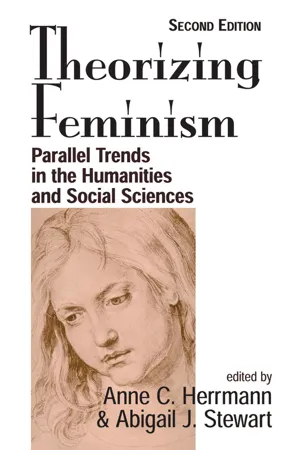
Theorizing Feminism
Parallel Trends In The Humanities And Social Sciences, Second Edition
- 548 pages
- English
- ePUB (mobile friendly)
- Available on iOS & Android
eBook - ePub
Theorizing Feminism
Parallel Trends In The Humanities And Social Sciences, Second Edition
About this book
In the past three decades, feminist scholars have produced an extraordinary rich body of theoretical writing in humanities and social science disciplines. This revised and updated second edition of Theorizing Feminism: Parallel Trends in the Humanities and Social Sciences, is a genuinely interdisciplinary anthology of significant contributions to feminist theory.This timely reader is creatively edited, and contains insightful introductory material. It illuminates the historical development of feminist theory as well as the current state of the field. Emphasizing common themes and interests in the humanities and social sciences, the editors have chosen topics that remain relevant to current debates, reflect the interests of a diverse community of thinkers, and have been central to feminist theory in many disciplines.The contributors include leading figures from the fields of psychology, literary criticism, sociology, philosophy, anthropology, art history, law, and economics. This is the ideal text for any advanced course on interdisciplinary feminist theory, one that fills a long-standing gap in feminist pedagogy.
Information
Part One
Inventing Gender
We begin our discussion of feminist theory by offering four approaches to some of feminism's central questions: What does it mean to be a woman, how is that meaning created, and what difference do these meanings make to feminist analysis? Rosalind Delmar (Chapter 1) differentiates between "woman" and "feminist" by situating her discussion historically, examining the narrative we have inherited from the nineteenth-century women's movement. The Combahee River Collective (Chapter 2) relies on a notion of "identity politics" to issue a statement in the form of a political manifesto about the struggle of the group's members to end their oppression as black feminists. Cherríe Moraga (Chapter 3) exposes the system of interlocking oppressions she faces as a Chicana lesbian in an autobiographical essay that attempts to understand the mother-daughter relationship within the context of Mexican history. Finally, Susan Bickford addresses recent feminist critiques of identity politics and rethinks the notion of a "politicized identity" by examining the subject of feminism as "suffering self" within the language of citizenship and democratic political action. In each case there is an emphasis not just on "feminist" as political subject but also on how the meaning of that subject is produced.
Delmar begins by insisting on the distinction between feminism and the women's movement, a history of ideas and the history of a social movement. Women organizing based on their shared identity as biological women is not the same as making a political choice to advocate feminism based on a shared set of ideas about the meaning of womanhood. Women may share a description of women's oppression and the ideal of emancipation, but they do not necessarily agree on how to analyze that oppression or how to resist it. Whereas the nineteenth-century women's movement sought to reconceive women as a social group rather than as a sex, culminating in female suffrage, a central concern of the women's movement since the 1970s has been to liberate woman as autonomous female subject. The historical shift from human rights to women's rights has meant an increased focus on the female body and its incumbent sexual needs, such as reproductive rights, freedom from sexual harassment and assault, and surrogate motherhood. At the same time, a consideration of female subjectivity has come to include differences among women based on race, class, ethnicity, sexuality, physical disability, religion, and so on. On the one hand, there is confusion between feminism and the women's movement as a diffuse set of activities based on a consensus about the category "woman." On the other hand, feminism is a form of consciousness about women's oppression that eventually forces the issue of multiple identifications.
The emergence in the 1970s of "woman" as a unified category producing a group identity characterized by "sisterhood" relied on an understanding of politics as grounded in identity rather than in conscious choice or political coalition. Identity politics begins with an understanding of personal experience to produce a political consciousness; political action involves organizing with like identities to end one's own oppression. The critique in the 1980s from women of color of a monolithic construction of "woman" as white, middle class, and straight produced efforts to create new understandings of "woman" by articulating, for instance, the position of the "black feminist" or the "Chicana lesbian feminist." At the same time, women of color described their position as providing no access to race or gender privilege. Thus, no single identity can define the category "woman," nor can the abolition of a single system of oppression liberate all women. This formulation of "simultaneous oppressions" is one of the most lasting contributions of the Combahee River Collective's Statement.
Moraga reveals her indebtedness to the collective, but she nevertheless singles out compulsory heterosexuality as the system of oppression most responsible for maintaining gender inequality within racial and ethnic groups. Through a recuperation of the figure of Malinche, who betrayed the Aztecs to the Spanish colonizers, Moraga portrays herself as a biracial lesbian potentially disloyal to both family and nation. As the daughter of an Anglo father and a Chicana mother, Moraga questions the one category the Combahee River Collective leaves unquestioned—namely race, by "passing" as white. As a lesbian, she puts at issue the unquestioned solidarity women have with men of their own race by invoking the desire she feels for other women, including white women. Her autobiographical discourse allows for an understanding of identity not only in terms of simultaneous oppressions but also in terms of the divisions within oppressed groups. These internal divisions must be contained in order to maintain the unity of the collective, divisions that in the case of both the Combahee River Collective and Moraga can be resolved only through writing in the first person. The role of same-sex desire in a single-sex setting such as the women's movement is most often raised in relationship to "lesbian separatism." "Separatism" invokes as specter the return of a unified notion of woman. As a fear that is rarely if ever based in reality, it could be said to exist as part of feminism's "unconscious."
The notion of identity politics has recently come under attack by feminist theorists who see it as producing a "suffering self" invested in its own subjection and in speaking about this subjection publicly. These suffering selves not only resist forms of collectivity but actually reinforce normalizing forms of power by demanding state protection. Bickford intervenes in this discussion by suggesting that "who I am" and "what I want for us" are not mutually exclusive questions. Without requiring a recommitment to a common political purpose, political identities form coalitions with other identities by means of speaking and listening. She insists on the importance of recognizing "suffering" as one of the languages of citizenship. This language requires in turn "political listening," practitioners of which could hear the claim of victimhood not as an expression of individual suffering but as a response to an exercise of unjust power. The question then becomes what conception of citizenship is being invoked.
The next two essays emerge from the disciplines of psychology and literary criticism even as they borrow from each other's theoretical paradigms and use examples not central to their disciplinary discourses—therapeutic practices and Harlequin novels, respectively. Rachel T. Hare-Mustin and Jeanne Marecek (Chapter 5) use literary theory in the form of Derridean deconstructlon to consider the meanings marginalized by psychotherapy; Leslie W. Rabine (Chapter 6) borrows from Nancy Chodorow's theory of psychological development to understand the romantic heroine. In both cases an epistemologlcal framework from one discipline enables a radical rethinking of notions of sexual difference In the other discipline by focusing on how gender Is theorized rather than on what gender means within a particular disciplinary context. For the psychologist, the deconstruction of a notion of "family harmony" enables psychological facts to be read as representations, produced by clients through reconstructed memories told by means of narrative conventions interpreted by the therapist. The literary critic places the formulaic narratives of romance fictions within the context of social facts about the entrance of women into the workplace and the profit margins of Harlequin Romances as publishing conglomerate. By relying on a feminine character structure distinguished from a masculine one by its investment in connectedness, Harlequins provide both a fantasy escape from and an eroticized compliance to low-paid clerical work. In the first case, deconstruction mediates between two ways of conceptualizing sexual difference in psychological research—alpha bias (exaggerating sexual difference) and beta bias (ignoring sexual differences)—by focusing on how relations to language and power construct our understanding of men and women. In the second case, psychological theory enables an understanding of how the marketable formula of Harlequins creates a heroine who seeks to have her feminine self recognized by the hero and to make a home for that self in the work world, even as it neutralizes these aspirations by providing only fictional solutions.
What difference does it make that a paradigm has been borrowed from another discipline? In each case it reveals the limitations of a feminist practice that already knows what gender means, in contrast to understanding how gender is produced. In both of these essays, Chodorow's theory of a feminine self as embedded in connectedness is put into question by refocusing on its historical origins in Western industrial capitalism. On the one hand, this reminds psychologists of the dangers of universalizing a particular structure of the feminine self; on the other hand, it enables literary critics to understand the wide appeal of romance novels as both individually consoling and socially productive. The fact that Hare-Mustin and Marecek accept an assumption of postmodernism and say that truth is what we agree on, and that Rabine recognizes forms of intense identification with static literary structures, suggests that the mutual influence of the humanities and social sciences is not only possible but also critical for feminist theorizing.
Defining Feminism and Feminist Theory
1
What Is Feminism?
There are many, feminist and non-feminist alike, for whom the question 'what is feminism?' has little meaning. The content of terms like 'feminism' and 'feminist' seems self-evident, something that can be taken for granted. By now, it seems to me, the assumption that the meaning of feminism is 'obvious' needs to be challenged. It has become an obstacle to understanding feminism, in its diversity and in its differences, and in its specificity as well.1
It is certainly possible to construct a base-line definition of feminism and the feminist which can be shared by feminists and non-feminists. Many would agree that at the very least a feminist is someone who holds that women suffer discrimination because of their sex, that they have specific needs which remain negated and unsatisfied, and that the satisfaction of these needs would require a radical change (some would say a revolution even) in the social, economic and political order. But beyond that, things immediately become more complicated.
For example, popular approaches to feminism often contain references to a style of dress, to looks, to ways of behaving to men and women, to what used to be called 'manners'. It is, in practice, impossible to discuss feminism without discussing the image of feminism and the feminists. Feminists play and have played with a range of choices in the process of self-presentation, registering a relation both to the body and to the social meaning of womanhood. Various, sometimes competing, images of the feminist are thus produced, and these acquire their own social meanings. This is important to stress now because in contemporary feminism the construction of new images is a conscious process. There is a strand whose central concern is to investigate culture (in its widest sense) and to experiment with the means of representation. But feminism's wish that women behave differently is also an historic element: Mary Wollstonecraft at the end of the eighteenth century called for 'a revolution in female manners'.
The diversity of representations of the feminist has undoubtedly grown since then. How difficult it would be to choose between them, to find the 'true' feminist image, the 'proper way' to be a feminist. And yet many books on feminism are written, and feminism is often spoken about, as if there were a 'true' and authentic feminism, unified and consistent over time and in any one place, even if fragmented in its origins and at specific historical moments.
Most people have heard a sentence which begins: 'As a feminist I think... .' It is a sentence which speaks of a wish that an agreed way of being a feminist should exist, but is not the product of any genuine agreement among feminists about what they think or how they should live their lives. In the women's movement, there is a strong desire to pin feminism down (whether as support for a series of agreed demands or as preoccupation with central concerns like sexual division or male domination) but this impulse has invariably encountered obstacles. General agreement about the situation in which women find themselves has not been accompanied by any shared understanding of why this state of affairs should exist or what could be done about it. Indeed, the history of the women's movement in the 1970s, a time of apparent unity, was marked by bitter, at times virulent, internal disputes over what it was possible or permissible for a feminist to do, say, think, or feel.
The fragmentation of contemporary feminism bears ample witness to the impossibility of constructing modern feminism as a simple unity in the present or of arriving at a shared feminist definition of feminism. Such differing explanations, such a variety of emphases in practical campaigns, such widely varying interpretations of their results have emerged, that it now makes more sense to speak of a plurality of feminisms than of one.
Recently the different meanings of feminism for different feminists have manifested themselves as a sort of sclerosis of the movement, segments of which have become separated from and hardened against each other. Instead of internal dialogue there is a naming of the parts: there are radical feminists, socialist feminists, marxist feminists, lesbian separatists, women of colour, and so on, each group with its own carefully preserved sense of identity. Each for itself is the only worthwhile feminism; others are ignored except to be criticized.
How much does this matter? Is it not the case that even extreme differences in politics can often mask underlying agreement? Could it not still be that what unites feminists is greater than what divides? Might not current fragmentation be merely an episode in an overriding histor...
Table of contents
- Cover
- Half Title
- Title
- Copyright
- Contents
- Credits
- Reading Feminist Theories: Collaborating Across Disciplines
- Part One: Inventing Gender
- Part Two: Sex, Sexuality, and Gender
- Part Three: Gender, Race, and Class
- Part Four: Questioning Feminisms
Trusted by 375,005 students
Access to over 1.5 million titles for a fair monthly price.
Study more efficiently using our study tools.
Frequently asked questions
Yes, you can cancel anytime from the Subscription tab in your account settings on the Perlego website. Your subscription will stay active until the end of your current billing period. Learn how to cancel your subscription
No, books cannot be downloaded as external files, such as PDFs, for use outside of Perlego. However, you can download books within the Perlego app for offline reading on mobile or tablet. Learn how to download books offline
Perlego offers two plans: Essential and Complete
- Essential is ideal for learners and professionals who enjoy exploring a wide range of subjects. Access the Essential Library with 800,000+ trusted titles and best-sellers across business, personal growth, and the humanities. Includes unlimited reading time and Standard Read Aloud voice.
- Complete: Perfect for advanced learners and researchers needing full, unrestricted access. Unlock 1.5M+ books across hundreds of subjects, including academic and specialized titles. The Complete Plan also includes advanced features like Premium Read Aloud and Research Assistant.
We are an online textbook subscription service, where you can get access to an entire online library for less than the price of a single book per month. With over 1.5 million books across 990+ topics, we’ve got you covered! Learn about our mission
Look out for the read-aloud symbol on your next book to see if you can listen to it. The read-aloud tool reads text aloud for you, highlighting the text as it is being read. You can pause it, speed it up and slow it down. Learn more about Read Aloud
Yes! You can use the Perlego app on both iOS and Android devices to read anytime, anywhere — even offline. Perfect for commutes or when you’re on the go.
Please note we cannot support devices running on iOS 13 and Android 7 or earlier. Learn more about using the app
Please note we cannot support devices running on iOS 13 and Android 7 or earlier. Learn more about using the app
Yes, you can access Theorizing Feminism by Anne C. Herrmann,Abigail J. Stewart in PDF and/or ePUB format, as well as other popular books in Social Sciences & Feminist Literary Criticism. We have over 1.5 million books available in our catalogue for you to explore.