![]()
Part I
General
![]()
1
Introduction
Owing to their positive features and various applications, the planetary gear trains (PGTs) are nowadays increasingly widely used in the different fields of engineering and in particular in the mechanical engineering sector:
In both the largest and the smallest powers, such as powerful ship reducers or multipliers in wind turbines, as well as in miniature clock mechanisms.
Also for the largest and smallest speed ratios.
As gears with the highest efficiency and as gears with the required lowest efficiency, or self-locking.
1.1 Features and Capabilities of PGTs
PGTs have a number of advantages and applications [30, 41, 46, 54, 99, 102, 104, 121, 147, 149, 155, 158, 161, 166, 167, 179, 194, 200, 224, 236, 239, 240, 259].
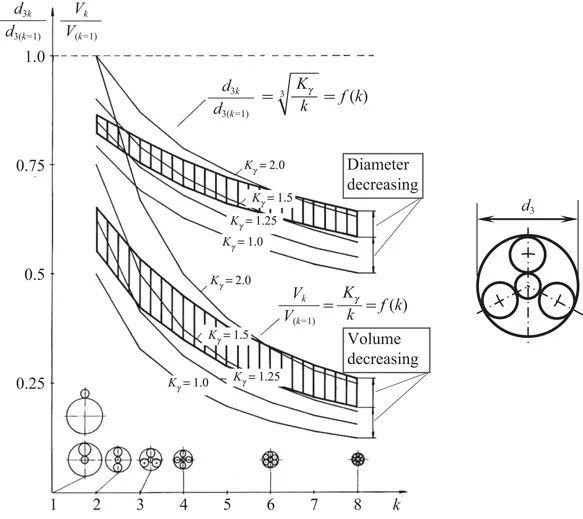
They are distinguished for being very compact; i.e., they have small dimensions and low weight—two to three (5) times lower than the common non-planetary gear trains thanks to the adoption of the multi-flow principle; i.e., several planets are used to split the power flow. The diminished dimensions (Figure 1.1) have a number of beneficial consequences:
Reduced material consumption and a light construction, respectively.
A small mass moment of inertia, important for fast-paced drives.
The diminished dimensions of the gears allow for both heat treatment and achieving higher accuracy in their production, which combined with the lower pitch line velocity leads to lower internal dynamic loads and to a quieter operation of the gear train, which is particularly important nowadays.
Due to their compactness, the required smaller gear train bearer is important in some cases. Especially for lifting equipment, such as bridge cranes, this accounts for a substantial lightening, not only for the trolley but also for the entire construction, and hence reduction in the price.
Another substantial advantage is the very high efficiency of some PGTs and vice versa—the possibility of self-locking when efficiency is low.
The coaxiality of the input and output shaft also has advantages in some cases (e.g., vehicles, wind turbines, and aircraft engines).
The PGTs allow for the rational solution of a number of problems in the area of machine drives. They offer new layout possibilities that do not exist with the other types of non-planetary gear trains. They are used as follows:
FIGURE 1.1
Constructive volume V and diameter d3 of the planetary gears depending on the number of the planets k and mesh load factor Kγ (the uneven distribution of the load between planets is taken into account; see Chapter 8.)
Gear trains, both with F = 1 and with F = 2 degrees of freedom
Reducers or multipliers
Differentials, i.e., power division or power summing gear trains
A part of systems to make a stepless change of the angular velocity
Change-gears (gearboxes) in vehicles—cars, buses, tugboats, tractors, tanks, etc.
Reversing gears in ships, locomotives, etc.
1.2 Difficulties in Using PGTs
The application of the PGTs despite the advantages has, on the other hand, some shortcomings and difficulties.
Their theory is more complex than the one of the non-planetary gear trains. These are the processes that run inside the train, and hence problems such as differentiating the types of internal power—absolute, coupling, and relative (rolling) power (see Chapter 10), internal division and internal circulation of power, and load sharing between planets. These processes, especially in the complex compound planetary gears, are not so clear and easy to understand and have contributed to the reputation of PGTs as something complicated and difficult to understand. Some unsuccessful technical solutions and failures, apropos, have also contributed to this reputation. This leads to the difficulties with the accurate determination of the loads as a prerequisite for the proper calculation of the gear train elements, and the difficulties with the correct determination of efficiency, which is crucial for some cases. All in all, the theory and practice of planetary gears have quite a lot of “pitfalls.”
The great compactness of PGTs, which is itself a considerable advantage, otherwise may mean a reduced cooling surface, which in some cases leads to difficulties in heat removal and complicated and costly arrangement due to forced...