eBook - ePub
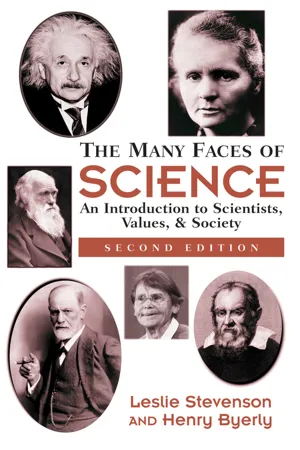
The Many Faces Of Science
An Introduction To Scientists, Values, And Society
- 288 pages
- English
- ePUB (mobile friendly)
- Available on iOS & Android
eBook - ePub
The Many Faces Of Science
An Introduction To Scientists, Values, And Society
About this book
In The Many Faces of Science, Leslie Stevenson and Henry Byerly masterfully, and painlessly, provide the information and the philosophical reflections students need to gain an understanding of the institution of modern science and its increasing impact on our lives and cultures. In this second edition, the authors update topics they explored in the first edition, and present new case studies on subjects such as HIV and AIDS, women in science, and work done in psychology and the social sciences. The authors also extend their discussion of science and values, in addition to revising their study of science and technology, to emphasize changes in scientific practice today. Accessible and rich with case studies, anecdotes, personal asides, and keen insight, The Many Faces of Science is the ideal interdisciplinary introduction for nonscientists and scientists in courses on science studies, science and society, and science and human values. It will also prove useful as supplementary reading in courses on science and philosophy, sociology, and political science.
Information
1 How Science as We Know It Has Developed
The term science is often used in a broad and rather vague sense. To bolster the credibility of claims for a product, advertisements speak of what "science" has shown or what "scientists" say. These words, along with the adjective scientific, are now generally used as honorific terms that express intellectual authority and indicate some especially trustworthy way of justifying beliefs. These days we are all expected to accept this, even if we know little or nothing about the theory and practice of science. Occasionally, and perhaps increasingly, voices are heard suggesting that all is not well with orthodox science, that it either ignores or is less than perfectly objective in regards to important and interesting phenomena such as ESP and alternative medicine and that it is subservient to the interests of big business in studying, for example, environmental pollution. And for a long time, some have held the plausible view that science cannot by its nature deal with certain vital human concerns (for example, personal relationships, moral values, and religious faith). But for the most part, scientists, scientific theories, and scientific method retain a special authority in our culture.
Much has been written about the epistemology of science, examining and sometimes questioning the nature of its special intellectual authority (see certain radical philosophers and sociologists of science, such as Feyerabend [1978], Bloor [1976], and Woolgar [1988]). Rather more often, philosophers of science have defended its privileged status of credibility (for example, Popper [1963], Hempel [1966], and Newton-Smith [1981]), even if they admit that articulating the distinctive characteristics of scientific method in an exact but general philosophical account is a difficult task. This book will not attempt to tread this well-trodden ground once more, but we cannot avoid saying something at the outset about what we take science to be, before we go on to explore how it has been pursued and applied by various scientists in different social contexts.
1.1 What Is Science?
What is the aim of science? One short answer is truth. But what kind of truths do scientists seek, and how and why do they seek them? To get clearer on what science is, let us start with what it is not. Science is not simply technology; it does not consist in the invention of devices, such as those that the twentieth century has brought us: radios, TVs, VCRs, computers, airplanes, antibiotics, lasers, CAT scans, and nuclear weapons. Technology (from technē, "craft") originally meant systematic knowledge of a craft such as glassblowing or pottery; it is the application of knowledge for practical purposes, to make things and achieve humanly useful results. High tech applies scientific knowledge and plays an increasing role in doing scientific research. But in a broad sense, technology includes the use of fire and stone axes and thus antedates science. Unlike science, moreover, technology is common in some form to every human culture that has ever existed. Only since the late nineteenth century has technology become closely tied to science. Nowadays they are so closely associated that people often speak of science-and-technology in one breath.
The traditional concern of science is "knowing that, the knowledge of truths, as opposed to "knowing how," the knowledge of techniques. Admittedly, these two kinds of knowing have become more closely interconnected, particularly in recent times. In early science, technological needs, especially for weapons of war, spurred scientific inquiry. Today theoretical knowledge is a necessary basis for many technologies. Technology needs science and science needs technology. Research scientists require experimental know-how and today often use elaborate and expensive technologies to test their theories. Nevertheless, we can still distinguish the goal of "pure" science—which aims to understand some aspect of the world—from that of "applied" science—which is used to change the world in some humanly beneficial way. Of course, some scientists may pursue research of both kinds at different times or may even have both aims in mind in a single project (as we shall see later).
What sort of truths, then, does pure science seek? Science is not merely the collection of observations or data; it is the development and testing of hypotheses, theories, and models that interpret and explain the data. As we have come to recognize it today science is primarily the attempt to understand the workings of nature by means of general theories. Scientific theories usually involve hypotheses about unobserved entities or processes that may be in principle imperceptible because they are too large, too small, or simply not the sort of things that human sense organs can detect (distant galaxies, the Big Bang origin of the universe, molecules, atoms and subatomic particles, magnetic fields, genes, the evolution of species, and so on). Theories about such things aim to explain what we can observe more directly, and they must be confirmed or disconfirmed according to their success in doing so.
Historically, these features can first be clearly recognized in seventeenth-century physics, Isaac Newton's theory of mechanics being the paradigm case. The term modern science is often used to refer to science since that time. And it must be emphasized that science is a dynamic process: Theories can always be rejected, modified, or extended. A static collection of theories would be dead science. So, in trying to understand the "game of science," we should focus not so much on particular results—the theories that scientists accept at any given time—but on the way the game is played, the rules that govern it, what the goals are, and what consequences can be expected. We shall examine the scientific approach to questions as a critical attitude toward testing propositions and acquiring knowledge, rather than thinking of science as a collection of facts or established beliefs.
The scientific attitude is one that almost everyone takes at some time—perhaps especially during childhood when we persistently ask "why?" and "how?" But as a steadfast, persevering approach to problems, the critical scientific approach is not common—in fact, it even appears to be not entirely natural as a matter of human psychology. American philosopher Charles Peirce (1839-1914) argued that doubt is central to the scientific mind-set, whereas most people usually try to avoid doubt because it is unsettling, even painful. In "The Fixation of Belief" (1877), he wrote that people have tended to follow "the way of tenacity" (sticking to previously formed beliefs) or "the way of authority" (letting the burden of fixing beliefs fall on someone else). The revolt against doctrines dictated by religious, political, and classical academic authorities was an important component in the rise of modern science.
English philosopher Bertrand Russell (1872-1970) emphasized in I lis many works on science that it is not what a scientist believes that distinguishes him but why he believes it. Scientific claims are based (somehow) on evidence as opposed to authority. This critical attitude of science is encapsulated by Karl Popper's phrase "conjectures and refutations." Scientists make hypotheses, which then must meet stringent criticism in the form of observational or experimental testing. Logically, the generality of scientific theories, their goal of stating universal laws, makes them in principle open to falsification by even a single counterinstance. (In practice, disconfirmation of theories is a complex affair.) Likewise, scientific claims must meet standards of quantitative precision that make them readily testable and hence falsifiable. Predicting that an earthquake of a specific magnitude will strike Los Angeles on January 1, 2005, is a stronger test than predicting that an earthquake will strike somewhere in California in the next decade. And since it is not clear what could possibly falsify a fortune-teller's vague prediction that next week is a good one tor making decisions, such a claim has no scientific status.
A claim does not become scientific simply by virtue of being true. Even if some of the purported astrological correlations between certain positions of the planets and characteristics of persons born under them were to hold up under investigation, astrology would not thereby become science if its central theoretical claims of causal influence between heavenly and human phenomena were not also subjected to critical scrutiny. A mere summary of observed data, however accurate, is not a scientific theory. Conversely, there are many scientific theories of the past, some of which we may still respect as well justified by the evidence available in their time, that we do not now accept. Of course, if we now think a claim is false, we can no longer describe it as knowledge. But the way in which the original hypothesis was formulated and tested might remain an example of good scientific practice (as might be claimed for Ptolemaic astronomy—see Chapter 4—or the phlogiston theory of combustion—see 5.3).
A special kind of thought process is required to conceive of the very idea of a controlled experiment, which is so basic to scientific research. The following anecdote illustrates this:
It was a good answer that was made by one who when they showed him hanging in a temple a picture of those who had paid their vows as having escaped shipwreck, and would have him say whether he did not now acknowledge the power of the gods,—"Aye," asked he again, "But where are they painted that were drowned after their vows?" And such is the way of all superstition, whether in astrology, dreams, omens, divine judgments, or the like
(Bacon 1870, vol. 4, 56)
The point is, of course, that a number of successes following a certain course of action does not prove anything unless it is compared with the number of failures. If a certain therapy has apparently worked for many people, we are easily impressed and tend to forget to ask how many people recover from such conditions without any treatment at all or with other sorts of therapy—or indeed, how many people have been made worse by the method in question. Looking at the "control" group seems less natural, and this step is easily neglected. Psychologists have devised subtle tests to show the human tendency to recognize confirmations rather than disconfirmations of hypotheses. Such bias is retained even by trained scientists when they react intuitively, without reflection, and they have to guard against it. This is especially important when the observers themselves may have strong hopes of finding positive results, for example, in investigating extrasensory perception or the claimed success rate of medical treatments (whether scientific or alternative"). This is the rationale for the careful testing of proposed new drugs.
Adherents of doctrines that are suspect sometimes use the label scientific" in an attempt to appear more credible—for example, scientific creationism or scientific astrology. It is vital to understand how to distinguish science from pseudoscience. Physicist Paul Davies, when asked why he found it "comparatively easy to believe in evaporating black holes and invisible cosmic matter, but not in straightforward things like ghosts and flying saucers that ordinary people see all the time," offered two basic criteria: (1) Scientists, unlike cranks, try to relate their work to existing science, and (2) if a theory differs from accepted views, scientists try to deduce novel predictions by which their hypotheses can be observationally tested (1993, 68). Orthodox science is not infallible, and it can never be complete, but any additions or subtractions must ultimately be justified by observation.
Scientists really want to know and to know really. Admittedly, they can't operate without presuppositions, theoretical ideas, and even intuitions. They shape and reshape the questions. But they must have a willingness ultimately to "let nature decide" the answers to their questions. The scientist proposes, but nature disposes. How in detail this works— the logic, methodology, and epistemology of it all—turns out to be very complex and remains controversial, as recent work in the philosophy of science abundantly illustrates. (See Suggestions for Further Reading at the end of this chapter.)
1.2 The Rise of Modern Science
The emergence of modern science appears as something of a miracle when we consider the complex of factors that seem to have been required for it to get started. Unlike technology, science has not been present at every stage of human history or in every cultural tradition. Chinese civilization, for example, has had a rich history in many areas of endeavor. Chinese technology was in some respects more highly developed than that of Europe until the sixteenth century, and it provided some of the keys to European dominance of the rest of the world since then: gunpowder, the magnetic compass, and paper for printing. But science never really developed in China until it was introduced from Western Europe. In a famous letter in which he responded to the question of why science developed in the West and not in China, Albert Einstein remarked: "It is not surprising that science did not arise in other civilizations; it is surprising that it ever arose at all" (quoted in Price 1962, 15).
The beginnings of the scientific tradition can be traced back to ancient Greek philosophers of nature starting with Thales (ca. 600 B.C.). But it is fair to say that science first flourished only with the rise of the new physics in Western Europe in the seventeenth century beginning with Galileo Galilei and Johannes Kepler and coming into full flower with Newtonian mechanics. This emergence of the scientific tradition is a major component of the modern age, in the historian's sense of the term modern. To get some insight into the nature of science and its relation to culture, let us consider some of the historical features of the epoch leading up to the rise of modern science in the seventeenth century. Even a brief sketch of the major causes that have been suggested for the emergence of science shows the complexity of this development. The historical influences are so interwoven that it is difficult to assign priority. Debate continues among historians on whether advances in technology stimulated development of scientific theory or whether it was science that first sparked the invention of new technology; in fact, a complex interplay seems to have existed between science and technology in both directions. We can list the following six major factors, without trying to point to any one of them as "the basic cause" of the rise of modern science.
1. The resurgence of Greek culture. The fall of Constantinople (now known as Istanbul) to the Turks in 1453 is often cited as a turning point of the Renaissance. A flood of refugee scholars into Italy brought to Europe many works of philosophy mathematics, and astronomy that had been written by the ancient Greeks nearly two millennia earlier. Knowledge of Euclid, Archimedes, and hitherto unknown works of Aristotle and Plato stimulated a rebirth of "natural philosophy" (as scientific inquiry was then called). Arabic scholars, especially those working on the border of the Christian and Moslem worlds in Spain, were also a vital source for the recovery of the works of the ancient world by the West.
2. The invention of the printing press. Johannes Gutenberg s Latin edition of the Bible appeared in 1455. Printing spread rapidly in the late fifteenth century, making possible the communication required for rapid progress in science. The printer was a prototype of the early capitalist; printing was one of the first examples of mass production, and an effective print shop required considerable capital expenditure. A necessary condition for the early technology of printing was a phonetic alphabet, which may help explain why science did not develop first in China. Cultural critic Marshall Mcl.uhan (1962) even suggested that a phonetic ...
Table of contents
- Cover
- Half Title
- Title
- Copyright
- Contents
- Preface
- Preface to the Second Edition
- Introduction
- 1 How Science as We Know It Has Developed
- 2 Images of Science
- 3 What Motivates Scientists?
- 4 Intellectual Curiosity: Mathematical Patterns in Nature
- 5 Intellectual Curiosity: Experiment
- 6 Scientific Reputation, Scientific Influence, and Public Fame
- 7 The Utility of Science
- 8 Science and Money
- 9 Scientists and the Totalitarian State
- 10 Scientists and Public Policy
- 11 Science Applied to Human Beings
- 12 Science and Values
- References
- Index
Trusted by 375,005 students
Access to over 1.5 million titles for a fair monthly price.
Study more efficiently using our study tools.
Frequently asked questions
Yes, you can cancel anytime from the Subscription tab in your account settings on the Perlego website. Your subscription will stay active until the end of your current billing period. Learn how to cancel your subscription
No, books cannot be downloaded as external files, such as PDFs, for use outside of Perlego. However, you can download books within the Perlego app for offline reading on mobile or tablet. Learn how to download books offline
Perlego offers two plans: Essential and Complete
- Essential is ideal for learners and professionals who enjoy exploring a wide range of subjects. Access the Essential Library with 800,000+ trusted titles and best-sellers across business, personal growth, and the humanities. Includes unlimited reading time and Standard Read Aloud voice.
- Complete: Perfect for advanced learners and researchers needing full, unrestricted access. Unlock 1.5M+ books across hundreds of subjects, including academic and specialized titles. The Complete Plan also includes advanced features like Premium Read Aloud and Research Assistant.
We are an online textbook subscription service, where you can get access to an entire online library for less than the price of a single book per month. With over 1.5 million books across 990+ topics, we’ve got you covered! Learn about our mission
Look out for the read-aloud symbol on your next book to see if you can listen to it. The read-aloud tool reads text aloud for you, highlighting the text as it is being read. You can pause it, speed it up and slow it down. Learn more about Read Aloud
Yes! You can use the Perlego app on both iOS and Android devices to read anytime, anywhere — even offline. Perfect for commutes or when you’re on the go.
Please note we cannot support devices running on iOS 13 and Android 7 or earlier. Learn more about using the app
Please note we cannot support devices running on iOS 13 and Android 7 or earlier. Learn more about using the app
Yes, you can access The Many Faces Of Science by Henry Byerly,Leslie Stevenson in PDF and/or ePUB format, as well as other popular books in Philosophy & Philosophy History & Theory. We have over 1.5 million books available in our catalogue for you to explore.