- 240 pages
- English
- ePUB (mobile friendly)
- Available on iOS & Android
eBook - ePub
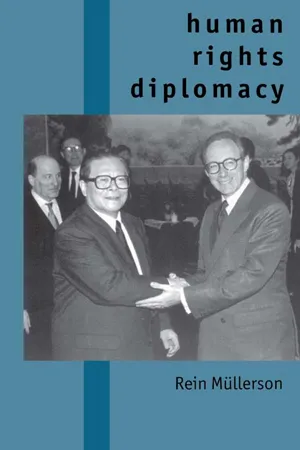
Human Rights Diplomacy
About this book
In this insightful analysis of human rights diplomacy Rein Mullerson examines the way foreign policy instruments are used to promote human rights abroad as well as how human rights issues are used for the sake of other foreign policy aims.
The book explores the relationship between human rights and international stability, the role of non-governmental organisations, the business community and mass media in formulating human rights agendas for governments and inter-governmental organisations. Also addressed are issues such as the universality of human rights in a multi-cultural world and the impact of religious and nationalistic extremism. Rein Mullerson concludes by looking at the role of the UN and other international bodies engaged in the promotion of human rights and how military force can be an option in settling violations
The author argues that it tends to be regimes that are hostile to human rights which in turn cause instability in the international community. Throughout the work it is demonstrated that a concern for human rights is legitimate because of the impact they have on international relations and because of the common bonds that link all people.
Information
1 The raison d’être of human rights diplomacy
Governments, even in democratic countries, are not, and can hardly be expected to act as, human rights organizations. As Louis Henkin writes, ‘state egoism, selfishness, is the hallmark of the international state system…. The occasional reference to mankind is rhetoric; it has no significant normative implications’.1 Governments have to take care of many other interests and, naturally, they have to take care of their own interest in staying in power. Their concern for human rights in other countries is only one, and certainly not the most important, of the imperatives of their foreign policy. Moreover, all too often human rights diplomacy does not fit comfortably with other foreign policy priorities.
Therefore, before turning to issues of efficiency (or inefficiency) and other problems of human rights diplomacy, it is necessary to ask: why should governments, which are, or at least should be, responsible to and before their own people, be at all concerned with human rights in far away places? Why should, for example, the British or French governments think of human rights in East Timor, Bahrain or Chechnya? Why should states create, finance and pay attention to activities of international bodies such as the UN Human Rights Commission, and the so-called ‘treaty-bodies’ which monitor the implementation of various human rights instruments; keep in Geneva the UN Centre for Human Rights; or have several regional human rights bodies?
Human rights issues have become part and parcel of everyday diplomatic discourse, and therefore these questions may seem too obvious to be asked. However, it seems that answers to and reflections on these questions may help to provide new approaches to concerns of practical diplomacy.
This chapter attempts to answer these questions. Starting from a historical point of view I will show that it was the rights and interests of religious and ethnic minorities, with the threat to international security that their violation often brought, which raised the issue of human rights to the international level.
I shall then go on to argue that undemocratic regimes, hostile to human rights, sometimes tend to choose foreign policy options which may threaten international stability; that most serious post-Cold War human rights violations are committed by weak regimes with insufficient legitimacy, with the attendant risk that such regimes may implode, thereby threatening international stability; that business interests may not always be inimical to human rights; that, on the contrary, under certain circumstances it is in the interests of business to support human rights; and that international concern for human rights is legitimate not only because of these links between human rights and international relations, but also because there are common bonds between different peoples and there is a certain meaning in the word ‘humankind’ which induces states to take human rights into consideration in their foreign policy.
FROM CHRISTIANS IN THE OTTOMAN EMPIRE TO MUSLIMS IN EUROPE
An interesting point as to the raison d’être of human rights diplomacy can be made by comparing the genesis of domestic human rights norms with that of international ones. England’s Magna Carta of 1215, the Habeas Corpus Acts and Bill of Rights of 1689; the French Declaration of the Rights of Man and the Citizen of 1789; and the US Declaration of Rights of 1774, are all texts which, with certain qualifications and exclusions dependent on the historical time period, of course, spoke of the rights of human beings generally. In contradistinction to such an approach, which was concerned with the human rights of all individuals, or at least those of all white male Protestant property owners, international concern for human rights started with attention to the rights of only one category of individuals: persons belonging to religious or ethnic minorities.
Reflection on this difference of genesis of domestic and international concern for human rights helps to shed some light on the questions of why states may be interested at all in human rights in other countries, and why human rights and freedoms, which are in principle an issue between the individual and the state, have become an international issue.
International concern with the rights of religious and ethnic minorities was from the very beginning related to the most important issue of international relations – war.2
Armed conflicts are usually divided into international wars and civil wars, though this rather clear-cut normative distinction is becoming now more and more blurred. However, from the point of view of the evolution of international concern for human rights (not only from this point of view of course, but that is what interests us here), wars, or armed conflicts as they are now usually called, can be characterized not only as being of an internal or international nature, but as involving or not involving ethnic or religious issues.
The history of humankind has proven that religion and war, like ethnicity and war, are closely related phenomena. Though there have been various reasons for armed conflicts, many of them could be characterized as religious or ethnic crusades. Religious or ethnic factors may not have always been the real or main cause of some so-called religious or inter-ethnic wars, but they have certainly been an important catalyst in many of them. Therefore it is not surprising that, in order to suppress or limit such armed conflicts, their sources, i.e., religious or ethnic issues, must have been addressed. Similarly, those who wanted to exploit these issues for the sake of their secular or material aims and interests had to fan the flames of religious or ethnic animosity in order to achieve their aims.
Though all international wars may ultimately be considered, at least to a certain extent, as inter-ethnic conflicts, there have been some international wars where ethnic factors have played a prominent role in the genesis of the conflict. For example, the medieval crusades were to a great extent religious wars, and the Thirty Years’ War (1618–48) also had important religious causes as well as consequences. It was caused mainly by the political rivalry between the Catholic and Protestant princes of Germany, as well as by the interests of other powers in Germany. The Treaty of Westphalia, which ended the war, established an important principle – cuius regio, eius religio (literally, ‘whose the region, his the religion’) – with important religious implications.
In the Second World War the Nazis used ethnic arguments as a pretext to attack their neighbours (for example, the claimed necessity to protect ethnic Germans in other countries). In his Proclamation of 15 March 1939 on the German occupation of Bohemia and Moravia, Hitler referred to ‘assaults on the life and liberty of minorities, and the purpose of disarming Czech troops and terrorist bans threatening the lives of minorities’.3 In their genocidal policy the Nazis singled out for extermination and tried to dehumanize certain ethnic groups (Jews, Gypsies and Slavs).
As for civil wars, some, like the American Civil War (1861–65) or the Russian Civil War (1918–20), may not have had any significant inter-ethnic or inter-religious characteristics, while others did, being caused by religious or ethnic factors, waged for the sake of religion or ethnicity and often resulting in outcomes which had religious or ethnic implications.
While many of the medieval domestic conflicts were based on religious differences, (for example the Wars of Religion in France, which started with the massacre of the Huguenots by the troops of the Duc de Guise, and tore France asunder for many years in the second half of the sixteenth century) most current conflicts (for example, in the former Soviet Union, Yugoslavia and in many places in Africa) have their roots in ethnic rivalries and hatred.
These and other internal conflicts with significant religious or ethnic elements, i.e., conflicts which very often originate from the oppression of religious or ethnic minorities, have always considerably affected international relations.
Therefore, it is not accidental and should not be surprising at all that the first international documents purporting to define and protect the rights of certain categories of human beings were treaties on the protection of religious minorities. For example, the Treaty between the King of Hungary and the Prince of Transylvania of 1606 accorded to the Protestant minority in Transylvania free exercise of its religion.4 Again, one of the most famous treaties of that time – the Treaty of Westphalia, concluded in 1648 between France and the Holy Roman Empire and their respective allies – granted religious freedom to the Protestants in Germany in terms of equality with Roman Catholics.5 At approximately the same time, the European powers started to conclude treaties with the Ottoman Empire in order to protect their respective religious minorities. Article 7 of the Austro–Ottoman Treaty of 1615 purported to protect Christians in the Ottoman Empire,6 where European countries intervened more than once in order to guarantee the rights of its Christian subjects. For example, in 1827 England, France and Russia used armed force in order to assist Greek Christian insurgents;7 and in 1860–61 French troops occupied parts of Syria to protect Maronite Christians against massacre by the Turks.8
After the First World War a system of treaties aimed at the protection of ethnic minorities in some European countries came into being under the aegis of the League of Nations. Here also the raison d’être of these efforts was the link between the rights and interests of minorities and the stability of the new international system in Europe after the break-up of the Austro-Hungarian and Ottoman Empires. US President Woodrow Wilson, in his statement of 31 May 1919 at a plenary meeting of the Peace Conference in Paris, stated that ‘nothing… is more likely to disturb the peace of the world than the treatment which might in certain circumstances be meted out to minorities…’9
The League of Nations system for the protection of minorities consisted of five treaties with the new states which had emerged or had enlarged their territory in the aftermath of the Second World War (Poland, Serbia, Romania, Greece, Czechoslovakia), four special chapters in the peace treaties with vanquished states (Austria, Bulgaria, Hungary, Turkey), and five unilateral declarations made between 1921 and 1932 by some states which were admitted to the League of Nations (Albania, Lithuania, Latvia, Estonia, Iraq).10
Although these first efforts at human rights protection were concerned only with specific categories of individuals in specific countries, and were one-sided and often used as a pretext for intervention in weaker states, they also show that, even at a time when few people spoke of human rights in their own countries, there were good reasons for attempts to try to take care of certain categories of persons in other states. Oppression of a whole population by its ruler of the same religion or, later, of the same ethnicity, could lead, at worst, to a rebellion or mutiny; oppression of groups which professed a different faith or were ethnically different could lead to the break-up of states and could drag other countries into the conflict as well.
There was also a sense of belongingness based on religion or ethnicity between the populations of different countries. And even if there were not any such feelings, they could be artificially created or fanned by religious or nationalistic leaders. These spiritual bonds between religious and ethnic kinsmen who lived in different states could be mobilized for the protection of the interests of those who were religiously or ethnically close to the ‘protecting’ powers. Therefore, the plight of minorities, especially those who had their religious or ethnic brethren in other countries, could directly affect inter-state relations. For example, the argument over who should protect the rights of the Christian subjects of the Sublime Porte played a role in the genesis of the Crimean War (1853–56) – the war which, in the words of Disraeli, was ‘a just but unnecessary war’ and which Sir Robert Morier called ‘the only perfectly useless modern war that has been waged’.11
Chapter Two will deal in some detail with contemporary issues related to the rights of ethnic and religious minorities, and with the influence which their violation may exert on international relations. Here it should be emphasized that it was this relationship between the interests and rights of ethnic or religious minorities and interstate relations which raised human rights issues to the international level.
Issues of minority rights remain most explosive at the end of the millennium, and international peace and security may often depend on how states resolve issues related to religious or ethnic minorities. How many perfectly useless and unnecessary wars are currently being waged in the name of religion or ethnicity in different parts of the world? Though religious or ethnic motivation, as I shall try to show later, is not always the only or even the principal cause (contrary to what may be claimed by the participants in a conflict) leading to wars and humanitarian disasters, it certainly plays an important role in triggering many human rights violations, some of which may constitute a threat to international stability.
All this shows that problems of ethnic and religious minorities are often as much issues of international security as they are human rights issues. As violation of the rights of minorities may result in refugee flows, wars of secession, irredentist claims and foreign interference, it is natural that other states and the world community as a whole should be concerned with the issue.
Moreover, repressions against religious or ethnic minorities have always involved, and unfortunately continue to involve, some of the most inhumane atrocities which a human being is able to commit against a fellow human being. The genocide by the Turks of the Armenians at the beginning of this century, the Holocaust, massacres of the Hutus by the Tutsis and the Tutsis by the Hutus, and of the Bosnian Muslims by their Serb or Croat neighbours, upstage most human rights violations committed by tyrants against their own ethnic or religious brethren. Even ideological murderers such as Stalin or Pol Pot who, as a rule, did not discriminate as to the ethnic origin or religion of their victims, occasionally singled out certain religious or ethnic groups as special targets (for example, the Jews, Chechens and Crimean Tatars by Stalin, ethnic Vietnamese and Buddhist monks by Pol Pot).
In summary, it is a mixture of idealistic or even emotional motives, practical political considerations, and the possibility for the cynical use of the idea of the rights and interests of minorities as justification for acts having, in reality, very little to do with these ideals, which is at the basis of the emergence of international norms on the protection of minorities. The same mixture of idealism, pragmatism and cynicism can be found in the emergence and development of other international human rights standards.
For many people in many countries the international effort to promote human rights everywhere, and especially in places where they are most egregiously trampled upon, is seen as an end in itself. For them, human rights are for the sake of human rights. Human rights NGOs whose number and influence is constantly growing represent this trend, without which there would not be any human rights movement in the world. There are those who believe that at least some human rights violations may negatively affect inter-state relations by creating refugee flows, dragging neighbouring countries into internal disturbances and generally destabilizing international relations. In addition, many governments have used human rights as it suited them, cynically manipulating public opinion at home and exerting pressure on their political and ideological adversaries, while at the same time ignoring violations by friendly dictators.
These three categories of reasons for the existence of human rights discourse at the international level will remain in the foreseeable future. There is reason to believe, however, that as time goes on there will be less ground for the abusive or manipulative use of human rights issues in international relations, and that governments will be able to see that, at least in the long run, it is in their interest to take human rights seriously in their foreign policy-making.
ARE OPPRESSORS ALSO POTENTIAL AGGRESSORS?
The most important reason for the post-Second World War rapid development of international human rights law was the link, r...
Table of contents
- Cover
- Half Title
- Title Page
- Copyright Page
- Table of Contents
- Acknowledgements
- Introduction
- 1 The raison d’être of human rights diplomacy
- 2 Human rights and international stability
- 3 The role of cultural factors, societal development and power interests in the human rights discourse
- 4 Some lessons of Cold War human rights diplomacy
- 5 A new era: what should, and what can, be done?
- 6 Human rights, peace and the use of force
- Conclusion
- Notes
- Bibliography
- Index
Trusted by 375,005 students
Access to over 1.5 million titles for a fair monthly price.
Study more efficiently using our study tools.
Frequently asked questions
Yes, you can cancel anytime from the Subscription tab in your account settings on the Perlego website. Your subscription will stay active until the end of your current billing period. Learn how to cancel your subscription
No, books cannot be downloaded as external files, such as PDFs, for use outside of Perlego. However, you can download books within the Perlego app for offline reading on mobile or tablet. Learn how to download books offline
Perlego offers two plans: Essential and Complete
- Essential is ideal for learners and professionals who enjoy exploring a wide range of subjects. Access the Essential Library with 800,000+ trusted titles and best-sellers across business, personal growth, and the humanities. Includes unlimited reading time and Standard Read Aloud voice.
- Complete: Perfect for advanced learners and researchers needing full, unrestricted access. Unlock 1.5M+ books across hundreds of subjects, including academic and specialized titles. The Complete Plan also includes advanced features like Premium Read Aloud and Research Assistant.
We are an online textbook subscription service, where you can get access to an entire online library for less than the price of a single book per month. With over 1.5 million books across 990+ topics, we’ve got you covered! Learn about our mission
Look out for the read-aloud symbol on your next book to see if you can listen to it. The read-aloud tool reads text aloud for you, highlighting the text as it is being read. You can pause it, speed it up and slow it down. Learn more about Read Aloud
Yes! You can use the Perlego app on both iOS and Android devices to read anytime, anywhere — even offline. Perfect for commutes or when you’re on the go.
Please note we cannot support devices running on iOS 13 and Android 7 or earlier. Learn more about using the app
Please note we cannot support devices running on iOS 13 and Android 7 or earlier. Learn more about using the app
Yes, you can access Human Rights Diplomacy by Rein Mullerson in PDF and/or ePUB format, as well as other popular books in Politics & International Relations & Diplomacy & Treaties. We have over 1.5 million books available in our catalogue for you to explore.