This book explores Lithuania's pagan ancestry and epochal struggles with Germanic and Russian states and examines Lithuania's struggle with the legacy of Soviet rule as it strives to establish democracy and economic prosperity.
At the European Crossroads:Lithuania's Historical Roots
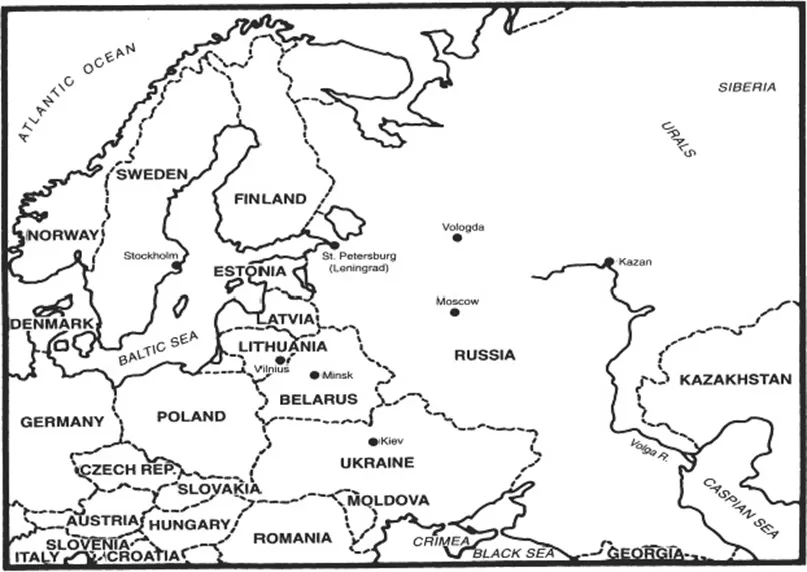
Lithuania is the largest of the three Baltic states and, like Latvia and Estonia, it has been strongly influenced by geography. Geopolitically, Lithuania's position is not enviable (see Map 1.1). As an extension of the Eastern European plain, Lithuania lies at the southern Baltic crossroads between Western Europe and Russia, which in the past has been trampled upon by European and Russian conquerors. The German Teutonic Knights of the Middle Ages, the Swedes and Russians of the seventeenth and eighteenth centuries, the French in 1812, and the Germans twice in the twentieth century, in 1915-1918 and again in 1941-1944, devastated Lithuania's infrastructure and inhibited its economic and cultural development. Lithuania's own armed insurrections against the Russian occupant in 1831,1863, 1941, and 1944-1953 added to the devastation and instability of its realm. The Russians were the final conquerors. After signing a Treaty of Amity and Commerce with the British in 1766, Tsarina Catherine II allied herself with Prussia and Austria to devour Poland. Lithuania was reduced to the state of a “northwestern province in the Russian empire.” The Tsars ruled Lithuania until 1915. After a brief interlude of Lithuanian independence, the country was reoccupied by Russia, this time under the Soviet banner, and held captive until 1991.
Czeslaw Milosz, the Nobel laureate of Lithuanian-Polish descent, quite artfully characterized the tenacious Lithuanian people by emphasizing the history of their ancient language and religion. Lithuanian culture is rife with pagan images and lore rooted in an animistic religion that these forest dwellers were loath to relinquish. The Lithuanian nation adopted Christianity only in 1385, becoming the last Western state to do so after more than a century of often fierce battle against Rome and the Teutonic Knights, a German militaristic and religious order. Similarly, the Lithuanian language is also the least changed among modern, spoken languages and is often studied by linguists as a template for the original Indo-European tongue from which European and Indian languages evolved. The conclusion one might draw is of a stubborn people rooted in their own traditions and beliefs for which they will battle even against irrationally large odds. Indeed, this book focuses on Lithuania as that small nation that was also the first to rebel against the Soviet empire by declaring political independence. After an overview of general Lithuanian history, this book will center on the perestroika period and its aftermath as Lithuania grappled with reform, national mobilization, and the welcomed challenges of new state building.
MAP 1.1 Lithuania's geopolitical location, 1990s
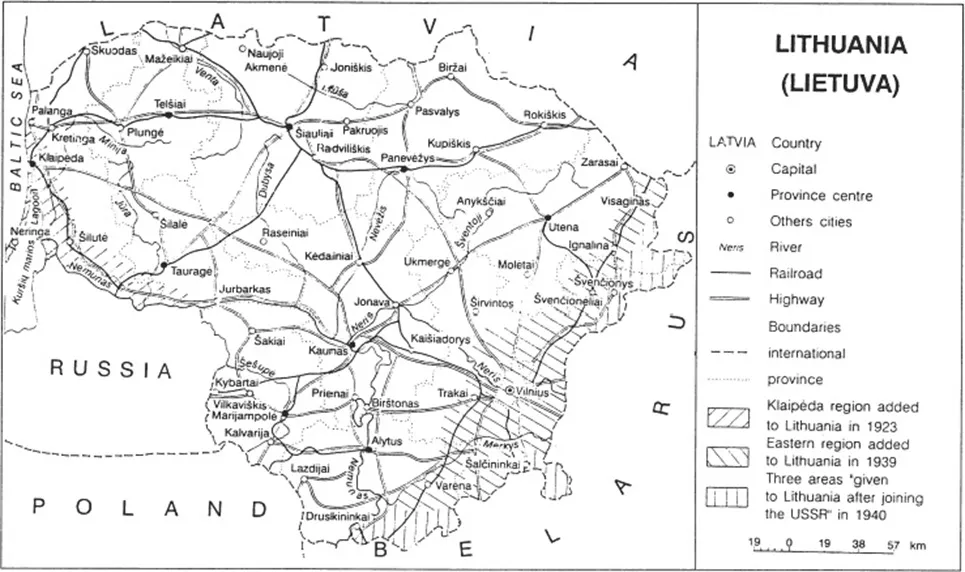
MAP 1.2 Lithuania
The Land
Lithuania forms an extension of the Great European plain, which stretches all the way from west of Berlin to east of Moscow (see Map 1.2). It covers a territory about the size of West Virginia (25,174 sq. mi. or 65,200 sq. km) and borders Latvia in the north, Russia (Kaliningrad region) in the west, Belarus in the east, and Poland in the south. Lithuania also has 99 km (60 mi.) of the Baltic Sea coast covered by white sand beaches around Palanga and the high rise dunes and pine forests at the Neringa peninsula, which draw tourists from Germany and Central Europe. The Neringa strip guards the approaches to the ice-free harbor of Klaipėda (population 206,000), which has huge dry docks that are used for repairing and constructing oceangoing fishing vessels. The mostly flat republic is dotted by some 2,900 lakes and traversed by about a thousand rivers and streams. Of these, however, only 628 km are navigable but even less can be used for commercial transportation. The main Lithuanian river, Nemunas, which originates in Belarus, has been dammed up to create a huge lake and a hydroelectric power station in the vicinity of the second largest Lithuanian city of Kaunas (population 435,000).1 Other large Lithuanian cities include Šiauliai, a center of the electronics industry (population 149,000), and Panevežys (population 132,000), a city with a strong showing in the chemical and auto parts industries. The capital is the city of Vilnius (population 600,000), founded in 1323.
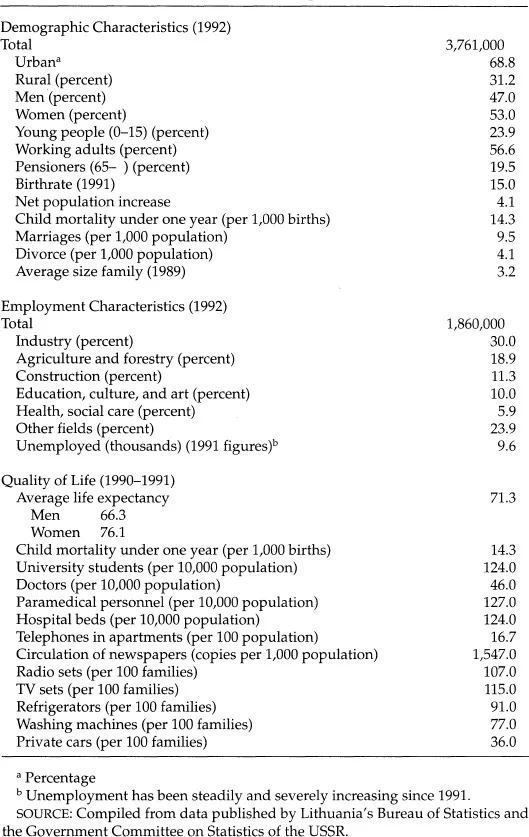
Almost 69 percent of Lithuania's population is made up of politically diverse and socially differentiated city dwellers of rather nationalistic disposition. The remaining 31 percent are farm people, many of them accustomed to the former Soviet agricultural organizations that in the 1970s brought the Lithuanian farmer relative prosperity and security. The rural population politically represents homogeneous and conservative views.
A traditionally important sector of Lithuania's population is its intelligentsia, that is, university graduates, professionals, scientists, and artists. This social segment has grown considerably under Soviet rule. For every 1,000 members of the adult population over the age of fifteen, there were 108 university graduates in Lithuania in 1989, as compared to 115 for Latvia and 117 for Estonia.2 In social origins and attitudes, this group differs considerably from their predecessors of the independence period. In 1918-1940 Lithuania's intellectuals represented the first generation of university graduates to leave the family farm and as such were shaped by religious and traditional views. In contrast, the postwar intelligentsia is more urban and shaped by Soviet-style secularization and modernization.
Lithuania's agricultural land for the most part is very fertile and is suited for diverse crops as well as for various forms of farming, such as dairy, cattle, or animal husbandry. Lithuania's natural resources, however, are rather modest. The republic has limestone, clay, quartz sand, gypsum, sand, dolomite, chalk, mineral water, and iron ore. Limestone, clays, and sands are very suitable for making good quality cement, which Lithuania does, for construction materials, glass, and ceramics. Oil, first discovered in Lithuania in the 1950s, promises supplies of 15-20 percent of the country's annual needs for some twenty years, though recent optimistic estimates of probable oil finds under the Baltic Sea shelf may augment this expectation. Western Lithuania has thermal energy resources that, if exploited, can help with home heating for some hundreds of thousands of people. In the past, Lithuania was covered by thick and vast forests. These have been severely cut by various invaders, primarily Russians and Germans, and forest land has been reduced to 28 percent of the territory. The country's well-developed furniture and paper industries have to import wood from Siberia and Karelia.
The People
The Lithuanian people are not Slavs but belong to the Baltic family of nations. Their forebears moved to the Baltic area in approximately 2000 B.C.,3 possibly from the Eurasian steppes. Confronting the sea, they had no means of crossing it to Scandinavia but spread along the Baltic coast and on the East European plain, all the way from the Mazurian lakes in the south to the boundaries of today's Estonia in the north. The Balts, or Aestii, as Roman historian Tacitus referred to them when they traded in amber with ancient Rome, once inhabited much of Pomerania and parts of Belarus and Russia, but the demographic as well as political pressures of the Germans and Slavs continuously pushed them to the Baltic littoral. Only the Lithuanians and the Latvians entered modern history. The other Baltic peoples, the Jotvings and Prussians, were conquered by Teutonic Knights in the eleventh and twelfth centuries and were absorbed, destroyed, or assimilated by the Germans. The Couronians, Semigallians, and others were assimilated either by the Lithuanians, the Latvians, or the Slavic peoples of Belarus and Poland. This history has led to modern territorial claims and counterclaims between the Lithuanians and the Germans, Poles, and Byelorussians. A note of nostalgia for the city of Vilnius can still be detected in the voices of some current Polish and Byelorussian intellectuals and politicians.4 The Baltic-speaking Lithuanians and Latvians today occupy only one-sixth of the territory their linguistic forebears did before the Slavic and Germanic expansion during the second millennium.
Lithuania is the larger of the two surviving nations. In 1989, 3,067,390 Lithuanians lived in the Soviet Union; of these, about 100,000 lived outside of Lithuania in the Kaliningrad region, Latvia, Russia, Belarus, Ukraine, Uzbekistan, Azerbaijan, and the former deportation region of the Komi republic.5 Some 30,000-40,000 Lithuanians are compactly clustered in the Suwalki-Sejny (Suvalkai-Seinai in Lithuanian) district of Poland. About two-thirds of a million people of ethnic Lithuanian ancestry are found in Western countries, mostly in the United States and Canada, but also in Latin America, Australia, and Western Europe.
Lithuanians speak an ancient tongue related to Sanskrit and often required in academic study of linguistics in universities around the world as the closest living example of the Eurasian proto-language. The languages of Lithuania and Latvia separated over 1,000 years ago and, though still very similar, are not as close as are the Estonian and Finnish tongues.
The Lithuanians were also the last nation in Europe to convert to Christianity. Before 1387, Lithuanians were pagans. Their religion could be characterized as belief in spiritualized, animized natural phenomena and in reincarnation.6 They venerated holy groves, water, fire, trees, and fields and used animal sacrifices. Belief in the life-sustaining spirituality of nature carried over into Christian times as pagan practices and animistic images were incorporated into Christian ritual.
The growth of the ethnic Lithuanian population has historically been slow. At the height of Lithuanian power, when the medieval empire was ruled by Grand Duke Vytautas (approximately 1350-1430), the estimated population of ethnic Lithuanians was about 590,000.7 Three hundred and fifty years later, at the time Lithuania was taken over by Catherine II of Russia, this number had increased by less than a million, to 1,540,000. It reached 2 million in 1923, soon after Lithuania had embarked on its shortlived era of independence, and 3 million seventy years later. Although the population growth of Lithuania has been greater than that of Western Europe, Latvia, or Estonia, it has been considerably slower than that of the Slavic neighbors—Byelorussians, Russians, and especially the Poles.
Once a large state—at the end of the fourteenth century it stretched from the Baltic to the Black Sea—it was reduced to a territory of 65,200 sq. km after World War II. Although the vastness of the medieval empire is still a source of nostalgic pride for Lithuanian nationalists of modern times, the region was never inhabited by a majority of Lithuanians. In comparison to the Slavic groups, which made up the largest part of the empire, the ethnic Lithuanian group was small. Nevertheless, it produced the rulers of the realm, who wisely co-opted Slavic natives to the ruling class and perhaps not so wisely themselves assimilated with their subjects.
Just before Lithuania declared independence in 1990, ethnic Lithuanians constituted 79.6 percent of the republic's population of 3,761,400 (see Table 1.1).8 Russians are now Lithuania's largest ethnic minority. In 1989 they constituted 9.4 percent of the population. The Poles constituted 7 percent; Byelorussians 1.7 percent; Ukrainians 1.2 percent; Jews 0.3 percent; Latvians, Tartars, Gypsies, Germans, and Estonians 0.1 percent each; and there were even a few ancient Karaites left.
About two-thirds of the Russian minority had migrated to Lithuania or were descendants of immigrants under Soviet rule. A smaller percentage had escaped to Lithuania in the nineteenth century in search of religious freedom. Some had fled the Communist revolution of 1917. While the percentage of Russians grew, that of the Poles declined. A portion of the Poles are descendants of inhabitants in the Grand Duchy of Lithuania, others are heirs to immigrants from Poland between the two world wars when the city and province of Vilnius were ruled by Warsaw, and still another group represents assimilated Lithuanians. The majority of the Byelorussians are descendants of old residents, though some are assimilated Lithuanians or immigrants of the Soviet period.
Birth of a Nation
The Pagan State
The Lithuanians appear as a nation in the pages of historical writings when the Grand Duke Mindaugas integrated the Lithuanian tribes into a single state around 1230.9 Until then, the attention of the Lithuanian ruling families was not concentrated on unification of linguistically related groups but on expansion into Slavic territories south and east of Lithuania.
The pagan Lithuanian state, ethnically composed of minority Lithuanians and a majority of Russians as well as Byelorussians, put pagans, Russian Orthodox Christians, Moslems, and a sprinkling of Latin Catholics and Jews into close proximity. It was known for its unusual, for the times, religious tolerance and for the adaptability of power to local conditions. As was typical for medieval states in that region, the language used in official documents and affairs of state was different from the one that prevailed as the local spoken language. The former, from the end of the fourteenth century on, was old church Slavonic, also known as Byelorussian.10
TABLE 1.1 Statistical Profile of Lithuania's Population, 1990-1992
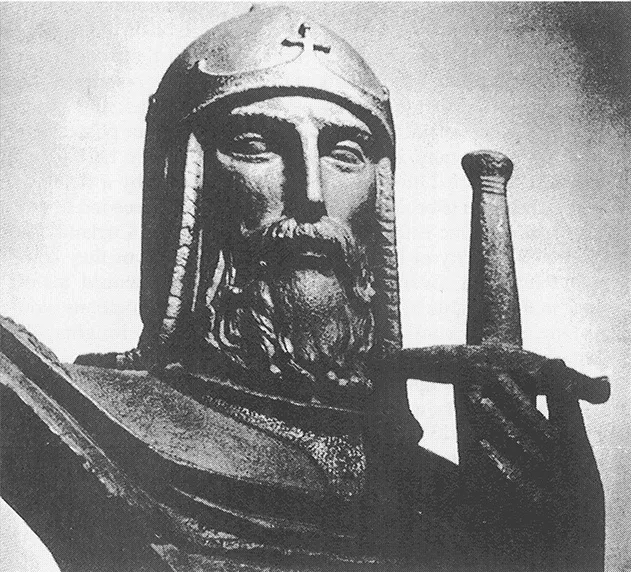
Lithuanian King Mindaugas, who reigned in the thirteenth century. (Sculptor: V. Košuba. Courtesy of Lietuvos Istorija.)
Encroaching Western Europeans seeking to Christianize and rule the pagan population hastened unification. Western merchants and missionaries first landed in Livland (Livonia in Latin, today's Latvia) during the twelfth century and quickly conquered the Livs and the other Finno- Ugrian tribes. Latvia's Christianization began in 1186 from Ikškilė (Üxküll) by Bishop Meinhard. The city of Riga was founded in 1201 by another bishop, Albert, and the next year the Order of the Brothers of the Sword was established militarily to protect missionary activities. The order's expansion into Lithuania was thwarted, however, with its serious defeat by Lithuanian princes in the battle of Saule in 1236.
The disintegrating order was rescued by another German military-missionary organization, the Knights of the Cross, which had invaded Prussian territory to aid Konrad, the Polish prince of Mazovia, in his effort to Christianize the pagan Prussians and expand his rule into their lands. The Knights secured permission from Emperor Frederick II von Hohenstaufen to conquer not only Semigallia—a part of Latvia—but also Curlandia and Lithuania. After the Prussians murdered a missionary bishop, the Knights, with the consent of Pope Gregory IX, established a secular state in the conquered territory. In 1237, they absorbed their compatriots in Livonia. After subduing the resistant Prussians, they colonized the conquered areas with Western settlers—Germans, Saxons, and others—in order to bridge the territorial gap between the Prussian possessions and Livonia. To completely unite their dominions, they had to acquire Samogitia, a western Lithuanian province inhabited by a fiercely independent Lithuanian tribe. The Knights of the Cross succeeded in wresting away a strip of Baltic littoral to connect Prussia and Curlandia and in 1251 founded the city of Memel (today's Klaipėda), but they could not conquer Samogitia. Every time Lithuanian...
Table of contents
Cover Page
Half title
Title Page
Copyright Page
Dedication
Contents
List of Tables and Illustrations
Preface
1 At the European Crossroads:Lithuania's Historical Roots
2 A Taste of Independence, 1918-1940
3 Foreign Rule:Invasion from the East
4 Resistance, Survival, and Reform
5 Sąjūdis and the Party: The March Toward Independence
6 Between the Kremlin and the West: Securing Independence
7 New Beginnings: The Politics of Transition
Selected Bibliography
About the Book and Authors
Index
Trusted by 375,005 students
Access to over 1.5 million titles for a fair monthly price.
Study more efficiently using our study tools.
Frequently asked questions
Yes, you can cancel anytime from the Subscription tab in your account settings on the Perlego website. Your subscription will stay active until the end of your current billing period. Learn how to cancel your subscription
No, books cannot be downloaded as external files, such as PDFs, for use outside of Perlego. However, you can download books within the Perlego app for offline reading on mobile or tablet. Learn how to download books offline
Perlego offers two plans: Essential and Complete
Essential is ideal for learners and professionals who enjoy exploring a wide range of subjects. Access the Essential Library with 800,000+ trusted titles and best-sellers across business, personal growth, and the humanities. Includes unlimited reading time and Standard Read Aloud voice.
Complete: Perfect for advanced learners and researchers needing full, unrestricted access. Unlock 1.5M+ books across hundreds of subjects, including academic and specialized titles. The Complete Plan also includes advanced features like Premium Read Aloud and Research Assistant.
Both plans are available with monthly, semester, or annual billing cycles.
We are an online textbook subscription service, where you can get access to an entire online library for less than the price of a single book per month. With over 1.5 million books across 990+ topics, we’ve got you covered! Learn about our mission
Look out for the read-aloud symbol on your next book to see if you can listen to it. The read-aloud tool reads text aloud for you, highlighting the text as it is being read. You can pause it, speed it up and slow it down. Learn more about Read Aloud
Yes! You can use the Perlego app on both iOS and Android devices to read anytime, anywhere — even offline. Perfect for commutes or when you’re on the go. Please note we cannot support devices running on iOS 13 and Android 7 or earlier. Learn more about using the app
Yes, you can access Lithuania by V. Stanley Vardys,Judith Sedaitis,Mrs V Stanley Vardys in PDF and/or ePUB format, as well as other popular books in Histoire & Histoire de la Baltique. We have over 1.5 million books available in our catalogue for you to explore.