Every community has issues or opportunities that need to be addressed. The expert knowledge of community members could be the key to creating lasting change. By making community members into facilitators, Making Change: Facilitating Community Action suggests they can guide community members through the process of making change and to help them determine their goals and methods.
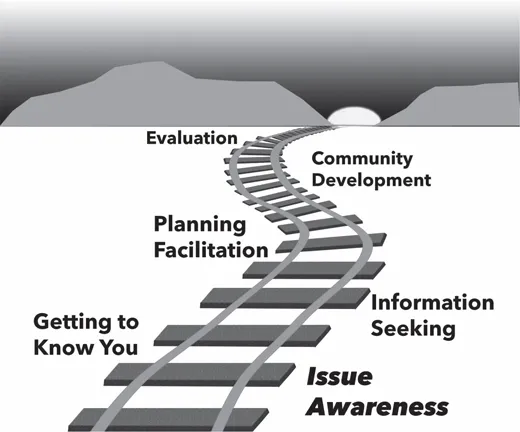
The aim of this book is to enable facilitators to identify concerns and address, enable and foster change at the local level through effective facilitation. This book follows a six-stage model for creating change. Beginning with issue awareness, it continues through getting to know the team they are working with, seeking information on the issue and community, through facilitating the planning and community development through evaluation. This book focuses on the human side of the change process while also teaching the practical skills necessary for individuals to reach their goal.
Making Change is for people interested in making change to improve their community, including students, community activists, local government and educational leaders.
At the beginning of a problem-solving process, we become aware of an issue by noticing its symptoms, or someone points it out to us. Keeping in mind that everyone has different perspectives on an issue, we need to clarify the issue as a team and to listen to each of the perspectives. This part is key, because when we select problems to solve and solutions to use, the best solutions are those that meet everyone’s needs.
This book follows a six-stage model for creating change. Beginning with issue awareness, it continues through getting to know the team you will be working with, seeking information about the issue and the community, facilitating the planning process and then continuing through community development, and evaluation.
Figure S1.0 Facilitation of Change Model Stage 1: Issue Awareness.
1The Beginning
Figure 1.0
What’s in This Chapter?
Community change initiatives often begin with a small group of people who are aware of an issue and come together to do something about it. However, to really get change moving requires a large number of people to become aware, take responsibility and participate in taking action, including the people most impacted. This chapter discusses the spectrum of attitudes that people bring to community development and defines three key principles for community development—participation, responsibility and changing conditions. Finally, it introduces the six-stage facilitation to change model.
Objectives
By the end of this chapter, you will be able to:
Describe issues in your community that need attention.
Reflect on your attitudes toward people most directly affected by these issues. Would you work on solving the issue for them or with them?
Describe how you might use principles of participation, responsibility and changing conditions to address this issue.
Describe the six stages in the facilitation of change model.
A Story About Beginning a Change
There was something about her face that was compelling us all to look in her direction. She was not only pretty in a conventional way, but attractive in the sense that she attracted people like a magnet. There was an internal glow, a light shining in her face that was causing all of us to turn in her direction. What was she saying? With an emotional and broken-voiced appeal, she asked us to notice the homeless people standing on the street corners in our town. Most of us had passed them by with barely a glance or, more likely, with feelings of shame that we were among the “haves”, but they had nothing at all but a cardboard sign with a pleading message—“Will work for food.” But she had noticed their pain and suffering and called our attention to the human “litter” at our door, which we were merely shifting aside. Pastor Christine had a heart for the homeless, and she single-handedly turned all of us around to look back at them to see what we could do. This was the genesis of the Homeless Coalition.
Within six months, Pastor Christine had gathered about 100 citizens who were concerned about the growing homeless population in their town. In small groups, they met with her over time to ask what they could do about this problem and how they could help solve it. Some were businesspeople who thought the town was beginning to look down-at-the-heels, and others were church people who felt a charitable impulse to help the down-and-outers. Among the initial founders of the Homeless Coalition were a wide spectrum of supporters ranging from academics, human service professionals, government officials and a variety of volunteers who all cared about their town and its future. Christine knew she needed to find a way to get them all on board, so she called a town meeting to hold a visioning session to bring them all together and find out what to do next.
What These Concepts Are About
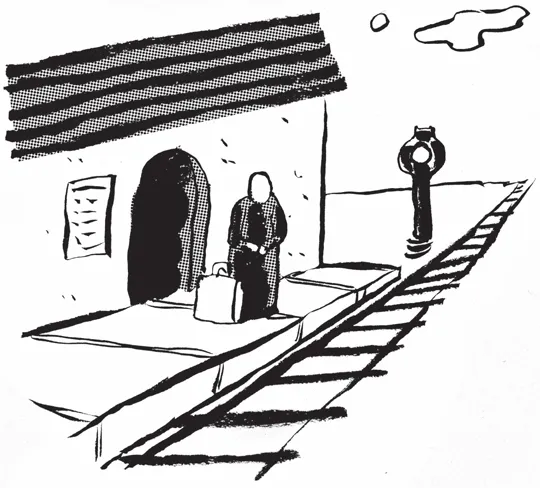
Getting on board is a metaphor often used by organizers who are appealing to people to change direction or join a new movement. The image of boarding a train can be helpful as a way to imagine ourselves in this scene. At the initial stage of any change process, people share the same excitement as train riders experiencing new vistas and new relationships, hopping on when they are ready and getting off when they are done. As new people join the process, there can be a surge of energy and a renewal of the community.
The first person we meet when boarding a train is the conductor, a skilled person who helps us to embark on a new journey. The facilitator can be viewed as a type of conductor, someone who has the experience, patience and ability to answer questions and solve problems along the way. Just like on a train journey, there will be unexpected detours, such as when an avalanche of snow covers the tracks, causing the train to be rerouted since the destination must be altered due to changing conditions. Sometimes you travel in the dark and can’t see the unfolding landscape, and you have to trust that progress is being made. The role of the facilitator, like that of a conductor on a train, is to keep the process on track even when things break down or conditions change.
Train riders sometimes just want to get to their destination, but others have a communal attitude. You never know who you will meet on a train, but you can usually expect to meet people who are different from yourself. First-time riders bring fresh viewpoints and are guided by the more experienced travelers who know how things work. Both perspectives are useful as the journey continues. Patterns and habits must change repeatedly when new riders get on and cars are added. Riders come aboard with an expectation of arriving on schedule; however, there will be many stops and starts along the way to changing any social condition.
As the group moves along in its developmental perspective, flexibility is needed. An effective conductor/facilitator listens to participants and observes changes in conditions. The journey is unfolding gradually, and no one knows when it will end. The facilitator can offer confidence that the destination will be reached eventually, even if the timing for arrival at the destination is not certain. Along the way there will be frustrations and successes, and with the help of careful facilitation, new directions will emerge from the visioning process. By carefully pursuing collective decision-making with skill and tact, the facilitator can ensure that the desired results will be produced.
The first thing that must be done before taking a journey is to determine the destination. In other words, the traveler needs a clear goal. Pastor Christine could see that among her 100 supporters there were at least 10 different ideas of how to approach the problem of homelessness. The police and the mayor wanted to halt panhandling, the church folks were feeling distressed by trying to meet needs of people experiencing homelessness one by one and the social activists saw homeless people as a cause. Pastor Christine decided to use a visioning approach as a first step to clarify at least a few of the initial directions the Homeless Coalition could take. She invited two trained facilitators from a local agency to lead the town meeting. That was a smart move, because the facilitators were neutral and had the skills to help coalesce the myriad opinions into a proposed destination for the journey.
Homelessness is a complex issue that is deeply rooted in conditions of poverty and injustice. Soon after the town meeting, the members began to learn the truth of the old adage, “It takes a lot of track to turn a big train around.” Although well-intentioned, they did not yet know that they were in for a very long ride. At this point, Maurine entered the scene, offering to become their volunteer facilitator to conduct them through the next phase, which is action planning.
At the end of the town meeting, excitement and enthusiasm were running high. Fifteen people had signed on to continue the conversation over a three-month period with a clear goal to address issues of homelessness in our town. Now it was time to think about choosing a framework for how the newly formed community of activists would proceed during the action planning phase. As their volunteer facilitator, Maurine recommended the framework of community development which she had practiced for many years as a social activist, knowing that it would provide a much-needed framework to contain the energy of the group and help them to look forward in the same direction.
Along the way in her training as a professional group facilitator, Maurine had encountered a wise and experienced teacher, William Lofquist, who had thought deeply about the concept of community development for many years. In his book, The Technology of Development (1996), he offers this definition:
In recent years much emphasis has been placed on … technologies … We have put much less emphasis on a technology of development for creating better communities. In this framework, development is defined as an active process of creating conditions [circumstances that exist in a particular situation] and fostering personal attributes [characteristics of a person] which promote the well-being of people. Conditions and personal attributes are two realities which are closely intertwined. It is difficult to consider one without giving attention to the other.
(p. 1; emphasis in original)
Clift, Wojciakowski, and Wojciakowski (2011) said that “Community development, in both concept and action, is dependent on a group of like-minded people working together to improve and further grow a local community” (p. 180). Lofquist has broadened this definition to include fostering personal and collective attributes that go beyond just solving problems. Simply stated, changed hearts can change the direction of society toward the common good.
When using a community development framework, the first question to ask is “What is happening now?” We need first to see the current conditions before we can create a new set of conditions. By asking questions, we are setting out on a journey of discovery and finding new and unexpected ways of responding to situations as they unfold. At the beginning, most activists tend to choose a problem-solving approach, and the solutions can seem simple. At the initial meeting of the Homeless Coalition, some of the ideas that were put forth were to provide free bedding or toothbrushes to homeless people seen around town. However, eventually we saw more complex sets of conditions unfolding and a more effective set of ideas emerged to respo...
Table of contents
Cover
Half Title
Title
Copyright
Dedication
Contents
List of Tables and Figures
Acknowledgments
Preface
Stage 1 Issue Awareness
Stage 2 Getting to Know You
4 Reflective Facilitation
5 Calling the First and Subsequent Meetings
6 Recruit and Retain Volunteers
7 Clearing Mental Space for Facilitation
8 Building Rapport and Unity
Stage 3 Information Seeking
Stage 4 Facilitation of Planning
Stage 5 Community Development
Stage 6 Evaluation and Conclusion
Index
Trusted by 375,005 students
Access to over 1.5 million titles for a fair monthly price.
Study more efficiently using our study tools.
Frequently asked questions
Yes, you can cancel anytime from the Subscription tab in your account settings on the Perlego website. Your subscription will stay active until the end of your current billing period. Learn how to cancel your subscription
No, books cannot be downloaded as external files, such as PDFs, for use outside of Perlego. However, you can download books within the Perlego app for offline reading on mobile or tablet. Learn how to download books offline
Perlego offers two plans: Essential and Complete
Essential is ideal for learners and professionals who enjoy exploring a wide range of subjects. Access the Essential Library with 800,000+ trusted titles and best-sellers across business, personal growth, and the humanities. Includes unlimited reading time and Standard Read Aloud voice.
Complete: Perfect for advanced learners and researchers needing full, unrestricted access. Unlock 1.5M+ books across hundreds of subjects, including academic and specialized titles. The Complete Plan also includes advanced features like Premium Read Aloud and Research Assistant.
Both plans are available with monthly, semester, or annual billing cycles.
We are an online textbook subscription service, where you can get access to an entire online library for less than the price of a single book per month. With over 1.5 million books across 990+ topics, we’ve got you covered! Learn about our mission
Look out for the read-aloud symbol on your next book to see if you can listen to it. The read-aloud tool reads text aloud for you, highlighting the text as it is being read. You can pause it, speed it up and slow it down. Learn more about Read Aloud
Yes! You can use the Perlego app on both iOS and Android devices to read anytime, anywhere — even offline. Perfect for commutes or when you’re on the go. Please note we cannot support devices running on iOS 13 and Android 7 or earlier. Learn more about using the app
Yes, you can access Making Change by Jeanne L Hites Anderson,Maurine H Pyle,Jeanne Hites Anderson,Maurine Pyle in PDF and/or ePUB format, as well as other popular books in Social Sciences & Social Work. We have over 1.5 million books available in our catalogue for you to explore.