eBook - ePub
Available until 4 Dec |Learn more
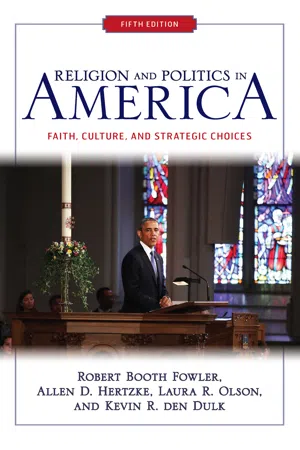
Religion and Politics in America
Faith, Culture, and Strategic Choices
This book is available to read until 4th December, 2025
- 362 pages
- English
- ePUB (mobile friendly)
- Available on iOS & Android
eBook - ePub
Available until 4 Dec |Learn more
Religion and Politics in America
Faith, Culture, and Strategic Choices
About this book
this book focuses on religion and politics and the dynamic interactions between them. It helps to understand the politics of religion in the United States and to appreciate the strategic choices that politicians and religious participants make when they participate in politics.
Frequently asked questions
Yes, you can cancel anytime from the Subscription tab in your account settings on the Perlego website. Your subscription will stay active until the end of your current billing period. Learn how to cancel your subscription.
No, books cannot be downloaded as external files, such as PDFs, for use outside of Perlego. However, you can download books within the Perlego app for offline reading on mobile or tablet. Learn more here.
Perlego offers two plans: Essential and Complete
- Essential is ideal for learners and professionals who enjoy exploring a wide range of subjects. Access the Essential Library with 800,000+ trusted titles and best-sellers across business, personal growth, and the humanities. Includes unlimited reading time and Standard Read Aloud voice.
- Complete: Perfect for advanced learners and researchers needing full, unrestricted access. Unlock 1.4M+ books across hundreds of subjects, including academic and specialized titles. The Complete Plan also includes advanced features like Premium Read Aloud and Research Assistant.
We are an online textbook subscription service, where you can get access to an entire online library for less than the price of a single book per month. With over 1 million books across 1000+ topics, we’ve got you covered! Learn more here.
Look out for the read-aloud symbol on your next book to see if you can listen to it. The read-aloud tool reads text aloud for you, highlighting the text as it is being read. You can pause it, speed it up and slow it down. Learn more here.
Yes! You can use the Perlego app on both iOS or Android devices to read anytime, anywhere — even offline. Perfect for commutes or when you’re on the go.
Please note we cannot support devices running on iOS 13 and Android 7 or earlier. Learn more about using the app.
Please note we cannot support devices running on iOS 13 and Android 7 or earlier. Learn more about using the app.
Yes, you can access Religion and Politics in America by Robert Booth Fowler,Allen D Hertzke,Laura R. Olson,Kevin R. Den Dulk in PDF and/or ePUB format, as well as other popular books in Politics & International Relations & Politics. We have over one million books available in our catalogue for you to explore.
1
Religion and Political Culture in America: The Historical Legacy to the Present
It would be difficult to understand American politics today without knowing something about American religion. And it would be equally difficult to understand either politics or religion without a sense of history, a sense of how the interplay among religion, politics, and culture has shaped the story of the United States to the present time. Since colonial days, religion has played a profound role in molding American culture, directly and indirectly, in ways that no one at the time of the founding could ever have imagined or predicted. In order to sort out the complex history of the relationships among religion, politics, and culture, we have organized this chapter around five themes: the Puritan temper, pluralism, the evangelical dimension, populism, and the contemporary growth of religious and spiritual individualism.
The Puritan Temper
The United States was born of religious zeal. Its colonization coincided with, and was fueled by, vast upheavals in Europe that had been unleashed by the Protestant Reformation. None of these was as important as the Puritan revolution, which shook England and inspired many to emigrate to the New World. Today the term puritanical connotes a narrow-minded, self-righteous rejection of anything pleasurable. But the Puritan legacy is something quite different. The Puritans bequeathed to Americans strong civic institutions, a sense of national mission, and a reformist impulse that continues to shape American society and political culture.
The Puritans earned their name from their desire to “purify” the Church of England and, more broadly, society itself in the late 1500s and early 1600s. Inspired by Calvinist Reformed theology, Puritans reacted vehemently against what they saw as laxity and corruption in Christian churches. Infused with a sense of moral urgency, Puritans threatened established political and religious elites, and they often suffered persecution as a result of their agitation. To many Puritans, America offered both an escape and a fresh start. Thus in the early 1600s, many Puritans (along with other religious dissenters) found their way to the American seaboard.1
Although the American colonies were characterized by religious diversity from the beginning, the Puritans brought with them such a powerful vision that they exercised a disproportionate influence for a century and a half before the Revolutionary War. Many people at the time, regardless of their denominational affiliation, embraced the central tenets of Puritanism, and several of the leading colonial intellectuals were Puritan ministers.2
To the Puritans, the new land was not just a place where they could freely exercise their religion. It was literally the New Israel, the Promised Land on which the faithful could build a holy commonwealth unencumbered by Old World corruption. The Puritans called their mission an “Errand in the Wilderness” and saw it as divinely ordained. In the celebrated Puritan phrase, America was to be “a city upon a hill,” a light to all nations. This sense of the New World’s providential destiny continues to fascinate, mystify, and sometimes shock people in other countries. From the “manifest destiny” of westward expansion, to Abraham Lincoln’s determination to preserve the Union, to Woodrow Wilson’s quest to “make the world safe for democracy,” to John Kennedy’s Peace Corps, to George W. Bush’s interest in foreign nation-building, some Americans have continued the Puritan legacy by acting on a sense of special mission and destiny. Understanding this legacy is especially important now as the United States strives to define its global responsibilities in a complex and often unsympathetic larger world.
Puritan doctrine also helped to nurture self-government in the new land.3 Puritans articulated a “covenant theology” that was a blatant rejection of the longstanding “divine right of kings” doctrine. As the Puritans saw it, political leaders did not derive their authority directly from God; instead, Puritans favored a model of government based on a community’s covenant with God. Puritan churches were autonomous, self-governing parishes. This “congregational” tradition gave rise to a parallel political preference for community self-governance.
To be sure, the Puritan conception of democracy was hardly today’s understanding of democracy. Only the religious “elect,” or church members, were allowed to participate. People could become church members only by persuading church leaders that they were most likely predestined for salvation; this status was understood to be enjoyed by only a small percentage of the population. But even if the Puritan colonies were more theocracies than democracies, they fostered a form of self-government from the start. Christian colonists had become outraged by 1775 as England and its established church continued to assert authority over the colonies. By then, the colonists had governed themselves for more than a century, and those in the Puritan tradition believed their religious doctrine justified their action.4
The Puritan emphasis on all humans’ tendency to sin also affected American politics, though scholars disagree on the extent. Certainly the Puritans’ skeptical view of human nature contributed to the American fear of concentrated governmental power. If political leaders are as tempted by sin as other human beings, then precautions against abuse must be built into the system. Thus some scholars see evidence of the residual cultural influence of Puritan doctrine in James Madison’s concern about diffusing and checking power in the US Constitution. Others note that early Americans in their Revolution largely avoided romantic and utopian thinking of the sort that led to the excesses of the French Revolution soon after. A deeply ingrained understanding of sin thus tempered the early American practice of government.5
In addition, throughout the nation’s history, many Americans have based their social practices on the Puritan understanding of the need to restrain individual sin for the good of the community. As the French observer Alexis de Tocqueville noted in the 1830s, the majority of Americans shared the Puritan conviction that “freedom” did not mean license to do anything one pleased, but rather the ability to do those things that are good and right. Tocqueville found Americans remarkably faithful to this ideal in their organization of churches, schools, communities, and families. Powerful socialization forces restrained human impulses deemed destructive to the community.6 Thus morally intrusive laws and practices that may seem suffocating today were actually viewed as helpful in early America, as they would liberate the individual from “slavery to sin.”7
Puritans emphasized the community’s central role in nurturing and restraining the individual. This aspect of their outlook is receiving renewed attention today. The Puritans and their heirs could be harsh, but their focus on community meant that people were not isolated. Women were not abandoned if they became widows; orphans were cared for; people did not suffer from rootlessness. Religious mores and strong communities restrained the atomizing tendencies unleashed by modern political freedom. Even today, many Americans continue to align themselves at least nominally with religious groups, even if their attendance is sporadic, in part just because they perceive this sense of community in congregations.8
Finally, Puritanism bequeathed to the nation a mighty store of moral zeal that often did not recognize that shades of gray are needed in a political system whose lifeblood is compromise. Critics note how Puritan clergy moved with equal stridency from depicting the French as anti-Christian during the French and Indian War to viewing the British in similar terms only a decade later during the American Revolution.9 More sympathetic voices note that politics sometimes cries out for an infusion of religious conviction and fervor. Where would the nation be, they ask, without the uncompromising fervor of the abolitionists in the nineteenth century or the reformist energies of suffragists?
Whether for good or ill, we see evidence of this zeal among some religionists across the political spectrum today. When today’s religious leaders prophesy against the evils of society and equate their political struggles with God’s cause, they are exemplifying the American Puritan tradition.
Religious Freedom and Pluralism
Important though the Puritan legacy was and is, the reality of religious pluralism played an even more powerful role in shaping the nation’s history. The roots of the dominant characteristic of American religion today—its almost bewildering multiplicity of religions, denominations, theologies, and organizational styles—may be traced to early colonial patterns. Moreover, the American break with the 1,500-year European tradition of maintaining a state-established church, as well as the eventual constitutional protection for religious freedom, combined to allow religious pluralism to flourish in the New World. And no one in any way planned this confluence of events.
Most colonies installed official state churches. The New England colonies formally designated the Congregational (Puritan) Church as their official faith; Maryland was at one time officially a Catholic colony; most southern colonies established the Anglican Church (the Church of England, which later became known as the Episcopal Church in the United States). This commonplace practice of establishing an official faith meant citizens had to pay a tax to support the colonial church and in some places had to be married by government-supported clergy.10
Despite the existence of established churches, however, members of other religious groups, including Jews, Quakers, Baptists, and many more, all found more room to practice their faiths in the New World than they had in Europe. If one found Massachusetts too suffocating, there was always Rhode Island, home to a host of dissenters, or New York, which had received numerous Jewish settlers by the late seventeenth century. Then there were the middle colonies—especially Pennsylvania, where religious freedom was official policy from the start—which modeled religious tolerance for the rest of the new nation. And there was always the seemingly endless wilderness, which became a haven to religious nonconformists and visionaries. So Catholics settled in Maryland and tolerated Protestants; Quakers settled in Pennsylvania and tolerated Lutherans; Baptists agitated for their own freedom in a number of colonies. The idea of a society in which each faith tolerated all others in order to enjoy its own freedom took root.11
Religious tolerance was strengthened in the late eighteenth century when the Constitution and the Bill of Rights were drafted and adopted, officially founding the United States. The framers of the US Constitution faced an enormous challenge: knitting together thirteen colonies with different cultures, religions, economies, and climates. The solutions were born of necessity and compromise, as we can see in the language of the religion clauses of the First Amendment, which are clearly an attempt to address the complexities of religious pluralism: “Congress shall make no law respecting an establishment of religion, or prohibiting the free exercise thereof.” The federal government was not to be allowed to favor one religion over all others, nor limit the liberty of worship of any particular religion.
Then as now, the goal of religious freedom meant different things to different people. Some of the framers, such as Benjamin Franklin, Thomas Jefferson, and James Madison, favored religious liberty in part to reduce any established clergy’s interference with politics, which to them represented a vestige of the corrupt and oppressive European world. Most of such men were Enlightenment deists who believed in a God who had set the universe on course with natural laws and then left it alone. They saw a chance to create an enduring United States free of the intense religious squabbles involving government interference that infected the Old World.
Jefferson, a religious skeptic who wrote his own version of the New Testament in which he did not affirm Christ as God, authored the Virginia Statute of Religious Freedom (a precursor to the First Amendment). Madison shared Jefferson’s belief that leaving individual conscience unfettered by the state would be the best guide in religion and morality. He therefore joined Jefferson’s effort to disestablish the state church in Virginia.
But this is not the full story. Fervent Baptists, along with other religious dissenters, also strongly supported constitutional protection of religious freedom and an end to state support for Virginia’s established church. Persecuted by Anglican authorities in the southern colonies and Puritan leaders in New England, Baptists remembered the times when they had been jailed for seeking marriages outside the established church or for refusing to pay the church tax. As a result they were natural allies of separation- ists, such as Jefferson and Madison.
Even for those Christians who initially favored state-established churches, the sheer necessity of protecting their own faiths ultimately led them to support religious freedom. Given the religious pluralism already present in the thirteen colonies, no one could ensure that any particular church would be the one established by the new national government. All believers wanted freedom for themselves and concluded that the “only way to get it for themselves was to grant it to all others.”12
The bold national experiment in religious freedom, as embodied in the First Amendment, did set the stage for an end to established churches in the states. Even though the language of the religion clauses was understood to prohibit only establishment by the federal government, the national model eventually swept through the states, which took it upon themselves to end the practice. Massachusetts was the last state to do away with its official faith, disestablishing the Congregational Church in 1833.13
This ideal of church-state separation and r...
Table of contents
- Cover
- Half Title
- Title Page
- Copyright Page
- Contents
- List of Illustrations
- Preface
- 1. Religion and Political Culture in America: The Historical Legacy to the Present
- 2. Christianity and Its Major Branches
- 3. Judaism, Islam, and Other Expressions of Religious Pluralism
- 4. Voting and Religion in American Politics
- 5. The Politics of Organized Religious Groups
- 6. Religion and Political and Cultural Elites
- 7. Religion, Civil Society, and Political Culture
- 8. The Politics of Religion in the Legal System
- 9. Church and State in the Courts
- 10. Latino and African American Religion and Politics
- 11. Gender, Religion, and Politics
- 12. Theories of Religion, Culture, and American Politics
- Index