- 248 pages
- English
- ePUB (mobile friendly)
- Available on iOS & Android
eBook - ePub
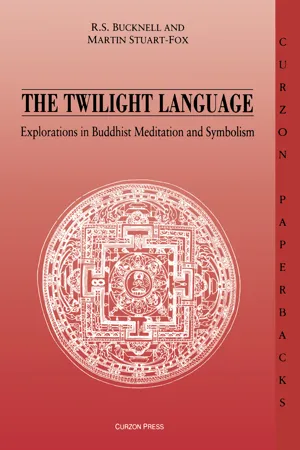
The Twilight Language
About this book
Explores the nature of Buddha's enlightenment and the meaning of Buddhist symbolism, discussing the relationship between Buddhist meditative techniques and examples of Buddhist symbolism found in early Pali texts and in the twilight language of the tantras.
Information
Notes
Notes to Chapter I
1 | On transpersonal psychology and meditation, see Roger N. Walsh and Frances Vaughan, Beyond Ego (Los Angeles: Tarcher, 1980), pp. 15 – 24; and Roger N. Walsh, ‘Meditation Research: An Introduction and Review’, Journal of Transpersonal Psychology 11 (1979), pp. 161 – 74. Also see Michael Murphy and Steve Donovan, ‘A Bibliography of Meditation Theory and Research’, Journal of Transpersonal Psychology 15 (1983), pp. 181 – 228. |
2 | In this book Buddhist technical terms are generally cited in Pali, less often in Sanskrit or Japanese depending on the context. |
3 | On awareness as the only true meditation, see J. Krishnamurti, Freedom from the Known, ed. Mary Lutyens (London: Gollancz, 1969), pp. 114 – 17. |
4 | On the importance of this, see Alan Richardson, Mental Imagery (London: Routledge and Kegan Paul, 1969), pp. 109 – 17; and T. Tart, ‘Scientific Foundations for the Study of Altered States of Consciousness’, Journal of Transpersonal Psychology 3 (1971), pp. 93 – 124. The case for recognizing inner experience, in particular imagery, as a valid object of psychological study is presented in Alan Richardson, The Experiential Dimension of Psychology (St Lucia: University of Queensland Press, 1984). For a very readable discussion of imagery, a topic particularly relevant to insight meditation, see Stephen M. Kosslyn, Ghosts in the Mind’s Machine (New York: Norton, 1983); and for a more technical state-of-the-art overview of the same topic, see Anees A. Sheikh, Imagery: Current Theory, Research, and Application (New York: John Wiley and Sons, 1983). |
5 | For example Roger N. Walsh, ‘Initial Meditative Experiences: Part I’, and idem ‘Part II’, Journal of Transpersonal Psychology 9 (1977), pp. 151 – 92, and 10 (1978), pp. 1 – 28; and Rod Bucknell, ‘Experiments in Insight Meditation’, Australian Journal of Transpersonal Psychology 3 (1983), pp. 96 – 117. |
6 | Attempts have been made to determine the nature of this ‘original Buddhism’; e.g. Kōgen Mizuno, Primitive Buddhism, transl. Kōshō Yamamoto (Ube: Karin Bunko, 1969). Other scholars, however, have questioned whether this is possible. See André Bareau, ‘Recherches sur la biographie du Buddha dans les Sūtrapiṭaka et les Vinayapiṭaka anciens’, vol. I (de la quête de l’éveil à la conversation de Śāriputra et de Maudgalyāyana) and vol. II (les derniers mois, le Parinirvāṇa et les funérailles). Publications de l’École Française d’Extrême-Orient vol. 53 (1963) and vol. 77, part 2 (1971). See also David L. Snellgrove, ‘Śākyamuni’s Final Nirvāṇa’, Bulletin of the School of Oriental and African Studies 36, part 2 (1973), pp. 399 – 411. And for a study of the biography of the Buddha, see Frank E. Reynolds, ‘The Many Lives of Buddha’, in The Biographical Process: Essays in the History and Psychology of Religion, ed. by Frank E. Reynolds and Donald Capps (The Hague: Mouton, 1976), pp. 37 – 61; and Edward J. Thomas, The Life of Buddha as Legend and History, 3rd rev. ed. (London: Routledge and Kegan Paul, 1949). |
7 | See e.g. D ii 311 – 313. All such references are to volume and page numbers in the Pali Text Society’s edition of the Tipiṭaka; D = Dῑgha, M = Majjhima, S = Saṃyutta, A = Añguttara. Quoted translations from the Pali Tipiṭaka are, unless otherwise stated, from the Pali Text Society’s English versions. |
8 | Many equate right view with the final liberating insight; e.g. Nyanatiloka, The Word of the Buddha (Kandy: Buddhist Publication Society, 1971), pp 26 – 7. This opinion, first expressed by the nun Dhammadinnā (M i 301), assumes the Path sequence is without significance. For evidence against it see Chapter VIII, and Rod Bucknell, ‘The Buddhist Path to Liberation: An Analysis of the Listing of Stages’, Journal of the International Association of Buddhist Studies 7 (1984), no. 2, pp. 7 – 40. |
9 | For example, D ii 312 – 313. This path is clearly both sequential (simpler, more basic practices precede more difficult and advanced ones), and cumulative (earlier stages are maintained as later ones are taken up). See M iii 71 – 77, and our discussion in Chapter VIII. |
10 | D ii 217, iii 271, etc. For an analysis of the Tenfold Path and other important variations on the Eightfold Path (including the ‘footprints of a Buddha’, discussed below), se... |
Table of contents
- Cover
- Half Title
- Dedication
- Title Page
- Copyright Page
- Table of Contents
- List of Plates
- Preface by R.B.
- Preface by M.S-F.
- Acknowledgements
- I: Meditation and Symbolism
- II: The Twilight Language in Historical Context
- III: Concentration
- IV: Insight Meditation
- V: The Three Knowledges
- VI: The Five Symbolic Groups
- VII: The Mandala and Cakras
- VIII: Doctrinal and Historical Implications
- IX: Conclusion
- Notes
- Index
Trusted by 375,005 students
Access to over 1.5 million titles for a fair monthly price.
Study more efficiently using our study tools.
Frequently asked questions
Yes, you can cancel anytime from the Subscription tab in your account settings on the Perlego website. Your subscription will stay active until the end of your current billing period. Learn how to cancel your subscription
No, books cannot be downloaded as external files, such as PDFs, for use outside of Perlego. However, you can download books within the Perlego app for offline reading on mobile or tablet. Learn how to download books offline
Perlego offers two plans: Essential and Complete
- Essential is ideal for learners and professionals who enjoy exploring a wide range of subjects. Access the Essential Library with 800,000+ trusted titles and best-sellers across business, personal growth, and the humanities. Includes unlimited reading time and Standard Read Aloud voice.
- Complete: Perfect for advanced learners and researchers needing full, unrestricted access. Unlock 1.5M+ books across hundreds of subjects, including academic and specialized titles. The Complete Plan also includes advanced features like Premium Read Aloud and Research Assistant.
We are an online textbook subscription service, where you can get access to an entire online library for less than the price of a single book per month. With over 1.5 million books across 990+ topics, we’ve got you covered! Learn about our mission
Look out for the read-aloud symbol on your next book to see if you can listen to it. The read-aloud tool reads text aloud for you, highlighting the text as it is being read. You can pause it, speed it up and slow it down. Learn more about Read Aloud
Yes! You can use the Perlego app on both iOS and Android devices to read anytime, anywhere — even offline. Perfect for commutes or when you’re on the go.
Please note we cannot support devices running on iOS 13 and Android 7 or earlier. Learn more about using the app
Please note we cannot support devices running on iOS 13 and Android 7 or earlier. Learn more about using the app
Yes, you can access The Twilight Language by Roderick Bucknell,Martin Stuart-Fox in PDF and/or ePUB format, as well as other popular books in Theology & Religion & Buddhism. We have over 1.5 million books available in our catalogue for you to explore.