- 120 pages
- English
- ePUB (mobile friendly)
- Available on iOS & Android
eBook - ePub
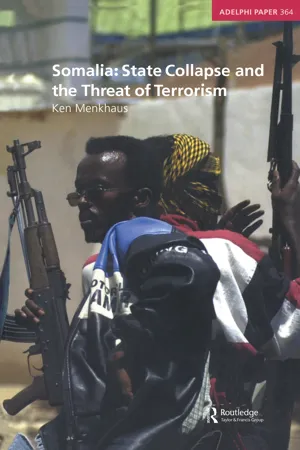
Somalia: State Collapse and the Threat of Terrorism
About this book
This work explores Somalia's state collapse and the security threats posed by Somalia's prolonged crisis. Communities are reduced to lawlessness, and the interests of commercial elites have shifted towards rule of law, but not a revived central state. Terrorists have found Somalia inhospitable, using it mainly for short-term transshipment.
Information
Chapter 1
Reassessing Protracted State Collapse in Somalia
International diplomacy in Somalia has assumed a predictable pattern. Every couple of years, an external actor sets out to broker talks aimed at bringing national reconciliation and a government of national unity to the country. An initiative follows, leading to a peace conference attended by hundreds of eminent Somali political figures, usually in a fine hotel in a regional capital. The initiative invariably sparks fanfare and optimism, and sometimes considerable intolerance towards critics who raise doubts or concerns. Then familiar problems arise, involving disputes over representation, agendas or the composition of technical committees. The debate over who has the right to represent whom confounds the external mediators, who may be accustomed to a less chaotic political environment. Regional authorities, factional chairmen, militia commanders, self-proclaimed presidents, clan elders, religious figures, intellectuals and civil-society leaders all demand a place at the table, and disparage one another as illegitimate or irrelevant. Somali delegates devote almost all of their energies, not to discussing the critical issues dividing them, but rather to extended and unseemly haggling over the apportioning of positions in a future national government. Defections occur as individuals and groups fail to get what they feel they deserve. Increasingly frantic international mediators try to cajole the defectors, then brand them as spoilers. Delegates who remain sign accords which are never implemented, and then return home, often to a third country where they have resident status. The host country for the peace conference is left with a large unpaid bill. And as it becomes clear that yet another Somali peace process has failed, bitter blame ensues. Disillusionment sets in, and the appetite for Somali reconciliation is temporarily soured.
This cycle has yielded over a dozen failed national reconciliation processes since 1991. These repeated frustrations pose both a puzzle and a problem. How is it possible that Somalia can remain so resistant to efforts to revive its central government? How do we explain the protracted nature of this extraordinary case of state collapse?
For years, observers have relied on a standard set of explanations: that external diplomacy has been consistently misinformed and incompetent in its mediation efforts; that Somali leaders have been irresponsible and myopic in their quest for power and their stubborn refusal to compromise; that external states such as Ethiopia conspire to perpetuate state collapse and warfare in Somalia for their own reasons; that collective fear of the re-emergence of a predatory state undermines public support for peace-building processes; and that the powerful centrifugal force of Somali clannism works against coalitions and central authority, making quests to rebuild a Western-style central state a fool’s errand. All of these theories have merit. But none fully captures the scope and dynamic of the Somali impasse, and all, to varying degrees, tend to be captive to residual thinking about the nature of conflict and the state in Somalia.
One part of the trouble encountered by analyses of Somalia is the tendency to group the country’s multiple crises into a single syndrome. This shorthand has had the unwanted effect of disguising what are in fact a number of distinct crises, which exist independently of one another, have different dynamics requiring different remedies and pose different types of threats. Three distinct crises – state collapse, armed conflict and lawlessness – must be disaggregated if they are to be better understood and diagnosed.
The collapse of central government
The most dramatic and unique aspect of the Somali crisis has been the complete and protracted collapse of the central government. There has been no functional, central governing authority in Somalia since January 1991; efforts to re-establish a central state have been both numerous and unsuccessful. The most promising attempt was the Transitional National Government (TNG) announced in August 2000. Unfortunately, it failed to become minimally operational, was plagued by internal schisms, did not gain widespread bilateral recognition, and by 2002 appeared increasingly irrelevant. It formally expired in August 2003, the point at which its three-year mandate ended, though TNG President Abdiqassim Hassan Salad declared an extension. Even at the regional, district and municipal levels, formal administrations that have periodically popped up throughout the country have tended to have relatively short lives. The sole exception is the secessionist (and to date unrecognised) state of Somaliland in the north-western corner of the country, where a functioning central government has since 1996 provided modest levels of administration: keeping the peace, surviving a constitutional succession upon the death of the president and holding local and national elections.
The terms ‘Failed state’ and ‘collapsed state’ have become throw-away lines to describe a wide range of crises.1 In general, the terms describe a situation in which a central government has either lost control over a significant area of the country (territorial collapse), or has lost the ability or interest to exercise meaningful control over territory in which it has a physical presence (collapse of governing capacity) – or both. By this set of criteria, dozens of countries, especially in sub-Saharan Africa, qualify as failed states.2 But in almost every other instance of state collapse, a weak, nominal central government has managed to maintain juridical sovereignty as a ‘quasi-state’, deemed to exist primarily because other states say it does.3 Somalia’s inability to retain even the most minimal central administration over the course of 13 years places the country in a class apart. Somalia is a failure among failed states.
The complete and sustained collapse of the central government in Somalia has created or contributed to numerous problems. But it is not inherently linked to other crises in Somalia, such as criminality and armed conflict. Indeed, Somalia has repeatedly shown that, in some places and at some times, communities, towns and regions can enjoy relatively high levels of peace, reconciliation, security and lawfulness despite the absence of a central authority. Moreover, a correlation between the existence of a functioning state authority and a state of peace and lawfulness is not borne out in the broader region. Somalis frequently and correctly point out that both criminality and deadly armed conflict are generally worse on the Kenyan side of the border, despite the existence of a sovereign state authority there. Those tempted to use Somaliland’s impressive success as evidence to challenge this proposition may be baffled to encounter the popular opinion in the northwest that Somaliland enjoys peace, reconciliation, lawfulness and relative prosperity despite, not because of, the existence of a central government. The Somaliland administration is viewed not so much as a purveyor of law and stability as a relatively benign parasite created by a social contract brokered and enforced by clan elders and civil society. This is not to argue that a central state is unnecessary, or that the collapse of the state has not come at a very high cost to Somalis. It is only to assert that one cannot attribute all of Somalia’s multiple woes to the collapse of the central government. One corollary to this observation is that strategies which presume that a revived central government is the solution to crime and armed conflict are incomplete and likely to result in disappointment.
In fact, a case can be made that attempts to revive a central state structure have actually exacerbated armed conflicts. State-building and peace-building are, in this view, two separate and in some respects mutually antagonistic enterprises. This is because the revival of a state structure is viewed in Somali quarters as a zero-sum game, creating winners and losers in a process with potentially very high stakes.4 Clans and factions which gain control over a central government will use it to accrue economic resources at the expense of others, and to wield the law, patronage politics and a monopoly on the legitimate use of violence to dominate the rest. This is the only experience of the central state Somalis have ever known, and it tends to produce conflict rather than compromise whenever an effort is made to negotiate the establishment of a national government. It is not the existence of a functioning and effective central government which produces conflict, but rather the process of state-building which appears consistently to exacerbate instability and armed conflict.
This has generally held true for over a decade, from 1991 (when the Djibouti peace accord sparked the highly destructive war in Mogadishu between the militias of General Mohamed Farah Aideed and Ali Madhi) to the 2002 Kenyan-mediated peace process sponsored by IGAD. In 2002, political jockeying in anticipation of the IGAD talks was partly responsible for a spate of armed clashes that rendered south-central Somalia more insecure and inaccessible than at any time in the previous ten years.5 As is common in collapsed states, a key flashpoint issue is over representation – the choices made by external mediators or technical committees over who may sit at the table. A seat at the negotiating table is viewed as an essential entrée for securing a position of power in a future government, so aspiring Somali political figures and their constituencies are simply unwilling to accept any formula which minimises or eliminates their presence. Decisions on the criteria for participation are thus viewed as more important than the peace negotiations themselves. Whatever choice of representation is made creates winners and losers, with the winners engaging in what one report describes as an ‘unimaginative cake-cutting exercise in power-sharing by an unelected political elite’. Meanwhile, the losers plot to assume the role of spoiler.6
These debates over representation invariably produce conflict. When peace talks opt for factional leadership as the criteria for participation, what ensues is either deadly internal squabbles over chairmanship of the faction or the rapid Assuring of political organisations as aspiring delegates seek to establish their own faction. In Somalia, six factions populated the political landscape in early 1991. By 1995, there were about two dozen – all because factions were chosen by the UN as the basis of representation in Somali peace talks.7 Alternatively, when peace talks focus on other criteria – such as administrative control of territory – conflicts break out over key towns or administrations. The Kenyan mediators of the 2002–2003 Eldoret peace talks wavered for some time over the question of criteria for participation, leading to armed conflicts over both factional chairmanship and control of regional administrations.8 This goes some way towards explaining the serious armed clashes in 2002 in Puntland and Bay region, two areas which had until that time enjoyed prolonged peace and stability. In both cases, long-running leadership and clan tensions existed, but had been held in check – until the peace process was announced. The armed conflicts which subsequently erupted were at root efforts by rival political leaders to assert primacy over territory and leadership positions in order to ensure a place at the table in Eldoret.
The fact that efforts at state-building and national reconciliation have failed so consistently for more than a decade has made it easy for observers to conclude that politics and governance in Somalia is mired in anarchy. But a closer look reveals an impressive if fragile level of local governance. Collectively, these developments do not add up to anything resembling a conventional state. But the mosaic of local polities and informal social pacts which has evolved does provide Somali citizens with some level of ‘governance’, if not ‘government’. In some cases, these informal and sub-national polities deliver more effective public order than in most neighbouring states in the Horn of Africa. The most visible manifestations of sub-national governance in Somalia are the formal, self-declared administrations. There are four levels of such polities: trans-regional, regional, district and municipal. Only one – the secessionist state of Somaliland, with an estimated population of two million9 – has endured for more than a few years, but some of the others have still shown resilience and public support.
A number of regional and trans-regional authorities have come into existence in the past seven years, following the termination in March 1993 of the UNOSOM mission. Somaliland and Puntland (a non-secessionist, autonomous state in the arid north-east corner of the country, with a population of probably 600,000 people) are the only two such entities which have achieved much functional capacity, but a number of others – the Rahanweyn Resistance Army (RRA)’s administration of Bay and Bakool regions in 1998–2002 and the Benadir Regional Authority in 1996 – showed some initial promise. Strictly speaking, most of these regional and trans-regional polities are or were essentially clan homelands, reflecting a Somali impulse to pursue a ‘Balkan solution’ – or, more appropriate to the Somali context, ‘clanustans’. Puntland’s borders, for instance, are explicitly drawn along clan lines, encompassing the territory of the Harti in the northeast, including the portions of Sool and Sanaag regions which are contested by Somaliland and Puntland.10 Even authorities which appear to be based on a pre-war regional unit are often thinly disguised clan polities. The periodic proclamation of a ‘Hiranland’, for instance, is really an attempt by the Hawadle clan to declare and control its own autonomous political unit, even though its remit extends only to the east bank of Hiran region.11
The fate of trans-regional and regional states in Somalia has been inversely related to the status of efforts to rebuild a national government. Trans-regional states were at their high-point in 1999, when both Somaliland and Puntland were operational and a nascent Rahanweyn administration in Bay and Bakool looked promising. The ‘building-block’ approach to Somali state-building, a policy favoured by external donors at the time, actively promoted these incipient states.12 Once the Djibouti-led Arta peace process began to promote a national government in 2000, however, the regional states declined in importance. Now, with the demise of the TNG, variations on the building-block approach are regaining favour. External actors are placing great emphasis on political decentralisation as a point of departure for a resuscitated central state, a presumption which by definition revives the importance of regions and regional administrations. Somalis themselves remain deeply divided between ‘unitarian’ and ‘federalist’ camps, a split which was not easily papered over in the 2002–03 IGAD-sponsored talks in Kenya. Those advocating some form of decentralised, federal or even confederal system claim that it alone can guarantee protection for local communities (i.e. clans) from a central state dominated by another lineage. Unitarians fear that decentralisation will balkanise Somalia, destroying any hope of reviving Somali nationalism and providing neighbouring states with ample opportunity to divide and rule.13 Among Somalis, preference for either the decentralised or Unitarian vision of a future Somali state tends to be closely linked to the perceived advantages the options afford their lineage. Clans such as the Rahanweyn, which are relatively weak politically but which claim as their home territory some of the most valuable riverine and agricultural land in the country, are strong proponents of a federal solution. They view ‘self-rule’ as their only protection against larger, predatory clans, and expect federal states to possess the power to determine exclusionary citizenship in order to preempt colonisation by land-hungry Somalis from other clans. Conversely, some lineages, especially the Hawiye clan-family, now dominate the political and economic life of Mogadishu, and hence view federalism as a thinly-veiled attempt to rob them of their ‘turn’ to enjoy the fruits of a central state.
Despite these differences, one significant trend in political discussions of a future Somali state is a much broader agreement that some sort of decentralised and federal system is probably inevitable. The details of such a political system are now the focal point of disagreement, with proponents of a more centralised state advocating federal models which minimise the authority and financial autonomy of regional units. Sharp disagreement also exists over the administrative units of decentralisation, with some insisting on the use of pre-war regional boundaries, while others, such as Puntland leader Abdullahi Yusuf, argue for recognition of autonomous transregional states. The fact that some variation of a federal system is increasingly viewed as inevitable will set in motion renewed efforts to form or consolidate regional states in coming years – almost certainly in Puntland, Bay and Bakool regions and the Middle Shabelle, and possibly in Hiran, Gedo and the Kismayo area. If these regional states are formed as ‘clanustans’, they will trigger conflict and at worst ethnic cleansing. In southern Somalia, decades of migration and settlement mean that much of the ethnic topography resembles the patch-quilt of a Bosnia rather than the ethno-state of a Puntland; here, the building-block approach is only viable if regional polities are ethnically heterogeneous experiments in co-existence and powersharing, rather than tools of ethnic hegemony.
The past 12 years have, however, produced ample evidence throughout Somalia that localised politics is not necessarily more benign to minorities.14 Instead, regional and local administrations have tended to be tools of domination wielded by the larger or more powerful clans against weaker groups. The dominant clan typically insists on control over formal political structures; monopolises employment and contracts with aid agencies; restricts commercial competition from weaker clans; and at worst engages in forced labour and land-grabbing at the expense of minority lineages. Some regions are better than others, but nowhere are weaker lineages accorded a ‘fair share’ of political and economic resources. Somaliland is without question the most promising regional polity. There, the powerful Isaaq clan dominates both commercial and political activity, but has taken a relatively enlightened approach to smaller clans, in large part out of political necessity – the Somaliland secessionist bid, in which the Isaaq are major stakeholders, is contingent on the perceived legitimacy of the state, which would be badly damaged were non-Isaaq clans to boycott the experiment. This approach was put to the test in May 2002 when the president of Somaliland, Mohamed Farah Egal (himself an Isaaq) passed away, leaving the presidency t...
Table of contents
- Cover
- Title Page
- Copyright Page
- Table of Contents
- Maps and Tables
- Glossary
- Introduction
- Chapter 1. Reassessing Protracted State Collapse in Somalia
- Chapter 2. Interests and Risk in a Collapsed State
- Chapter 3. Somalia, Global Security and the War on Terrorism
- Conclusion: Policy Implications
- Notes
Trusted by 375,005 students
Access to over 1.5 million titles for a fair monthly price.
Study more efficiently using our study tools.
Frequently asked questions
Yes, you can cancel anytime from the Subscription tab in your account settings on the Perlego website. Your subscription will stay active until the end of your current billing period. Learn how to cancel your subscription
No, books cannot be downloaded as external files, such as PDFs, for use outside of Perlego. However, you can download books within the Perlego app for offline reading on mobile or tablet. Learn how to download books offline
Perlego offers two plans: Essential and Complete
- Essential is ideal for learners and professionals who enjoy exploring a wide range of subjects. Access the Essential Library with 800,000+ trusted titles and best-sellers across business, personal growth, and the humanities. Includes unlimited reading time and Standard Read Aloud voice.
- Complete: Perfect for advanced learners and researchers needing full, unrestricted access. Unlock 1.5M+ books across hundreds of subjects, including academic and specialized titles. The Complete Plan also includes advanced features like Premium Read Aloud and Research Assistant.
We are an online textbook subscription service, where you can get access to an entire online library for less than the price of a single book per month. With over 1.5 million books across 990+ topics, we’ve got you covered! Learn about our mission
Look out for the read-aloud symbol on your next book to see if you can listen to it. The read-aloud tool reads text aloud for you, highlighting the text as it is being read. You can pause it, speed it up and slow it down. Learn more about Read Aloud
Yes! You can use the Perlego app on both iOS and Android devices to read anytime, anywhere — even offline. Perfect for commutes or when you’re on the go.
Please note we cannot support devices running on iOS 13 and Android 7 or earlier. Learn more about using the app
Please note we cannot support devices running on iOS 13 and Android 7 or earlier. Learn more about using the app
Yes, you can access Somalia: State Collapse and the Threat of Terrorism by Ken Menkhaus in PDF and/or ePUB format, as well as other popular books in Politics & International Relations & Military & Maritime History. We have over 1.5 million books available in our catalogue for you to explore.