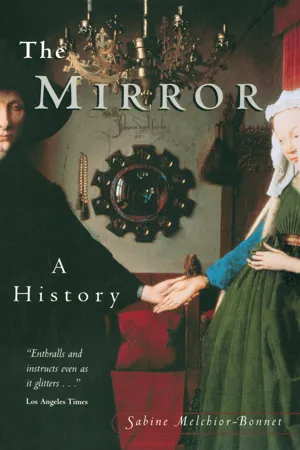
- 224 pages
- English
- ePUB (mobile friendly)
- Available on iOS & Android
eBook - ePub
About this book
This engaging and witty cultural history traces the evolution of the mirror from antiquity to the present day, illustrating its journey from wondrous object to ordinary trinket. With its earliest invention, the mirror allowed us to gaze upon ourselves, bestowing a power both fascinating and terrifying.
Part One
The Origin of the Mirror
I will have a magnificent drawing room. ...I shall have three mirrors in there, each seven feet high. I have always liked that kind of somber, magnificent decoration. “I wonder what the measurements are of the largest mirror they make at Saint-Gobain?” And the man who had just spent three-quarters of an hour thinking of taking his own life promptly climbed on to a chair to hunt in his bookshelves for the Saint-Gobain mirror catalogue.
—Stendhal, Armance
1
The Secret of Venice
Metal Mirrors and Glass Mirrors
The First Mirrors
Even though the mirror was for centuries a rare object endowed with magical and often disturbing powers, it would be wrong to speak of a pre-mirror and a post-mirror schism. Man has been interested in his own image since prehistoric times, using all sorts of expedients—from dark and shiny stones to pools of water—in order to catch his reflection. The myths of Narcissus, who is enchanted by his own image, and Perseus, who makes Medusa see herself in his shield, bear witness to this early curiosity toward reflecting surfaces. Indeed, even in his own shadow, man had already found his double. He had to wait centuries, however, before he could obtain a bright, clear, and true image of himself. The metaphorical distance from the polished surface of a small lead mirror to the great mirrors manufactured by the Saint-Gobain Company is about the same as that between oilpaper panes and the glass display windows of department stores. The act of seeing oneself between two mirrors— whether in profile or from behind—is, in proportion to the scale of history, very recent.

Greek mirror carried by a slave (c. 440 B.C.). Cambridge.
Ancient Mediterranean civilizations were obsessed with beauty. Mycenea, Greece, Etruria, Rome and, before them, Egypt, made mirrors of metal, most often by mixing an alloy of copper and tin.1 Bronze was also used, but in very thin sheets to minimize rusting. Appropriately, the invention of the mirror was attributed to Hephaistos, the Greek god of fire and metal. Scenes of elegant Corinthians gazing at themselves in small disks of polished metal attached to handles or footstands and sometimes decorated on the back with mythological scenes can be seen on antique pottery from the fifth century B.C. More refined mirrors were made of silver, or more rarely, of gold; silvering and gilding were applied with heat. Nearly always rounded, these mirrors were either concave or convex, the former enlarging the size of the reflected object, the latter reducing it. Ancient mirrors were generally very small—roughly five to eight inches in diameter—and were used primarily in three ways: as pocket mirrors enclosed in cases; as grooming mirrors equipped with a welded handle and a ring so they could be held before a master’s face by his slave while he went about his daily grooming and then hung on the wall; and finally, as stationary mirrors propped on a three-legged stand, which often depicted a feminine or masculine silhouette. Scrolls, palms, and crowns decorated the metal or wood frames of the polished disk. Their owners took great care of them and protected them from rust, stains, and scratches with fabric coverings, remnants of which are still visible in the specimens that exist today.
Mirrors similar to Greek ones with handles, footstands, and cases have been found in the tombs of Etruscan women. As for wealthy Roman women, their inability to deprive themselves of such objects merited this reprimand by Seneca, “For a single one of these mirrors of chiseled silver or gold, inlaid with gems, women are capable of spending an amount equal to the dowry the State once offered to poor generals’ daughters!”2 Romans later invented new shapes, producing square or rectangular mirrors, perhaps borrowed from the Etruscans, with ivory handles. Fine sponges were attached to the frames and were used to clean the metal, which needed to be polished before each use. Eventually servants themselves acquired mirrors, and silver surpassed bronze as the preferred metal. Under the Roman Empire, mirrors were also used by men. Lucius Apuleius, the philosopher and writer, owned one, and satirical poet Juvenal mocked the emperor Otho, who counted his mirror among the principal pieces of his military equipment! Among the most wealthy, mirrors reached such large proportions that one’s entire body could be viewed in them: Specula totis paria corporibus [Mirrors equal to the whole of the body], said Seneca. In exceptional cases, even the walls of apartments were sometimes inlaid with mirrors.3
Besides metal, Romans also valued obsidian, a very black and transparent volcanic rock, for its reflective powers, even though, as Pliny the Elder, author of Natural History, noted, this stone “reveals the shadows of objects much more than the objects themselves.”4 Pieces of polished obsidian more than six thousand years old have been found in Anatolia. Pliny, who collected abundant documentation on the different materials used in his time, also mentions mirrors of black carbuncle, and emerald mirrors that belonged to the emperor Nero. Some of these mirrors were used to adorn palaces. Nero covered his Domus Auria (“golden house”) with reflective phengite (a type of mica) that “gave offsuch a dazzling glow that they overpowered the natural light of day.”5 Seneca remarked, “He is truly poor whose room is not lined with a few panes of glass.”6 Pliny recorded that the emperor Domitian, susceptible to great anxieties, had the walls of his porticos covered with squares of phengite, so that he could view what was going on behind him as he strolled, and thus was able to arm himself in advance against the dangers that he believed threatened his life.7
Whether the ancients were familiar with glass mirrors is a matter of debate.8 Only two written references have been found; the first by a commentator on Aristotle, Alexander of Aphrodisias, in the third century A.D., and the second is found in the work of Pliny the Elder, who attributes the invention of glass mirrors to the inhabitants of Sidon (now Saida in Lebanon), “makers of glass.” Glass mirrors that have been found in archaeological digs date back no further than the third century A.D. Dozens have been inventoried, primarily from Egypt, Gaul, Asia Minor, and Germany. They are extremely small (from roughly under one to three inches in diameter), and their usefulness was limited; indeed, they make one think of amulets or jewelry rather than of objects for grooming. The 1895 digs at Antinoë in Egypt uncovered some small, well-preserved convex mirrors, roughly carved and backed with lead: one was set in a frame of plaster, the other, in a small metal crown, between the hands of a young girl. Slightly colored, the glass capsule was made with a blowing rod, and in the convex curve behind the lens there is a layer of melted lead, on which a coating of gold or of tin was applied. Variations on this mirror-making process prevailed for centuries. Given the difficulty of the procedure and the poor quality of the results, metallic mirrors were preferred over glass for many years to come.
The Arrival of Glass Mirrors
As long as a technique for producing flat, thin, and clear glass remained elusive, and as long as it was impossible to spread a hot layer of metal onto glass without causing breakage induced by thermal shock, the glass mirror could never exceed a small tea saucer in size. Progress was slow and benefited from all sorts of indirect contributions. The first obstacle to overcome was the opaque quality of glass. Composed of sand containing iron oxide, early glass gave offa blue-green hue that diminished its transparency. Attempts at decoloration through the addition of manganese oxide resulted in glass of a dirty yellow or gray color and produced air bubbles. Results were somewhat improved when the proportions of ingredients in the glass itself were modified: repeated attempts at adding a mixture of soda, potash, and fern ashes to limestone and manganese eventually produced the desired colorlessness. Still, glassmakers during the Middle Ages were, for a long time, more successful at producing colored glass and jewelry stones than clear glass.
A second difficulty consisted in making glass regular and flat enough to serve as plate or stained glass windows. Théophile the monk, a twelfth-century scribe, made numerous references in his writings to contemporary glassmaking techniques. French glassmakers were considered masters of the art, and in his writings, Théophile revealed their formula—two parts beech tree ashes to one part washed sand—and their method, glassblowing procedures inherited from the ancients.9 This technique was perfected throughout the Middle Ages: while the ball of glass was attached to a stem and blown, it was rotated rapidly; the glass flared out into a sort of tray from which very small irregular squares were cut and then set in lead to serve as windowpanes.
The technique of cylindrical glassworking—the only process that permitted the manufacture of mirrors—was the next step. A regular, cylindrical “sleeve” was blown through a straw; the two ends were cut offand the whole piece was spliced lengthwise and spread over a flat hearth. Glass produced in this way had a natural shine and was of a fairly uniform thickness. But there was much breakage before the technique was mastered, and for a long time oiled paper was preferred for windows over expensive glass panes. In a famous story, the duke of Northumberland, upon leaving his castle, had all of the glass panes in his windows removed to ensure their safety during his absence!10 When Marie de Médicis replaced her stained-glass windows with clear glass, it was regarded as an unprecedented luxury. In 1674, during Louis XIV’s siege of Dôle, La Grande Mademoiselle (Anne-Marie-Louise d’Orléans, duchess of Montpensier) decamped to a country house where, she remarked disparagingly, all the window frames were made of paper except one, fitted with glass panes and “even then the middle of the glass was a lamp bottom!”11 In short, the glass window was rare and small in the early years of the eighteenth century and alongside clear glass, oiled paper was still much in use: Didérot’s 1781 Encyclopédie describes the work of chassissiers, professionals who covered windows with paper.
To the general difficulties of glass manufacture, mirror making adds the complication of reflective silvering. As mentioned previously, one ancient technique, used by the Romans, consisted in applying hot lead to a layer of glass, but the glass layer that served as a support had to be fairly thin and regular to resist the heat. After the ball of glass was blown, melted lead was poured into a concave bowl and was then removed. The mirror was never larger than what could be cut from the glass ball, and

Quentin Metsys, The Moneychanger and His Wife (1514). Louvre, Paris, France.
the curvature gave it a bulging shape that can be found in Flemish paintings and German engravings of the fifteenth and sixteenth centuries. This is the mirror on the table in Quentin Metsys’s Moneychanger and His Wife and on the bedroom wall in Van Eyck’s Arnolfini Portrait; no larger than a tea saucer and reflecting a distorted image. One hundred fifty years later, Velásquez’s Las Meninas, and De Witte’s Woman at the Keyboard present perfectly flat mirrors of larger dimensions.
Many ancient texts mention mirrors silvered with lead and boast of the clarity of their reflections, but clarity is relative. In his Speculum majus (c. 1250), Vincent de Beauvais judged glass mirrors “silvered” with lead to be superior to those of polished metal because “glass is a better receptor of light rays due to its transparency.” Soon thereafter, John Peckham, a Franciscan from Oxford, wrote a treatise on optics that mentioned glass mirrors covered in lead along with mirrors of steel, copper, and polished marble. He noted that if the lead was scraped away from glass mirrors, no image could be reflected.12
The technique of silvering mirrors made rather slow progress. In the thirteenth century, small, rounded mirrors were made in Basel and exported to Genoa.13 In the fourteenth century, Florentine artisans learned how to apply lead without heat and soon lead was being replaced with tin or pewter. The Venetian alchemist Fioravanti speaks of German mirror makers who applied a “mixture of lead, tin, silver and wine sediment to the globe of the glass. They brush it on and the mixture attaches itself to the glass; then, they cut the globes into round pieces that become the aforementioned mirrors.”14 Traffic in quicksilver through Anvers at the beginning of the sixteenth century indicates that mirror makers were then using mercury for silvering. This technique circulated throughout northern Europe. As luxury objects, mirrors became widespread in châteaux, then in bourgeois homes in the cities, and eventually were sold at major fairs. But they did not replace the larger and more easily handled steel mirrors that were used for daily grooming.
The silvered glass mirror produced only a very imperfect image and the curious enjoyed them especially for their optical distortions: in the château of Hesdin, in the fifteenth century, the accounts of the financial manager of the duke of Burgundy reveal that at the door of the entrance gallery there was a “mirror with several visible stains” in which visitors who looked at themselves appeared disfigured. Moreover, notes a contemporary, “one sees someone else there rather more than oneself.”15 Of modest dimensions, these mirrors served mostly as architectural and personal decoration. They were sometimes attached to clothing and can be found, rather surprisingly, in religious ceremonies. Early in his career as a metallurgist, after having succeeded in making metal and then glass mirrors, Johannes Gutenberg sold them to pilgrims traveling to Aix-la-Chapelle (now Aachen in Germany, the site of Charlemagne’s shrine), so they could attach them to their hats. Pilgrims believed that mirrors were able to attract and capture the grace emanating from holy relics, despite the crowds that prevented them from getting close to the altars and relics themselves.16 The prodigious properties of mirrors, studied by scholars from the Middle Ages, and in particular by the famous Oxford school, did not fail to interest literary writers as well. Jean de Meung, the thirteenth-century poet, dedicates two hundred and fifty lines of the Roman de la Rose to the “marvelous powers of the mirror.”17 At the time, most commentators viewed science and the supernatural as intimately linked, and as an art of fire, the manufacture of glass shored the prestige of the alchemist’s quest for the philosopher’s stone. The transformation of half-solid, half-liquid molten glass into a transparent and rigid substance indeed seemed like alchemy.
Thanks to a valuable witness, Volcyr de Sérouville, secretary to the duke of Lorraine, we have a methodical study of the techniques and centers of mirror production in the duchy in the early sixteenth century. A curious and precise observer, he admits a fascination for “this marvelous artifice.”18 Thanks to him we know how the worker pierced the molten glass with “an iron attached to the end of a stick,” how he pulled out “the glowing timber which, once blown and rolled out on a plank became so round and swollen that it took the form and size of large, average and small mirrors, as needed.” The worker then applied lead “with great skill in order to reveal the luster and reverberation of those things placed in front of said mirrors.” In elaborating at length on the properties of the mirror and the reproduction of the image, “a process in which clarity [is] distilled from matter,” the author seeks to share his admiration with an ignorant reader to whom he can explain at once both the causes and the effects of the reflection.
Volcyr lists next the great glass-producing centers of Lorraine of his era: Banville-aux-miroirs, Saint-Quirin, Raon, Nicolas-Blamontois. Their reputation extended “far beyond Christianity,” affirms another chronicler, who proudly concludes: “there are no people as ingenious as the Lorrains, who have invented a way to make mirrors of glass.”19 Mirror manufacture in Lorraine eventually declined under the weight of wars and Venetian competition.
The Venetians still challenge the Lorraines over who was the first to perfect glass making. In fact, from the second half of the fifteenth century, glassmakers from Murano knew how to make a glass so pure, white, and fine that they called it “crystalline”...
Table of contents
- Cover Page
- Half Title page
- Title Page
- Copyright Page
- Contents
- Translator’s Note
- Preface
- Introduction
- Part One The Origin of the Mirror
- Part Two The Magic of Resemblance
- Part Three Troubling Strangeness
- Conclusion
- Notes
- Index
Trusted by 375,005 students
Access to over 1.5 million titles for a fair monthly price.
Study more efficiently using our study tools.
Frequently asked questions
Yes, you can cancel anytime from the Subscription tab in your account settings on the Perlego website. Your subscription will stay active until the end of your current billing period. Learn how to cancel your subscription
No, books cannot be downloaded as external files, such as PDFs, for use outside of Perlego. However, you can download books within the Perlego app for offline reading on mobile or tablet. Learn how to download books offline
Perlego offers two plans: Essential and Complete
- Essential is ideal for learners and professionals who enjoy exploring a wide range of subjects. Access the Essential Library with 800,000+ trusted titles and best-sellers across business, personal growth, and the humanities. Includes unlimited reading time and Standard Read Aloud voice.
- Complete: Perfect for advanced learners and researchers needing full, unrestricted access. Unlock 1.5M+ books across hundreds of subjects, including academic and specialized titles. The Complete Plan also includes advanced features like Premium Read Aloud and Research Assistant.
We are an online textbook subscription service, where you can get access to an entire online library for less than the price of a single book per month. With over 1.5 million books across 990+ topics, we’ve got you covered! Learn about our mission
Look out for the read-aloud symbol on your next book to see if you can listen to it. The read-aloud tool reads text aloud for you, highlighting the text as it is being read. You can pause it, speed it up and slow it down. Learn more about Read Aloud
Yes! You can use the Perlego app on both iOS and Android devices to read anytime, anywhere — even offline. Perfect for commutes or when you’re on the go.
Please note we cannot support devices running on iOS 13 and Android 7 or earlier. Learn more about using the app
Please note we cannot support devices running on iOS 13 and Android 7 or earlier. Learn more about using the app
Yes, you can access The Mirror by Sabine Melchoir-Bonnet, Katharine Jewett in PDF and/or ePUB format, as well as other popular books in History & History of Art. We have over 1.5 million books available in our catalogue for you to explore.