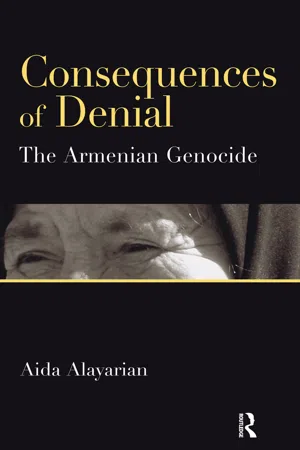
"Consequences of Denial" seeks to provide some awareness and understanding of the horrendous tragedy of the Armenian genocide. This book illuminates the little known fact that over two million innocent Armenians died at the hands of the Ottoman Empire between 1894 and 1922; a genocide that has been, and continues to be, denied by successive Turkish governments. In this book, the author demonstrates the need not only for remembrance, but first and foremost for the acknowledgement of genocides, from government level downwards. Only by taking adequate steps at personal, group, national and international levels to acknowledge such massacres, and the trauma they create, can humankind attempt to prevent such atrocities from ever happening again. By documenting the psychological effects of the forgotten Armenian genocide and by linking these effects to crossgenerational trauma and processes of response and denial, this book aims to shed light from a psychoanalytic perspective on an insufficiently researched aspect of this genocide.
- 230 pages
- English
- ePUB (mobile friendly)
- Available on iOS & Android
eBook - ePub
About this book
Information
Part I
The Armenian Genocide and Trauma
Chapter One
History of the Armenian genocide to the present day
“What unites most races, and keeps them together that way is not the manifestation of love, or friendship, nor the respect they have for one another. It is the common hatred they feel against their enemies”
(Chekhov, 1920)
Before Rwanda and Bosnia, and before the Holocaust, the first genocide of the twentieth century happened in Turkish Armenia. This was a terrible precedent that has come to haunt Armenians, Kurds, and Turks, as well as others throughout the twentieth century and beyond.
In trying to find out why genocide is happening, one needs to see how people in a community come to fall outside the constrictions of moral responsibility and commitment. It is also necessary to think and reflect in order to identify what it is that admired illusions and complicated enquiries concerning the nature of individuals, of nation-states, and of civilization. It is important to investigate to see what is the psychological mechanism that compels individuals to become part of a process of mass destruction. Is genocide an historical deviation or aberration, or an integral part of the culture of civilization that may impart a sense of inequality, of superiority and power?
Concerning the Armenian genocide, as time has passed the Turkish government has continued not only to remain silent about it, but also to adamantly and consistently deny that any genocide was committed against the Armenians, bringing about a type of social amnesia or a mode of forgetting in which almost a whole society separates itself from its discreditable past. This kind of collective denial may happen at an organized, official, and conscious level, through deliberate cover-ups and the inaccurate recording of history, or through the type of cultural slippages that occur when information disappears. Successive Turkish governments have continued this official state denial for more than ninety years from the official memorial day of the genocide and more than a century since the beginning of systematic killings, through the use of deliberate propaganda, “forged documents”, suppression and destruction of archives, and “bribing scholars” or, when bribery was unsuccessful, “persecuting and executing” them (Dadrian, 1995).
If we approach these issues from a developmental perspective, we can see that our understanding of an adult psyche is fundamentally different from that of a child, who depends for its healthy development on interaction with other people who are sufficiently benign and reflective—this is inherently intersubjective, requiring relationships between subjects for the individual to develop a capacity for self-reflection.
Recent developments in the acknowledgement of the Armenian genocide
There has been a strong relationship between the United States of America and the Turkish government, in which Turkey aligns itself in a special relationship with the USA and acts as a regional base for the American military to supply their forces in Iraq and Afghanistan. None the less, in October 2007, the USA for the first time officially challenged the Turkish denial, disavowal, and refusal to acknowledge the Armenian genocide.
On 10 October 2007, the US House of Representatives Foreign Affairs Committee was expected to approve a bill that called on the USA to recognize the Armenian genocide. However, President George W. Bush promptly urged United States legislators not to pass a resolution declaring the killing of Armenians by Ottoman Turks to be genocide. Just before the Foreign Affairs Committee began debating the resolution, Bush warned of the enormous and negative impact of such a resolution being passed, not only on the USA, but worldwide, claiming that “This resolution is not the right response to these historic mass killings, and its passage would do great harm to our relations with a key ally in Nato and in the global war on terror” (Goldenberg, 2007).
This seemed to be a panic response from President Bush to the Turkish Prime Minister, Recep Tayyip Erdogan’s reaction; he threatened that the bill’s passing would result in a “significant weakening” of his country’s ties with the USA. President Bush was not the only person in panic; many of his political colleagues were also anxious about the issue. One of them was US Secretary of State, Condoleezza Rice, who claimed that “the passage of this resolution at this time would be very problematic for everything we are trying to do in the Middle East”. Defence Secretary Robert Gates felt that “Access to airfields and to the roads and so on in Turkey would very much be put at risk if this resolution passes and Turkey reacts as strongly as we believe they will.” This tie is so significant for the USA because, at that point, 70% of their air cargo passed through Turkey on its way to Iraq and Afghanistan, along with about one third of the fuel utilized by their military forces (Guardian Unlimited, 2007).
This would not be the first time that Turkey reacted to the issue in an extreme manner. Relations between France and Turkey in October 2006 serve as a good example. The national assembly of France voted to regard as a crime the denial that the Armenians suffered genocide between 1915 and 1917, and recommended the punishment of one year’s imprisonment and a fine of 45,000 Euros for anyone who did so (Chrisafis, 2006). Turkish authorities were so angry that they went as far as to terminate all defence contracts with France.
Evidence of the threat from Turkey if such a resolution was passed can be seen in a quote by the US embassy in Ankara, who issued a statement saying that:
If, despite the administration’s concerted efforts against this resolution, it passes committee and makes its way to the floor of the House for debate and a possible vote, there could be a reaction in the form of demonstrations and other manifestations of anti-Americanism throughout Turkey. [Guardian Unlimited, 2007]
Yet, on 10 October 2007, despite pleas from the White House to reject the resolution, the House’s Foreign Affairs Committee voted in favour of the official US recognition of the Armenian genocide, by twenty-seven votes to twenty-one. The majority of support came from the Democrats, including the speaker, Nancy Pelosi. By 17 October 2007, however, this group of Democrats, having voted one week earlier for the official US recognition of the Armenian genocide, suddenly withdrew their support. They claimed that they withdrew the resolution to protect relations with Turkey at what they viewed as a critical time in global history. As if to prove them right, just as the Democrats withdrew this resolution, Turkey’s parliament was voting to give its military the authority to enter northern Iraq to attack several thousand Kurdish guerrillas based there. It is a sad reality to see how politics overshadow what is right and what is wrong. It is also an indication that generations after Young Turks and the Ottoman Empire, the Turkish government is still willing to create a power to kill when they wish, even if the whole, or the majority of, the international community is against this. This also raises the issue of whether all these discussions and arguments actually had their roots in an attempt by America to prevent the Turkish authority from killing Kurds, rather than real concern and acknowledgement of the Armenian genocide.
In recent years, especially during the past two decades, there have been some more substantial affirmations of the Armenian genocide by scholars, states, and international organizations. These affirmations are a matter of recognition, not the legislation of truth; although they do offer recognition that the Turkish government’s denial is essentially political and not a historical representation of reality. In contrast, some states have aided Turkey in its denial out of convenience, rather than acceptance of Turkish arguments.
The Armenian campaign for recognition, acknowledgement, and condemnation of what happened has been going on for decades worldwide, and has been supported by many non-Armenians who believe in human rights. As a result of these ongoing campaigns, the European Parliament voted to recognize the Armenian Genocide in 1987 and in 1990. Bill Clinton, former President of the USA, issued a news release (1987) calling on all Americans to join with Armenians in commemorating the Armenian Genocide on 24 April. The Israeli Deputy Foreign Minister, Yossi Beilin, on 27 April 1994, in answer to the claims of denial by the Turkish Ambassador, said, “It was not war. It was most certainly massacre and genocide, something the world must remember”.
In contrast to Yossi Beilin, a few years later, on 10 April 2001, the Foreign Minster of Israel, Shimon Peres, was quoted as saying, “We regret attempts to create a similarity between the Holocaust and the Armenian allegations. Nothing similar to the Holocaust occurred. It is a tragedy, but not a genocide”. This statement was repeated by the Israeli Ambassador in Armenia, Rivka Cohen, in February 2002 (Auron, 2003; Demoorjian, 2003). These statements are clearly based on the political situation and foreign policy of Israel and their relations with, and benefit derived from, the Turkish government. It is surprising, but it is also sad, that Israeli ministers so easily change their tone politically. After the Holocaust one would expect that no government in Israel would compromise over such an issue. This type of denial is an escalation from passive to active denial, from moderate denial to hard-line denial, by those other than the Turkish government for political reasons.
Who are Armenians?
Until their persecution, Armenians were seen as belonging to a nation-state. The first record of an Armenian state dates back to the early 6th century BC, and the state itself has a long history of conquering, or being conquered and ruled by, Persians, Byzantines, Arabs, Mongols, and Ottoman Turks. In this regard it is no different from many of its neighbours, who also shared similar fates. However, post-genocide Armenians are now regarded as an ethnic group, despite the declaration of independence of Armenia from the USSR in 1991.1
What is genocide?
Since the term “genocide” has been the source of much heated debate in the Armenian context, it helps to understand how the word is understood and defined.2
The Oxford English Dictionary (Soanes, 2002) describes genocide as: “The deliberate killing of a very large group of people from a particular ethnic group or nation”. So, in plain English, this is what happened to the Armenians.
United Nations Convention
The 1948 United Nations Convention on the Prevention and Punishment of the Crime of Genocide (CPPCG) provides a legal definition of the term. Article 2 of the CPPCG defines genocide as
any of the following acts committed with intent to destroy, in whole or in part, a national, ethnical, racial or religious group, as such: killing members of the group; causing serious bodily or mental harm to members of the group; deliberately inflicting on the group conditions of life, calculated to bring about its physical destruction in whole or in part; imposing measures intended to prevent births within the group; [and] forcibly transferring children of the group to another group. [See Appendix II for full text]
While “genocide” as a legal term was not conceptualized until after the mass persecution of Jews and gypsies during the Second World War, it is a definition that is directly relevant to the mass killing of Armenians by the Ottoman Empire and successive Turkish governments in the late nineteenth and early twentieth centuries.
Historical documentation
A vast amount of reliable historical detail concerning the Armenian genocide is documented mainly on two websites, which I use as the main resources in regard to historical data. Many Armenians in the diasporas have written passionately on this topic, emphasizing that the nature of the genocide was not just about the eradication of the Armenians, but also the extensive destruction of their history and culture. But, much of the historical data and information can be imperfect and, in some cases, contradictory, so, obtaining empirical information by and large can be challenging. Therefore, I owe much of the research on the history of the Armenian genocide website to the Armenian National Institute (http://www.armenian-genocide.org). They have carefully sifted and collated the information available, and seem to provide a comprehensive and reliable source of information on the Armenian genocide.
It is documented that Armenian genocide falls into four stages. In a series of mass murders, the following number of Armenians were killed:
- in 1894–1896, around 300,000;
- in 1909, around 30,000;
- between 1915 and 1916, 1.5 million;
- from 1918 to 1922, about 300,000.
Over two million Armenians in total were killed in an attempt by Ottoman Turkey to exterminate the Armenian nation (Dadrian, 1995), and by 1922 the Armenians had been almost entirely eradicated from their historic homeland.3 Some survivors took refuge under French administrative rule in the Sanjak of Alexandretta. Later, in 1939, when the Turkish authority threatened to occupy the district, many fled to Syria and Lebanon. It is estimated that out of two million Armenians, currently 40,000–70,000 are living in Turkey, mainly in Istanbul.4
History of the Armenian genocide
The Ottoman Empire was a multi-national state from the sixteenth century to its collapse following the First World War, and its territory included historic Armenia. Although by the early twentieth century, this state had become restricted mainly to the Middle East, and although it was still a diverse society, its rulers governed by Turkish authority and maintained institutional favour of a Muslim population. In the main, those of Turkish origin treated Christians and Jews as less important. The Turkish majority was allowed to dominate within the society and to treat Christians and Jews as second-class citizens, justifying their actions with a range of discriminatory laws and regulations imposed both by the state and its Islamic officials.
It is indicated that from 1894 to 1896, Sultan Abdul-Hamid II killed around three hundred thousand Armenians, mostly men, in a series of massacres in 1895. This type of systematic and organized violence by the central authorities and head of state inevitably resulted in widespread hatred and violence towards Armenians by the Turkish.
Initially, these actions took place in response to fear, and the intention was to prevent the growth of Armenian nationalism. The sultan, particularly, was concerned about the growth of Armenian political groups and their possible activity in the civil rights’ movement’s plans for Armenian autonomy. Sultan Abdul-Hamid was quite right to be fearful about the development of the Armenian Nationalists, since any nationalist movement may present a danger for the society in which it occurs. However, his shortcoming was that he did not take into consideration that, like any ethnic or national group within a population, Armenians were not unified and held different political views and/or allegiances to each other. Those who aligned themselves with the Armenian Nationalists and believed in extreme separatism were different in their philosophy from those Armenians who actually advocated the reform of an existing institution and constitution, and different again from those Armenians from small isolated villages, who did not have the knowledge, wish, or capacity for such political activity in the first place. Based on his short-sightedness in seeing the reality of the Armenian movement, the sultan’s decision to destroy the Armenians actually increased their sense of nationalism. As a result, instead of reflecting on his decision to try to identify whether it was right or wrong, he took his action further in order to exclude the Armenians from having a role in their own government, without considering that depriving the Armenians of their political existence was not a sensible way of dealing with the growth of nationalism either.
Balakian, 2003, reports that
In the aftermath of 1878, as Armenian frustration grew, a new Armenian activism emerged. Because article 61 of the Berlin treaty was an obvious hollow clause, Armenian expectations for reform were dashed and, in fact, conditions grew worse. With the treaty of Berlin signed and sealed, Abdul Hamid felt emboldened to send masses of Muslim refugees (muhajirs), whom the Russo-Turkish wars had driven from the Balkans and the Caucasus, into eastern Anatolia. This led to open violence against the Armenians—as murdering, looting, and pillaging were sanctioned. Enraged that the Armenian Question had become an international issue, the sultan by 1890 had created the Hamidiye, a well-trained force made up of Kurds whom he armed and had clothed in distinctive uniforms. [p. 43]
Balakian further suggests that
In forming the Hamidiye (literally, “belonging to Hamid”) regiments the sultan could both control the unruly Kurds and at the same time use them to deal with the Armenians as he wished. The lands over which the Kurdish nomads roamed bordered on and often dovetailed with those of the Armenian peasants, whom the Kurds resented for their relative prosperity. It was the old scheme of divide and conquer. [ibid., p. 44]
However, in 1908, the Turkish government was overthrown by a group of reformists known as the Young Turks; and otherwise known as the Committee of Union and Progress (CUP), who decided to “Turkify”5 the multi-ethnic Ottoman society in order to safeguard the Ottoman state’s remaining in power, and to prohibit any aspirations or demands of the various minorities. Refusal to accept or to go along with these measures essentially led to a situation where, by and large, the minorities, and specifically the Armenians, were not treated as equals within the society in which they were living and were therefore unable to integrate. When the First World War broke out in 1914, the Young Turks found a perfect opportunity to clear the country of its Armenian population. They perhaps formed a mental picture of the synchronized victory of an empire in the east, incorporating Turkish-speaking peoples in Iran, Russia, and Central Asia.
Balakian (2003) reported that because Germany was the Ottoman Empire’s closest wartime ally, there is a large body of extraordinary Germany testimony about the Armenian genocide. For example, Colonel Stange, the highest-ranking German guerrilla commander in the Russian–Turkish border region, referred to the chetes as “scum” (Gesindel), who “in the area of Tercan killed without exception all the Armenians of the convoy coming from Erzurum”. This incontestable fact, he wrote, was carried out with the assistance of the military escort. Balakian also reports that German consul Scheubner-Richte...
Table of contents
- Cover
- Half Title
- Title
- Copyright
- Contents
- ACKNOWLEDGEMENTS
- ABOUT THE AUTHOR
- FOREWORD: A FORTUITOUS MEETING
- FOREWORD: RECOGNIZING THE ARMENIAN GENOCIDE
- PREFACE
- INTRODUCTION
- PART I: THE ARMENIAN GENOCIDE AND TRAUMA
- PART II: THE IMPORTANCE OF UNDERSTANDING THE PSYCHOLOGICAL RESPONSE TO GENOCIDAL VIOLENCE
- APPENDIX I: Maps of 1915 Armenian genocide
- APPENDIX II: United Nations Convention on the Prevention and Punishment of the Crime of Genocide
- APPENDIX III: Article 301
- APPENDIX IV: Previous, recent, and current involvement in the question of the Armenian genocide by world leaders, significant figures, and the media
- APPENDIX V: Turkish quotes about the Armenian genocide
- REFERENCES
- INDEX
Trusted by 375,005 students
Access to over 1.5 million titles for a fair monthly price.
Study more efficiently using our study tools.
Frequently asked questions
Yes, you can cancel anytime from the Subscription tab in your account settings on the Perlego website. Your subscription will stay active until the end of your current billing period. Learn how to cancel your subscription
No, books cannot be downloaded as external files, such as PDFs, for use outside of Perlego. However, you can download books within the Perlego app for offline reading on mobile or tablet. Learn how to download books offline
Perlego offers two plans: Essential and Complete
- Essential is ideal for learners and professionals who enjoy exploring a wide range of subjects. Access the Essential Library with 800,000+ trusted titles and best-sellers across business, personal growth, and the humanities. Includes unlimited reading time and Standard Read Aloud voice.
- Complete: Perfect for advanced learners and researchers needing full, unrestricted access. Unlock 1.5M+ books across hundreds of subjects, including academic and specialized titles. The Complete Plan also includes advanced features like Premium Read Aloud and Research Assistant.
We are an online textbook subscription service, where you can get access to an entire online library for less than the price of a single book per month. With over 1.5 million books across 990+ topics, we’ve got you covered! Learn about our mission
Look out for the read-aloud symbol on your next book to see if you can listen to it. The read-aloud tool reads text aloud for you, highlighting the text as it is being read. You can pause it, speed it up and slow it down. Learn more about Read Aloud
Yes! You can use the Perlego app on both iOS and Android devices to read anytime, anywhere — even offline. Perfect for commutes or when you’re on the go.
Please note we cannot support devices running on iOS 13 and Android 7 or earlier. Learn more about using the app
Please note we cannot support devices running on iOS 13 and Android 7 or earlier. Learn more about using the app
Yes, you can access Consequences of Denial by Aida Alayarian in PDF and/or ePUB format, as well as other popular books in Psychology & Genocide & War Crimes. We have over 1.5 million books available in our catalogue for you to explore.