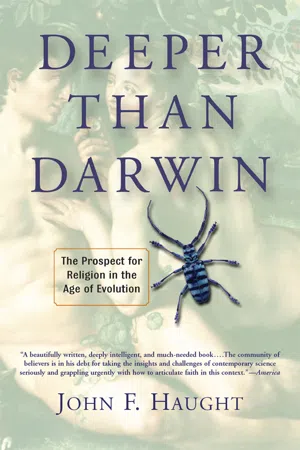
In his acclaimed book God After Darwin, John Haught argued that religious belief is wholly compatible with evolutionary biology. Now, in Deeper Than Darwin, he advances his argument further by saying that religious belief is even more revealing about life than Darwinism. Haught looks hard at the question of how, after Darwin, religions may plausibly claim to be bearers of truth and not just of meaning and adaptive consolation. While he assumes the fundamental correctness of evolutionary biology, he firmly rejects the non-scientific belief that evolutionary biology amounts to an adequate explanation of living phenomena. Even though Darwinism is illuminating, Haught argues, it by no means tells us everything we need to know about life, even in principle. To find the deepest, though certainly not the clearest, understandings of life and the universe, we may still profitably consult the religions of the world. Deeper Than Darwin takes up where God After Darwin left off, arguing that Darwin's vision is important and essentially correct but that we can still dig deeper in our understanding of what is going on in the life-story.
- 232 pages
- English
- ePUB (mobile friendly)
- Available on iOS & Android
eBook - ePub
About this book
Information
1
Religion and Darwins Truth
What religions have said about the universe does not always appear to correspond with what science reports. Religion and science even seem incompatible at crucial points. And so we are now divided. Some of us look to science to tell us what is real or true. Others, ignorant of science, or distrustful of its methods, continue to fill our minds and hearts with religious images and ideas. A few can keep their scientific knowledge separate from their religious sensibilities and in this way apparently avoid conflict. But, as everyone knows, science now questions the factual basis of much of the Bible, the Quran and other religious texts. How then can those of us who cherish our faiths and live joyfully within their visions of the universe also claim that they place us in touch with what is? Aren’t religions essentially fiction, merely imaginative constructs? Can we any longer take them seriously as pathways to truth?
The Darwinian picture of life, more dramatically than any other development in modern science, tempts us now to place the whole of religion in the realm of illusion. Perhaps nothing challenges the religious notion of a purposeful universe more directly than does evolutionary biology. Moreover, recent versions of Darwinism even claim that our ethical and religious inclinations are nothing more than adaptations, survival mechanisms “put in place to help our genes get into the next generation.”1 Our moral and religious aspirations are guileful evolutionary contrivances deluding us into the groundless belief that we are cared for by a providential reality. Prominent evolutionary psychologists now believe they have exposed all of religion as a grand illusion.2 Religious beliefs, they say, make us feel at home in an otherwise unbearable universe and in this way contribute to our race’s reproductive fitness. But in fact, they claim, religions are empty of referential substance.
In Darwinian perspective the ultimate reason why ideas about the gods persist and religions continue to survive is because they are biologically adaptive. As vehicles of evolutionary cunning, religions motivate us to work hard, raise families and communicate a spirit of trust to our offspring. But now, with Darwin’s help, we have found out what is really going on underneath our religious posturing. It is simply this: Our genes are seeking to get themselves into the next generation. All the rich layers of religious symbolism are, in the final analysis, nothing more than the consequence of our genetic endowment seeking out a circuitous path to immortality. Genes may not be the direct or immediate cause of our specific religious ideas, but they are the ultimate explanation.3
By explaining religion, therefore, evolutionary ideas also seem to explain it away. In Darwinism, if we are to believe some of its adherents, the world is now finally handing itself over completely to human understanding. Francis Bacon’s sensational dream that the human mind can force nature to spill forth all of its innermost secrets appears close to realization. Today an increasing number of scientists think Darwin’s ideas, updated by genetics in the form of “neo-Darwinism,” are about as deep as we can go in our efforts to understand life. It is not surprising then that religious skeptics and critics of theology are also turning to Charles Darwin. If they want science to back their suspicions about the reality of the sacred, they look not so much to Vienna and continental Europe as to Down House in the English countryside. Freud and Marx have lost much of their former luster, and the anti-theistic disciples of Nietzsche, Sartre and Derrida are not interested in getting the seal of science anyway. But for those who still think that science is both authoritative and essentially ruinous to religion, Darwin has become more compelling than ever.
Not only does Darwin’s picture of nature’s indifference seem to give the most convincing reasons yet for scientific atheism, but his powerful idea of natural selection, in combination with our recent knowledge of the gene, also apparently provides the cleanest explanation of why our species became religious in the first place. An increasing number of Darwinians, after countless centuries of human ignorance, claim now to have reached rock bottom in explaining both our own existence and the motivating power of our religions. Science has not only found out what is really going on in nature. It has also found out what is really going on in our religious longing for the sacred.4
Heartwarming Fiction
Obviously it is hard for religious people not to be distressed at the starkness of what Darwin’s net has dredged up from the depths of life. Intriguing as it may be intellectually, the Darwinian account of life hardly provides a space within which spiritual and ethical aspirations can flourish. This is not a logically sound argument for writing it off, of course, but it is reason enough, even for those of us who accept evolution as factual, to ask just how deep Darwin does in fact take us into the heart of the real. Impressed and grateful though we may be for his clarifications, we still have cause to wonder whether his limpid accounts lead us, after all, to the foundational levels of life and religion. To satisfy our longing for meaning in an age of science, some of us may turn to piety or poetry. But enlightened evolutionists caution us that religion and art are merely heartwarming fiction.5 Our genes, they claim, have created adaptive but essentially deceptive brains and emotions that spin seductive spiritual visions in order to make us think we are loved and cared for. But in fact it is all illusion. Darwin has allowed us at last to naturalize religion completely.6
A “naturalized” explanation accounts for religion without having to appeal either to cultural factors or the notion of the “supernatural.”7 The naturalizing of religion and other facets of human culture has gained enormous appeal recently among some Darwinians. What would happen, though, if everyone on Earth suddenly took seriously the claim that religion has a purely natural explanation? Suppose that tomorrow all humans became convinced that their most cherished beliefs are ultimately the products of their genes alone. Wouldn’t all the poetry and piety that had reassured our ancestors lose their power to comfort us today? Having seen religion for what it really is—brilliant illusions fabricated, at least remotely, by mindless genes—won’t even the noblest spiritual visions inevitably fall flat before all lovers of truth? And if religions lose their power to attract us because they are now cognitively suspect, what then will happen to our genes? By learning the “truth” about religion—that our spiritual dispositions are purely natural vehicles in the service of genetic interest—won’t we contribute to species suicide? If the naturalizers of religion really cared about the human future, why don’t they keep their Darwinian revelations to themselves?
Ironically, by alerting us to the genetic flow beneath our religious and ethical “constructs,” the Darwinian psychologists risk making the river run dry. If they follow the dictates of logic, the newly awakened will conclude that all the ideas of ultimacy cherished by naive religious souls throughout generations past are empty of any real content. And religion will no longer have a transformative effect on us once we become assured that it does not lead toward Absolute Reality. If it was adaptive at one time because we thought it was true, religion can no longer be so once we have acknowledged its referential emptiness.
At our best, after all, we humans are truth-seeking beings, and eventually we realize that only candid contact with what is can bring us lasting satisfaction. Certainly the Darwinian debunkers of religion cannot deny this point without self-contradiction. Otherwise, why are they such devout seekers of the ultimate truth about religion? If we were all to assume with them that science alone can retrieve the deepest or most “fundamental” truths about the universe, then our sense of “the sacred” would soon appear to us as emotionally charged fiction at best. We would see through the filminess of religion, recognizing it to be nothing more than a cozy cover-up protecting us from the ultimate meaninglessness lurking beneath the benign surface of nature. If we come to suspect that our religions are not in some very deep sense true, then honesty should compel us to abandon them, once and for all. To tolerate religious ideas as charming inventions or as pre-scientific holdovers of frail human conjecture would be unworthy of truth-seeking beings.
Can Religions Give Us Truth?
Yet, what does it mean to be truthful? To scientific skeptics, there can be no surer road to truth than science. To some so-called postmodern thinkers, neither religion nor science can be “objectively true” because nothing in the arena of thought can claim to be truthful (except, of course, that judgment itself!). But it is still the authority of science, much more than any academically sequestered expressions of postmodernism, that makes religion seem dubious to most sincere skeptics. To many people, both in and beyond the academy, religious ideas do not connect easily with the world that science has opened to our view. And even though skeptics sometimes concede that religion continues to have ethical, aesthetic or emotional import, they find it hard to believe that it contributes anything to our knowledge of what is.
Religions, however, no matter how “counterintuitive” or “counterfactual” they may seem to the scientifically literate, are to their followers profoundly truthful ways of reading the universe. Religious people themselves are convinced that their myths and metaphors are about something, indeed about Absolute Reality.8 If their religious ideas were not taken to be representative of something eminently real, then these same ideas would have no ethical or aesthetic power either. When beauty and goodness are divorced from truth they grow too hollow to stir us.
Even Sigmund Freud, who thought of religion as made up totally by the human imagination, realized that at least to its devotees it is about something real. He himself was convinced, of course, that religion is only a matter of our projecting childish wishes and fears onto an inhospitable cosmos. But he acknowledged that to religious believers themselves faith has a truly cognitive rather than purely projective status. Freud knew that it is only to outsiders such as himself that religion seems to be a mere construct. As far as the devout themselves are concerned, God, salvation, heaven, nirvana, enlightenment and so on are much more than simply aesthetic or ethical adornment of an inherently pointless life. On the contrary, religion is about the deepest of all realities. And although today most theologians grant that, viewed psychologically, there is an imaginative aspect to all religious expression, this does not mean—at least to most of us—that religion is nothing but human projection. Religion, to anyone who takes it seriously, is about what is Most Real.9
Freud predicted that religious people, as they become imbued with the spirit of science, will eventually abandon the conviction that faith conforms to what is. They will come to see the real world as the province of scientific inquiry alone. In his view, if we could only agree that there are no dimensions of reality deeper or more comprehensive than those accessible to empirical investigation, religion would be fully exposed as the enemy of true knowledge. Religious people would then relinquish any notion that there is in fact a transcendent reality or an ineffable depth of meaning that underlies the universe.10
If we add to Freud’s the now even more influential ideas of Darwin, a religious reading of the universe may seem more implausible than ever. The known facts of biology appear to contradict the ideas of religion. It is hard to reconcile evolution’s blind rigor and aimless meandering with the nearly universal religious sense that we live in a purposefully ordered world. Consequently, today, many prominent evolutionists dismiss abruptly any speculations that locate the story of life within a spiritually endowed universe. Rather than fitting nature to religion, it is more appropriate, they argue, to fit religion to a Darwinian account of nature. In this fascinating new perspective, our ancestors became religious only because sacred symbols and stories adapted their scientifically uninformed minds and hearts—and ultimately their genes—to a harsh universe. In a roundabout sort of way, religion promoted their reproductive fitness. In neo-Darwinian perspective, religious symbolism amounts to just one more aspect of adaptive evolution. As for its actual content, religion is pure fantasy bearing no relationship to reality itself. 11
Gould’s Overtures
Some evolutionists actually enjoy telling us that Darwinian accounts of religion have made our species’ sacred dreams completely unbelievable, and that we must therefore choose between science and religion. Sometimes, however, they break the news more gently. Recently, for example, Americas most prolific—and justifiably honored—evolutionist, Stephen Jay Gould (who died after a long illness while this book was in press) tried mightily to soften the devastating theological implications of his own understanding of Darwin. Science and religion, he said, can peacefully coexist. He proposed that any alleged conflict between the two may be overcome if we would just learn to view them as “non-overlapping magisteria” (NOMA). Science and religion, he claimed, are talking about two entirely disparate sets of topics. They should be “equal, mutually respecting partners, each the master of its own domain, and with each domain vital to human life in a different way.”12
The realm of science, according to Gould, is that of “factual knowledge,” and that of religion is “values and meaning.”13 Situated in these separate domains, “how can a war exist between two vital subjects with such different appropriate turfs—science as an enterprise dedicated to discovering and explaining the factual basis of the empirical world, and religion as an examination of ethics and values?”14 Gould was trying to put a distance between himself and the more publicly anti-theistic neo-Darwinians. While candidly professing his own agnosticism, he had awakened apparently to the prospect that in a theistic culture the cause of science education is hardly served by tying Darwin’s ideas as tightly to atheism as do his neo-Darwinian rivals, especially the Tufts philosopher Daniel Dennett and the Oxford evolutionist Richard Dawkins.15 The latter two clearly enjoy brandishing the godlessness they claim to be implicit in Darwin’s revolution. Gould, on the other hand, considered such antics heartless as well as pointless.
However, a closer look at Gould’s writings about science and religion will show that he could reconcile them only by understanding religion in a way that most religious people themselves cannot countenance. Contrary to the nearly universal religious sense that religion puts us in touch with the true depths of the real, Gould denied by implication that religion can ever give us anything like reliable knowledge of what is. That is the job of science alone. As far as Gould was concerned, our religious ideas have nothing to do with objective reality. Scientific skeptics may appreciate religious literature, including the Bible, for its literary and poetic excellence. But they must remember that only science is equipped to give us factual knowledge. Doubters may enjoy passages of Scripture that move them aesthetically, or they may salvage from religious literature the moral insights of visionaries and prophets. After all, the exhortation to live a life of justice and love is always humanly respectable. Still, Gould could not espouse the idea that religion in any sense gives us truth. No less than Dennett and Dawkins, when all is said and done, he too held that only science can be trusted to put us in touch with what is. At best, religion paints a coat of “value” over the otherwise valueless “facts” disclosed by science. Religion can enshroud reality with “meaning,” but for Gould this meaning is ...
Table of contents
- Cover
- Half Title
- Title Page
- Copyright Page
- Dedication Page
- Contents
- Preface
- Introduction
- 1 Religion and Darwins Truth
- 2 A Reading Problem
- 3 The Depth of Nature
- 4 Deeper Than Despair
- 5 Beneath Evolution
- 6 Deeper Than Dawkins
- 7 Deeper Than Design
- 8 Religion and Deep Darwinism
- 9 Truth After Darwin
- 10 Darwin and the Deities
- 11 Deeper Than Death
- 12 A Deeper Theology
- 13 Darwin, God and the Search for Extraterrestrial Intelligence
- Notes
- Index
Trusted by 375,005 students
Access to over 1.5 million titles for a fair monthly price.
Study more efficiently using our study tools.
Frequently asked questions
Yes, you can cancel anytime from the Subscription tab in your account settings on the Perlego website. Your subscription will stay active until the end of your current billing period. Learn how to cancel your subscription
No, books cannot be downloaded as external files, such as PDFs, for use outside of Perlego. However, you can download books within the Perlego app for offline reading on mobile or tablet. Learn how to download books offline
Perlego offers two plans: Essential and Complete
- Essential is ideal for learners and professionals who enjoy exploring a wide range of subjects. Access the Essential Library with 800,000+ trusted titles and best-sellers across business, personal growth, and the humanities. Includes unlimited reading time and Standard Read Aloud voice.
- Complete: Perfect for advanced learners and researchers needing full, unrestricted access. Unlock 1.5M+ books across hundreds of subjects, including academic and specialized titles. The Complete Plan also includes advanced features like Premium Read Aloud and Research Assistant.
We are an online textbook subscription service, where you can get access to an entire online library for less than the price of a single book per month. With over 1.5 million books across 990+ topics, we’ve got you covered! Learn about our mission
Look out for the read-aloud symbol on your next book to see if you can listen to it. The read-aloud tool reads text aloud for you, highlighting the text as it is being read. You can pause it, speed it up and slow it down. Learn more about Read Aloud
Yes! You can use the Perlego app on both iOS and Android devices to read anytime, anywhere — even offline. Perfect for commutes or when you’re on the go.
Please note we cannot support devices running on iOS 13 and Android 7 or earlier. Learn more about using the app
Please note we cannot support devices running on iOS 13 and Android 7 or earlier. Learn more about using the app
Yes, you can access Deeper Than Darwin by John Haught in PDF and/or ePUB format, as well as other popular books in Theology & Religion & World History. We have over 1.5 million books available in our catalogue for you to explore.