- 192 pages
- English
- ePUB (mobile friendly)
- Available on iOS & Android
eBook - ePub
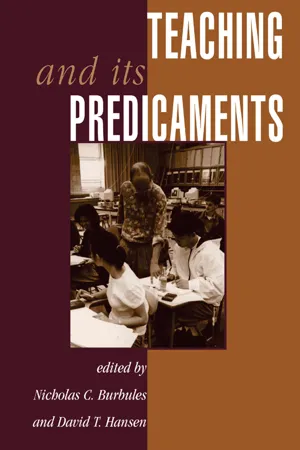
Teaching And Its Predicaments
About this book
Teaching is a complex and challenging endeavour. Teachers are continually faced with difficult choices in which competing values are set in tension with one another. The interests of all students, and of other groups and constituencies, can rarely be served at the same time. Different educational goals, each desirable in and of itself, often place
Information
1
Introduction
______________
A predicament is a problematic state of affairs that admits of no easy resolution. Predicaments require compromise and trade-offs. They do not necessarily paralyze human action; people can and do respond to them all the time. However, responses to predicaments tend to take the form of provisional, working resolutions: provisional because no response can permanently dissolve the predicament, but working because the response at least provides a strategy or a way of addressing the situation. Complex human endeavors, such as parenting, friendship, marriage, and teaching, all feature distinctive predicaments. Teachers cannot dictate what their students learn or the attitudes their students develop toward education. The reality of human individuality and the diversity of human interests means that predicaments such as these will persist for as long as parenting, teaching, and similar endeavors do.
Fortunately, life is not as daunting as the previous paragraph may suggest. Practices such as parenting and teaching do have their ongoing problematic dimensions. But they also yield incalculable fulfillment. Generation after generation would not willingly engage in those pursuits if they were not meaningful. Countless numbers of people have found a sense of self and identity in these very endeavors. For them, parenting and educating are purposeful activities that render human life into something other than random, aimless, or chaotic. Their work gives life form and direction and, in so doing, creates the possibility of growth, accomplishment, and joy.
Nonetheless, most people would probably agree that endeavors such as parenting and teaching are punctuated by difficulties and problems. Many would go further. They would suggest that misunderstandings, conflicting needs and values, unfulfilled hopes, and unmet expectations—in short, predicaments—are part of the ethos of such practices.
This book presents nine essays that identify and discuss predicaments in teaching. The authors are experienced researchers and teachers who are attuned to the nature of everyday classroom practice and to the kinds of pressures and problems teachers encounter in varied settings. The contributors take their point of departure from a shared perspective: that teaching is an invaluable, irreplaceable human endeavor, but one that is also indeterminate. The authors believe that teachers play a vital role in fueling the well-being of society, but they also argue that the teacher’s world is characterized by uncertainty, ambiguity, and sometimes irreconcilable expectations. Those conditions make teaching unpredictable. Teaching at all levels of the educational system is alternately surprising, frustrating, delightful, and dispiriting. This indeterminacy holds in even the most favorable circumstances.
This book has been written for a broad audience: prospective teachers, experienced practitioners, teacher educators, researchers who study teaching, policymakers, and members of the public interested in learning more about conditions in the classroom. The contributors do not aim at resolving the predicaments of teaching—something the authors do not believe is possible. Rather, their purpose is to illuminate new ways of perceiving those dilemmas, to make them more manageable, less debilitating, and perhaps even a source of interest and inquiry on the part of teachers, prospective teachers, and others who care about the practice.
Each chapter can be read independently, depending on readers’ inclinations and interests. However, the order in which the chapters appear is intentional. Chapters 2 through 4 examine predicaments generated by what might be called the culture of educational practice today. That culture produces a host of expectations and demands on teachers that can create difficult if not impossible challenges. Chapters 5 and 6 discuss predicaments that emerge from a broader origin, namely societal conditions writ large. Those conditions press down on teachers—who may not be aware of the source of the pressure—in ways that can trouble their classroom work. Chapters 7 through 10 illuminate predicaments that come more directly from within the practice of teaching. These are predicaments that, in some cases, simply cannot be avoided regardless of the prevailing educational culture or societal atmosphere.
This way of distinguishing the chapters, however, is neither hard nor fast. The chapters overlap considerably in terms of the authors’ concern both for the broader circumstances in which teachers work and for the immediacies of everyday practice. Recurring themes cut across the individual contributions. We hope that readers find something of value in each of them.
* * *
In Chapter 2, Robert E. Floden points out that educational reforms often call on teachers to teach more than they know or understand. Floden focuses on contemporary calls for teachers not only to “deliver the goods”—the traditional image of what teachers do—but also to help students understand the logic and structure of subject matter. He points out that this expectation demands knowledge and experience that many teachers have never had. In many cases, their own education has not provided them an “insider’s” understanding of, for example, the nature of historical thinking and interpretation. But they are suddenly asked to teach this very material to students. After describing some of the tensions and difficulties (and anxieties) this predicament engenders, Floden argues that teachers do not have to respond by taking on the Olympian task of mastering a subject inside and out, including its underlying epistemological and logical structures. There is no need, Floden implies, for teachers to assume the burden of what has been called the “Atlas complex,” in which teachers perceive themselves as having to be all-knowing and all-wise.1 Instead, Floden suggests, teachers can engage students more actively in learning and can also make enhanced use of curricular materials and computer technology. In other words, rather than feeling that they must be the exclusive source of knowledge, teachers can learn to assist students in their own inquiry. Floden contends that this kind of response, which he also compares with other possible responses, does not eliminate the predicament of having to teach more than one knows. But he argues that the approach provides teachers with a potentially enlightened method for dealing with it.
Nel Noddings, the author of Chapter 3, might respond to the difficult predicament Floden discusses by asking why teachers should be made to teach subject matter at all, or at least why they should be made to do so with the force and tenacity expected of them. Noddings poses a question that challenges many familiar educational assumptions: Must teachers motivate their students? At first glance, many educators might be startled by the question. Of course teachers need to motivate students. How else can they connect students and subject matter? Isn’t that what teaching is about, at least in large part?
Noddings’s reply is that this is not what teaching should be about. She urges the educational community to rethink what she regards as its well-intentioned but misguided emphasis on teaching common subject matter to all students. She suggests that, in practice, liberals and conservatives share this universalist posture, despite their being at loggerheads on many other issues. To construct her own position, Noddings explores notions of human freedom and also what it means to accept and interact with other human beings as genuinely “other.” She applies this analysis to answer her opening question. In her view, teachers should not be put in the predicament of having to motivate students who may, in effect, not all want the same education. Rather, Noddings argues, “we must work more closely with students’ own motives if we are to succeed in teaching them things we take to be worthwhile and in preparing them for democratic life.”
Floden’s and Noddings’s chapters illuminate how much more challenging teachers’ work is made as a result of externally defined pressures and expectations. In Chapter 4, Robert Boostrom treats another set of broad expectations—or better, assumptions—that cause problems for teachers. Boostrom recalls the familiar lament among educators that too much teaching consists of drills focusing on memorization, rote learning, and step-bystep skill building, all of which, so it is echoed, renders schooling mechanical and boring. Many educators complain that in the urgency to teach students how to read, we forget what it means to enjoy reading and that reading can be a path to new worlds and to changing people’s lives. In short, we forget why human beings might want to read in the first place.
However, Boostrom suggests, while educators deplore what he calls “teaching by the numbers,” they contribute to its ubiquity because of their own educational assumptions. Boostrom discusses widespread but often unarticulated views about knowledge, expertise, and student equality. He argues that those views, without anyone intending them to do so, conspire to entrench practices that emphasize both knowledge transmission and testing procedures designed to determine if the transmission has taken place. In a paradoxical sense, according to Boostrom, educators’ fondest assumptions imprison their practice. Teachers find themselves at the very center of this predicament: They want to teach for meaning, they want to influence for the good the lives of the young, but despite themselves, they continue to fall into transmission-based pedagogical approaches. As do members of the larger educational culture, they find it difficult to abandon hardened assumptions about knowledge, expertise, and students. Boostrom offers no panacea for this predicament. How could he, he might point out, given the depth and breadth of the assumptions that created the predicament in the first place? What we can and must do, he suggests, is undertake the project of seriously questioning those assumptions.
Boostrom also writes that genuine or transformative teaching always implies “giving up” something. That is, to be educated is not just to “add on” information or skills, but rather to undergo a qualitative change in outlook, in attitude, in belief. Nicholas C. Burbules, in Chapter 5, describes the reality of having to give things up in the course of education as one of its tragic dimensions. Burbules focuses on the tragic as an inherent aspect of teaching. He suggests that the complicated, value-laden nature of education virtually guarantees that teachers face repeated trade-offs in their work. For example, Burbules writes, many teachers want to share authority with their students to empower them and create a sense of community in the classroom. However, society then turns around and blames teachers for poor student test scores because the teachers have not doggedly put students through their skill-building paces. Providing another example of a tragic dimension of teaching, Burbules points out that many educators work tirelessly to help students acquire knowledge of subject matter and the ability to perform well in a work environment. But the same educators often wonder about the quality of life in the “adult world,” raising the deeper issue of what makes adulthood (as currently experienced in society) superior to childhood.
In analyzing these and other tensions in teaching, Burbules urges the educational community to temper what he calls its “utopian” expectations. Educators set themselves up for disillusionment by entertaining relentlessly overweening expectations of teachers and students. As a consequence, an unnecessary cloud of disappointment and failure sometimes hangs over the field. Burbules offers the idea of the tragic as a response to those conditions. A recognition of the tragic, he writes, can remind teachers what inspired them to enter their field in the first place. That recognition can help them embrace teaching once again as a terrain of the possible rather than accept it as a scene of the impossible, which it quickly becomes when burdened with unrealistic and contradictory societal expectations.
Burbules and Boostrom both address squarely, albeit in different terms, the fact of loss in education: that to “gain” an education means, at the very least, abandoning some of one’s prior beliefs and assumptions. This dynamic of gain and loss creates a permanent predicament in teaching, but one that, according to both authors, need not lead to a pessimistic or dour assessment of educational practice. Far from it. Each author in his own way suggests that acknowledging loss in education opens the door to a more significant educational experience.
In Chapter 6, Jo Anne Pagano proposes what a meaningful educational experience might look like. Focusing on teacher-student relationships in the university, Pagano urges faculty and students alike to reconceive the terms of their encounter in the classroom. She argues that both parties are subject to intense if sometimes indirect pressure from the media and societal politics. Those forces cajole faculty and students alike into picturing the world in black-and-white terms, into believing there is only one truth, only one correct way to see the world, only one correct curriculum, only one correct approach to teaching.
Rather than accepting this harsh conception of education, Pagano urges, faculty and students should consider the idea of generative criticism as an orientation to teaching and learning. According to Pagano, generative criticism invites teachers and students to resist easy “isms” and to consider the possibility that university education can be a means of growth for all. Rather than bringing out hostility and suspicion, the premises of discourse that Pagano advances encourage empathy and compassion. The implications of generative criticism are like those of reflection as put forth by John Dewey: “Reflection also implies concern with the issue—a certain sympathetic identification of our own destiny, if only dramatic, with the outcome of the course of events.“2 Generative criticism can bring to life dispositions and ideas that help people see beyond the present conflictual terms of discourse, with an eye not on sidestepping disagreement—quite the contrary, Pagano argues—but rather on developing agreement and disagreement that acknowledges our too often battered and subdued hope of creating a more humane world in which to live. Pagano suggests that “troubled times” will recur and will continue to spark difficult predicaments for faculty and students in the university. But she shows how these men and women need not let their educational relations be determined by the oppositional terms in which the media and society as a whole often frame the problems of education.
What happens when teachers experience tension between their educational values and hopes and the philosophy embedded in a curriculum they are asked to teach? In Chapter 7, Elaine Atkins takes up this issue. Like Pagano, Atkins focuses explicitly on university-level education. She describes in detail the experiences of two pairs of faculty members, each of which was asked to teach a fused English/Humanities course embedded in a program whose philosophy Atkins describes as postmodern or poststructuralist. The philosophy assumes that no “fixed truths” reside in literature and that no single or “final” interpretations of a work of literature are possible. The program emphasizes writing assignments that emerge from students’ own responses to the reading and entails considerable peer review and student interaction—rather than, for example, centering on a teacher’s knowledge. In addition, the program urges attention to social and historical contexts in the exploration of literary materials.
Atkins shows how one team of teachers, practicing in harmony with the program’s vision, enacted a rich version of the program’s philosophy. The other team remained at best ambivalent about the program’s aims, and each member more or less clung to a prior, more “traditional” set of values and beliefs about teaching and curriculum. Atkins explores the tensions and ambiguities in the teachers’ curricular deliberations. She embeds her analysis of the two cases in a broader consideration of the often unappreciated power that values and assumptions play in curriculum deliberation. She suggests that teachers, like the rest of humanity, can never fully know or articulate their most deeply held views and beliefs—a fact that can trigger predicaments in curriculum deliberation and perhaps in other collaborative educational ventures as well. But Atkins writes that acknowledging the presence and potential influence of those basic values and beliefs can help teachers bring aspects of them to the surface. That process may generate other predicaments, particularly if a teacher finds that her newly uncovered values are out of sync with a curriculum. However, Atkins implies that such a teacher would be able to control her destiny more directly than would a teacher who was uncomfortable with a curriculum but could not articulate the sources of that discomfort.
In Chapter 8, Kathryn H. Au and Sheila W. Valencia examine curriculum deliberation as it pivots around the always problematic issue of assessment. As the authors report, portfolio assessment is a relatively new venture designed to replace exclusive reliance on instruments such as standardized tests and multiple-choice and fill-in-the-blanks examinations. Portfolio assessment makes possible an ongoing, cumulative record of student learning by drawing together in “folio” fashion students’ work in areas such as reading and writing.
Au and Valencia describe this approach as more than just another tool of evaluation. They regard it as a curricular innovation. Taking portfolio assessment seriously, they argue, compels the teacher to think with greater care about her curriculum, her students’ academic needs and capabilities, and her long-term goals over the school year. Consequently, this form of assessment is not an add-on package that leaves the rest of a teacher’s practices untouched.
The authors walk the r...
Table of contents
- Cover
- Half Title
- Title Page
- Copyright Page
- Table of Contents
- Acknowledgments
- 1 Introduction
- 2 Reforms That Call for Teaching More Than You Understand
- 3 Must We Motivate?
- 4 Teaching by the Numbers
- 5 Teaching and the Tragic Sense of Education
- 6 The Problems of Teacher-Student Relationships in Troubled Times
- 7 Predicaments in Curriculum Deliberation
- 8 The Complexities of Portfolio Assessment
- 9 Understanding and Managing Classroom Dilemmas in the Service of Good Teaching
- 10 Being a Good Influence
- About the Book
- About the Editors and Contributors
- Index
Trusted by 375,005 students
Access to over 1.5 million titles for a fair monthly price.
Study more efficiently using our study tools.
Frequently asked questions
Yes, you can cancel anytime from the Subscription tab in your account settings on the Perlego website. Your subscription will stay active until the end of your current billing period. Learn how to cancel your subscription
No, books cannot be downloaded as external files, such as PDFs, for use outside of Perlego. However, you can download books within the Perlego app for offline reading on mobile or tablet. Learn how to download books offline
We are an online textbook subscription service, where you can get access to an entire online library for less than the price of a single book per month. With over 1.5 million books across 990+ topics, we’ve got you covered! Learn about our mission
Look out for the read-aloud symbol on your next book to see if you can listen to it. The read-aloud tool reads text aloud for you, highlighting the text as it is being read. You can pause it, speed it up and slow it down. Learn more about Read Aloud
Yes! You can use the Perlego app on both iOS and Android devices to read anytime, anywhere — even offline. Perfect for commutes or when you’re on the go.
Please note we cannot support devices running on iOS 13 and Android 7 or earlier. Learn more about using the app
Please note we cannot support devices running on iOS 13 and Android 7 or earlier. Learn more about using the app
Yes, you can access Teaching And Its Predicaments by Nicholas Burbules,David Hansen in PDF and/or ePUB format, as well as other popular books in Education & Education General. We have over 1.5 million books available in our catalogue for you to explore.