- 160 pages
- English
- ePUB (mobile friendly)
- Available on iOS & Android
eBook - ePub
About this book
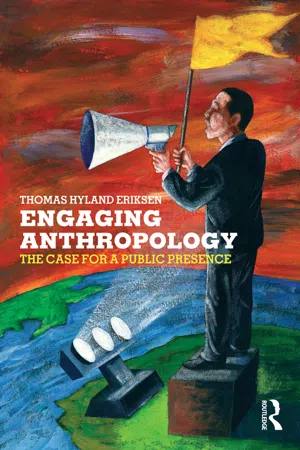
Anthropology ought to have changed the world. What went wrong? Engaging Anthropology takes an unflinching look at why the discipline has not gained the popularity and respect it deserves in the twenty-first century. From identity to multicultural society, new technologies to work, globalization to marginalization, anthropology has a vital contribution to make.While showcasing the intellectual power of the discipline, Eriksen takes the anthropological community to task for its unwillingness to engage more proactively with the media in a wide range of current debates. If anthropology matters as a key tool with which to understand modern society beyond the ivory towers of academia, why are so few anthropologists willing to come forward in times of national or global crisis? Eriksen argues that anthropology needs to rediscover the art of narrative and abandon arid analysis and, more provocatively, anthropologists need to lose their fear of plunging into the vexed issues modern societies present. Engaging Anthropology makes an impassioned plea for positioning anthropology as the universal intellectual discipline. Eriksen has provided the wake-up call we were all awaiting.
Information
1
A Short History of Engagement
Anthropology should have changed the world, yet the subject is almost invisible in the public sphere outside the academy. This is puzzling, since a wide range of urgent issues of great social importance are being raised by anthropologists in original and authoritative ways. Anthropologists should have been at the forefront of public debate about multiculturalism and nationalism, the human aspects of information technology, poverty and economic globalization, human rights issues and questions of collective and individual identification in the Western world, just to mention a few topical areas.
But somehow the anthropologists fail to get their message across. In nearly every country in the world, anthropologists are all but absent from the media and from general intellectual discourse. Their sophisticated perspectives, complex analyses and exciting field material remain unknown to all but the initiates. In fact, whenever anthropologists endeavour to write in a popular vein, they tend to surround themselves with an air of coyness and self-mockery, or they stress that the topic at hand is of such a burning importance that they see no other option than (God forbid) addressing non-anthropologists. Philippe Descola, writing in the context of a French anthropology that has produced popular works of great literary and intellectual value, thus describes his mixed feelings when asked by a publisher to write something about the Jívaro, the Amazonian people he had lived amongst, for a general public (Descola 1996). Retracing the process of writing Les Lances du Crépuscule [The Lances of the Twilight], he admits to feeling ‘an obscure wish to justify to my peers the project of writing an anthropological book “for the general public”’ (1996: 208). He then speculates that the curious reluctance of anthropologists to address general audiences may be caused by an anxiety that the outside world might discover ‘the fragility of the scientific precepts’ fundamental to the subject. In other words, Descola suggests that it may ultimately be a lack of confidence that has caused the cocooning of anthropology. This view has a lot to recommend it although it is partial, and we’ll look at it again below. But first it is necessary to make a brief excursion back in time.
For it was not always thus. Things were in fact going rather well for a long time. The Royal Anthropological Institute in London was founded in 1871 in the spirit of bringing science to the masses, and all over Europe and North America, nineteenth-century anthropology was firmly based in the museums, whose very raison d’être consisted in communicating with the general public. It was only in the second half of the twentieth century that the dominant Anglophone traditions in anthropology turned away from a wider readership and began to gaze inwards. Why did this happen?
Of the men generally recognized as the founding fathers of modern anthropology, neither Lewis Henry Morgan, E. B. Tylor nor James Frazer saw themselves as members of a closed clique, but happily and energetically took part in the debates of their time. Morgan, whose work on social evolution and kinship has had lasting effects, was read eagerly by the likes of Friedrich Engels; Charles Darwin borrowed from Tylor, the originator of the modern concept of culture, when he wrote The Descent of Man. Frazer, the author of the multi-volume Golden Bough, a vast comparative study of myth, was one of the most influential British intellectuals of the early twentieth century, stimulating writers like T. S. Eliot and philosophers such as Ludwig Wittgenstein. Dealing with the large questions of cultural history and human nature, these early generations of anthropologists were part of a broad and colourful intellectual public sphere which included naturalists, historians, archaeologists, philosophers and others who strove to understand humanity’s past and present. These anthropologists, lacking an academic training in a subject called ‘anthropology’, were generalizts and often gentleman-scholars of independent means, who respected no institutional boundaries between university subjects in their quest for knowledge. In their last generation, they included Alfred Haddon, whose keen interest in biology led him to theorise human origins, W. H. R. Rivers, a pioneering cultural historian and an unsung founder of psychological anthropology, and Frazer himself.
Posterity has tended to dismiss these early modern anthropologists as dilettantes and, often inaccurately and unfairly, as speculative armchair theorists (Hart 2003). Tellingly, a leading representative of the next generation of anthropologists, Bronislaw Malinowski, boasted in 1922 that ethnology (or anthropology) had now finally begun to ‘put its workshop in order, to forge its proper tools, to start ready for work on its appointed task’ (Malinowski 1984 [1922]: xv). Professionalization and specialization were under way, and the stage was set for anthropology’s withdrawal, although its ultimate cocooning was still a generation away.
In fact, there is a stark contrast between Malinowski and his generation, and the post-war anthropologists, as regards their willingness to talk across disciplinary boundaries and to the interested lay public. Malinowski himself wrote in popular magazines and gave public lectures on topics of general interest, such as primitive economics and sex. Franz Boas, generally acknowledged as the founder of American cultural anthropology and an important public voice in the anti-racist discourse of his time, debated vigorously in the press, in magazines and journals, and at public meetings. His opponents were those who held that race could account for cultural variation, and in the early twentieth century, they were many and powerful. In France and Germany, similarly, anthropologists were immersed in the issues of their day, and saw themselves not so much as a distinct intellectual movement as members of a larger public sphere exploring topics of shared interest. There was, by the time of the inter-war years, a growing professional self-awareness by anthropologists, who had sharpened their theoretical tools and purified their field methods; but even the likes of E. E. Evans-Pritchard in Britain and Robert Lowie in the USA had to write their books with professionals and non-professionals alike in mind.
In fact, the inter-war years saw some of the most spectacular successes in the history of anthropological interventions in a wider field. Ruth Benedict’s Patterns of Culture (1934) was a bestseller in many countries, challenging popular preconceptions about culture and founding a research programme within anthropology at the same time. However, it was Boas’ and Benedict’s student Margaret Mead who would become the greatest celebrity and bestselling author in the discipline in the twentieth century.
At the time when Mead published her first book, Coming of Age in Samoa (1928), fieldwork-based anthropology informed by cultural relativism could credibly present itself as a fresh and exciting approach to human diversity, offering genuinely new insights and provocative truths about possible worlds. As emphasized by Marcus and Fischer (1986), Mead’s books showed in powerful ways how anthropology could function as a cultural autocritique, by showing that much of what we tend to take for granted might have been different.
It was cultural relativism’s finest hour. Boas could confidently, in his best avuncular style, preface his protégé’s debut work as an exemplification of the best that cultural relativism had to offer – simultaneously a distorting mirror and a source of new, exciting knowledge, and ultimately probing deeper than most into the human condition:
[C]ourtesy, modesty, good manners, conformity to definite ethical standards are universal, but what constitutes courtesy, modesty, good manners, and ethical standards is not universal. It is instructive to know that standards differ in the most unexpected ways. It is still more important to know how the individual reacts to these standards. (Boas in Mead 1977 [1928]: 6)
Mead’s books never became classics within anthropology. She was perceived as too superficial in her ethnography, too quick to make sweeping generalizations and, arguably, too engaged to be properly scientific. Her uncomplicated, often overtly sentimental prose also had its detractors, as when Evans-Pritchard (1951: 96) described it as ‘chatty and feminine’, perhaps narrowly escaping allegations of misogyny by associating her style with ‘what I call the rustling-of-the-wind-in-the-palm-trees kind of anthropological writing, for which Malinowski set the fashion’. In Europe at least, Mead is scarcely read by students, unlike her contemporaries Malinowski and Evans-Pritchard.
In fact, the mixed reactions to Mead’s flowing prose seem to have set a standard for the later reception of popularized and engaged anthropology. As a rule, anthropological texts that become popular with a wider readership rarely receive much credit within the discipline itself.
There can obviously be both good and bad reasons for this sceptical attitude. In her eagerness to present crisp and clear-cut images of her ‘alien cultures’ for her middle-class American readership, Mead rarely shies away from making sweeping generalizations of at least three kinds: she caricatures her own culture, she turns ‘the others’ into cardboard cut-outs, and finally, she draws conclusions about the characteristic traits of entire cultures after examining the stories of a few individuals. On the other hand, it can equally well be argued that Mead’s intellectual style added a few drops of complexity to the lives of thousands, possibly millions of middle-class Westerners, and the world may have become a slightly better and more enlightened place as a result. Let the academics’ academics discuss the finer points about explanation, interpretation and ethnographic accuracy, one might argue in defence of Mead – and leave the dissemination of the main vision to someone capable of doing the job. Apparently, in Coming of Age in Samoa, the comparisons between the Polynesians and the Americans were added by Mead following a suggestion by her publisher (di Leonardo 1998).
Mead wrote her first books at a time when cultural relativism stood for a new and largely untried perspective on the human condition, notwithstanding embryonic cultural relativism in canonical Western thinkers like Pascal and Montaigne; in some versions of intellectual history its ancestry is traced all the way back to Herodotos. As a tool for cultural reform at home, Mead’s commonsensical relativist injections proved very powerful indeed, influencing beatniks, hippies and other cultural radicals in the post-war period; and her impact as an antidote to facile biological essentialism in the inter-war years should not be underestimated.
In spite of her reputation as a feminist and a cultural relativist, Mead was not accepted as a fully paid-up member in either camp. Di Leonardo very acerbically, at the end of a lengthy treatment of Mead’s work, describes Mead’s ‘relativism’ as ‘the self-assured modernist’s imperial evaluation of the world’s cultural wealth for the “benefit of all”’, adding that her views of ‘benefits’ had, naturally, shifted over the decades (1998: 340). She concludes that Mead ‘thought the world was both her natural laboratory and a domain in need of her American tutelage’ (1998: 363).
Mead was the best known, but far from the only anthropologist of her generation who easily, and with visible pleasure, translated research materials into engaging prose. Ralph Linton, a master of popularization, wrote volumes of fascinating anthropology and sociology without ever lapsing into jargon. His most famous piece was probably ‘One Hundred Per Cent American’, first published in The American Mercury in 1936 before its inclusion in the author’s introductory text, The Study of Man (1937).
Featured in the chapter on cultural diffusion, the article was originally written as a subversive comment on tendencies to isolationism and nationalist self-righteousness in the US of the 1930s. Linton sets the tone of his ethnographic vignette by an arresting opening sentence: ‘Our solid American citizen awakens in a bed built on a pattern which originated in the Near East but which was modified in Northern Europe before it was transmitted to America’ (Linton 1937: 326). Following his ‘typical American’ through the minutiae of morning routines, buying a newspaper with coins (a Lydian invention), eating his breakfast with a fork (a medieval Italian invention) and a knife made of steel (an Indian alloy), he eventually thanks ‘a Hebrew deity in an Indo-European language that he is 100 per cent American’ (Linton 1937: 327).
Unlike Mead, who had to describe others’ lives vividly and intimately to create a basis for empathy and identification, Linton could safely rely on instant recognition among his readers. While she strives to make the exotic appear familiar, he makes the familiar exotic.
And there were others. Even the evolutionist Leslie White, who mobilized expressions like ‘harnessing energy’ and a distinction between ‘general and specific evolution’ in a bid to make anthropology less chatty and more scientific, could often be engaging and provocative (like, incidentally, his student Marshall Sahlins). In an article published in a popular scientific magazine, The Scientific Monthly, White (1948) talks about anything from mute consonants to women’s skirt lengths and the puzzling absence of polygyny in Western cultures. White, who also once expounded at length about the curious American habit of treating dogs as though they were a kind of human, had a complex argument to make about the insignificance of the individual will and the link between technology and culture. Yet he did it without losing his non-anthropologist readers on the way.
Much of the energy invested into popularized and interdisciplinary anthropology at the time came from a culture war fought on two fronts: against ethnocentric supremacism (our culture is the best; the others are inferior) and against biological determinism (humans should primarily be understood as biological organizms). Both tendencies were powerful ideological forces in the West of the inter-war period. After the war, this changed. Nazism had discredited the notion of race and, through a logically dubious corollary, the notion that humans were biologically determined. Scientists were divided on the matter, but the social and cultural anthropologists were almost unanimous in arguing in favour of the primacy of social and cultural factors.
One of the most important public figures of post-war anthropology – a man whose works are rarely read on anthropology courses – was Ashley Montagu. A defender of the view that humans were shaped by the environment rather than by biological inheritance, Montagu had a decisive influence on UNESCO policies in its early days, and until his death in 1999, he tirelessly wrote polemical tracts against biological determinism. Admittedly, his books could be unexciting, but they were lucid, passionate and important in providing ammunition against biological reductionism.
Montagu’s position on race and culture conformed to the Boasian view, but it was enhanced by his background in physical anthropology, and the question he addressed also became a public issue of the first order during and after the war.
Doubtless helped by the Nazi atrocities, but also by advances in human genetics, the social and cultural anthropologists had won a provisional victory in the ‘nature–nurture’ debate. The conventional wisdom from the 1950s and a few decades on was that humans are primarily conditioned socially; consequently biological factors are less important. At the same time, however, the relativist views which were now firmly a part of the anthropologal teachings became controversial from the moment they were seen to be inconsistent with universal human rights. In a 1947 statement on human rights from the American Anthropological Association (AAA), penned by the widely respected Melville Herskovits, denounced the idea of universal human rights, deeming it ethnocentric (AAA 1947). Instead of this so-called universalism, the AAA defended the idea that every culture had its unique values and its own way of creating the good life.
In the post-war era, therefore, two fundamental tenets of the newly institutionalized discipline of social/cultural anthropology became central to public discourse about the world and its peoples. Instead of capitalizing on this new public importance, anthropology began to withdraw soon after the war.
There are exceptions, some of them very notable, and I shall only mention a few which have made a perceptible public impact. In France, where intellectuals of all kinds routinely interact with the outside world, Claude Lévi-Strauss published Tristes Tropiques in 1955, a travelogue and a philosophical treatise about humanity which was received well in almost all quarters. Lévi-Strauss, of course, is recognized as a maître-penseur, and through his long professional life, he has intervened quite often with political statements – and he seems to have rather enjoyed his exchanges with non-anthropologists, be they philosophers like Sartre or, more recently, sociobiologists.
A couple of decades after Tristes Tropiques, the American anthropologist Marvin Harris published a few books in a popular style, the most famous being Cannibals and Kings (1978), which sets forth to explain cultural evolution as a result of the interaction between technological and ecological factors. In Great Britain, by the 1960s Edmund Leach was almost alone in writing for magazines, giving radio lectures and engaging in general intellectual debate. Colin Turnbull wrote two books with a perceptible impact outside of anthropology, The Forest People (1961) and the much more controversial The Mountain People (1972), both of which were meant to shed light on fundamental aspects of social (dis)integration. The latter was adapted for the stage by Peter Brook. Yet, in the 1980s, the only truly bestselling anthropologist in the UK was Nigel Barley, whose humorous books made fun not only of the anthropologist but also, less easily digestible, of his informants. A few more could have been mentioned, including Akbar Ahmed’s important popularizing and critical work on Islam (e.g. Ahmed 1992) and David Maybury-Lewis’s work on indigenous peoples, such as Millennium (1992). Ernest Gellner’s stature as a major public intellectual grew until his untimely death in 1995, but it could be argued that it was chiefly Gellner as philosopher and theorist of nationalism, rather than as anthropologist, who became a household name in intellectual circles around Europe. More recently, Kate Fox’s popular books about the anthropology of racing, pub-crawling, flirting and Englishness have enjoyed very good sales and positive reviews in the daily press (as well as, it must in all fairness be said, a few extremely hostile ones). The merits of her books notwithstanding, Fox is an outsider in anthropology; she does not participate in professional meetings or contribute to journals and edited books, and she works at an independent centre of applied social research. Watching the English (Fox 2004), a description of ‘typically English’ forms of behaviour, contains no careful presentation of the data on which generalizations are made, and has little to offer by way of analysis. Fox is more comfortable in discussion with people like Jeremy Paxman and travel writer Bill Bryson than in engaging with anthropologists who have done research in Britain, such as A. P. Cohen, Nigel Rapport or Marilyn Strathern. (The only ethnographer of England who is ci...
Table of contents
- Cover
- Half Title
- Title Page
- Copyright Page
- Dedication Page
- Contents
- Preface
- 1 A Short History of Engagement
- 2 What Went Wrong?
- 3 Complexity and Context
- 4 Fast and Slow Media
- 5 Narrative and Analysis
- 6 Altercentric Writing
- 7 Why Anthropology Matters
- Bibliography
- Index
Trusted by 375,005 students
Access to over 1.5 million titles for a fair monthly price.
Study more efficiently using our study tools.
Frequently asked questions
Yes, you can cancel anytime from the Subscription tab in your account settings on the Perlego website. Your subscription will stay active until the end of your current billing period. Learn how to cancel your subscription
No, books cannot be downloaded as external files, such as PDFs, for use outside of Perlego. However, you can download books within the Perlego app for offline reading on mobile or tablet. Learn how to download books offline
Perlego offers two plans: Essential and Complete
- Essential is ideal for learners and professionals who enjoy exploring a wide range of subjects. Access the Essential Library with 800,000+ trusted titles and best-sellers across business, personal growth, and the humanities. Includes unlimited reading time and Standard Read Aloud voice.
- Complete: Perfect for advanced learners and researchers needing full, unrestricted access. Unlock 1.5M+ books across hundreds of subjects, including academic and specialized titles. The Complete Plan also includes advanced features like Premium Read Aloud and Research Assistant.
We are an online textbook subscription service, where you can get access to an entire online library for less than the price of a single book per month. With over 1.5 million books across 990+ topics, we’ve got you covered! Learn about our mission
Look out for the read-aloud symbol on your next book to see if you can listen to it. The read-aloud tool reads text aloud for you, highlighting the text as it is being read. You can pause it, speed it up and slow it down. Learn more about Read Aloud
Yes! You can use the Perlego app on both iOS and Android devices to read anytime, anywhere — even offline. Perfect for commutes or when you’re on the go.
Please note we cannot support devices running on iOS 13 and Android 7 or earlier. Learn more about using the app
Please note we cannot support devices running on iOS 13 and Android 7 or earlier. Learn more about using the app
Yes, you can access Engaging Anthropology by Thomas Hylland Eriksen in PDF and/or ePUB format, as well as other popular books in Social Sciences & Social Philosophy. We have over 1.5 million books available in our catalogue for you to explore.