eBook - ePub
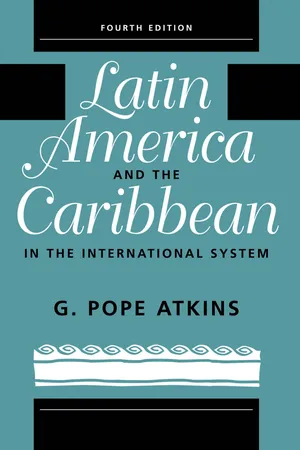
Latin America And The Caribbean In The International System
Fourth Edition
- 472 pages
- English
- ePUB (mobile friendly)
- Available on iOS & Android
eBook - ePub
About this book
The fourth edition of this widely praised text has been thoroughly revised to reflect the evolving characteristics of the current international system that have had a dramatic effect on every aspect of international relations of Latin America and the Caribbean. The original purpose of this book is unchanged: It continues to provide a topically current and analytically integrated survey of the region's role in the world. Still organized around the idea of Latin America and the Caribbean as a separate subsystem within the global international system, the discussion gives special emphasis to complex interstate and transnational structures and processes. Within this framework, Atkins analyzes the foreign policies of the Latin American states themselves and those of the United States and other countries toward Latin America and the Caribbean. He also looks closely at the nature and role of transnational actors in the region, such as the multinational corporations, the Holy See, Protestant Churches, transnational political parties, international labor, nongovernmental organizations, and others. He gives special attention to Latin American participation in international institutions at all levels.
Trusted by 375,005 students
Access to over 1.5 million titles for a fair monthly price.
Study more efficiently using our study tools.
Information
Part One
A Framework for Analysis
The first three chapters of this book establish the overall framework within which the rest of the study is cast. Chapter 1 discusses the systems concept as a way to organize analysis of international relations in general. Chapter 2 identifies Latin America and the Caribbean as a subsystem of the global system and outlines the general characteristics of the subsystem’s evolution. Chapter 3 presents and critiques the major explanatory and prescriptive theories regarding the region’s international relations. Using this framework for analysis, the rest of the book provides a detailed examination of the various elements of the Latin American and Caribbean subsystem’s international relations.
Chapter One
The International System
As an overview of the international system and its constituent elements, this chapter discusses international systems theory to the extent that it provides the analytic framework used for selecting, arranging, and comparing data relating to the complex Latin American subsystem.1 The emphasis here is on the role of theory as an organizing device rather than as explanation, prediction, prescription, or judgment (matters that are explored in Chapter 3). This does not preclude reference to such theoretical uses, however, when they clarify the reasoning behind the selection of certain organizational components.
A Systems Perspective
The Approach to This Study
Certain developments over the past four decades in the study of IR (as analysts like to refer to the inquiry of international relations) have influenced the approach taken in this book.2 Among the most important of these developments was systems theory, which from the late 1950s was increasingly adopted as an analytic framework and became the generally assumed paradigm (but not without criticism or dissent). Systems theory is concerned with structures and processes in the study of human behavior. Any system by definition consists fundamentally of the interaction between two or more distinct units and of the functions of that interaction. “Structure” means the system’s form and configuration—the way in which its elements are organized and interrelated. The structure of a system is characterized both by differentiation (the presence and workings of separate units) and by integration (the overall organization of the system, perhaps including any subsystems). “Process” is the series of specific, continuous, and interdependent operations of the system—in effect, the activities and interactions of the units and subsystems that have consequences, results, or outcomes. Process indicates that a system is dynamic. Structure and process both imply some measure of regularity of relations and mutual dependence among the units and subsystems.
While adopting a systems approach, IR analysts distinguished between international politics and foreign policy analysis.3 The first area addresses the overall interstate system, with an emphasis on the interactions of the nation-state units and the consequences for the system’s structures and processes. This embraces a large portion of the established traditional approach to the study of IR, which includes the historical evolution of the international system, the regulatory elements such as balances of power and international organization and law, and strong attention to the “high politics” of security, diplomacy, and war. The second area, foreign policy analysis, focuses on the nation-states themselves, either singly or in comparison. It deals with the nature, attributes, and actions of states and, in particular, inquires about the way decision makers form images, expectations, and perceptions, respond to motivations and aspirations, process information, formulate interests, analyze situations, select objectives, and decide upon and execute courses of action. In foreign policy analysis, the overall system embraces the extrasocietal environments that give rise to decisions and in which subsequent policy action takes place.
Beginning in the early 1970s, analysts broadened their notions of the international system and its units in order to account for crucial transnational phenomena. They have generally acknowledged that states remained the most important actors in world affairs but insisted that the significance of transnational (nonstate) actors and relations (especially economic, social, and cultural, but also including insurgencies, drug trafficking, and common criminal activities) had increased to the extent that they should be integrated with the interstate model into a single global system. With the end of the cold war and with subsequent developments, students of IR have reemphasized these concepts.4
A subsystemic area of inquiry, as implied in the preceding commentary, lies between the individual actors (state and transnational) and the global system (the combination of interstate and transnational phenomena). International subsystems are defined as groupings of some of the total system’s units that interact on a regular basis. Subsystemic structures and processes remain distinct, even as they form the entire system and even though the units also participate on a broader basis in the global system. Several different kinds of international subsystems may be identified—for example, the regularized interaction of two states, international organizations, ideological or common-interest groupings, and geographic regions. Most of the elements of a system apply to subsystems; their analysis likewise involves the concepts of actors, interaction, regulation, and even further subsystems. Thus regional international relations, such as those of Latin America and the Caribbean, can be viewed as subsystems.
Finally, the continuing problem of terminological ambiguity that has characterized the study of IR is relevant to this analytic framework. The very terms “international relations” and the derivative “international system” are inexact. The designation of “international” assumes too much about the homogeneity of the “nation.” “Interstate” would be more accurate but would not correctly denote the scope of inquiry, which goes beyond the relations of states to encompass transnational phenomena. And the term “transnational,” since it plays off the “international” concept as its counterpoint, suffers from the same inexactitude (“transstate” and “transsociety” are likewise insufficient). The notions of a “world system” or “global system” would be improved representations, but they have been co-opted by specific theoretical schools (see Chapter 3). In any event, “international relations” and “international system” remain firmly imbedded as the generic “umbrella” terms despite their deficiencies. Thus, somewhat reluctantly, I continue to use the term “international system,” with the understanding that it refers to a combined interstate-transnational global system that includes regional subsystems in its structure.
Characteristics of the International System
The international system as conceived in this book is a complex political, military, economic, social, and cultural structure of both power and interdependence. It is comprised of states interacting in cooperation and conflict, informal power relationships, and formal international rules and institutions—and of transnational actors that join the mix and add to the complex array of interactions. A systems approach offers analytic advantages by providing a broad overview of international structures and processes and by facilitating the analysis of a wide range of relationships. Systemic concepts are also applicable to the specific levels of activity within the global system—from individual state and transnational actors to various groupings of them (such as in a geographic region). Within each of these interrelated levels are found discreet structures and processes involving units, subsystems, interaction, and regulation.
Nevertheless, certain assumptions of international systems thinking gives rise to some conceptual problems. Some critics argue that an international system does not exist, and, therefore, international relations are not susceptible to such analysis. This view assumes that IR should deal only with the flux of changing concrete situations that are not amenable to systemic generalization or theoretical explanation and that students in the field must be satisfied with describing particular past or current events. More specifically, it assumes that international relations are anarchic, since no centralized international decision-making authority exists, and a system, by definition, requires regularity. This view is similar to the position taken (mostly in the past) by some historians who viewed history as a series of new and unique events and who denied the existence of behavioral patterns. A similar perspective has also been expressed by some sociologists who have found individual psychological patterns of behavior but no social system as such.
One can hardly claim, in reply, that international events fall into immutable patterns, and one must acknowledge that the international system differs in fundamental ways from domestic processes. The essential problem is that of regulation: The international arena, unlike the domestic realm, lacks higher authoritative decision-making agencies able to make and enforce rules and reconcile conflicting parties. Furthermore, little feeling of legitimacy exists above the state level, which continues to be the central structural feature and decisional source in the system. Certain other actors also occupy important positions, which serves to further decentralize the system.
International relations, however, do not merely consist of anarchic competition. A degree of integration is found, although it is considerably less than within most state systems. In reality, state independence is far from absolute, whether in the domestic or the international domain. Loyalty and legitimacy remain problematical within the state itself, and state interdependence is a fact as well as a theory of international life. The distribution of power and influence among states and other actors has always had a primary structural influence; the “balance of power” has been recognized by strategists for centuries as an informal controlling device. Formal regulatory institutions are embodied in international law, organizations, and other interstate regimes; various forms of informal consensus (norms) also exist. Although any authoritative activity of such institutions is ultimately limited by the sovereign autonomy of the member states (which today seems to be to some degree an eroding concept), many formal and informal rules are voluntarily accepted and followed. In addition, the variety of sustained identifiable patterns of interstate and transnational interaction is significant. Today’s international system may be characterized as primitive, rudimentary, and decentralized, but it demonstrates enough regularity to apply systemic concepts as the basis for organizing the analysis of IR and the accompanying theoretical debates.5
The Nation-State Actors
The Nature of the Modern State
The most important differentiated units in international politics today, as in the past three centuries, are sovereign nation-states. At present they number about 200 and are located in all parts of the world. The nation-state has never been and is not now the only unit in the international system. Its long evolution has been an irregular one, and today it is challenged in several important ways. Nevertheless, it is and will continue for the foreseeable future to be the most prominent actor. As such, it is the central concept in world politics and the starting point for an understanding of the international system.
The state units themselves have changed over time. For example, Chinese states, Greek city-states, Egyptian and Indian civilizations, and pre-Columbian American entities such as the Aztec and Inca empires as well as European empires and feudal realms all preceded the nation-state. Some of them paralleled for a time or even survived along with the nation-state’s ultimate spread around the globe.
The modern state system evolved after the collapse of feudalism and the dual empire-papacy system in Europe at the end of the Middle Ages. The new system developed throughout the fifteenth and sixteenth centuries and was legally institutionalized by the Peace of Westphalia (1648), which settled the Thirty Years War among kings, pope, and emperor (supported by feudal lords). The peace arrangement recognized the independence of secular nation-states from the Holy Roman Empire and the papacy. This system subsequently spread from Europe to all parts of the world. The process was not essentially completed in Europe until the late nineteenth century (and then not entirely), when Italy and Germany each were finally consolidated. In the meantime, after their own emergence, the new European states began to expand their power around the globe through imperialism and trade. This movement was led first by Portugal in the early fifteenth century and Spain beginning in the 1490s, followed by France, Holland, and England in the sixteenth century. Eventually, almost all European states adopted imperialist policies, and overseas empires were established in most of the non-European world.
Independent nation-states of the European type did not appear outside of Europe until the United States of America was established in 1776 through a revolutionary process. Most of Latin America followed suit between 1804 and 1824 by forcefully breaking away from imperial Spain and Portugal; Japan did so in the late nineteenth century through a nonrevolutionary process of “opening” to the outside world. China did not effectively become a nation-state in the Western sense until after 1911, the year of Sun Yat Sen’s revolution. The European empires in Asia, Africa, and the Caribbean largely broke up in the twentieth century. Most of the new states in those areas were created after World War II, including two of the most populous in the world, India and Indonesia. Thus, what originated as a European system became a cumbersome world-wide one through several kinds of change.
The modern state is endowed with two unique and abstract characteristics that it shares with no other entity—the attribute of sovereignty and the relationship of nationalism to statehood. Sovereignty and nationalism are distinct concepts, but they are related in their complex evolution over the past three and a half centuries.
Introduced in seventeenth century international law, sovereignty is traditionally defined as the state’s supreme authority over its citizens—the state is the final arbiter in their lives. Whether sovereignty is, indeed, absolute and indivisible has long been a matter of debate. The idea was the product of the times that witnessed the rise of the nation-state under absolute monarchs. It replaced the medieval concept of limited sovereignty under natural (divine) law embodied in the contractual relationship of the feudal system. The concept of sovereignty stressed the superiority of the territorial state to both imperial universalism and feudal localism. It reflected the need for central government authority, embodied in the monarch (“the sovereign”), in order to create domestic order and stability within a given territory.
An analysis of the phenomenon of nationalism is complicated: first by the lack of a precise and widely accepted definition; second because the variety of nationalism is highly complex; and third because of both the fragmentation of and alternatives to nationalism. Nevertheless, the continuing importance of nationalism to the nature of the modern state and to foreign policy formulation cannot be denied.
Classic definitions characterize nationalism as a “group consciousness” in which individuals identify themselves with and give supreme loyalty to the abstraction of the nation, which reinforces the state as the ultimate source of authority and legitimacy. This definition should be modified with the caveat that particular nationalists may use nationalism in attempts to capture control of the state and its authority, claiming to speak for “the nation” in order to gain advantage over political competitors. Nationalism represents an emotional identification of the individual with the nation-state, as a psychological refuge and source of a sense of well-being that inspires devotion to the nation-state. It is also a structural and institutional phenomenon—it represents the lodging of social functions and their structural base in the nation-state.
States and nations have existed throughout recorded history, but only after the consolidation of feudal units into kingdoms in Western Europe were the two elements combined. Since then, a principal theme has been the search by multicultural states for a single nationhood and by homogeneous nations for separate statehood. These processes involve the melding of distinct entities that are not necessarily coterminous—the state (a legal-political entity defined in terms of territory, population, and effective autonomous government) and the nation (a social-cultural entity defined in terms of people who, for whatever reasons, share a sense of sameness and uniqueness). From the rise of the modern state until the late eighteenth century, European dynastic states worked to create nations of their domains, with the “sovereign” serving as the symbol of national identity among the people living within the state borders. With the American and French revolutions (1776/1789) and the subsequent development of republicanism, nationalism came to be identified with “the people.” Thereafter, national groups sought to create states that conformed to national boundaries, and the idea of “national self-determination” was born. Since then, a tension has existed over the nature and relationship of nations and states.
The definitional elusiveness of nation and nationalism has been and continues to be problematical. Realities of ethnic and social identity on the part of distinct internal sectors within societies challenge their meaning. This has been true not only for the decidedly multicultural societies in the Americas but in numerous European states, where modern nationalism was born, and in other parts of the globe. Immigrants often have dual identities and loyalties: Although they are newly citizens of a state to which they give loyalty out of appreciation for the economic opportunities or political havens provided, their cultural roots are elsewhere. Other, more recent transnatio...
Table of contents
- Cover
- Half Title
- Title
- Copyright
- Dedication
- Contents
- List of Illustrations
- List of Acronyms and Abbreviations
- Preface
- Part One A Framework for Analysis
- Part Two The Nation-State Actors
- Part Three Interstate Institutions
- Part Four Transnational Actors
- Part Five Interstate and Transnational Relations
- Index
Frequently asked questions
Yes, you can cancel anytime from the Subscription tab in your account settings on the Perlego website. Your subscription will stay active until the end of your current billing period. Learn how to cancel your subscription
No, books cannot be downloaded as external files, such as PDFs, for use outside of Perlego. However, you can download books within the Perlego app for offline reading on mobile or tablet. Learn how to download books offline
Perlego offers two plans: Essential and Complete
- Essential is ideal for learners and professionals who enjoy exploring a wide range of subjects. Access the Essential Library with 800,000+ trusted titles and best-sellers across business, personal growth, and the humanities. Includes unlimited reading time and Standard Read Aloud voice.
- Complete: Perfect for advanced learners and researchers needing full, unrestricted access. Unlock 1.5M+ books across hundreds of subjects, including academic and specialized titles. The Complete Plan also includes advanced features like Premium Read Aloud and Research Assistant.
We are an online textbook subscription service, where you can get access to an entire online library for less than the price of a single book per month. With over 1.5 million books across 990+ topics, we’ve got you covered! Learn about our mission
Look out for the read-aloud symbol on your next book to see if you can listen to it. The read-aloud tool reads text aloud for you, highlighting the text as it is being read. You can pause it, speed it up and slow it down. Learn more about Read Aloud
Yes! You can use the Perlego app on both iOS and Android devices to read anytime, anywhere — even offline. Perfect for commutes or when you’re on the go.
Please note we cannot support devices running on iOS 13 and Android 7 or earlier. Learn more about using the app
Please note we cannot support devices running on iOS 13 and Android 7 or earlier. Learn more about using the app
Yes, you can access Latin America And The Caribbean In The International System by G. Pope Atkins in PDF and/or ePUB format, as well as other popular books in Politics & International Relations & International Relations. We have over 1.5 million books available in our catalogue for you to explore.