- 386 pages
- English
- ePUB (mobile friendly)
- Available on iOS & Android
eBook - ePub
About this book
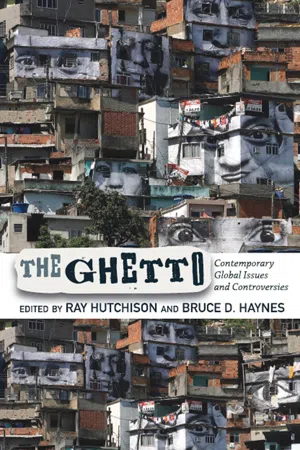
This book discusses more general consideration of marginalized urban spaces and peoples around the globe. It considers the question: Is the formation and later dissolution of the Jewish ghetto an appropriate model for understanding the experience of other ethnic or racial populations?
Information
CHAPTER 1

A Janus-Faced Institution of Ethnoracial Closure: A Sociological Specification of the Ghetto
The scientific mind must form itself by continually reforming itself.
—Gaston Bachelard, Psychanalyse de l’esprit scientifique (1938)
It is a paradox that, while the social sciences have made extensive use of “ghetto” as a descriptive term, they have failed to forge a robust analytical concept of the same. In the historiography of the Jewish diaspora in early modern Europe and under Nazism, the sociology of the black American experience in the twentieth-century metropolis, and the anthropology of ethnic outcasts in East Asia and Africa—its three traditional domains of application—the term ghetto variously denotes a bounded urban ward, a web of group-specific institutions, and a cultural and cognitive constellation (values, mind-set, or mentality) entailing the socio-moral isolation of a stigmatized category as well as the systematic truncation of the life space and life chances of its members. But none of these strands of research has taken the trouble to specify what makes a ghetto qua social form, which of its features are constitutive and which are derivative, as they have, at each epoch, taken for granted and adopted the folk concept extant in the society under examination.
This explains that the notion, appearing self-evident, does not figure in most dictionaries of social science.1 It is also why, after decades of employing the word, sociologists remain vague, inconsistent, and conflicted about its core meaning, perimeter of empirical pertinence, and theoretical import. The recent “Symposium on the Ghetto” organized by City & Community in the wake of Mario Small’s critique of the central theses of my book Urban Outcasts richly documents the myriad observational anomalies and analytic troubles spawned by the unreflective derivation of social-scientific from ordinary constructs (Haynes and Hutchison 2008). These troubles are not resolved but redoubled when the composite U.S. imagery of the (black) ghetto (after its collapse) gets transported to western Europe and Latin America, and they are trebled when scholars attempt cross-national comparisons of patterns of urban marginality and/or ethnoracial inequality based on the national common sense of their home societies as to the meaning of “the ghetto.”2 This debate vividly demonstrates that the ghetto is not a contested concept à la Gallie (1956) so much as a confused conception that comes short of the level of analytic specificity, coherence, and parsimony minimally required of a scientific notion.
This chapter clears up this confusion by constructing a rigorous sociological concept of the ghetto as a spatially based implement of ethnoracial closure. After spotlighting the semantic instability and slippage of the notion in American culture and scholarship, I extract the structural and functional similarities presented by three canonical instances of the phenomenon: the Jewish ghetto of Renaissance Europe, the black American ghetto of the Fordist United States, and the reserved districts of the Burakumin in post-Tokugawa Japan. Against thin gradational conceptions based on rates (of ethnic dissimilarity, spatial concentration, poverty, and so on), which prove promiscuous and prone to metaphorical bleeding, as well as inchoate, I elaborate a thick relational conception of the ghetto as a socio-spatial institution geared to the twin mission of isolating and exploiting a dishonored category. So much to say that the ghetto results not from ecological dynamics but from the inscription in space of a material and symbolic power asymmetry, as revealed by the recurrent role of collective violence in establishing as well as challenging ethnoracial confinement. Next, I unscramble the connections between ghettoization, segregation, and poverty and articulate an ideal-typical opposition between ghetto and ethnic cluster with which to carry out measured comparisons of the fates of various stigmatized populations and places in different cities, societies, and epochs. This points to the role of the ghetto as organizational shield and cultural crucible for the production of a unified but tainted identity that furthers resistance and eventually revolt against seclusion. I conclude by proposing that the ghetto is best analogized not with districts of dereliction (which confuses ethnoracial seclusion with extraneous issues of class, deprivation, and deviance) but with other devices for the forcible containment of tainted categories, such as the prison, the reservation, and the camp.
A FUZZY AND EVOLVING NOTION
A brief recapitulation of the strange career of “the ghetto” in American society and social science, which has dominated inquiry into the topic both quantitatively and thematically, suffices to illustrate its semantic instability and dependency on the whims and worries of urban rulers. For the past century, the range and contents of the term have successively expanded and contracted in keeping with how political and intellectual elites have viewed the vexed nexus of ethnicity and poverty in the city (Ward 1989).
At first, in the closing decades of the nineteenth century, the “ghetto” designated residential concentrations of European Jews in the Atlantic seaports and was clearly distinguished from the “slum” as an area of housing blight and social pathology (Lubove 1963). The notion dilated during the Progressive era to encompass all inner-city districts wherein exotic newcomers gathered—namely, lower-class immigrants from the southeastern regions of Europe and African Americans fleeing the Jim Crow regime of racial terrorism in the U.S. South. Expressing upper-class worries over whether these groups could or should assimilate into the predominant Anglo-Saxon pattern of the country, the notion referred then to the intersection between the ethnic neighborhood and the slum, where segregation was believed to combine with physical disrepair and overcrowding to exacerbate urban ills such as criminality, family breakdown, and pauperism and thwart participation in national life. This conception was given scientific authority by the ecological paradigm of the emerging Chicago School of Urban Sociology. In his classic book The Ghetto, Louis Wirth (1928, 6) assimilates to the Jewish ghetto of medieval Europe the “Little Sicilies, Little Polands, Chinatowns, and Black Belts in our large cities,” along with the “vice areas” hosting deviant types such as hobos, bohemians, and prostitutes. All of them are said to be “natural areas” born of the universal desire of different groups to “preserve their peculiar cultural forms,” and each fulfills a specialized “function” in the broader urban organism.3 This is what one may call Wirth’s error: confounding the mechanisms of socio-spatial seclusion visited upon African Americans and upon European immigrants by conflating two urban forms with antinomic architectures and effects, the ghetto and the ethnic cluster. This initial error enabled the ecological paradigm to thrive even as the urbanization of African Americans blatantly contradicted its core propositions (Wacquant 1998). It would be repeated cyclically for decades and persistently obfuscate the specificity of ghettoization as an exclusive type of enclosure.
The notion contracted rapidly after World War II under the press of the civil rights movement to signify mainly the compact and congested enclaves to which African Americans were forcibly relegated as they migrated into the industrial centers of the North. The growth of a “Black Metropolis in the womb of the white” wherein Negroes evolved distinct and parallel institutions to compensate for and shield themselves from unflinching exclusion by whites (Drake and Cayton 1945/1993) contrasted sharply with the smooth residential dispersal of European Americans of foreign stock. And the mounting political mobilization of blacks against continued caste subordination made their reserved territory a central site and stake of sociopolitical struggles in the city as well as a springboard for collective action against white rule. Writing at the acme of the black uprisings of the 1960s, Kenneth Clark (1965, 11) made this relationship of ethnoracial subordination epicentral to his dissection of the Dark Ghetto and its woes: “America has contributed to the concept of the ghetto the restriction of persons to a special area and the limiting of their freedom of choice on the basis of skin color. The dark ghetto’s invisible walls have been erected by the white society, by those who have power.” This diagnosis was confirmed by the Kerner Commission (1968/1989, 2), a bipartisan task force appointed by President Johnson whose official report on the “civil disorders” that rocked the American metropolis famously warned that, because of white racial intransigence, America was “moving toward two societies, one black, one white—separate and unequal.”4
But over the ensuing two decades, the dark ghetto collapsed and devolved into a barren territory of dread and dissolution, due to deindustrialization and state policies of welfare reduction and urban retrenchment. As racial domination grew more diffuse and diffracted through a class prism, the category was displaced by the duet formed by the geographic euphemism of “inner city” and the neologism of “underclass,” defined as the substratum of ghetto residents plagued by acute joblessness, social isolation, and antisocial behaviors (Wilson 1987). By the 1990s, the neutralization of the “ghetto” in policy-oriented research culminated in the outright expurgation of any mention of race and power to redefine it as any tract of extreme poverty (“containing over 40% of residents living under the federal poverty line”), irrespective of population and institutional makeup, in effect dissolving the ghetto back into the slum and rehabilitating the folk conception of the early twentieth century (Jargowsky 1997).5 This paradoxical “deracialization” of a notion initially fashioned, and until then deployed, to capture ethnoracial partition in the city resulted from the combination of the crumbling of the historic dark ghetto of the industrial era and the correlative political censorship of race in policy-oriented research after the ebbing of the civil rights movement. This “gutting of the ghetto” (Wacquant 2002) was then taken one step further by the rash proposal to abandon the notion altogether, instead of clarifying it, on grounds that it cannot capture the complexity, heterogeneity, and fluidity of “poor black neighborhoods” in the United States (Small 2009)—as if ghettoization were a flat and static synonym for impoverishment, occurred only in the United States, and could not encompass, or partake of, a fluid and differentiated urban formation.
Meanwhile, the term was extended to the study of the distinctive socio-cultural patterns elaborated by homosexuals in the cities of advanced societies “in response to both stigma and gay liberation” after the Stonewall riots (Levine 1979, 31). It has also made a spectacular return across western Europe in heated scholarly and policy debates over the links between postcolonial immigration, postindustrial economic restructuring, and spatial dualization as the fear of the “Americanization” of the metropolis swept the continent (Musterd, Murie, and Kesteloot 2006; Schierup, Hansen, and Castles 2006). That European social scientists took to invoking “the ghetto” to stress the growing potency and specificity of ethnoracial division in their countries just when their American colleagues were busy extirpating race from the same notion is an irony that seems only to further muddle its meaning. Yet one can extract out of these varied literatures common threads and recurrent properties to construct a relational concept of the ghetto as an instrument of closure and control that clears up most of the confusion surrounding it and turns it into a powerful tool for the social analysis of ethnoracial domination and urban inequality. For this it suffices to return to the historical inception of the word and of the phenomenon it depicted in Renaissance Venice.
A JANUS-FACED INSTITUTION OF ETHNIC CLOSURE AND CONTROL
Coined by derivation from the Italian giudecca, borghetto, or gietto (or from the German gitter or the Talmudic Hebrew get—the etymology is disputed), the word ghetto initially referred to the forced consignment of Jews to special districts by the city’s political and religious authorities. In medieval Europe, Jews were commonly allotted quarters wherein they resided, administered their own affairs, and followed their customs. Such quarters were granted or sold as a privilege to attract them into the towns and principalities for which they fulfilled key roles as money-lenders, tax collectors, and long-distance tradesmen. But between the thirteenth and sixteenth centuries, in the wake of the upheavals caused by the Crusades, favor gradually turned into compulsion (Stow 1992). In 1516 the Senate of Venice ordered all Jews rounded up into the Ghetto Nuovo, an abandoned foundry on an isolated island enclosed by two high walls whose outer windows and doors were sealed while watchmen stood guard on its two bridges and patrolled the adjacent canals by boat (Curiel and Cooperman 1990). Jews were henceforth allowed to come out to pursue their occupations by day, but they had to wear a distinctive garb that made them readily recognizable and return inside the gates before sunset on pain of severe punishment. These measures were designed as an alternative to expulsion to enable the city-state to reap the economic benefits brought by the presence of Jews (including rents, special taxes, and forced levies) while protecting its Christian residents from contaminating contact with bodies perceived as unclean and dangerously sensual, as carriers of syphilis and vectors of heresy, in addition to bearing the taint of moneymaking through usury, which the Catholic Church equated with prostitution (Sennett 1994, 224).
As this Venetian model spread in cities throughout Europe and around the Mediterranean rim (Johnson 1987, 235–245),6 territorial fixation and seclusion led, on the one hand, to overcrowding, housing deterioration, and impoverishment as well as excess morbidity and mortality and, on the other, to institutional flowering and cultural consolidation as urban Jews responded to multiplying civic and occupational restrictions by knitting a dense web of group-specific organizations that served as so many instruments of collective succor and solidarity, from markets and business associations to charity and mutual aid societies, to places of religious worship and scholarship. The Judenstadt of Prague, Europe’s largest ghetto in the eighteenth century, even had its own city hall, the Rathaus, emblem of the relative autonomy and communal strength of its residents, and its synagogues were entrusted with not only the spiritual stewardship but also the administrative and judicial oversight of its population. Social life in the Jewish ghetto was turned inward and verged “on overorganization” (Wirth 1928), so that it reinforced both integration within and isolation from without.
One can detect in this inaugural moment the four constituent elements of the ghetto, namely, (i) stigma, (ii) constraint, (iii) spatial confinement, and (iv) institutional parallelism. The ghetto is a social-organizational device ...
Table of contents
- Cover
- Half Title
- Title Page
- Copyright Page
- Table of Contents
- INTRODUCTION
- 1. A Janus-Faced Institution of Ethnoracial Closure: A Sociological Specification of the Ghetto
- 2. De-spatialization and Dilution of the Ghetto: Current Trends in the United States
- 3. Toward Knowing the Iconic Ghetto
- 4. “You Just Don’t Go Down There”: Learning to Avoid the Ghetto in San Francisco
- 5. In Terms of Harlem
- 6. The Spike Lee Effect: Reimagining the Ghetto for Cultural Consumption
- 7. Places of Stigma: Ghettos, Barrios, and Banlieues
- 8. On the Absence of Ghettos in Latin American Cities
- 9. Divided Cities: Rethinking the Ghetto in Light of the Brazilian Favela
- 10. Demonstrations at Work: Some Notes from Urban Africa
- 11. From Refuge the Ghetto Is Born: Contemporary Figures of Heterotopias
- 12. Where Is the Chicago Ghetto?
- ABOUT THE CONTRIBUTORS
- INDEX
Trusted by 375,005 students
Access to over 1.5 million titles for a fair monthly price.
Study more efficiently using our study tools.
Frequently asked questions
Yes, you can cancel anytime from the Subscription tab in your account settings on the Perlego website. Your subscription will stay active until the end of your current billing period. Learn how to cancel your subscription
No, books cannot be downloaded as external files, such as PDFs, for use outside of Perlego. However, you can download books within the Perlego app for offline reading on mobile or tablet. Learn how to download books offline
Perlego offers two plans: Essential and Complete
- Essential is ideal for learners and professionals who enjoy exploring a wide range of subjects. Access the Essential Library with 800,000+ trusted titles and best-sellers across business, personal growth, and the humanities. Includes unlimited reading time and Standard Read Aloud voice.
- Complete: Perfect for advanced learners and researchers needing full, unrestricted access. Unlock 1.5M+ books across hundreds of subjects, including academic and specialized titles. The Complete Plan also includes advanced features like Premium Read Aloud and Research Assistant.
We are an online textbook subscription service, where you can get access to an entire online library for less than the price of a single book per month. With over 1.5 million books across 990+ topics, we’ve got you covered! Learn about our mission
Look out for the read-aloud symbol on your next book to see if you can listen to it. The read-aloud tool reads text aloud for you, highlighting the text as it is being read. You can pause it, speed it up and slow it down. Learn more about Read Aloud
Yes! You can use the Perlego app on both iOS and Android devices to read anytime, anywhere — even offline. Perfect for commutes or when you’re on the go.
Please note we cannot support devices running on iOS 13 and Android 7 or earlier. Learn more about using the app
Please note we cannot support devices running on iOS 13 and Android 7 or earlier. Learn more about using the app
Yes, you can access The Ghetto by Ray Hutchison,Bruce D. Haynes in PDF and/or ePUB format, as well as other popular books in Social Sciences & Sociology. We have over 1.5 million books available in our catalogue for you to explore.