eBook - ePub
Popular Management Books
How they are made and what they mean for organisations
- 208 pages
- English
- ePUB (mobile friendly)
- Available on iOS & Android
eBook - ePub
About this book
The growing interest in management knowledge has generated an enormous literature and brought great success for a number of management gurus. This book is a timely and radical critique of the quick-fix solutions offered by popular management books. Features include:*Detailed criticism of the ideological hegemony of North American managerial discour
1
A study of popular management books
A growing interest in management knowledge in the 1980s
Since the early 1980s there has been a growing interest in management knowledge in the western world. This has taken many forms. Special sections on management are published in newspapers, and American business magazines like the Harvard Business Review, Fortune and Business Week are disseminated worldwide. Moreover, a number of local business journals appear in many countries. These magazines cover the fads and the popular practically oriented development in the broad field of managerial knowledge. Another feature is an increasing number of seminars and short courses on management-related issues which are arranged inside companies and offered on the market. These are of various kinds, some being connected to business schools and universities and organised as management development programmes mainly based on academic research; others are more spectacular, where for example clergymen and actors have been engaged to give lectures. Programmes are also devised, based on psychology and oriental mysticism, to help people become familiar with their ‘inner energy’ and build up their self-confidence. Furthermore, the market for various kinds of management consultancy has grown, where the supply varies from offering adventurous tours for top management to conducting sophisticated clinical analyses of organisations’ problems followed by suggestions, advice and support on how to cure them. Concerning the latter kind of consultancy, a preeminent feature during the 1980s was the increasing worldwide activities pursued by, in particular, American-based consulting firms like Arthur Andersen & Co., the Boston Consulting Group, and McKinsey & Co. These endeavours have continued and escalated in the 1990s.
But the most obvious occurrence of the increased interest in manifestations of management and leadership is perhaps the popularity of statements by great management thinkers like Peter Drucker, Kenneth Blanchard, Henry Mintzberg, Rosabeth Moss-Kanter, Tom Peters and Michael Porter. These thinkers, or gurus, as Kennedy (1991) and Huczynski (1993) prefer to call them, travel around the world and give lectures and executive seminars. In recent years, advances in multimedia technology have enabled them to give live video performances broadcast simultaneously to several places. This has been practised by those such as Michael Porter, Peter Drucker and Tom Peters, and it means that gurus can now give lectures from home which can be attended by several audiences in different cities and countries all over the world. These seminars are organised as ordinary executive live performances where people pay fees to listen to the guru even though they will only meet him or her on a video screen. As at conventional seminars, there is also time for questions after the performance, where the global audience can fax questions to be answered live by the speaker (Jackson 1994).
According to Huczynski (1993:4–5), Blanchard, Mintzberg, Moss-Kanter and Porter can be characterised as modern business-school academics, while Peters is seen as a management consultant. It also seems fair to assign the grand old man of management gurus, Peter Drucker, to the first category. Closely related to this feature of contemporary western society are the books which these gurus have written. A substantial element in achieving worldwide guru status consists in the production of books which reach considerable sales volumes (cf. Huczynski 1993:230). The most obvious example in this case is probably Tom Peters, whose book In Search of Excellence (1982), written jointly with Robert Waterman, sold close to a million copies within a year, and by 1988 was said to have sold over ten million copies worldwide (Thomas 1989).1 Even today, in the late 1990s, it is well known and read by researchers, students and practitioners. It also is one of the most cited books in the field of management studies (Engwall 1998). In this regard it can be seen as a classic of management literature. Peters is presented by Kennedy (1991) as the guru of gurus, since he has continued to write books which have become bestsellers even though they have not sold as well as In Search of Excellence. He has also made great efforts in travelling around the world and holding seminars ever since the publication of the 1982 book. But he is not alone in this business, although he was one of the first to gain a global reputation; among many others, the authors of the bestselling Reengineering the Corpora tion; A Manifesto for Business Revolution (Hammer and Champy 1993) can be seen as recent rising stars.
However, yet another major category of bestselling authors is mentioned by Huczynski, namely well known chief executives like Jan Carlzon (1985; 1987), Harold Geneen (1985), Lee Iacocca (1984), Mark McCormack (1984) and John Sculley (1987), all of whom have written career autobiographies detailing how they, or the organisations which they managed, made successful turnarounds or attained remarkable success in a short period. In the 1990s we have seen fewer books written by this category of author, yet successful managers continue to be valued speakers at management seminars and other large events.
The phenomenon outlined above is the starting point for this study. The focus is on the 1980s, since this was a dramatic period in the globalisation of popular management culture, manifested by gurus with million-selling books and worldwide seminar tours. Although the 1980s was a spectacular period, the phenomenon as such was not new, and is still remarkable in the late 1990s. As implied by Barley and Kunda (1992) in their study of the development of the American managerial discourse from the late nineteenth century until the early 1990s, the rise of new ideas and changes in the principal ideologies, and the dissemination of these, can be traced back to important oral (speeches and lectures) and written (articles and books) presentations by a few individuals, certain groups at business schools (mainly at Harvard), and a few consulting firms and business magazines. Furthermore, texts written by gurus often appear as overt (explicit) or underlying (implicit) references in articles in business journals, in literature used in management development programmes, and in other popular books (cf. Kennedy 1991). However, such texts also appear in courses at universities and business schools, as important references for consultants (cf. Furusten and Kinch 1996) and in academic research (cf. Engwall 1994). Although the gurus may advocate different perspectives and suggest different models for solving organisational and managerial problems, it is still true that what a few gurus articulate is disseminated to a vast number of people in the world through the various distribution channels of modern society. To conclude, it should be noted that the supply of managerial manifestations both in the past and today seems to be dominated by services offered by a few consulting firms, a few management books, a few management gurus, a few business magazines, and a few management development programmes. Moreover, it has been noted that most of them originate from Boston (Bjørkman 1997).
This book puts popular management books in focus and addresses the question of how they are produced and what they mean for organisations. The analyses are illustrated primarily by examples from the 1980s. However, although the 1980s was an interesting period, it is not this period as such this book wants to examine. The 1980s is significant because of the boom of an international popular management culture, but when it comes to the questions raised here, examples could just as well have been selected from the early twentieth century when the ideas of Frederic Taylor were first set in print, or the 1930s when Chester Barnard wrote his seminal work, or the 1950s when several books were published in areas such as human relations, or the 1990s when the concept of Business Process Re-engineering spread across the globe, primarily promoted by Hammer and Champy’s (1993) book. Rather than comment on the production of popular management books during this century as a whole, which has been done elsewhere (e.g. McGill 1988; Barley and Kunda 1992; Huzcynski 1993) this book concentrates on a limited time period. This limitation makes it possible to go deeper into the processes whereby popular management books are produced, and the analysis of their production.
Popular managerial manifestations as elements of the organisational environment
The phenomenon discussed above appeared on a worldwide scene, and the scenario was organisational and managerial life. This means that activities by people who supply ideas, advice and education on how organisations work and should be managed take place in environments of organisations. Moreover, due to the fact that just a few consulting firms, books, business magazines, management development programmes, etc. reach considerable popularity, there are reasons to believe that these have a major influence on how individuals and organisations in modern society apprehend and make enactments of their reality. In other words, due to the wide diffusion of a few particular manifestations, they can be seen as important carriers of representations of managerial and organisational life in contemporary global society. If this holds true it is very important to know what they carry, since they thereby may represent ideas that a great deal of individuals in modern western society are most likely to refer to when they make enactments of the reality in organisations. Moreover, as argued by e.g. Weick (1979a), these enactments are important for the reality they observe as well as the choices and actions they make. This would mean that popular managerial manifestations are powerful elements that contribute to the isomorphism of ideas about managerial and organisational reality in the western world, and thereby perhaps also of individual and collective choices and actions. If north American gurus and management consultants are as important in the worldwide managerial discourse as the discussion above intimates, then this phenomenon can be seen as somewhat of an American crusade of managerial ideas. This would imply that when people in for example Sweden, the UK, Italy and other western countries make enactments of organisation and management, they primarily refer to ideas emanating from north America.
This study is devoted to an analysis of the popularity of managerial manifestations. However, it is a broad topic and we therefore focus on a more narrow aspect of the phenomenon. In particular the purpose here is to study what popular management books represent as elements in the environments of organisations. Can they, for instance, be characterised as representing, and thereby carrying, knowledge; are they on the other hand more likely to be defined as carriers of myths, institutions, beliefs, and ideologies; or do they tend to be a mixture of the two? Moreover, what do they mean for organisations? By seeking to identify the characteristics of the production and supply of popular management books, my intention is that the analyses and discussions throughout the book will, if not answer these questions comprehensively, at least suggest possible explanations of just what it is that popular managerial manifestations— such as books—carry between organisations and societies. Even though this is important to know, it is very complex to investigate. Therefore we shall identify below a few aspects of particular importance in the discussions to follow. It will not be possible in one study to make empirical observations on all, but by observing a few it will be possible to elaborate theoretically on the others.
From the production of popular managerial manifestations to their consumption by organisations
So far we have noted that in this book popular managerial manifestations are seen as elements in environments of organisations. In fact they are regarded as packages that articulate and thereby carry knowledge, ideologies, norms, values, notions, standards and institutions of managerial and organisational life between individuals, organisations and societies. Following Scott and Meyer (1983; 1991) these kinds of environmental elements belong in the institutional environment of organisations. This means that they contribute to the social construction of reality both in organisations and in the wider society. Thus they are of some importance for our concepts of what organisations are and how they can be managed. In this way they can be seen as constituents of social mechanisms that together with, for example, laws and regulations made by governments and business trade associations, create and govern the institutional rules and conventions (cf. Meyer 1994) of managerial and organisational life in a modern society.
Figure 1.1 seeks to demonstrate that popular management books are elements in a debate that takes place in the institutional environments of organisations. People who create, diffuse and consume popular management books constitute what in this study we call the general managerial discourse. The figure also illustrates how the concepts mentioned above are believed to be related, namely that there is an interrelationship between the consumption of management books in organisations and the production and diffusion thereof. Thus popular management books are voices in the general managerial discourse, which is, in its turn, a layer in the institutional environments of organisations which is also an element in the more general environment of organisations.
This environment can then be seen as embedded in modern society, although it is not illustrated in the figure.
The figure is intended to illustrate the discussions to come in later chapters of this book; however, it is important to note here that the processes represented by the different concepts in the figure are taking place simultaneously. In other words, events occur in society and in organisational environments at the same time as management books are consumed in organisations and produced and diffused by others in their environments. Thus the relationship between the production of popular management books and the consumption thereof in organisations may not follow the common view. In other words, it might not be that an individual first observes something and then reports it in, for example, a book which in the next step is diffused to a consumer who then consumes it. The reverse may very well be true, where the consumer in one way or another communicates what he likes to consume to the creator, who then produces this to please him. But this is an empirical question which will be discussed more thoroughly later in this book, when the characteristics of the supply and production of popular management books are discussed.
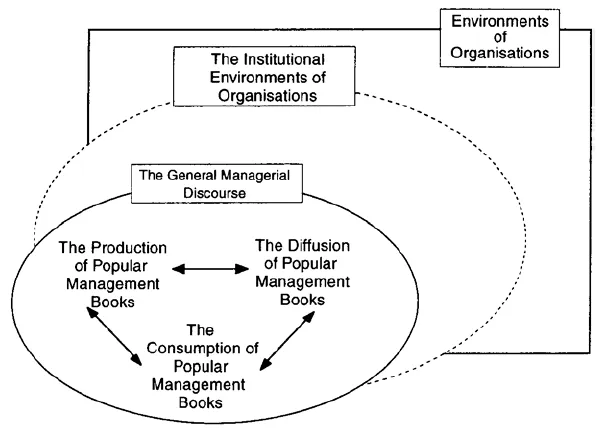
Figure 1.1 The environments of organisations and the production, diffusion and consumption of managerial manifestations
Some limitations of the study
What popular management books represent as elements in the environments of organisations is a broad topic and difficult to investigate. The analyses must therefore be limited to a few tangible aspects. One limitation has already been stated inasmuch as the purpose should be fulfilled by searching for characteristics of the supply and production of popular management books. Thus this study is confined to popular books as such, ignoring their application in organisations. However, these applications will be discussed in terms of the consumption of managerial manifestations, where we start with the findings from empirical observations of their characteristics. Similar complexities have been in focus elsewhere and it is thereby possible to draw upon earlier studies which discussed both the application of knowledge and the relation between elements in the institutional environments of organisations and local organisational processes.
Another delimitation derives from the difficulties inherent in a comprehensive study of all kinds of managerial manifestations. Therefore we shall here focus on popular management books, since these can be seen as significant elements in the popular managerial discourse. In other words, popular management books describe aspects of managerial life and are as such likely to be connected to many other situations where popular managerial manifestations are formulated.
Consequently, the explicit purpose of this study can be described as a search for characteristics of the supply and production of popular management books in order to define the characteristics of the popular managerial discourse. It will then be possible to discuss theoretically the relations between the production, diffusion and consumption of popular managerial manifestations. This will then enable us to draw conclusions as to what the contents of popular management books are, and what they represent as elements in the organisational environment. We can then go on to discuss the implications for organisations when popular managerial manifestations are consumed therein: namely what they mean for organisations.
Earlier studies of popularised management knowledge
Few studies are to be found where popular management books are selected as empirical objects and analysed as elements of the organisational environment. Nevertheless, several studies have discussed the popularity of management issues, and in order to clarify the purpose of the present study it is therefore important to compare it to a selection of these previous investigations.
The popularity of managerial manifestations is mentioned in many studies, although very few have dealt with it explicitly. Nevertheless, McGill (1988) for instance, attempts to expose modern management myths. He maintains that the predominant assumptions in modern society are presented as quick fixes, i.e. particular models and methods are supposed to be applied to complex organisational problems as instant remedies which will blow all the problems away. His concern is that the vast supply of such quick fixes has resulted in a ‘managerial morass wherein simplistic solutions take form, flower briefly, then sink back to feed new forms’ (ibid.: 6). The major conclusion he draws is that the mythical quick fixes do not correspond with the reality which surrounds managers, and therefore obstruct the understanding of the real complexities of management (ibid.: 220–1). Although he argues that in times of distress and uncertainty myths can provide comfort and guidance, he holds that the mythology of management has ‘drawn managers away from the realities of modern management and fixed them in patterns of feeling and thought that are inappropriate to contemporary organizational life’ (ibid.: 202).
According to McGill, the predominant modern managerial myths represent a ‘wrong’ view of organisational and managerial life. He also implies that there is a ‘right’ view, even though he does not state it. However, the differentiation of ‘right’ from ‘wrong’ representations of organisational and managerial life is not unproblematic, particularly if we apply a social constructive approach to knowledge (cf. Berger and Luckmann 1967). This approach is one of the major points of departure of the present study and is discussed in detail in Chapter 3. However, it may be appropriate at this point to briefly clarify how this approach differs from McGill’s. In other words, according to Berger and Luckmann, the meaning of reality and ‘knowledge of reality’ are not natural objects, but rather results of particular social processes where individuals interact and negotiate to reach socially accepted agreements on assumptions which are supposed to be real. Consequently, what is experienced as real is socially constructed, and what is believed to be right in one social network may be seen as wrong in another, and vice-versa. It is therefore hazardous to introduce the predominant manifestations as incorrect descriptions of organisational and managerial life. It might be appropriate to do so in some situations and social networks but, as pointed out by Czarniawska-Joerges (1988), what is most wrong might sometimes be what causes the best actions, i.e. the wrong myth could act as a metaphor which encourages people to make important moves that otherwise would not have occurred.
Huczynski’s (1993) examination of management gurus is another relevant study which explicitly discusses the wide popularity of managerial manifestations. His major concern is to determine why certain ideas are so attractive and confer extremely high rewards on the management gurus who develop and present them (2). His main conclusions are that the idea must be timely, be brought to the attention of its potential audience, meet organisational requirements and individual needs, and be attractively articulated (1). These conclusions are hardly surprising: his identification of management gurus over time is, however, of more interest, together with his comments that the development of management studies over the last hundred years can be divided into six major families of ideas, and that some themes recur in all of these.2 He discusses the development and diffusion of these ideas over time and says, for instance, that many of the popular ideas in the 1980s represented ‘old wine in new bottles’ (210). Furthermore, that these families of ideas constitute somewhat of an ‘intellectual bank from which the producers of management ideas make withdrawals in order to produce what, ultimately, may become the management fad of the future’ (269). However, Huczynski’s study is most likely to be seen as a presentation of empirical observations on management thinkers whose books have been widely distributed over time. In other words, he does not present a structured analysis and dis...
Table of contents
- Cover Page
- Title Page
- Copyright Page
- Illustrations
- Preface
- Acknowledgements
- 1: A study of popular management books
- 2: The managerial discourse and the organisational environment
- 3: When management knowledge moves
- 4: Trends in the supply of management books
- 5: Popular management books as carriers of ideology
- 6: How popular management books are made
- 7: What do popular management books mean for organisations?
- Appendix
- Notes
- Bibliography
Trusted by 375,005 students
Access to over 1.5 million titles for a fair monthly price.
Study more efficiently using our study tools.
Frequently asked questions
Yes, you can cancel anytime from the Subscription tab in your account settings on the Perlego website. Your subscription will stay active until the end of your current billing period. Learn how to cancel your subscription
No, books cannot be downloaded as external files, such as PDFs, for use outside of Perlego. However, you can download books within the Perlego app for offline reading on mobile or tablet. Learn how to download books offline
Perlego offers two plans: Essential and Complete
- Essential is ideal for learners and professionals who enjoy exploring a wide range of subjects. Access the Essential Library with 800,000+ trusted titles and best-sellers across business, personal growth, and the humanities. Includes unlimited reading time and Standard Read Aloud voice.
- Complete: Perfect for advanced learners and researchers needing full, unrestricted access. Unlock 1.5M+ books across hundreds of subjects, including academic and specialized titles. The Complete Plan also includes advanced features like Premium Read Aloud and Research Assistant.
We are an online textbook subscription service, where you can get access to an entire online library for less than the price of a single book per month. With over 1.5 million books across 990+ topics, we’ve got you covered! Learn about our mission
Look out for the read-aloud symbol on your next book to see if you can listen to it. The read-aloud tool reads text aloud for you, highlighting the text as it is being read. You can pause it, speed it up and slow it down. Learn more about Read Aloud
Yes! You can use the Perlego app on both iOS and Android devices to read anytime, anywhere — even offline. Perfect for commutes or when you’re on the go.
Please note we cannot support devices running on iOS 13 and Android 7 or earlier. Learn more about using the app
Please note we cannot support devices running on iOS 13 and Android 7 or earlier. Learn more about using the app
Yes, you can access Popular Management Books by Staffan Furusten in PDF and/or ePUB format, as well as other popular books in Business & Business General. We have over 1.5 million books available in our catalogue for you to explore.