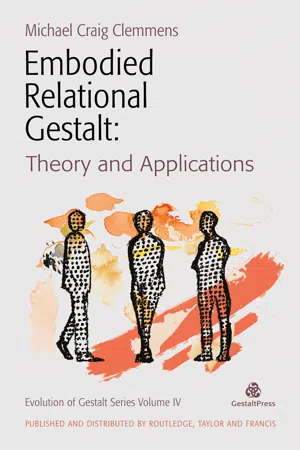
An international selection of authors provide a detailed exploration of Gestalt as a somatic and relational practice. Covering many aspects of this relationship, the chapters include discussion of our relationships with nature, the role of Eros, energy in Taoism, affect and methods of practice. Both theoretical and practical application of an embodied relational approach to GT are presented, and many chapters include case studies from the contributors' own work. The overall view of the book is that our bodies are inextricably embedded and co-creating with the environment, and that we know our body and the world through our embodiment.
eBook - ePub
Embodied Relational Gestalt
Theories and Applications
- 346 pages
- English
- ePUB (mobile friendly)
- Available on iOS & Android
eBook - ePub
Embodied Relational Gestalt
Theories and Applications
About this book
Information
Subtopic
Emotions in PsychologyIndex
PsychologyCHAPTER ONE
Embodied Contexts: The Forms We Create, The Forms that Create Us
“Self may be regarded as at the boundary of the organism, but the boundary is not itself isolated from the environment; it belongs to both, environment and organism. Contact is touch touching something. The self is not to be thought of as a fixed institution; it exists wherever and whenever there is in fact a boundary interaction.” (Perls, Hefferline & Goodman, 1951, p. 435)
Our sense of self and others, and of world emerges through our somatic relationship within a larger context or field. This field in the present moment is occurring not only in our consciousness, our somatic experience or the “environment” but as the interplay of all of these. We co-constitute ourselves through the dance of our bodies and the world in which we dance. The challenge for all therapies, including body-oriented approaches, is to include in our mode of practice both somatic process and the larger contextual field. Rather than seeing our somatic process as only “my” way of being in the world in the moment or the sum of developmental and environmental forces, there is a much larger lens. This vision and the resulting practice allows us to appreciate any person as evolving bodily in relation to themselves, to others and the physical world within the present moment and context. Through our kinesthetic sense, our actual touch, smell, hearing and vision we know and are known. As we move through life, the field we are situated in becomes increasingly complex and multilayered. Each relational field, both developmentally and socially, has a physical configuration or “Form”. These forms are the situation (Wollants, 2012) in which our body emerges, the contexts from which “I” am inseparable, intrinsically influenced and influencing. Our bodies are part of the situation and yet shaped by the form of the situation. The figures that emerge for us, the meanings we make of our experience and relationships, the way we orient are all embedded in the physical situations we move through. For the man in a tunnel, the world is circular with light at either end shaping how he tends to move or the direction he will go. And the woman in the desert with endless sky above is drawn to looking for a horizon. These physical forms repeat and exist in our relationships with others during significant and consistent moments of our lives. The forms have meanings that influence our consciousness. The actual self/world (Bloom, 2012) is physical yet moves us to meaning. The form of embodiment shapes my embodied consciousness; it is the very meaning of what I call family, other, world.
My own experience as a Gestalt therapist and trainer began with my mentors at the Gestalt Institute of Cleveland; Elaine Kepner; Rainette Fantz; Joseph Zinker; Sonia Nevis and Thomas Cutolo. They introduced me to Isadore From and then Lore Perls. It was from Tom Cutolo and Lore Perls, along with my work as fellow student, trainee and later longtime colleague with Jim Kepner, that I began to explore Gestalt as a holistic bodily approach. During that time I trained at Duquesne University with Amadeo Giorgi, Paul Richer and Anthony Barton in phenomenology. For many years, I trained in different somatic approaches in order to know what to attend to, look for or even feel with my clients. Over the years I became adept in working with client’s somatic experience, movements, and patterns. While all of this was instructive, I became aware that my sense of working with client’s embodiment was more than a biomechanical process. There was always in my awareness a sense of the context and meaning within which all of these patterns seemed to emerge and be related to both the clients meaning making and my own attention. As Peter Phillipson points out “you cannot reduce consciousness to physical interactions but you also cannot disconnect them” (2014, p205). This is exactly the complexity of the embodied interactions I was exploring in my work with clients and in teaching. Over time, I presented in multiple cultural and national contexts, resulting in my interest in body and culture (Clemmens and Bursztyn, 2003). And as I began to reside for longer periods of time at the Esalen Institute in Big Sur, Ca, and travel to other compelling physical contexts, my vision and interest has grown to the surrounding fields from which all our sensations and meaning grow. My intention and focus in this chapter is to explore the different physical and relational contexts in which we live and through which we understand each other and the present moment.
In this chapter I will describe the forms of embodiment from in utero to the largest embodied field possible that which Roszak (2003) called “Person/Planet”. These forms while related to developmental steps are not only rungs of a ladder we climb to some sort of ascendancy on or fields we dis-embedded from (McConville,1995) but ongoing forms that we re-experience and co-create with others. They also occur simultaneously. For example, we are both part of a culture and a family, perhaps we are a partner and are moving in a shared erotic form, as well as living in an embodied physical culture. These forms in which we are situated are the very “stuff “ of our “life world”, yet so integral that we rarely focus on them.
I will begin each section with an experiential suggestion to you, the reader, in order to more fully evoke your experience of each form, becoming sensitized to the description and experiences that follow.
The Oceanic Bowl
Feel yourself lying on the ground lying next to the ocean, listening to the sound of the waves crashing and receding outside. Allow your body to relax into the ground as you yield to the wave pattern. Focus on the rhythm of the wave pattern, allowing the floor to “hold” you safely without pressure or restriction. Notice how you respond to this oceanic form. Can you let the ground support you and be moved by the rhythm of the sea? Can you allow yourself to float as if in fluid?
This first physical form we develop in is a bowl or container. The shape is like a nut or piece of fruit with inner and outer boundaries. The outer bowl holds and contains and the inner is held and contained. The movement is a gentle rocking and swaying to the extent that we can’t tell who is doing which because both are co-creating the movement. The experience is oceanic, as if we are in the water and swimming and/or as if we are the water. This form begins in utero and can be felt when we are held, making love, sailing, rocking and swimming.
Ideally, this is the ultimate confluent form, both the holder and the held merge. However, many of us have experienced a different kind of holding or a lack of holding, for example if the bowl is unsteady. Sometimes when the container is not consistent or is erratic in pulsation, we may learn not to trust this form, others, or our own self. We may fear being engulfed or suspended as if there is no outer form surrounding us. Our response to an unstable bowl can be a sense that we are too much for others, or the opposite that there is not enough me, or a sense of isolation as if there is only myself. I can then have difficulty defining my sense of who I am. This embodied experience can then become a style described by Lowen (1971), and Judith (1996) as “schizoid” or an existing structure characterized by a withdrawal from the present field in which we physically move upward and back away from others and don’t fully inhabit our own internal space.
In the clinical or consulting situation this bowl form is described as “the container” which is created by the physical/emotional presence of the therapist. Often therapists literally gesture with hands open towards the client in semi-circular movements as speaking. Some therapists refer to this as “holding space” for the other, holding the other or the other’s interests as we would hold the spine of a baby in our hands. As the client we experience the bowl as being understood or held by the other, by their eyes, by their words and even by the hands. In this we can relax and drop into the present “world”. It is our comfort as therapists that allows this form if needed. Yet if our experience of this form has been unstable or one of engulfing, we may approach the present situation and organize our self by withdrawing and moving again up and away or compress our internal space. We may also respond similarly to the arms of a lover or friends who seek to hold us or be a support. In this embodied interactive field, both people co-create the quality of contact, yet we each bring our own history and physical organization which structures (Kepner, 2001, Clemmens, 2011) the situation.
An example from my own practice illustrates this form. My client is a woman who was born five weeks premature and separated from her mother and father at birth by being placed in a unit in the hospital to “thrive” and be medically monitored. She could not attach to her parents, particularly her mother during that stay and for years afterward. She entered her first session with me, and upon my offer for her to choose whatever chair or couch she wanted, she stopped and stared at the barrel like leather chair where I usually sat. “Can I sit there? Isn’t that your seat”? I replied that she could sit there or anywhere else she wanted. Flopping into the chair, she pulled her legs up to her chest and began to swivel the chair from side to side. “This feels wonderful”. When I asked her to stay with her experience, she described feeling surrounded or held in by chair and by my office. She asked me if we could pull down the blinds. When I did this, she started rocking in her body vertically very rhythmically. “I like the feeling of being in a cocoon, being close in and it’s all dark…now I can talk some about why I am here”. I could feel my hands spreading out palms forward and out, my breathing was slowing to a slow pace. I asked her if what she was doing now felt related to her coming to therapy. Her response was to say: “yes but more this is what I need to be here, to be safe and not cold, exposed, and alone!”. “Can you tell me more about being cold, exposed and alone? From this question emerged her story of the beginning of her life, her birth and her repeated attempts to find comfort and safety in relationships, her feeling that people were studying her (like in the hospital and her early childhood when her family was worried about her being sickly).
The form she craved and which emerged in the form between us in my office (which she referred to as “the cave” or “the bear cave” (with me being the bear) was created by her need, my space and our mutual physical embodiment, literally my holding space for her in a rounded open way, her curling movements and allowing her whole body to feel supported without the risk of feeling cold, exposed and not alone. It was the basis for a long and successful process of her developing a sense of self warmth and competency as she established an “internal cave”. When she ended therapy after a long hiking trip in the Rockies, she gave me a small Native American carving of a grizzly bear and she suggested that the bear and I would be there for the next person who needed to “be born in a cave”.
Horizontal/Vertical: The world above, in front of and around
Return to lie on the floor, look around and above you, imagining someone there. How does the world/other appear to you? Is it/are they soft, welcoming, harsh, noisy or does the world seem empty, vacant. How do you organize yourself in the face of this world of larger others? Do you feel secure on the ground, able to yield or clutching, holding yourself upward from your back?
This Form has two phases, the first being the position of horizontality (Jager, 1971), lying supine to the world with our back on floor in relationship to others above us as horizon. The second phase is the movement from the horizontal to verticality in which we co-create an entirely different relational field. This vertical field is the beginning of supporting oneself through legs and moving towards, around, and away from others. In between is the middle position and form of being on all fours, crawling with head not completely upright.
The relational challenges of these forms are different. In the horizontal form the embodied relationship involves yielding to the floor and allowing ourselves to be supported by the other(s). But if the other(s) or the floor (literally and experientially) are not stable, then the form we embody becomes one of holding ourselves up off the floor or reacting warily to other(s). Another response can be one of shame in response to the disgusted or impatient other who stands above and around.
The mid-point of crawling involves multiple levels of patterning (Frank, 2001) and carries the form of tentative moving to the possibility of boundless forward movement. The horizon is met but also vertical space is now somewhat in reach. We experience the beginnings of interacting actively with others, objects, pets, and other crawlers from a fuller capacity to approach with our whole body and withdraw when necessary. In the horizontal mode, a continuation of the interaction of being held and given space is what the other offers but now they can be encouraging us to move out and reach. If we are held “loosely” by the other or given too much space, then we reach uncertainly. Or if the other and the field crowds us or surrounds us too tightly, we learn to not venture forth or look for the other’s permission. Or we learn to run from any sense of containment or surrounding because it feels too confining.
Becoming vertical then is more than just “standing on our own two feet” (Strauss, 1980). Our world is now three dimensional and parts of it are more attainable or “reachable” such as grasping on to someone or a chair for balance or moving around in multiple directions. Becoming vertical (moving upward) supports a longer reach, thus changing our perspective and intentionally our impact on the world. Up and down are now more clearly delineated. The form involves a greater degree of parallel interactions with adults and adult objects. Our reach can be extended by the extension of our legs and arms. Support from and co-creation by the field of this form is developed by others standing with us or against us or even alongside us. Our capacity to push is supported by the other encouraging this push when the other offers to receive their push.
In encountering my client horizontally in the consulting situation, I am the other who can call them forth to move upward and forward (Jager, 1971) or the “visible voice” (Chretien 2004) who sees them with my voice and hears with my eyes. My own experience of being horizontal and moving to the vertical influences how I welcome the other with my face, my eyes and my encouragement. If I too quickly push the client to “stand on their own two feet”, it may be just a re-enactment of my own experience of being “hurried” in my development.
I remember working with a young man who needed to feel welcomed to take more space in our relationship, he not only needed to feel safe but actually needed to be encouraged to sit up and take the next step. As a child all this was assumed of me, I seemed to figure it on my own. This left me with an experience of not noticing support nor my role in supporting others. For a moment I waited for him to move forward or as we sometimes say in Gestalt “take responsibility!” Finally, I looked with my whole face and said: “what do you need?”. He leaned forward and said” I need to know you’re there if I am coming forward. In my world there ain’t no one to come forward to”. I sat up and said: “Here I am”. This became the work for him, in order to move forward he learned to look outward as he readies his legs to take the next step. As a child he was left alone and consequently was “not part of anything… good on my own but disinterested”. The form we created was one of him arising and reaching with his step toward me as the other to greet and welcome him. As Jager (1971) says: “A child who has not been faced c...
Table of contents
- Cover
- Half Title
- Title Page
- Copyright Page
- Dedication
- Table of Contents
- Introduction
- Chapter One: Embodied Contexts: The Forms We Create, The Forms That Create us
- Chapter Two: Attentional scope and mental illness
- Chapter Three: Nature-Healing-Body-Healing-Nature: Embodied Relational Gestalt Ecopsychology
- Chapter Four: Erotic Ground: Always and Already There
- Chapter Five: Signature Movement
- Chapter Six: Nature Heals
- Chapter Seven: Introjects and Introjection as Relational Embodied Phenomena
- Chapter Eight: Engaging Strategic Curiosity: Toward an Embodied Relational Approach to Research in Gestalt Therapy
- Chapter Nine: Towards Healing and Wholeness. The Menstrual Cycle: Self-Regulation and Self-Support for Women
- Chapter Ten: Energy: A Taoist Gestalt Approach
Trusted by 375,005 students
Access to over 1.5 million titles for a fair monthly price.
Study more efficiently using our study tools.
Frequently asked questions
Yes, you can cancel anytime from the Subscription tab in your account settings on the Perlego website. Your subscription will stay active until the end of your current billing period. Learn how to cancel your subscription
No, books cannot be downloaded as external files, such as PDFs, for use outside of Perlego. However, you can download books within the Perlego app for offline reading on mobile or tablet. Learn how to download books offline
Perlego offers two plans: Essential and Complete
- Essential is ideal for learners and professionals who enjoy exploring a wide range of subjects. Access the Essential Library with 800,000+ trusted titles and best-sellers across business, personal growth, and the humanities. Includes unlimited reading time and Standard Read Aloud voice.
- Complete: Perfect for advanced learners and researchers needing full, unrestricted access. Unlock 1.5M+ books across hundreds of subjects, including academic and specialized titles. The Complete Plan also includes advanced features like Premium Read Aloud and Research Assistant.
We are an online textbook subscription service, where you can get access to an entire online library for less than the price of a single book per month. With over 1.5 million books across 990+ topics, we’ve got you covered! Learn about our mission
Look out for the read-aloud symbol on your next book to see if you can listen to it. The read-aloud tool reads text aloud for you, highlighting the text as it is being read. You can pause it, speed it up and slow it down. Learn more about Read Aloud
Yes! You can use the Perlego app on both iOS and Android devices to read anytime, anywhere — even offline. Perfect for commutes or when you’re on the go.
Please note we cannot support devices running on iOS 13 and Android 7 or earlier. Learn more about using the app
Please note we cannot support devices running on iOS 13 and Android 7 or earlier. Learn more about using the app
Yes, you can access Embodied Relational Gestalt by Michael Clemmens, Michael Clemmens,Michael Craig Clemmens in PDF and/or ePUB format, as well as other popular books in Psychology & Emotions in Psychology. We have over 1.5 million books available in our catalogue for you to explore.