
- 288 pages
- English
- ePUB (mobile friendly)
- Available on iOS & Android
eBook - ePub
e-Business Fundamentals
About this book
This comprehensive textbook considers all of the key business, management and technical issues of e-Business, examining and explaining how technologies can help organizations in both the public and private sectors conduct business in new ways.After addressing the changing nature of the e-Economy and the impact of the dot.com 'bubble' of the late 19
Part I Introduction
Chapter 1 Organizations in the Electronic Age
PAUL JACKSON AND PETER M. ECKERSLEY
KEY LEARNING POINTS
After completing this chapter you will have an understanding of:
- The meanings of e-Commerce, e-Business and e-Government
- The reasons why e-Business demands new skills and thinking
- The structure of the book and the role of each chapter
ORDERED LIST OF SUB TOPICS
- e-Commerce, e-Business, e-Government
- Structure of the book
We live today in a world much beyond the hype of the dotcom bubble. It is a world in which even the most staid and traditional businesses, such as banks and insurance companies, would not be without their online and telephone service channels. In the United Kingdom the government is committed to putting all suitable public services online by 2005. Put simply, e-Business is now a mainstream part of most organizations.
This doesn’t mean, of course, that all organizations have thrown off the shackles of Industrial Age business models and ways of working. In many factories and offices life goes on, seemingly unchanged. But peer beneath the surface and a lot has happened. Purchasing clerks may still spend their days staring into a computer screen, but nowadays that computer is as much a communication tool as a word processing or computational device. While paper may still exist, more and more processes are now handled electronically. With links to the Internet, the clerks in question may spend most of their time exchanging e-mails with remote suppliers, ordering goods via electronic catalogues and tracking those orders through the whole procurement cycle.
Beyond the purchasing department, senior manager and marketing departments will be pulling together a range of newly integrated, up-to-date information (not least about customers and products) and using it to perform more effective analysis and decision making. That same infrastructure is also allowing closer links with suppliers and collaborating organizations, and enabling personnel to operate more flexibly and remotely – in the field (with clients), at home (as tele-workers) or with other colleagues and partners (in virtual project teams).
Slowly but surely the old approach is giving way to a new way of doing things. But, as it does, most organizations are still trying to fathom the implications and opportunities this presents. As managers increasingly recognize, the Electronic Age calls into question many established ‘good’ business practices while also creating new challenges and dilemmas.
How, for instance, can organizations make the most effective use of the data that e-enabled processes now produce on customers and their buying habits? Inside the organization, what use should be made of electronic information systems to improve internal communications? And, in both cases, what safeguards should be put in place to insure against invasions of (e-)privacy?
These and other questions will be addressed in the chapters that follow. Each one examines the fundamental aspects of life in the Electronic Age. Whether it’s the nature of the e-Business environment, or the intricacies of Internet technology; ethics and the law, or maybe database marketing, there are few ‘e-issues’ that managers can now afford to ignore. Big or small, public or private, today’s organizations have some challenging times ahead. But with the guidance of the chapters below, we trust they’ll be able to face them with a little more skill and confidence.
e-COMMERCE, e-BUSINESS, e-GOVERNMENT
In a moment, we’ll look at an overview of the book. Before we do, let us clear up some of the basic conceptual issues underlying the chapters that follow. Most people know that the prefix ‘e’ commonly denotes something to do with ICT (information and communications technology) and the Internet (the worldwide network of computer networks that link together, using common ICT standards). Nandish Patel in Chapter 3 of this volume deals with the key hardware and software components that make up Internet systems; we shall therefore leave a detailed discussion of the more technical issues to him.
For now, let us clarify some of the differences between ideas of e-Commerce and e-Business. As Harris (2002) discusses in another volume in this series, there are numerous definitions of e-Commerce and e-Business, with many people treating them somewhat synonymously. For most, though, e-Commerce has a more restrictive meaning and is concerned with the buying and selling of goods online. This may also extend to ‘back-end’ processes where supply chains are managed through electronic stock ordering systems (which, as Harris points out, pre-date the Internet in the form of EDI, or Electronic Data Interchange).
e-Business is therefore a broader concept and describes arrangements where organizations have redesigned their business structures, processes and services to take advantage of Internet capabilities. The essential features of an e-Business are that it:
- Makes greater use of electronic devices in the processing and communicating of data.
- Allows increased integration of databases and hardware devices (thanks largely to the ‘open protocols’ that govern the transfer of data between systems).
- Enables users to engage ‘interactively’ with systems and services – for instance, to purchase goods, check on orders or collaborate in virtual teams or communities.
Realizing the full benefits of the Internet, as well as the e-Commerce functions it supports, is not easily done using traditional systems of work and organization. It is therefore an e-Business orthodoxy that organizations need to ‘reinvent’ their business processes or entire business models if they are to see the full dividends from their Internet investments (see, for example, Chaffey 2002).
The same principles apply equally well to the public sector, of course. Indeed, many parts of government might be seen as archetypal bureaucracies that could benefit significantly from a rethink and redesign. When talking about the public sector, though, it’s common to discuss such ‘e’ developments under the banner of ‘e-Government’. This of course does not disguise the fact that most e-Commerce and e-Business issues and theories are just as relevant to the public sector as they are to the private.
ACTIVITY
Take a look at some books and articles that discuss e-Commerce, e-Business and e-Government. Do they treat these concepts synonymously or quite separately? Are they implicit or explicit about what the concepts mean? Why do you think different sources may define these concepts differently?
STRUCTURE OF THE BOOK
The book has eight main chapters, which cover the essential economic, technical, organizational, ethical, legal and marketing issues raised by e-Business.
In Chapter 2, ‘The business environment for e-Commerce’ by Leslie Budd and Fintan Clear, we look at the similarities and differences between e-Commerce and traditional ways of doing business, some of which led commentators to proclaim the ‘end of economics’ during the ‘dotcom boom’ at the end of the twentieth century. The chapter outlines some of the technology that has made e-Commerce possible, whilst cautioning that technology cannot overcome a number of older obstacles (such as transport costs). It also highlights other difficulties, for example low Internet access levels in the developing world and the World Wide Web’s (WWW) complicated governance structure.
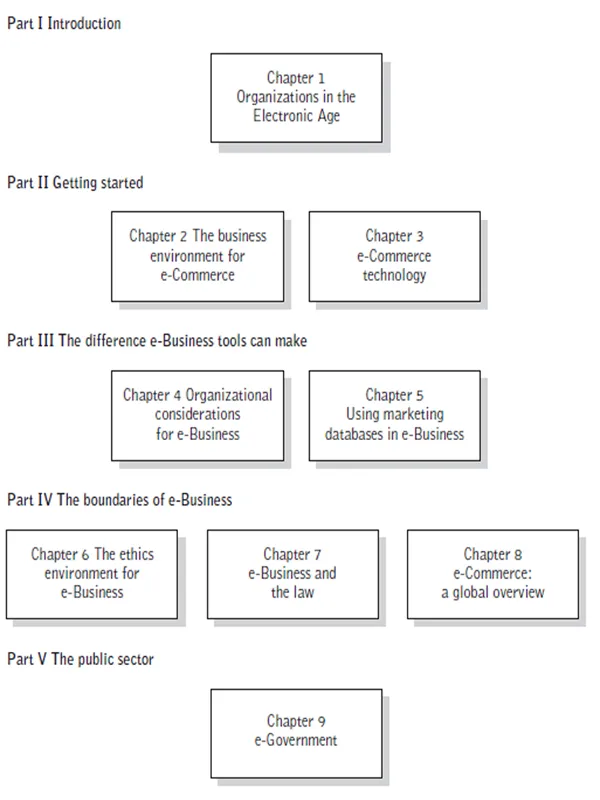
Figure 1.1 Structure of this volume
Although e-Commerce’s original economic drivers (the desire to break out of traditional market places) remain, Budd and Clear remind us that many people (a large number of stockbrokers as well as companies) got their fingers burnt during the late 1990s Internet ‘bubble’. As they argue, the Internet is a very useful medium through which one can conduct business and social transactions and disseminate information, but it has not heralded the arrival of a ‘new economy’ in the true sense of the term.
Chapter 3, ‘e-Commerce technology’ by Nandish Patel, provides a useful introduction to how the Internet and World Wide Web can be used to facilitate e-Commerce transactions. It traces the development of the technologies that make up the Internet and World Wide Web, and explains much of the terminology that sometimes acts as a deterrent to those people and organizations that would otherwise embrace them.
Patel goes on to explain how these technologies complement each other to create an architecture that enables online trading. Other tools, such as databases and evaluation software, are able to improve the customer’s experience of e-Commerce. Although concern still exists over the security of some transactions, the chapter outlines some of the methods available to prevent unauthorized parties accessing customers’ data and credit card details. It finishes by outlining how newer technologies, such as eXtensible Mark-up Language (XML), will benefit e-Businesses in future.
Chapter 4, ‘Organizational considerations for e-Business’ by Lisa Harris and Nelarine Cornelius, traces the development of traditional personnel responsibilities into modern strategic Human Resource Management (HRM). The authors argue that this must now also be updated to be relevant for e-Businesses. ‘e-HRM’ is necessary because of the extra communication, IT, customer service and networking skills that e-Business demands, as well as the recruitment and retention problems that many companies encounter. Harris and Cornelius address the extent to which ‘clicks and mortar’ organizations (large, traditional companies which have introduced e-Business methods) have adopted e-HRM, as well as global ‘dotcom’ corporations.
In a similar way, new marketing techniques must also be developed to respond to modern business methods. New forms of communication and information dissemination, such as Internets and intranets, have radically altered external and internal marketing strategies. Increasingly, organizations initiate contact with potential clients online and then seek to form longer-term ‘relationships’ with them offline, rather than view them as one-off customers. This approach requires strong internal branding, because organizations must maintain their image in all forms of communication, and for a much longer time than previously. The chapter concludes by outlining some of the barriers to introducing e-Business practices in traditional organizations.
Chapter 5, ‘Using marketing databases in e-Business’ by Michael Collins, emphasizes the importance of databases to e-Commerce and traditional ways of doing business. It explains how organizations can acquire different types of data from primary or secondary sources, and advises on ways to ensure that the information is of good quality. He also warns of potential data decay (between 8 per cent and 10 per cent of the UK population move home or die every year) and recommends methods of appraisal to ensure that the information held by organizations is up-to-date and relevant. This last point also has legal implications for all organizations under the Data Protection Act.
The chapter then addresses data manipulation and analysis tools, including storage mechanisms like warehousing or marting and other techniques such as mining or campaign management, which interpret the data in a way that is more useful to marketers. Companies are now able to use their databases to improve the customer experience, by providing the ‘front office’ with extensive information about their profile and previous experiences with the organization. This also puts them in a much better position to reach their target customers in marketing campaigns.
Chapter 6, ‘The ethics environment for e-Business’ by Laura Spence, points out that global e-Business recognizes few legal boundaries, leaving ethics as the most useful guide for determining the behaviour of organizations involved in the ‘new economy’. The chapter suggests useful tools that transcend traditional business ideas of profit maximization and explains how ethical guidance can be applied to individual and organizational behaviour in the electronic age. She describes how approaches such as ethical egoism, utilitarianism, Kantianism, discourse ethics theory and virtue theory can provide decision makers with a more rounded and sustainable perspective.
New technology introduces many different ethical issues into business activities: one notable advantage is the removal of potentially prejudicial barriers through electronic (rather than face-to-face) communications. However, it also enables other, more controversial, behaviour, such as increased monitoring of customers, competitors and employees, often without their express consent. The law is unclear on this and many other issues, such as data ownership and the personal use of ICT in work time. Such lack of clarity serves to highlight the need for a detailed, professional code of conduct or computer use policy in order to maintain mutual trust in employer–employee, business–customer and business–business relationships.
Chapter 7, ‘e-Business and the law’ by Dave Wadsworth, examines the combination of cross-border agreements, UK legislation and case law that forms the legal framework of e-Business transactions and Internet behaviour. Echoing Spence’s point about the problems caused by the Web not recognizing traditional legal boundaries, he outlines some of the battle lines between anarchic Netizens and states attempting to jealously guard their jurisdictions. This conflict has encouraged states to reach a number of international agreements, which form the basis of governance in cyberspace. Wadsworth goes on to describe the various pieces of legislation that inform criminal or civil prosecutions and protect citizens’ privacy under English law, and the chapter also addresses issues of copyright, trade marks and patents.
Although much of the relevant legislation and case law dates from before the technological revolution, the chapter illustrates how the Internet has led to new problems with these old issues. When compared with traditional ways of conducting transactions, business–client relationships in e-Business can be far more complex, subject as they are to outside interference by third parties such as hackers, cyber-squatters or Internet service providers. Web posting allows individuals to broadcast information to far more people than was previously possible, leading to increased claims of defamation, for example. This chapter charts the law’s success in trying to keep abreast of these developments and questions where the line should be drawn between respecting the anonymity of the Internet and protecting the rights of individuals and organizations that may be targeted as a result.
Chapter 8, ‘e-Commerce: a global overview’ by Geraldine Cohen, looks at how new technology has transformed business practice in recent years, benefiting from and accelerating the process of ‘globalization’. As domestic markets have become saturated, large businesses have tried to expand into other countries, eventually becoming ‘multinational’ or even ‘transnational’ companies, and the Internet enables them to reach potential consumers all over the world. However, Cohen points out that e-Commerce is not limited to these corporations, since the Web is the perfect market place for selling ‘niche’ commodities, which may have numerically limited but geographically disparate customers. Her chapter addresses a number of important issues for organizations wishing to enter the realm of international e-Commerce.
First, they have to ensure they get the balance right between specialist, country (or even regional) specific marketing, and standardized, general, brand-based approaches. Although two-thirds of the Web is in English, less than half of all Internet users have English as their mother tongue. This is likely to have significant implications for anglophone companies attempting to sell in other countries, since online translation facilities are notoriously bad and consumers are unlikely to buy something if they do not know exactly what it is. Cohen also highlights other problems that need to be addressed, such as payment methods, exchange rates, distribution and legislative differences across boundaries. As her chapter shows, e-Commerce has evolved in different ways across the world, reflecting local diversity.
Finally, Chapter 9, ‘e-Government’ by Noah Curthoys, Peter Eckersley and Paul Jackson, begins with an overview of the e-Government concept and traces its development in the United Kingdom. They explain the difference between e-Government (essentially using ICT to improve the delivery of public services) and e-Governance (how technology can change the way important decisions are made by enabling better engagement with stakeholders, greater transparency and more democratic legitimacy). The...
Table of contents
- Cover Page
- Routledge e-Business series
- Title Page
- Copyright Page
- Illustrations
- Contributors
- Preface
- Acknowledgements
- Abbreviations
- Part I Introduction
- Part II Getting started
- Part III The difference e-Business tools can make
- Part IV The boundaries of e-Business
- Part V The public sector
Trusted by 375,005 students
Access to over 1.5 million titles for a fair monthly price.
Study more efficiently using our study tools.
Frequently asked questions
Yes, you can cancel anytime from the Subscription tab in your account settings on the Perlego website. Your subscription will stay active until the end of your current billing period. Learn how to cancel your subscription
No, books cannot be downloaded as external files, such as PDFs, for use outside of Perlego. However, you can download books within the Perlego app for offline reading on mobile or tablet. Learn how to download books offline
Perlego offers two plans: Essential and Complete
- Essential is ideal for learners and professionals who enjoy exploring a wide range of subjects. Access the Essential Library with 800,000+ trusted titles and best-sellers across business, personal growth, and the humanities. Includes unlimited reading time and Standard Read Aloud voice.
- Complete: Perfect for advanced learners and researchers needing full, unrestricted access. Unlock 1.5M+ books across hundreds of subjects, including academic and specialized titles. The Complete Plan also includes advanced features like Premium Read Aloud and Research Assistant.
We are an online textbook subscription service, where you can get access to an entire online library for less than the price of a single book per month. With over 1.5 million books across 990+ topics, we’ve got you covered! Learn about our mission
Look out for the read-aloud symbol on your next book to see if you can listen to it. The read-aloud tool reads text aloud for you, highlighting the text as it is being read. You can pause it, speed it up and slow it down. Learn more about Read Aloud
Yes! You can use the Perlego app on both iOS and Android devices to read anytime, anywhere — even offline. Perfect for commutes or when you’re on the go.
Please note we cannot support devices running on iOS 13 and Android 7 or earlier. Learn more about using the app
Please note we cannot support devices running on iOS 13 and Android 7 or earlier. Learn more about using the app
Yes, you can access e-Business Fundamentals by Peter Eckersley,Lisa Harris,Paul Jackson in PDF and/or ePUB format, as well as other popular books in Business & Business General. We have over 1.5 million books available in our catalogue for you to explore.