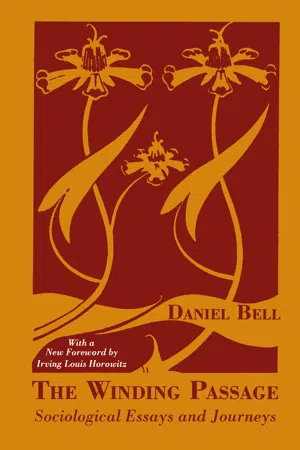
This collection brings together Daniel Bell's best work in essay form. It deals with a variety of topics: technology and culture, religion and personal identity, intellectuals and their societies, and the uses and abuses of doctrines of social class. The Winding Passage demonstrates the author's continuing concern with the salient issues of our times, while its inspiration draws upon an older, humanistic sociological tradition.
TECHNOLOGY, NATURE, AND SOCIETY The Vicissitudes of Three World Views and the Confusion of Realms*
The terms of the will of James Smithson bequeathed the whole of his property to the United States of America, “to found at Washington, under the name of the Smithsonian Institution, an Establishment for the increase and diffusion of knowledge among men.” Though the bequest, in one sense, was clear, the effort to implement it led for several decades to many confusions and debates. What is knowledge, and how does one increase it or diffuse it? Some individuals wanted to create a national university, others a museum, still others a library, and others still a national laboratory, an agricultural experiment station, or, with John Quincy Adams, a national observatory. Today we have all these except a national university—though some local patriots might consider my home on the Charles such an institution. And certainly, under Mr. Dillon Ripley, the Smithsonian has become “an Establishment.”
______________________________
* This essay was originally written as a lecture to be given, in December 1972, at the Smithsonian Institution in Washington. On such occasions, one usually seeks to make a gracious genuflection to the place, and omit such parochial introductions on publication. However, since the nineteenth-century debates about the purposes of the Smithsonian are still relevant to the question of “what knowledge is worth having,” I have retained that introduction in this publication.
But if in later years buildings were built and institutions established, the more vexing question of what knowledge should be increased and promoted, which bedeviled the regents of the Institution, still remains. In the mid-nineteenth century the “promotion of abstract science,” as Joseph Henry, the first head of the Institution, put it, dominated the activities of the Smithsonian. But Mr. Henry soon found himself under attack from all sides. There were those like Alexander Dallas Bache, who said that “. . .a promiscuous assembly of those who call themselves men of science would only end in disgrace.” Under the new conditions of scientific specialization, he declared, the universal savant was obsolete; the differentiation of scientists from amateurs demanded the material support only of professional research scientists. On the other hand, Horace Greeley, in the New York Tribune, accused Mr. Henry of converting the Smithsonian into “a lying-in hospital for a little knot of scientific valetudinarians.” The question of what kind of science, theoretical or applied, continues to be refought.
A different, equally familiar issue was the one between men of science and men of letters. Ethics and philosophy, said Ruf us Choate of Massachusetts, were as vital as soil chemistry and a knowledge of noxious weeds, and in the debate in the House of Representatives Choate’s protégé Charles W. Upham, representing the men of letters, declared: “. . . vindicate art, taste, learning, genius, mind, history, ethnology, morals—against sciologists, chemists & catchers of extinct skunks.”1
In the unhappy further differentiation of the world since then, I present myself neither as a man of science nor as a man of letters. Sciologists (the bearers of superficial learning) have become crossed with logomachs (those who contend wearily about words) to create sociologists, that hybrid with a Latin foreword and a Greek root, symbolizing the third culture which has diffused so prodigiously throughout the modern world.
Yet as an intellectual hybrid my provenance may not be amiss. For my theme is the redesign of the intellectual cosmos, the hybrid paths it has taken, and the necessary and hybrid forms it may take. With Mr. Upham’s charge in mind, I am prepared to vindicate all his categories, except extinct skunks.
I
The Confusion of Realms
If we ask what uniquely marks off the contemporary world from the past, it is the power to transform nature. We define our time by technology. And until recently we have taken material power as the singular measure of the advance of civilization.
______________________________
1. My discussion of the Smithsonian legacy and its vicissitudes is taken from A. Hunter Dupree, Science in the Federal Government (Cambridge, Mass.: Harvard University Press, 1957), chapter IV, and Howard S. Miller, “Science and Private Agencies,” in Science and Society in the United States, Van Tassel and Hall, eds. (Homewood, Ill.: Dorsey Press, 1960), pp. 195-201.
The philosophical justification of this view was laid down a hundred or more years ago by Marx. Man has needs which can only be satisfied by transforming nature, but in transforming nature he transforms himself: as man’s powers expand he gains a new consciousness and new needs—technological, psychological, and spiritual—which serve, further, to stimulate man’s activity and the search for new powers. Man, thus, is defined not by nature but by history. And history is the record of the successive plateaus of man’s powers.2
But if it is, as Marx states in Capital that in changing his external environment man changes his own nature, then human nature in ancient Greece must have been significantly different from human nature under modern capitalism, where needs, wants, and powers are so largely different. And if this is so, how is it possible, as Sidney Hook asks, to understand past historical experience in the same way we understand our own, since understanding presupposes an invariant pattern? This is a problem which confronts not only historical materialism but all philosophies of history.3
Marx only once, to my knowledge, in a fragment written in 1857, sought to wrestle with this conundrum; and his answer is extraordinarily revealing:
It is a well-known fact that Greek mythology was not only the arsenal of Greek art but also the very ground from which it had sprung. Is the view of nature and social relations which shaped Greek imagination and Greek [art] possible in the age of automatic machinery, and railways and locomotives, and electric telegraphs? Where does Vulcan come in as against Roberts & Co.; Jupiter as against the lightning rod; and Hermes as against the Crédit Mobilier? All mythology masters and dominates and shapes the forces of nature in and through imagination; hence it disappears as soon as man gains mastery over the forces of nature. ... Is Achilles possible side by side with powder and lead? Or is the Iliad at all compatible with printing press and steam press? Do not singing and reciting and the muses necessarily go out of existence with the appearance of the printer’s bar, and do they not, therefore, disappear with the prerequisites of epic poetry?
But the difficulty is not in grasping the idea that Greek art and epos are bound up with certain forms of social development. It rather lies in understanding why they still constitute with us a source of aesthetic enjoyment and in certain respects prevail as the standard and model beyond attainment.
The reason, Marx declares, is that such art is the childhood of the human race and carries with it all the charm, artlessness, and precocity of childhood, whose truths we sometimes seek to recapture and reproduce “on a higher plane.” Why should “the social childhood of mankind, where it had obtained its most beautiful development, not exert an eternal charm as an age that will never return?”4 That is why we appreciate the Greek spirit.
______________________________
2. “Human history may be viewed as a process in which new needs are created as a result of material changes instituted to fulfill the old. According to Marx ... the changes in the character and quality of human needs, including the means of gratifying them, is the keystone not merely to historical change but to the changes of human nature.” Sidney Hook, From Hegel to Marx (Ann Arbor: Univ. of Michigan Press, 1962), p. 277.
3. Sidney Hook, “Materialism,” Encyclopedia of the Social Sciences, Vol. X (New York: Macmillan, 1933), p. 219.
The answer is a lovely conceit. Yet one must know the sources of the argument to understand the consequences. For Marx, this view derived, in the first instance, from the conception of man as homo faber, the tool-making animal; the progressive expansion of man’s ability to make tools is, therefore, an index of man’s powers. A second source of this view was Hegel, who divided history into epochs or ages, each a structurally interrelated whole and each defined by a unique spirit qualitatively different from each other. From Hegel, this view passed over into cultural history, with its periodization of the Greek, Roman, and Christian worlds, and Renaissance, Baroque, Rococo, and Modern styles. Sociologically, Hegel’s idea is the basis of the Marxist view of history as successive slave, feudal, bourgeois, and socialist societies. Behind it all is a determinist idea of progress in human affairs, or a marche générale of human history, in which rationality in the Hegelian view, or the powers of production in the Marxist conception, are the immanent, driving forces of history that are obedient to a teleology in which anthropology, or a man-centered world, replaces theology, or a God-created world.
Today we know that, of the two views, that of homo faber is inadequate and that of the march of society and history is wrong. Man is not only homo faber but homo pictor, the symbol-producing creature, whose depictions of the world are not outmoded in linear history but persist and coexist in all their variety and multiplicity through the past and present, outside of “progressive” time. As for the nineteenth-century view of society, just as the mechanistic world view of nature has been shattered by quantum physics, so the determinist theory of history has been contradicted by the twentieth-century clash of different time-bound societies.5
So we are back to our initial question: what marks off the present from the past, and how do we understand each other; how, for example, do we read the ancient Greeks, and how would they read us? The answer lies, perhaps, in a distinctive interplay of culture and technology. By culture, I mean less than the anthropological view, which includes all “nonmaterial” factors within the framework of a society, and more than the genteel view, which defines culture by some reference to refinement (for example, the fine arts). By culture, I mean the efforts of symbol makers to define, in a self-conscious way, the meanings of existence, and to find some justifications, moral and aesthetic, for those meanings. In this sense, culture guards the continuity of human experience. By technology—in a definition I will expand later—I mean the effort to transform nature for utilitarian purposes. In this sense, technology is always disruptive of traditional social forms and creates a crisis for culture. The ground on which the battle is fought is nature. In this paper, I want to deal largely with the vicissitudes of nature as it is reshaped by technology, and the vicissitudes of technology in its relation to society. To that extent, I have to forgo an extensive discussion of culture, though I shall return to that theme at the end.
______________________________
4. “Introduction to the Critique of Political Economy.” The essay, much of it in the form of notes, was intended as an introduction to the main work of Marx. As a posthumous essay, it was first published by Karl Kautsky, Marx’s literary executor, in Neue Zeit, the theoretical organ of the German Social Democratic Party, and published in English as an appendix to Marx’s A Contribution to the Critique of Political Economy (Chicago: Charles H. Kerr, 1904). The quotations in the text are from pp. 310–312.
5. Socialism has not come as the successor of capitalism. Communist China is technologically more backward than capitalist U.S.A. If it is socially more “progressive,” on what dimensions do we make relevant comparisons: freedom, sexual styles, standard of living, communal care, personal dignity, social cohesion, attachment and l...
Table of contents
Cover
Half Title
Title Page
Copyright Page
Dedication
Epigraph
Table of Contents
Foreword to the Transaction Edition
Preface
Part I Techne and Themis
Part II Prophets of Utopia
Part III The Intellectuals and ‘The New Class”
Part IV Directions of Social Change
Part V Culture and Beliefs
Acknowledgements
Index
Trusted by 375,005 students
Access to over 1.5 million titles for a fair monthly price.
Study more efficiently using our study tools.
Frequently asked questions
Yes, you can cancel anytime from the Subscription tab in your account settings on the Perlego website. Your subscription will stay active until the end of your current billing period. Learn how to cancel your subscription
No, books cannot be downloaded as external files, such as PDFs, for use outside of Perlego. However, you can download books within the Perlego app for offline reading on mobile or tablet. Learn how to download books offline
We are an online textbook subscription service, where you can get access to an entire online library for less than the price of a single book per month. With over 1.5 million books across 990+ topics, we’ve got you covered! Learn about our mission
Look out for the read-aloud symbol on your next book to see if you can listen to it. The read-aloud tool reads text aloud for you, highlighting the text as it is being read. You can pause it, speed it up and slow it down. Learn more about Read Aloud
Yes! You can use the Perlego app on both iOS and Android devices to read anytime, anywhere — even offline. Perfect for commutes or when you’re on the go. Please note we cannot support devices running on iOS 13 and Android 7 or earlier. Learn more about using the app
Yes, you can access The Winding Passage by Daniel Bell in PDF and/or ePUB format, as well as other popular books in Social Sciences & Social Science Research & Methodology. We have over 1.5 million books available in our catalogue for you to explore.