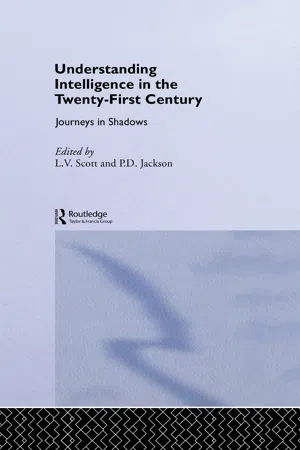
eBook - ePub
Understanding Intelligence in the Twenty-First Century
Journeys in Shadows
- 256 pages
- English
- ePUB (mobile friendly)
- Available on iOS & Android
eBook - ePub
Understanding Intelligence in the Twenty-First Century
Journeys in Shadows
About this book
Intelligence has never been more important in world politics than it is now at the opening of the twenty-first century. The terrorist attacks on the United States on September 11, 2001, along with the politics and diplomacy of the Second Gulf War, have brought intelligence issues to the forefront of both official and popular discourse on security and international affairs. The need for better understanding of both the nature of the intelligence process and its importance to national and international security has never been more apparent. The aim of this collection is to enhance our understanding of the subject by drawing on a range of perspectives, from academic experts to journalists to former members of the British and American intelligence communities.
Information
1 Journeys in Shadows
Len Scott and Peter Jackson
The first few years of the twenty-first century have witnessed a transformation in the role of secret intelligence in international politics. Intelligence and security issues are now more prominent than ever in Western political discourse as well as the wider public consciousness. Public expectations of intelligence have never been greater, and these demands include much greater disclosure of hitherto secret knowledge. Much of this can be attributed to the shock of the terrorist attacks of September 2001. These events drove home the vulnerability of Western societies and the importance of reliable intelligence on terrorist threats. But debates over the role of intelligence in the build-up to the Second Gulf War have played an equally important role in transforming the profile of the ‘secret world’ in Western society. As Christopher Andrew points out in his contribution to this collection ‘In the space of only a year, the threats posed by Osama bin Laden and Saddam Hussein had succeeded in transforming British government policy on the public use of intelligence’.1 The relationship between political leaders and their intelligence advisors came under unprecedented public scrutiny in both Britain and the United States. Both Prime Minister Tony Blair and President George W. Bush were widely charged with purposefully distorting intelligence information in order to justify their decision to make war on Iraq in April 2003. The need for a better understanding of both the nature of the intelligence process and its importance to national and international security policy has never been more apparent.
Understanding Intelligence in the Twenty-First Century draws upon the views of academics, journalists and former practitioners to consider the nature of intelligence and its evolving role in domestic and international politics. It also examines the development of intelligence as an area of academic study and assesses its emerging contribution to the study of international relations. An important aim is to explore the way the subject is studied, for what purpose and with what consequences.
It is nearly five decades since intelligence first emerged as a subject of serious academic study with the publication of Sherman Kent’s Strategic Intelligence for American Foreign Policy.2 It is some 20 years since two eminent British historians invoked Sir Alexander Cadogan’s description of intelligence as the missing dimension of international affairs.3 The development of intelligence studies as a sub-field of international relations has continued to gather momentum ever since. Initially the terrain of political scientists, the role of intelligence in domestic and international politics now attracts the attention of an ever larger number of historians. The subject is firmly established in centres of teaching and research in both Europe and North America. As a result, the study of international security has been increasingly influenced by a better understanding of the role of intelligence in policy making – although Christopher Andrew maintains that ‘it is still denied its proper place in studies of the Cold War’.4 And as Andrew argues persuasively in this collection, the specific and potentially crucial subject of signal intelligence remains almost wholly neglected in Cold War historiography.5
The rapid growth of intelligence as a focus of academic enquiry will surely continue. Recent progress in archival disclosure, accelerated by the end of the Cold War and by changing attitudes towards official secrecy and towards the work of the security and intelligence services, has further facilitated research, understanding and debate.6 Newly released documents, along with a range of other sources, provide an opportunity to reconsider long-standing assumptions about the motives of policy makers and the institutional character of foreign and security policy making. The events of September 11 and the war on Iraq have focused attention on all aspects of the subject. In light of these developments, the time seems right to take stock of what has been accomplished in this relatively new area of scholarly enquiry, to reflect upon the various methodological approaches used by scholars as well as the epistemological assumptions that underpin research and writing about intelligence.
Scope and focus: What is intelligence? How do we study it?
Popular perceptions and general understanding of the nature of intelligence and its role in international relations leaves much to be desired. A starting point is the question: what is intelligence? The way intelligence is defined necessarily conditions approaches to research and writing about the subject. Sherman Kent’s classic characterisations of intelligence cover the ‘the three separate and distinct things that intelligence devotees usually mean when they use the word’ : knowledge, the type of organisation that produces that knowledge and the activities pursued by that organisation.7 In most contemporary analyses, intelligence is understood as the process of gathering, analysing and making use of information. Yet beyond such basic definitions are divergent conceptions of exactly what intelligence is and what it is for. This is perhaps because, as James Der Derian has observed, intelligence is the ‘least understood and most “undertheorized” area of international relations’.8 David Kahn, one of the most eminent scholars in the field, similarly laments that ‘[n]one of the definitions [of intelligence] that I have seen work’.9 A brief survey of various approaches to the study of intelligence illuminates the difficulties inherent in any search for an inclusive definition.
Many observers tend to understand intelligence primarily as a tool of foreign and defence policy making. Others focus on its role in domestic security. Still others concentrate on the role intelligence services have played as mechanisms of state oppression.10 One interesting divergence of views pertains to the basic character of intelligence. Michael Herman (a former practitioner) treats it as a form of state power in its own right and this conceptualisation is at the heart of the analysis in his influential study Intelligence Power in Peace and War.11 John Ferris (an historian) proffers a different view, judging that ‘Intelligence is not a form of power but a means to guide its use, whether as a combat multiplier, or by helping one to understand one’s environment and options, and thus how to apply force or leverage, and against whom.’12 Whichever formulation one adopts and whatever the quality of intelligence on offer it is the judgement of political leaders and their grasp of the value and limitations of intelligence that is most crucial.13
So how do we define intelligence work? Should we make a distinction between ‘secret’ and ‘open source’ information? Does the internet change how we evaluate ‘open source’ information? What distinguishes the intelligence process from the information gathering activities of other government agencies? Michael Herman has offered a solution to this problem by identifying ‘government intelligence’ as ‘the specialised organizations that have that name, and what they do and produce’.14 This distinction can become problematic, however, when it comes to analysing the impact of intelligence on decision making. Assessments drafted by intelligence agencies are usually based on a combination of ‘secret’ and ‘open’ source information. And a substantial percentage of the information from open sources is quite often drawn from material acquired and processed by other government departments, the popular media and even work that has been contracted out to non-government agencies. Since all of these areas cannot reasonably be defined as intelligence activity, this suggests that the essence of intelligence lies at the level of analysis or assessment.15 The problem is that assessments are only one element in the decision-making process, and the illumination that they provide may only complement information provided by other government agencies or other sources of information at the level of decision. It therefore remains difficult to make confident judgements about exactly what intelligence is and precisely how it influences decision making. Should scholars accept this level of imprecision as inevitable? Or, conversely, should we continue to strive to come up with a definition of intelligence that resolves this uncertainty?
A good illustration of the difficulties inherent in defining intelligence is the controversial question of secret intervention in other societies (most commonly referred to as ‘covert action’). Scholars have frequently ignored covert action in their analyses of intelligence. As Elizabeth Anderson has argued: ‘the specific subject of covert action as an element of intelligence has suffered a deficiency of serious study’. She further observes that
while academics have developed different theoretical concepts to explain other instruments of international relations – for example, weapons, trade and diplomacy – the separation of covert action from ‘traditional’ foreign policy instruments means that these same concepts have not been applied to covert action.16
There is a clear need to locate ‘covert action’ within the study of international relations in general and within intelligence in particular. This may also pose an interesting challenge for theorists of intelligence because considering covert action as intelligence work means that intelligence might be better understood as a tool for the execution of policy as well as a tool to inform policy. Since September 11 the political context, both national and international, has changed. Amid widespread calls for intelligence reform in the United States there are those who argue for a radical new conceptualisation of the role of intelligence in national security policy. In this collection Charles Cogan, a former senior officer in the American Central Intelligence Agency (CIA), advocates, inter alia, a change in the orientation of US intelligence from gathering information to hunting the United States’ adversaries. Such a transformation may require a new conceptual architecture for intelligence reflecting its new role in the exercise of US military power.
There is also substantial, if rarely articulated, divergence in approaches to studying intelligence. Scholars tend to approach the subject from three relatively distinct perspectives, in the pursuit of relatively distinct objectives. The first approach, favoured among international historians in particular, but also characteristic of theoretical approaches that seek to explain the relationship between organisational structure and policy making, conceives of the study of intelligence primarily as a means of acquiring new information in order to explain specific decisions made by policy makers in both peace and war. Close attention is paid by these scholars to the process of intelligence collection, to the origin and nature of individual sources of intelligence, and to the precise use that is made of intelligence as it travels up the chain of decision. A thorough understanding of the organisational structure of government machinery, and of the place of intelligence within this machinery, is crucial to this approach. This literature overlaps with journalistic endeavours that focus on particular cases of espionage and biographies of individual officials and agents.
A second approach strives to establish general models that can explain success and failure in the intelligence process. Characteristic of political science approaches to the discipline, it focuses almost exclusively on the levels of analysis and decision. Decisive importance is attributed by adherents of this approach to structural and cognitive obstacles to the effective use of intelligence in the policy process. The aim is to identify and analyse the personal, political and institutional biases that characterise intelligence organisations and affect their performance in the decision-making process. The emphasis is on the role of preconceptions and underlying assumptions in conditioning the way intelligence is analysed and used. The result has been a range of insights into the nature of perception and misperception, the difficulty in preventing surprise, and the politicisation of the intelligence process.17 Both of the first two conceptual approaches focus primarily on intelligence as a tool of foreign and defence policy making.
A third approach focuses instead on the political function of intelligence as a means of state control. The past decade, in particular, has seen the appearance of a range of historical and political science literature on this subject. If the Gestapo has long been a subject of historical study, recently released archival material has enabled scholars to study the role of state security services in political and social life in the USSR and Eastern bloc states after 1945. This has provided a stimulus for a new wave of scholarship on state control since 1789. Historians are now working on a wide range of topics from the role of British and French intelligence services in maintaining imperial control overseas to the activities of security services such as MI5 or the FBI and their impact on political culture in Britain and the United States.18 Many of the scholars engaged in this research would not consider themselves as contributing to ‘intelligence studies’. Their focus is instead the use of intelligence sources to understand better the role of ideology and state power in political, social and cultural life. Yet there are strong arguments for embracing this scholarship under a broader definition of ‘intelligence studies’ and no reason to remain confined by disciplinary boundaries that are porous and arbitrary. One area of contemporary social science that has clear relevance to intelligence studies is the concept of surveillance. The potential of this area of enquiry is demonstrated in this volume by Gary Marx in his analysis of the new forms of surveillance in both official and private contexts. Marx explores an ‘empirical, analytic and moral ecology’ of surveillance and demonstrates how the evolution of information technology poses serious challenges to existing conceptions of individual liberty and security.19
The best writing about intelligence incorporates all three of the above approaches in different ways. But there are nearly always differences in emphasis even in the seminal works that have been crucial in pushing research forward. At the heart of these divergences, arguably, is disagreement concerning the extent to which political assumptions and political culture shape the intelligence process at all levels. Few would deny that the process of identifying threats is inextricably bound up with political choices and assumptions. The same can be true for the gathering, assessment and dissemination of information on these threats. Yet how we understand political processes and political culture is crucial. Scholars vary in the importance that they attribute to political culture and to ideology. Christopher Andrew, for example, argues in this collection that, ‘For the conceptual framework ...
Table of contents
- Cover Page
- Title Page
- Copyright Page
- Foreword
- Preface
- List of Abbreviations and Acronyms
- List of Figures and Tables
- List of Contributors
- 1: Journeys in Shadows
- 2: Intelligence, International Relations and ‘Under-theorisation’
- 3: German Intelligence History: A field in search of scholars
- 4: Netcentric Warfare, C4ISR and Information Operations: Towards a revolution in military intelligence?
- 5: Some Concepts that may be Useful in Understanding the Myriad Forms and Contexts of Surveillance
- 6: ‘Who Profited from the Crime?’ Intelligence Failure, Conspiracy Theories and the Case of September 11
- 7: Bletchley Park and the Holocaust
- 8: Fiction, Faction and Intelligence
- 9: The Geopolitics of James Bond
- 10: Hunters not Gatherers: Intelligence in the twenty-first century
- 11: Secret Intelligence, Covert Action and Clandestine Diplomacy
- 12: Ethics and Intelligence after September 2001
- 13: ‘As Rays of Light to the Human Soul’? Moral Agents and Intelligence Gathering
Trusted by 375,005 students
Access to over 1.5 million titles for a fair monthly price.
Study more efficiently using our study tools.
Frequently asked questions
Yes, you can cancel anytime from the Subscription tab in your account settings on the Perlego website. Your subscription will stay active until the end of your current billing period. Learn how to cancel your subscription
No, books cannot be downloaded as external files, such as PDFs, for use outside of Perlego. However, you can download books within the Perlego app for offline reading on mobile or tablet. Learn how to download books offline
Perlego offers two plans: Essential and Complete
- Essential is ideal for learners and professionals who enjoy exploring a wide range of subjects. Access the Essential Library with 800,000+ trusted titles and best-sellers across business, personal growth, and the humanities. Includes unlimited reading time and Standard Read Aloud voice.
- Complete: Perfect for advanced learners and researchers needing full, unrestricted access. Unlock 1.5M+ books across hundreds of subjects, including academic and specialized titles. The Complete Plan also includes advanced features like Premium Read Aloud and Research Assistant.
We are an online textbook subscription service, where you can get access to an entire online library for less than the price of a single book per month. With over 1.5 million books across 990+ topics, we’ve got you covered! Learn about our mission
Look out for the read-aloud symbol on your next book to see if you can listen to it. The read-aloud tool reads text aloud for you, highlighting the text as it is being read. You can pause it, speed it up and slow it down. Learn more about Read Aloud
Yes! You can use the Perlego app on both iOS and Android devices to read anytime, anywhere — even offline. Perfect for commutes or when you’re on the go.
Please note we cannot support devices running on iOS 13 and Android 7 or earlier. Learn more about using the app
Please note we cannot support devices running on iOS 13 and Android 7 or earlier. Learn more about using the app
Yes, you can access Understanding Intelligence in the Twenty-First Century by Peter Jackson, L.V. Scott, Peter Jackson,L.V. Scott in PDF and/or ePUB format, as well as other popular books in Politics & International Relations & Historiography. We have over 1.5 million books available in our catalogue for you to explore.