The School Handbook for Dual and Multiple Exceptionality (DME) offers a range of practical strategies to support SENCOs, GATCOs, school leaders and governors in developing effective provision for children that have both High Learning Potential and Special Educational Needs or Disabilities. Building on the principles of child-centred provision and coproduction, it provides useful tips on developing the school workforce to better identify and meet the needs of learners with DME.
Relevant for learners in primary, secondary or specialist settings, the book focuses on ways of meeting individual needs and maximising personal and academic outcomes. It includes:
An explanation of what DME is and why we should care about it
Practical advice and guidance for SENCOs, GATCOs and school leaders on developing the school workforce
A discussion of the strategic role of governors and trustees in the context of DME
Suggested approaches to ensure effective coproduction between families and professionals
Case studies exploring the experiences of learners with DME
Sources of ongoing support and resources from professional organisations and key influencers.
This book will be beneficial to all those teachers, school leaders, SENCOs, GATCOs, governors and trustees looking to support learners by identifying and understanding DME. It recognises the central role that leaders and governors play in setting the inclusive ethos of a school and suggests ways for schools to ensure that all learners have the opportunity to meet their full potential.
She is refusing to go to school, and we think it is a behavioural issue, but the parents say that she is afraid of failure and highly anxious. We put her in the bottom set to support her.
(Teacher, prior to knowing about DME)
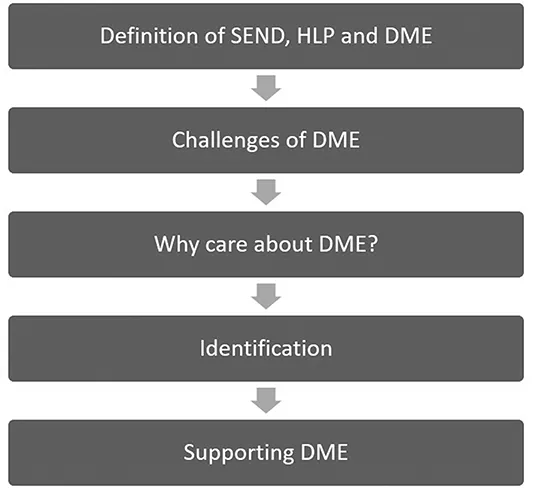
Figure 1.1
This book is about potential; more specifically, how to identify, support and nurture High Learning Potential (HLP) in a child or young person with one or more Special Educational Needs or Disabilities. A child or young person who has a gift or talent in one or more areas as well as a special need or disability is called Dual and Multiple Exceptional (or DME for short). In some countries, this individual may be referred to as being Twice Exceptional or 2e or Gifted with Learning Difficulties (GLD).
DME may not be a term many professionals have come across, whether they are a SEND Co-ordinator or a Gifted and Talented Co-ordinator (GATCO), and yet it is a term which is important to both disciplines as well as class teachers and other professionals in school including the senior leadership team and the board of governors or trustees who lead the school.
Definition of SEND
Those professionals who work in the area of SEND or who have some experience of these issues in the classroom or beyond should be familiar with the definition of SEND.
According to the Department for Education and the Department of Health SEND Code of Practice (DfE and DoH, 2015), a child or young person has Special Educational Needs if they have a learning difficulty or disability which calls for special educational provision to be made for him or her. A child of compulsory school age or a young person has a learning difficulty or disability if he or she has:
significantly greater difficulty in learning than the majority of others of the same age; or
a disability which prevents or hinders them from making use of educational facilities of a kind generally provided for others of the same age in mainstream schools or mainstream post-16 institutions.
Special Educational Needs and Disabilities are grouped under four broad areas:
Communication and interaction – children and young people with speech, language or communication issues. Specific learning difficulties such as dyslexia or a physical or sensory impairment such as hearing loss may also lead to communication difficulties. Children and young people with an Autism Spectrum Condition may have difficulties with communication, social interaction and imagination. In addition, they may be easily distracted or upset by certain stimuli, have problems with change to familiar routines or have difficulties with their co-ordination and fine-motor functions.
Cognition and learning – children and young people with learning difficulties may learn at a slower pace than other children and may have greater difficulty than their peers in acquiring basic literacy or numeracy skills or in understanding concepts, even with appropriate differentiation, including dyslexia, dyscalculia and dyspraxia. However, those with cognition and learning issues may also have other difficulties such as speech and language delay, low self-esteem, low levels of concentration and under-developed social skills.
This definition of cognition and learning issues can be difficult to demonstrate for children and young people with DME, many of whom are learning at age-appropriate levels and pace. The key is not to evaluate their learning difficulty in relation to that of their class peers but in relation to what and how they are capable of otherwise learning with the right support. The risk is that children and young people with DME can appear to be operating at or above average within their peer group. As shall be seen later, particularly in some of the case studies, whilst this can be difficult to measure, it is not impossible to identify and provide for.
In circumstances where DME is unidentified, children are at risk of developing additional Special Educational Needs, particularly social, emotional and mental health issues. They may then need additional support in these areas, even where it did not present as a Special Educational Need in the first instance but arose from inaccurate identification within the broad area of cognition and learning.
Social, emotional and mental health – children and young people who have difficulties with their social and emotional development may have immature social skills and find it difficult to make and keep healthy relationships. Resulting issues can range from being withdrawn or socially isolated to having disruptive or challenging behaviour. This can lead to emotional health issues such as self-harm, eating disorders, trichotillomania, anxiety or depression. Some children and young people may also have other recognised disorders such as attention deficit hyperactivity disorder (ADHD), attachment disorder, anxiety disorder or, more rarely, conditions such as schizophrenia or bipolar disorder.
Sensory and/or physical – children or young people with vision impairment (VI), hearing impairment (HI) or multisensory impairment (MSI) or other physical difficulties would fall into this broad area.
Many children and young people have difficulties that fit clearly into one of these areas. Increasingly, learners have needs that span two or more areas, which is known as comorbidity or co-occurring needs, but for others the precise nature of their need may not be clear at the outset. This can often be the case with a child or young person who has DME.
An introduction to Alex
Alex was a highly verbal child; speaking in whole sentences by the age of 2. By 3 he could tell his family members stories which tapped into his vivid imagination and which left them in no doubt what a bright boy they had. He went to a local private nursery setting on a part-time basis and they confirmed what his parents had thought when his key worker talked to them about his intellectual boredom being a possible reason for the sudden onset of his misbehaviour. His key worker recommended that he should be moved to primary school as soon as possible to get greater intellectual stimulation, which his parents did.
At school, he enjoyed anything which enabled him to talk and use his imagination. However, he struggled at the outset with his handwriting and organisational skills and avoided reading wherever possible. His maths ability was also extremely variable. For example, he struggled with mental maths, but he was extremely good at anything which involved visual or spatial maths.
His teachers could not understand how, when he was asked a question, he usually knew the answer but when he had to write anything down or concentrate on something in which he wasn’t interested, he did not engage. Various teachers put it down to everything from laziness to poor behaviour to lack of ability.
As he grew older, Alex became the class clown and was good at playing his teachers and parents off against each other to get out of homework which, when he had to do it, was a nightmare at home and could take the better part of a day to complete. His parents found that if he dictated it to them it was fine and then they dictated it back to him in ‘chunks’ over the course of the day. Sometimes this lasted into the evening as he grew tired quickly and found it difficult to write for long periods.
By the time he was 8, his parents were extremely worried about Alex. They began to research everything about various Special Educational Needs, looking for answers about what was going on in school. He could read when he set his mind to it, although he wasn’t a natural reader. In addition, providing maths was explained visually or spatially, his only issues seemed to be with lack of interest and ability to process information. Lack of organisational skills was still a problem but that was put down to it ‘just being Alex’.
In secondary school, Alex remained the class clown and his parents were regularly contacted by his teachers ‘because of his sense of humour’ and imaginative antics. However, what they didn’t realise until many years later was that he was also bullied by the other boys because he did not like things like football, preferring music and drama.
To build on his strengths and his interests, his parents paid for music lessons and a drama club in the local community and these were recognised when he was placed on the ‘Gifted and Talented Register’ at school. This amused Alex because, from the age of about 8 or 9, his self-esteem in terms of his schoolwork had been rapidly decreasing, making school in most cases a negative experience for him. For example, when asked who was better than he was at maths he answered, ‘an ant’.
Alex’s full story can be found in Chapter 5.
Definition of HLP
Those individuals who work with children and young people who are clever or who have one or more gifts or talents will know that there are many terms and definitions in use currently, or which have been used in the past, to define these children.
The variety of terms for these individuals is recognised by Freeman in the seminal work ‘Educating the Very Able’ (Freeman, 1998), a government-commissioned report published just before the launch of the government’s gifted and talented programme. Here she refers to ‘the troublesome word “gifted”, with its implications of gifts bestowed intact from on high’. However, ‘gifted and talented’ was the term chosen by the government for its national programme and this continued to be used for many years after the programme ended and is still in use in many schools across the country.
This repeated failure to agree to standard terminology and definitions which everyone could use, and which were not seen as elitist, contributed to the closure of the only national government programme in England to support these children. Following this closure of the government’s gifted and talented programme in the mid-2000s (and after a number of years without a co-ordinated government policy) the most popular of these terms are or have been:
More able, Most Able or High Attainers – these are the current terms used by Ofsted and the Department of Education and focus on ‘those who have abilities in one or more academic subjects such as mathematics or English’.
More/Most Able – this term either on its own or with gifted and talented was inserted by schools and government and reflects the unease which many people felt at the term ‘gifted and talented’ which was seen as ‘elitist’ and ‘not reflecting the education situation in many schools’. More/most able (which are often used interchangeably) was defined as those who have abilities in one or more subject areas and the capacity for or ability to demonstrate high levels of performance. Thus, someone could be academic because they worked hard and applied themselves rather than because they had an innate ability in one or more subjects.
More Able and Talented – this was used by the Welsh Government to show pu...
Table of contents
Cover
Endorsements
Half Title
Series Page
Title Page
Copyright Page
Table of Contents
Foreword: Danielle Brown MBE
Introduction
1. What is DME and why should we care?
2. Equipping the school workforce
3. Leadership and governance
4. Effective relationships with learners and their families
5. DME provision Real stories
Conclusion: The way forward for DME in your school
References
Appendix 1: Glossary of terms used
Appendix 2: DME support available for schools
Appendix 3: Ten myths of supporting pupils with DME
Index
Trusted by 375,005 students
Access to over 1.5 million titles for a fair monthly price.
Study more efficiently using our study tools.
Frequently asked questions
Yes, you can cancel anytime from the Subscription tab in your account settings on the Perlego website. Your subscription will stay active until the end of your current billing period. Learn how to cancel your subscription
No, books cannot be downloaded as external files, such as PDFs, for use outside of Perlego. However, you can download books within the Perlego app for offline reading on mobile or tablet. Learn how to download books offline
Perlego offers two plans: Essential and Complete
Essential is ideal for learners and professionals who enjoy exploring a wide range of subjects. Access the Essential Library with 800,000+ trusted titles and best-sellers across business, personal growth, and the humanities. Includes unlimited reading time and Standard Read Aloud voice.
Complete: Perfect for advanced learners and researchers needing full, unrestricted access. Unlock 1.5M+ books across hundreds of subjects, including academic and specialized titles. The Complete Plan also includes advanced features like Premium Read Aloud and Research Assistant.
Both plans are available with monthly, semester, or annual billing cycles.
We are an online textbook subscription service, where you can get access to an entire online library for less than the price of a single book per month. With over 1.5 million books across 990+ topics, we’ve got you covered! Learn about our mission
Look out for the read-aloud symbol on your next book to see if you can listen to it. The read-aloud tool reads text aloud for you, highlighting the text as it is being read. You can pause it, speed it up and slow it down. Learn more about Read Aloud
Yes! You can use the Perlego app on both iOS and Android devices to read anytime, anywhere — even offline. Perfect for commutes or when you’re on the go. Please note we cannot support devices running on iOS 13 and Android 7 or earlier. Learn more about using the app
Yes, you can access The School Handbook for Dual and Multiple Exceptionality by Denise Yates,Adam Boddison in PDF and/or ePUB format, as well as other popular books in Education & Early Childhood Education. We have over 1.5 million books available in our catalogue for you to explore.