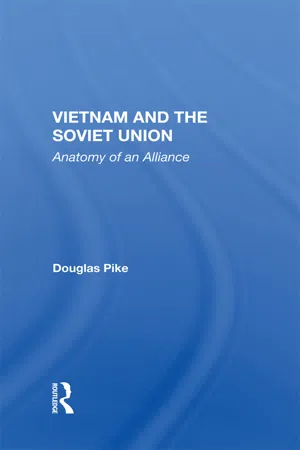
Examining the long and turbulent relationship between Vietnam and the Soviet Union, Douglas Pike traces its political, economic, and diplomatic history from the Bolshevik Revolution to today's deep and intricate alliance. He not only explores this extraordinary relationship but also outlines its great geopolitical significance for the entire region
- 288 pages
- English
- ePUB (mobile friendly)
- Available on iOS & Android
eBook - ePub
About this book
Information
One
The Formative Years
Pretense and Reality
THE HISTORY OF Vietnamese-USSR relations until well into the decisive 1960s was nominal and cursory. There was neither much intercourse nor emotional attachment for either party. The heritage of those years, which continues to be influential today, is best expressed thematically. The earliest years, the 1920s, were an amalgam of pretense and reality for both Ho Chi Minh's little band of revolutionaries and the ruling Comintern in Moscow. The Stalin years of the 1930s and 1940s were a time of cruel indifference for Vietnamese radicals seeking Moscow assistance in ridding their homeland of colonialism. The last years of this formative period, the time of Nikita Khrushchev, witnessed the advent of a deeper and more complex association that left scars of distrust in Hanoi—scars that still have not disappeared. It is these themes that we seek to trace in this chapter.
Earliest Years
The history begins with the initial contact between the fledgling Indochinese Marxist movement and Moscow after the 1917 Bolshevik Revolution and the start of the slow filtering of Marxist-Leninist thought into Indochina. Here there is no large body of early documentation to be examined, no lengthy histories to be consulted. Rather, the record is one of scattered references in memoirs and brief passages in historical accounts devoted to larger events.
Hanoi historians today trace Vietnamese communism's spiritual roots back to 1903 and the July 30 meeting of the Russian Social Democratic Workers Party. This, it is held, was "the key turning point in the history of the revolution of the working class and laboring people in Russia, and in the world as a whole, including Vietnam . . . that set the principles of a new proletarian party which later Ho Chi Minh fostered in founding the Communist Party of Vietnam from which stemmed the victories of the Vietnamese revolution . . . (and) the lines and orientations for economic development."1
Actually, there is no evidence that Marxist thought was at all influential among Vietnamese revolutionaries prior to the Bolshevik Revolution. According to Truong Chinh, Ho Chi Minh first began reading Marx (and Lenin) in a systematic and meaningful way in late 1919, initially in preparation for the December 1920 French Socialist Party Congress at Tours (which resulted in a French left split and the formation of the French Communist Party, of which Ho was a charter member).2 Vietnam's other early great revolutionary figure, Phan Boi Chau, likewise did not begin studying Marxism until after the Bolshevik Revolution.3 Vietnamese with revolutionary stirrings in the early days found their lodestar in the east—in Japan because of its turn of the century victory over Russia, and in China with Sun Yat Sen's 1912 revolution. If there was identification with the west among these young proto-Marxists it was not with Bolshevism but with the radicals of France, in the spirit of the Paris commune.
Lenin and the other Bolsheviks, prior to their revolution, had been aware of developments in Indochina, although clearly these were marginal for them in the general scheme of things. The earliest specific reference to Indochina the author has been able to find is Lenin's August 1908 article on the "tinderboxes of the world," in which he wrote,
A look at the attitude of the French in Indochina shows that this time some of those who have taken part in the plundering of the colony feel uneasy: they helped the "historical government" of China suppress revolutionaries! They are also fraught with worry over keeping "their" Asiatic colonies on the edge of China intact.4
Much of what Lenin wrote about colonialism—including his important Imperialism, The Highest Stage of Capitalism (1916)—was generally relevant and did make specific reference to Indochina. A third early Lenin reference was to "rebellious plots in French-controlled Annam" in a July 1916 newspaper article on self-determination.5
The first post-revolutionary official pronouncement out of Moscow that even remotely could be related to Vietnam came in December 1917, a month after the Bolsheviks had seized power. It was Lenin's message to the Moslims in and out of Russia, a general statement that, in effect, defined the Communist revolution in Asia as liberation from colonialism.6
Of course, the Bolshevik Revolution in itself was profoundly meaningful for the revolutionary movement in Indochina. Previously the Vietnamese revolutionary impulse that had arisen with the arrival of the French as colonialists in the 1860s was narrowly structured though amorphous. The Bolshevik Revolution became a fork in the road for Indochinese revolutionaries, offering them (or forcing them into) a choice of revolutionary routes, Communist or non-Communist.
Serious attention by Moscow to issues primarily concerning colonized Indochina began in mid-1920, when Lenin sent a draft report to the Comintern Second Congress that then went to a special commission and finally emerged as a policy statement titled First Outline of Theses on the National and Colonial Questions.7
The document deals with two issues: nationalities or ethnic minorities in the USSR and colonialism. The portion dealing with the latter is largely an elementary set of instructions on the thinking to be followed and the pitfalls to be avoided by Communist cadres in their organizational and operational activities in what today would be called the Third World. Lenin was apparently primarily concerned with ensuring that native revolutionary movements were kept under firm party supervision and ideologically uncontaminated by "petty bourgeois nationalism and pacificism." Organizational efforts, of necessity, were to be centered in the peasantry but would include whatever local proletariat was available. The party should always be self-contained, Lenin said, and should eschew the false opportunism represented by broad political movements such as the Pan Asian and Pan Islamic movements. Organizers were warned to be particularly wary of bourgeois-democratic tendencies that could either subvert the revolutionaries' character or co-opt the revolution. However, temporary relations, even alliances, were sometimes necessary, and they were permissible as a tactic. The sense of Theses on the National and Colonial Questions seems to be that, as most peasants were tradition bound, parochial in outlook, and stubbornly apolitical, the peasantry was a very weak reed. Lenin's pessimistic conclusion seems to be that not much could be created from such unpropitious material.8
Even so, the advent of Theses was significant. It raised the status of Asia and moved it closer to the center of Communist strategic thinking. No longer was Asia a mere contributor to world revolution. Now it was a major actor assigned an essential role. Asia, which principally meant China, was seen as capitalism's vulnerability. If Asian peoples could be organized and motivated to revolt, an avalanche could be set in motion. The revolt could best be accomplished by harnessing the hostile forces latent in the institutions of feudalism, colonialism, imperialism, and racism. It became part of a vision of the world transformed: Conflagration in the hinterland would cause first crisis and then revolution in the imperialist citadels—and this could not be done without the contribution of the peoples of Asia. It was all succinctly expressed in Grigory Zinoviev's aphorism coined at the 1925 Comintern Plenary meeting: "The road to World Revolution lies through the East rather than through the West."9
Much later, Ho Chi Minh said that Lenin's Theses is what drew him to Marxism—it hit him like a thunderbolt, he told an interviewer. Truong Chinh describes Ho's encounter with Lenin's Theses on the National and Colonial Questions: "Sitting alone in his small room at Number 9, Impasse Compoint (Paris) he was extremely moved. Tears flowed down his cheeks. He shouted aloud, as if addressing a large crowd: 'Dear martyrs! Compatriots! This is what we need! This is the path to our liberation.'"10 Perhaps, as with Chapman looking into Homer, it was a profoundly moving experience. Or it may simply have been that Lenin had raised the subject of colonialism to a transcendental level, something Ho had been attempting to do among the French left, but without much success. Possibly the legend is simply Ho's gesture of deference to the fountainhead of communism.
Much later, Vietnamese Communists speaking privately would argue that Ho Chi Minh at the time was more advanced in his thinking on the liberation of Asia than was Lenin, that he certainly knew more about organizing a revolution around the peasantry, and that Lenin's formula—which called first for ousting the colonial/imperialist power and then for achieving revolution—was not necessarily correct. Ho argued the two could be combined11 and that, in any event, they were intricately linked. This was the burden of Ho's contribution to the debate at the Comintern's Fifth Congress (Eighth Session, June 3, 1924) in Moscow:
My purpose in speaking here is to direct the attention of the delegates to the colonies, which to a large degree will determine the destiny of the world proletariat. Colonies supply the food and soldiers for the large imperial countries; if we want to defeat these countries we must begin by taking away their colonies. . . .
Apparently you have yet to accept fully the thinking that the destiny of the international proletariat, especially the proletariat in countries that send forces to invade and occupy colonies, is closely linked to the destiny of the oppressed classes of the colonies. . . .
Why in these matters of revolution have you not reorganized your tactics and forces? Why do you give no attention to the forces and the propaganda from the opposition you wish to struggle against and topple? Why do you ignore the colonies when the capitalists use the colonies to defend themselves and oppose you? . . . It is the colonies that are the foundation of counter-revolution. Yet when you talk about revolution you give only slight attention to the colonial question. . . .
Comrades, forgive my boldness. But I must say as I listen to the debate by those of you from mother countries, I have the impression you are trying to kill the snake by hitting it on the tail, not the head. The venom and vitality of imperialism are in the colonies, not the mother countries.12
The Vietnamese colonial complaint, voiced here and elsewhere, was that while the Bolshevik and Comintern leaders paid lip service to the liberation of Vietnam and other colonies, their strategic planners were not acting on the logic of the utility represented by colonies.
Indeed, there was justification for Ho's criticism. Lenin's Imperialism, The Highest Stage of Capitalism must have greatly disappointed him, for it made no reference to the idea of revolution in the mother country via revolution in the colonies. This writing was the logical place for Lenin to deal with the concept, had he been so inclined. The idea itself was not new, nor was it unknown in Moscow. Marx, using Ireland as a model of thought, had seen the vulnerability that colonialism represented to the colonizing power. He recognized that denying markets and resources to a European power, by means of revolution in colonial and semicolonial nations, might well trigger revolution at home. Although the early Comintern leaders endorsed the idea, they did not share Ho's preoccupation with it. Or perhaps their attention was elsewhere, focused on what they perceived as a greater strategic opportunity. As a result, they treated colonialism in an undifferentiated manner, lumping it under the rubric of the National Question. They spoke of liberation of the European colonies, but in the context of the right of self-determination of the colonial peoples. Most contended that this right would be realized only as a by-product of revolution in the mother country. Trotsky was perhaps the most insistent on this point; "The workers and peasants not only of Annam, Algeria, Bengal but also of Persia and Armenia will obtain the possibility of independent existence only on the day when the workers of England and France will have overthrown Lloyd George and Clemenceau and taken the state power into their hands."13
The early Comintern statement that most closely approached Ho's thinking on strategy for Asia is found in the report that emerged from the Sixth Comintern Congress (1928). It called for the overthrow of "imperialism, feudalism, and landlord bureaucracy; establishment of democratic dictatorship of the proletariat and peasantry on the basis of Soviets; expropriation [and] nationalization of all land; and establishment of revolutionary worker's and peasants army."
The position of Trotsky and of others such as Zinoviev was quite clear; Lenin's was somewhat less so. In any event Ho's suggested strategy was ignored. It would not be the last time in which he and his Vietnamese cadres would differ with Moscow on grand strategy, later to be proved possessed of greater clarity of vision.
If Ho was not persuaded by Lenin's geopolitical thinking, he was greatly impressed by the Leninist concept of the organizational weapon in making a revolution. Strategy in mobilization and emotionalism on the evils of colonialism seem to have been the two characteristics of Lenin's writings that made the greatest impact on Ho, as evidenced by the half-dozen or so articles he wrote about Lenin and Leninism. This is typical of Ho's early rhetoric:
The peasants in Vietnam and the hunters in the forest of Dahomey have heard that the people in a remote ...
Table of contents
- Cover
- Half Title
- About the Book and Author
- Title
- Copyright
- Contents
- Preface
- List of Acronyms and Abbreviations
- Apocryphal Story
- Introduction: Soviet Overview of Asia
- 1 The Formative Years: Pretense and Reality
- 2 The Stalin Years: Cruel World of Indifference
- 3 The Khrushchev Years: Opportunity Versus Caution
- 4 Zigzag: The Sino-Soviet Dispute
- 5 Hanoi and Moscow at War
- 6 Soviet-Vietnamese Economic Relations
- 7 The Subliminal Dimension
- 8 Post-Vietnam War Relations
- 9 The Evolving Relationship
- Selected Bibliography
- Index
Trusted by 375,005 students
Access to over 1.5 million titles for a fair monthly price.
Study more efficiently using our study tools.
Frequently asked questions
Yes, you can cancel anytime from the Subscription tab in your account settings on the Perlego website. Your subscription will stay active until the end of your current billing period. Learn how to cancel your subscription
No, books cannot be downloaded as external files, such as PDFs, for use outside of Perlego. However, you can download books within the Perlego app for offline reading on mobile or tablet. Learn how to download books offline
We are an online textbook subscription service, where you can get access to an entire online library for less than the price of a single book per month. With over 1.5 million books across 990+ topics, we’ve got you covered! Learn about our mission
Look out for the read-aloud symbol on your next book to see if you can listen to it. The read-aloud tool reads text aloud for you, highlighting the text as it is being read. You can pause it, speed it up and slow it down. Learn more about Read Aloud
Yes! You can use the Perlego app on both iOS and Android devices to read anytime, anywhere — even offline. Perfect for commutes or when you’re on the go.
Please note we cannot support devices running on iOS 13 and Android 7 or earlier. Learn more about using the app
Please note we cannot support devices running on iOS 13 and Android 7 or earlier. Learn more about using the app
Yes, you can access Vietnam And The Soviet Union by Douglas Pike in PDF and/or ePUB format, as well as other popular books in Social Sciences & Asian Politics. We have over 1.5 million books available in our catalogue for you to explore.