![]()
1
A reader’s guide to Pierre Janet
A neglected intellectual heritage1
Onno van der Hart and Barbara Friedman
A century ago, Pierre Janet (1859–1947) became France’s most important student of dissociation and hysteria. At that time, hysteria included a broad range of disorders now categorized in the DSM-5 (American Psychiatric Association, 2013) as dissociative, somatization, conversion, borderline personality, and posttraumatic stress disorders. The ICD-10 (World Health Organization, 1992), moreover, correctly regards conversion disorders as dissociative disorders of movement and sensation. Through extensive study, observation, and experiments using hypnosis in the treatment of hysteria, Janet discovered that dissociation was the underlying characteristic process present in each of these disorders.
Unfortunately, his view of the importance of dissociation in hysteria and its treatment was abandoned when hypnosis fell into disrepute. This retreat from hypnosis at the end of the nineteenth century coincided with the publication and popularity of Freud’s early psychoanalytic studies. Historically, Janet’s considerable body of work was neglected in favour of the rising popularity and acceptance of Freud’s psychoanalytic conceptualizations and theories.
Today, renewed clinical and scientific interest in dissociation and the dissociative disorders calls for reexamining the experimental, clinical, and theoretical observations made in psychiatry during the past century. While many psychoanalytically oriented clinicians restrict their historical interest to the study of Breuer and Freud (1895), others have searched for the original sources in French psychiatry, especially those of Janet. Their efforts have been hampered by the difficulty of obtaining the original publications in French, and by the scarcity of these works translated into English.
In the 1970s a change began to occur with regard to Janet. The Société Pierre Janet in France has been reprinting his books since 1973, and subsequently the French publisher L’Harmattan has reissued most of them. In 1973, Claude Prévost published an important book on Janet’s psycho-philosophy (Prévost, 1973b). Numerous articles in French followed. In the English-speaking world a small group of devotees has long recognized the value of Janet’s contribution to psychopathology and psychology. With the reprint of Janet’s Major Symptoms of Hysteria in 1965, the publication of Ellenberger’s The Discovery of the Unconscious in 1970, and Hilgard’s Divided Consciousness in 1977, the importance of Janet’s contribution to the study of dissociation and related phenomena became better known to the English-speaking world (cf. Decker, 1986; Haule, 1986; Nemiah, 1979, 1980; Perry, 1984; Perry & Laurence, 1984). However, Janet’s contributions to the field are not limited to hysteria and dissociation, but encompass a wide range of subjects, as indicated by Ellenberger (1970) and a handful of other English-language publications (cf. Horton, 1924; Bailey, 1928; Mayo, 1948; Havens, 1966; Ey, 1968; Hart, 1983; Haule, 1984b; Pitman, 1984, 1987; Pope, Hudson, & Mialet, 1985). In December 1989, John C. Nemiah, the editor of the American Journal of Psychiatry, dedicated his editorial to the centenary of Janet’s most important book, L’Automatisme Psychologique: Essai de Psychologie Experimentale sur les Formes Inférieures de L’Activité Humaine. Under the title, “Janet redivivus: The centenary of L’Automatisme Psychologique,” he wrote:
The recent festivities celebrating the bicentennial of the French Revolution have overshadowed the remembrance of another occurrence in French history that, from a scientific point of view at least, is perhaps of equal magnitude – the publication in 1889 of Pierre Janet’s L’automatisme psychologique.
(1989, p. 1527)
Nemiah ended his homage as follows:
[W]e have much to learn from what Janet has to teach us. He was first and foremost a psychologist, and his attention was focused on the experimental side of human life, with a particular concern with its vicissitudes in those suffering from mental illness. ‘It is in no way wrong,’ he wrote in the introductory chapter of L’automatisme psychologique, ‘for psychology to probe the varied details of mental aberrations instead of remaining stuck in vague generalizations that are too abstract to be of any practical value. However one looks at it, experimental psychology must be a pathological psychology. … The method that I have attempted to employ here, without in any to have been successful, is that of the natural sciences. Without bringing any preconceived notion to the problem, I have merely accumulated facts, and, whenever possible, have verified the consequences of these hypotheses by experimentation.’
The advances in psychiatric knowledge during the 100 years since that was written have not improved on Janet’s scientific method and vision.
(p. 1529)
In the same year, a celebration of this centenary took place in Paris, organized by the Société Médico-Psychologique and the Société Pierre Janet. Furthermore, several international journal articles, including the current paper, highlighting Janet’s work were published. Since then, interest in Janet’s work has steadily grown.
The purpose of this chapter is to review Janet’s books on hysteria and dissociation and to provide a summary of the central concepts in each of them. A brief description of Janet’s career enables the reader to place these studies in their historical perspective. For a more complete biography, the reader is referred to Ellenberger’s encyclopaedic opus, The Discovery of the Unconscious (1970).
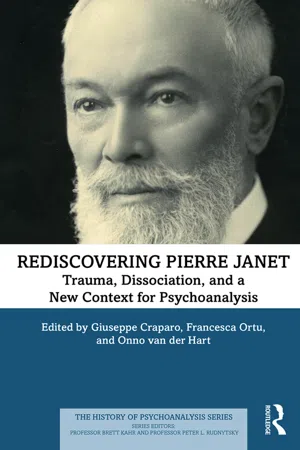
Pierre Janet
Pierre Janet was born in Paris on 30 May 1859, to an upper-middle-class family. He maintained a distinguished academic standing in the finest French schools, dividing his interests between science and philosophy. At 22, when he embarked upon his professional career as professor of philosophy in Le Havre, two events had had a profound effect upon him. The first, in 1881, was the International Electrical Exposition in Paris, where it became clear that the future would be dominated by science, technology, and electricity. The second, in 1882, was the presentation at the Académie des Sciences and subsequent publication of Charcot’s paper, “Sur les divers état nerveux déterminés par l’hypnotisation chez les hystériques” [“On the various nervous states determined by the hypnotization of hysterics”] (Charcot, 1882), which reestablished the scientific status of hypnosis (Ellenberger, 1970, p. 335).
At Le Havre Janet devoted his spare time to voluntary work with patients at the hospital and to psychiatric research. In search of a subject for his doctoral dissertation, he was introduced to Léonie, a 45-year old woman who he proved could be hypnotized directly and from a distance. His experiments were reported in a paper read at the Société de Psychologie Physiologique in Paris in 1885, under the chairmanship of Charcot. Although these experiments (Janet, 1885, 1886a) gave Janet instant fame, he soon realized that many reports of his work were inaccurate. He became suspicious of parapsychological research, preferring instead to pursue systematic investigation of the phenomena of hysteria, hypnosis, and suggestion. Influenced by the work of Ribot and Charcot, Janet dedicated himself to the study of modification of states of consciousness in Léonie and hysterical patients in Le Havre’s psychiatric hospital (Janet, 1886b, 1887, 1888). He jokingly named his little ward “Salle Saint-Charcot” in the popular fashion of naming French hospitals wards after saints (Ellenberger, 1970). Janet read everything he could on hypnosis, finding a wealth of important clinical descriptions in Alexandre Jacques François Bertrand, Joseph Philippe François Deleuze, and Antoine Despine, the old masters of magnetism. He discovered that important theoretical notions had been developed by early researchers such as Main de Biran, Moreau de Tours, and Taine.
Janet found that the concept of dissociation is a concept first presented in the work of Moreau de Tours in 1845. Its somehow equivalent term, psychological dissolution (désagrégation psychologique), also introduced by Moreau de Tours in 1845, was equally well received. Janet’s extraordinarily exact and lucid descriptions of experimental and clinical observations (cf. Binet, 1890) of these concepts and his theoretical system continue to receive praise in modern reviews of his works (cf. Pope, Hudson, & Mialet, 1985; Pitman, 1987; Van der Kolk & van der Hart, 1989).
In 1889, Charcot invited Janet to the Salpêtrière, the famous psychiatric teaching hospital in Paris, where he became head of a psychological laboratory. While continuing his vocation as professor of philosophy and publishing a textbook in that field (Janet, 1894a), Janet began to study medicine, completing his studies in 1893 with his doctoral thesis (Janet, 1893a). During this period, he published a number of papers describing his innovative therapeutic approaches to hysteria. As Ellenberger (1970, pp. 764–765) remarked, had Janet published the case histories of Lucie, Marie, Marcelle, Madame D., and the others he had successfully treated at that time, no one would ever have questioned his priority in discovering what was later called cathartic therapy. However, van der Hart and Van der Velden (1987) showed that the Dutch physician Andries Hoek (1868) provided the first case study of cathartic hypnotherapy.
Janet’s clinical research at the Salpêtrière became the basis of his dissociation theory of hysteria. These findings formed the thesis for his medical degree and were applauded both within France and internationally. Janet seemed to have a brilliant career ahead when, three weeks after his promotion to Doctor of Medicine in 1893, Charcot suddenly died and a new era in psychiatry began. Many of Charcot’s ideas about the presumably physical nature of hypnosis were discarded in favour of the views of the Nancy School of Hypnosis (under Hippolyte Bernheim); namely, that hypnosis was a psychological phenomenon based purely on suggestion. Precisely because of its established psychological nature, hypnosis itself became discredited.
Janet was soon the only one in the Salpêtrière using hypnosis in his research and clinical work. He published many studies on hysteria (cf. Janet, 1898a & b; Raymond & Janet, 1898), then turned his attention to another broad category of neuroses: psychasthenia, with its inherent obsessions, phobias, tics, etc. This resulted in the two volumes on Obsessions and Psychasthenia (Les Obsessions et la Psychasthénie) published in 1903 (cf. Pitman, 1984, 1987).
Meanwhile, the climate at the Salpêtrière worsened for Janet. Babinski, formerly loyal to Charcot, but invested exclusively in the neurological portion of Charcot’s teaching, began to regard hysteria as essentially the result of suggestion, and even as a form of malingering, a disorder able to disappear entirely by the influence of persuasion (Babinski, 1901, 1909). Déjerine regarded hypnosis as morally reprehensible (cf. Janet, 1919; Ellenberger, 1970). In 1910, when Déjerine became director of the Salpêtrière, Janet, the champion of both hysteria and hypnosis, had to leave. Janet was very well received in North and South America where he visited and lectured regularly, beginning in 1904. He received an honorary doctorate at Harvard’s tricentenary celebration in 1936. His Harvard lectures in 1906 were published as The Major Symptoms of Hysteria (1907b) and are currently garnering much attention.
A decade earlier, in 1896, Janet had become Professor of Psychology at the Collège de France, a famous institute of advanced learning in Paris. First as Ribot’s substitute, then as his successor, Janet held this chair until 1934. Many of his courses have been published, complete or in summary (cf. Janet, 1919, 1920, 1926b, 1927a, 1929a, 1929b, 1932a, 1932b, 1925, 1936a; Horton, 1924; Bailey, 1928). Obliged to present a new subject every year, Janet used his classes as a means of combining his psychopathological findings and normal psychology into a unified system. This endeavour began appearing in L’Automatisme Psychologique (Psychological Automatism), where he remarked that for those who know mental illness well, it is not difficult to study normal psychology (1889).
Janet possessed a remarkable talent for integrating very different materials into a harmonious whole (Delay, 1960). One of these results was the formulation of his psychology of conduct (psychologie de la conduite), a major effort to synthesize a multitude of behavioural observations with an evolutionary philosophical approach. In his book, Les Stades de l’Évolution Psychologique, he presented a hierarchically ordered classification of human activity from simplest to most complex (1926b). Although Janet’s dissociation theory has been rediscovered, there is still little awareness of what treasures are hidden in his later work on the psychology of conduct and in his psychopathological studies, such as those on paranoid schizophrenia (1932c, 1932d, 1932e, 1936a, 1937, 1945, 1947a). Janet’s last unfinished work concerning the psychology of religious belief remains unpublished (Janet, 1947b). It is estimated that the published work of this great man, who according to his daughter, did not know the act of rest (Pichot-Janet, 1950), amounted to at least 17,000 printed pages (Prévost, 1973b, p. 10).
Since Janet’s primary purpose was to inspire his pupils’ independent thinking on the basis of empirical facts, he did not leave a school or ideological movement behind. Instead, time and again, open-minded researchers and clinicians discover that Janet made the same observations as they, and that his theoretical explanations of this information remain viable sources of inspiration. This discovery extends well beyond the field of dissociation.
The following is a chronological review of books that Janet published over a 30-year period. It begins with L’Automatisme Psychologique (1889), which first appeared approximately 130 years ago and ends with Les Médications Psychologiques (1919). (However, Janet subsequently published a number of other books, a discussion of which is outside the scope of this chapter.) In reading his books, it becomes apparent that one series of works shows Janet’s remarkable abilities of classification (abilities that are also reflected in his being an ardent botanist). In these studies, he mapped the various manifestations of hysteria, which then became the foundation of his hypotheses about their origins, nature, and relationship. These hypotheses and observations form Janet’s dissociation theory. In another series of studies, the emphasis is on the psychological analysis of one or a few case descriptions in depth. The last book reviewed reflects Janet’s attempt to delineate the various forms of psychotherapy he encountered in the literature and the dynamic psychotherapy that he himself practiced as an eclectic psychotherapist.
L’Automatisme Psychologique
Psychological Automatism, Janet’s first book in psychology, existed only in French until recently. In 2013 the first translation, in Italian, was published. It introduces his dissociation theory and his model of the functional and structural elements of the mind. It describes psychological phenomena observed in hysteria, hypnosis, suggestion, possession states, and spiritism, though it clearly goes beyond those topics (Janet, 1889). As the book’s subtitle, Experimental-Psychological Essay on the Inferior Forms of Human Activity, suggests, Janet began with the study of human activity in its simplest and most rudimentary forms. His goal was to demonstrate that this elementary activity forms the psychological automatism: automatic because it is regular and predetermined, and psychological because it is accompanied by sensibility and consciousness (cf. van der Hart & Horst, 1989).
In presenting his model of the mind, Janet distinguished between two different ways that mind functions: activities that preserve and reproduce the past and activities that are directed towards synthesis and creation (i.e. integration). Normal thought is produced by a combination of the two acts that are interdependent and regulate each other. Integrative activity
reunites more or less numerous given phenomena into a new phenomenon different from its elements. At every moment of life, this activity effectuates new combinations which are necessary to maintain the organism in equilibrium with the changes of the surrou...