eBook - ePub
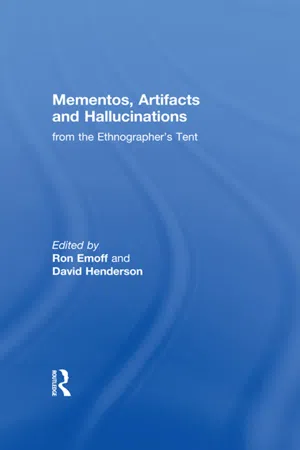
Mementos, Artifacts and Hallucinations from the Ethnographer's Tent
- 208 pages
- English
- ePUB (mobile friendly)
- Available on iOS & Android
eBook - ePub
Mementos, Artifacts and Hallucinations from the Ethnographer's Tent
About this book
With contributions from leading researchers in the fields of anthropology, ethnomusicology, and folklore, this volume contains personal, imaginative accounts of ethnographic fieldwork that do not fit into a traditional scholarly context, yet are a vital part of research. Some pieces are engaging autobiographical accounts of ethnographers' experienc
Information
The Battered Wife’s Tale
Sometimes a story squeezes through the narrow apertures of an interviewer’s agenda and presents itself, unexpected, fully formed, and unforgettable, the urgent presence of that must be told, shared, acknowledged. I have written of how the shaman, Yongsus mother, utterly subverted my attempts to conduct a simple household survey: “When we asked about marriage, the dam burst and the words poured out, rising and falling until the tale was told” (Kendall 1988, 19). The force of that flood swept me into writing The Life and Hard Times of a Korean Shaman. Yongsu’s mother was a dominant presence in my life. Her stories punctuated nearly two years of fieldwork, and her voice was loud in my head during the years that I wrestled with the book she had all but willed me to write. The story I am about to retell does not have this history. I heard it in a single morning during an interview with a woman I never saw again. This interview haunted me for many years, but far from feeling empowered to write about it, I have wondered whether I ought to write it at all.
In the autumn of 1987,1 was in Seoul interviewing match-makers for a book on late twentieth century Korean matrimony. My small team of researchers was charged with the responsibility of finding matchmakers among their mothers, mother’s friends, and relations and arranging for them to talk with me about their experiences. Misuk was one of my assistants, a recent graduate of a not-so-prestigious university. She would telephone and tell me to meet her at one or another unfamiliar outlying subway station and then lead me to a modest apartment or threadbare tearoom where I would conduct one more interviews with an amateur matchmaker.
On this misty September morning, we meet at Tongjak Station, south of the Han River. Misuk arrives, slightly out of breath, and without pausing to elaborate on where we are going, sets a brisk pace across an empty, park-like space and through residential streets. We walk a great distance, Misuk with only plastic shower clogs on her feet. From the clogs, and the fact that she is not carrying her usual handbag and notebook, I realize that we are going to her own home.
Although real estate developers have turned Seoul south of the river into a forest of high-rise buildings, Misuk’s neighborhood, up a steep hillside, is of another time, a cluster of small Korean-style houses, vegetable patches, and even a few trees shading narrow walled courtyards. Misuk’s mother is a pleasant, middle-aged woman whose face crinkles into a smile when we arrive. She is sitting in her glassed-in veranda with a young neighbor, a thin, delicate woman with unruly hair, dressed for housework in a shapeless skirt and bulky sweater. The young woman has a fidgeting baby in her arms.
What is Misuk’s plan? Is her mother going to tell me about her own matchmaking experiences? Am I supposed to interview the young mother? Matchmaking is a preoccupation of the middle aged, but the young woman could be an amateur match-maker. Misuk has already introduced me to a former classmate who arranged a successful match. Or has this young woman simply stopped by to gossip with a neighbor?
We exchange pleasantries. Misuk serves the juice and cookies that I have brought. The pendulum clock on the veranda bongs the hour. The young woman turns her pale face to me and says, “Ask your questions.” Questions—I have a battery of questions. So she is my matchmaker. I clear my throat. “You’ve done match-making?”
I come from Pusan. A granny arranged my marriage. My husband was so disreputable that no one would marry him. I lived in the countryside before I got married, and he lived in the city.
I shift gears, begin a different batch of questions, the ones I ask when my subjects are recently married women. “Who was the matchmaker? What was her relationship to you?”
The granny was my mother’s elder sister, and when she told the groom’s family that she knew of a good young woman, they asked her to matchmaker for them. She was sympathetic to my mother-in-law’s request. The son was in such bad shape that it would have been difficult to marry him off in Seoul.
“She was deceived,” Misuk’s mother states, quietly but firmly. Now I understand. Because I am “interested in match-making,” Misuk and her mother have decided that I should hear this story of matchmaking gone horribly wrong.
My mother-in-law was anxious to marry him off She thought that if he were married he might get a grip on his violent outbursts and wild demands for cash.1 She thought that a Seoul woman would fleefrom that kind of man, but that a countrywoman would endure it. Besides, she thought that a countrywoman would be hard working and have a simple and honest disposition.…
I ask if I can turn on my small and unreliable tape recorder. “Is this for some broadcast network?” she asks.
Once again, an anthropologist is mistaken for a journalist. I am used to this. “No, no, this is for my research, so I can listen again later. Korean is difficult for me to understand. If I write about you someday, it will be in English and I will hide your identity.”
She continues to speculate about a broadcast. “If my children’s daddy heard it, he would be furious. I would really be in for it. Of course it won’t matter if I decide to get divorced. You could broadcast it then.…”
Again, I insist that I am not a journalist, that I want to hear about her experiences so that I can broaden my understanding of matchmaking in Korea. I am curious now, anxious to hear her story. I ask another standard interview question: “Did you have other arranged meetings before you met your husband?”
I went to many arranged meetings.… My mother would only reach a decision after she had gone to a diviner. I had no recourse but to keep on seeing a certain man [from an arranged meeting] until she got the [unfavorable] results.… My father said that since the courtship had gone so far, we had to go through with it. He insisted on it. All this dithering would only give rise to rumors and nothing good would come of it.
She is already into her story, and she will tell it to the end, even as she pats and comforts her squirming baby, gives the child her breast, and, at one point, removes diapers, opens the sliding door, and positions the child to relieve itself over the courtyard.
I was about to be married. Just on the day before we were to receive the formal request of marriage (from his family), my maternal aunt showed up out of the blue. My mother let my aunt know that even though things had gone so far, she wasn’t comfortable with the arrangement, her heart wasn’t in it. Immediately, my aunt said that there was a fine bachelor in Seoul and that she had been asked to arrange a marriage for him with a suitable young woman. My mother told her to go right back up to Seoul and arrange a meeting with that man. Without pausing for so much as an hour to rest, my aunt dashed back up to Seoul.
They agreed to it in Seoul. As for us, it sounded too good to be true. Of course we trusted my aunt. She wasn’t just anyone. She was my mother’s sister. One would expect her to take great pains over her niece’s wedding. Besides, my aunt was not one to take marriage lightly. There was no reason for us to be suspicious.
While all this was going on, I was out working in the peach orchard. I hadn’t any idea that Mother had sent my aunt back to Seoul. When my mother said that she had gone so far as to send them my picture [to initiate matchmaking], I didn’t feel right about it. Since this was what my parents had done, I hadfaith in them and followed their wishes. For my part, I wasn’t particularly happy about the man with whom I was going to finalize my engagement, but other people had made the arrangement. Fd met with him, and over time, Fd discovered his good qualities and thought that I might have a good life if I married him. It wasn’t that my mother didn’t like him so much as that she thought he wasn’t good enough for us [probably because he was a farmer, by then a highly undesirable groom]. That was why, on the very day before we would finalize it, she sent her sister up to Seoul with my picture.
That evening, we called my suitor’s family and asked them not to deliver the formal request of marriage because something had happened in the family.… You can’t just bluntly rebuff an offer of marriage.… If you say words like, “Something has happened so let’s postpone it,” they’ll take your meaning as, “Oh, they don’t want it.”
[Her aunt returned from Seoul the following afternoon with the bachelor and his mother.] In Korea, the greatest distance is from Seoul to Pusan. I was startled that they had come all that way on my account, to see me on the strength of just having seen my photograph. Isn’t it natural that I should have felt grateful toward them because they had done this on my account? I was overwhelmed. And when there’s a marriage prospect, the woman’s side wants to make a good impression. We didn’t dare ask them about this and that after they had come all this way to see me. All I could do was blush. It’s human nature. I wanted to believe everything, I didn’t want to doubt them.
In my aunt’s telling, all of the conditions were favorable. I’m only a high school graduate. In the countryside, that’s not so bad, but the groom was a college graduate, living well, and had an amicable personality.… My (future) father-in-law was a retired lieutenant colonel. Everything seemed fine. My mother-in-law appeared to be warm hearted and understanding and made a good appearance. My future husband also gave the impression of being normal and healthy. At that moment, I was so glad that they had come.
They ate supper at our home. They say that when the groom’s side looks the bride’s side over, and if all of the conditions are favorable, then when the groom is served dinner, if he likes us and is of a mind to get married, he should eat every last grain of rice. But if he is the least bit uncomfortable with the idea or has no intention of getting married, then he should leave it in his bowl. That’s what they say, and he ate it all up, even drank every last drop of water. Since they had comefrom Seoul to look me over, the neighborhood grannies had all come over to our house to see what was going on. They laughed and said that he’d really polished the meal off in a hurry. The bachelor laughed and my (future) mother-in-law laughed with them. [The memory still produces a smile.] … As she was leaving to catch the night train, my mother-in-law invited us up to see their home and set the date with my father for the next Sunday.
I write in my fieldnotes that she is changing her child’s sodden diapers when she tells me this, but that she does not interrupt the flow of her story. After this auspicious beginning, she went up to Seoul with her father to receive her first intimation that something is amiss.
When you tell someone to visit you, you ought to be at home. We arrived at Seoul Station with just their address—I ’d asked the groom to write it down for me. We called, but no one was at home. That was strange. We doggedly took a taxi to their neighborhood and… searched high and low for their house.2 We searched and searched. Worn out, I began to get angry. It hurt my pride. If something had come up, they should at least have left someone at home to answer the telephone since, after all, they had invited us. My anger rose as I searched.… I asked at this house and at that house and then leaned against someone’s wall while my father continued to look for their house. Then, fortunately, the proprietress of a little hole-in-the-wall store told us that it was the house right in front of us and pointed to their front gate.
We knocked on the gate and a man came out and asked who we were. “We’re from Pusan.” He told us to wait and went inside. Maybe he tidied up. He seemed not to know where to put us. He said, “This is (the bachelor’s) room, ’’and the three of us sat down. He said that they had completely forgotten about our appointment. My future mother-in-law had gone off somewhere, the bachelor was somewhere else, no one was at home, my future father-in-law had himself just come back from an appointment. What if he hadn’t come back early?
[Wanting to leave the two men alone to talk, and feeling exhausted from the search, she takes a nap in her future sister-in-law’s room.] I opened my eyes with a start when someone awakened me. It was my mother-in-law, who had come back home before the others. It was seven-thirty, almost supper time, so she fixed and served the meal. When I asked where she had gone, she said that she’d gone off in a hurry to deal with a sudden infestation of bugs in her grapevines. I told her how we had wandered around for such a longtime looking for them….
We ate supper and talked past ten o’clock, but even then that bachelor hadn’t returned. He seemed to be very busy. Since the last train was at ten-thirty, we left and came back home on train tickets my father-in-law had purchased for us. My father had taken to my future father-in-law right away and was pleased with the way they were living. I justfollowed suit, thinking that once I was married, then everything would be fine.
One week later, their side took all the initiative, even to setting the wedding day and bringing the betrothal gifts. When they brought me a diamond ring a gold ring, a diamond necklace, a bracelet, and a Korean dress [as betrothal gifts], I received these things with a feeling of deep gratitude…. The bachelor spent three or four days at our house and told me to come up to Seoul and see them. When he left, I promised that I would be up in a week.
A week later, I went to Seoul by myself, spent a day, and came back home. But when I was at my [future] husband’s house, he didn’t act the least bit like a man who had asked a woman for a date. It was strange. He barely said anything. Since I ’m very bashful myself, I thought that he was just being shy. I wasn’t at all suspicious.
Only a short time after that, we were married. The wedding was in Seoul. Pusan was too far away for them. We sent3,500,000 won up to Seoulfor dowry goods. They had suggested that it would be easier if they just bought everything in Seoul. Since we were busy with transplanting rice, we sent the money up to the groom’sfamily. Rather than going from market to market buying things, it would be better if the concerned parties bought the things themselves [the gifts for the groom and his family and the dowry furniture]. It would reduce our burden.… After the wedding, I learned that [my future husband] had given only 3,000,000 won to my mother-in-law and had pocketed500,000 won for himself. At first, I didn’t realize this. I found it out about it three months after the wedding. It was money that my parents had put together from their farming.… Every bit of the wedding money was from the harvest and sale of peaches. The very money we’d taken in, only just the day before, was bundled into that3,500,000 won.
Even with the stolen 500,000 won, this was a modest sum of marriage money at the time of her wedding (in 1982). I asked if she had worked before her marriage, knowing from other interviews that women who had not been able to save at least some of their earnings toward their weddings were often disadvantaged in marriage negotiations. After graduating from a commercial high school, she had worked for two and a half years, but had been forced to quit and help out at home when her mother was disabled by illness. Like many other working women with younger siblings, she had contributed her early wages to their education.
She answers my questions and takes up the thread of her story. A week after her marriage, her in-laws moved the couple from their own home into a room secured with a deposit of key money, and then the full truth of her situation was revealed.
… And then from the very next day, he came home drunk every night. Before even a month hadpassed, he insisted that we sell my gold double ring [a betrothal gift] because he needed the money....
Table of contents
- Cover
- Title
- Copyright
- Contents
- Introduction
- Samosir’s Dark Rains
- Sacred Secrets: Lessons with Francisco
- Wildness in the Heart of Town
- The God of Doorways
- A Touch of Danger
- Leaving My Father’s House
- Miguel Alemán and His Dam
- The Battered Wife’s Tale
- The Freak Street Riots of ’59
- The Last Time Tere Danced a Rumba
- About the Contributors
Trusted by 375,005 students
Access to over 1.5 million titles for a fair monthly price.
Study more efficiently using our study tools.
Frequently asked questions
Yes, you can cancel anytime from the Subscription tab in your account settings on the Perlego website. Your subscription will stay active until the end of your current billing period. Learn how to cancel your subscription
No, books cannot be downloaded as external files, such as PDFs, for use outside of Perlego. However, you can download books within the Perlego app for offline reading on mobile or tablet. Learn how to download books offline
Perlego offers two plans: Essential and Complete
- Essential is ideal for learners and professionals who enjoy exploring a wide range of subjects. Access the Essential Library with 800,000+ trusted titles and best-sellers across business, personal growth, and the humanities. Includes unlimited reading time and Standard Read Aloud voice.
- Complete: Perfect for advanced learners and researchers needing full, unrestricted access. Unlock 1.5M+ books across hundreds of subjects, including academic and specialized titles. The Complete Plan also includes advanced features like Premium Read Aloud and Research Assistant.
We are an online textbook subscription service, where you can get access to an entire online library for less than the price of a single book per month. With over 1.5 million books across 990+ topics, we’ve got you covered! Learn about our mission
Look out for the read-aloud symbol on your next book to see if you can listen to it. The read-aloud tool reads text aloud for you, highlighting the text as it is being read. You can pause it, speed it up and slow it down. Learn more about Read Aloud
Yes! You can use the Perlego app on both iOS and Android devices to read anytime, anywhere — even offline. Perfect for commutes or when you’re on the go.
Please note we cannot support devices running on iOS 13 and Android 7 or earlier. Learn more about using the app
Please note we cannot support devices running on iOS 13 and Android 7 or earlier. Learn more about using the app
Yes, you can access Mementos, Artifacts and Hallucinations from the Ethnographer's Tent by RON EMOFF,DAVID HENDERSON,Ron Emoff,David Henderson in PDF and/or ePUB format, as well as other popular books in Social Sciences & Ethnomusicology. We have over 1.5 million books available in our catalogue for you to explore.