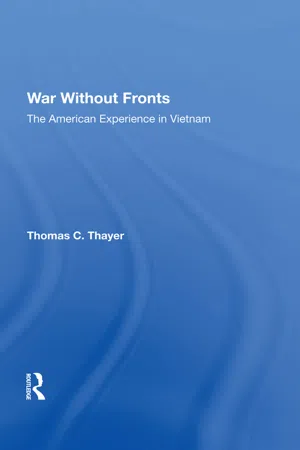
This book is a unique source of information about U.S. troop involvement in South Vietnam from 1965 to 1972. It stresses that Vietnam was a war without fronts or battle lines—a war different from any that the United States had previously fought.
- 304 pages
- English
- ePUB (mobile friendly)
- Available on iOS & Android
eBook - ePub
About this book
Part One
Basic Patterns of This War Without Fronts
1
Why Was the War So Confusing?
The public was also confused because it was impossible to follow the war by simple lines on the map as in other wars.1
General William C. Westmoreland
It was September 10, 1963. Two presidents would be killed before the end of November. The National Security Council was meeting on the issue of Vietnam. The State Department’s man was talking. He had accompanied the general on a four day trip to assess the situation in Vietnam, and was now reporting to the President. The general had already spoken. When the diplomat finished, President Kennedy looked at the two of them and said: “You two did visit the same country, didn’t you?”2
Confusion reigned. This is not too surprising because war is a game of confusion. When the fighting starts it must often seem to a commander that everything is going wrong. His enemy pulls surprises, messages get lost, missions are misunderstood, supplies disappear, and dozens of other problems arise to hamper the quest for victory. All the while he worries about the progress being made. In Vietnam the worry about progress and the demand for reports on it were incessant.
General William Westmoreland said of Vietnam: “The longest war in our history, it was the most reported and most visible to the public—but the least understood.”3 Even Westmoreland, shortly after his arrival in Vietnam, was heard to complain that he couldn’t make much sense out of the briefings he was receiving. He asked this author to develop a new system for him, but this author couldn’t make sense of the war either in those early days.
General Lewis Walt, Commander of the Marines and other American Forces operating in the northern area of South Vietnam said: “Soon after I arrived in Vietnam it became obvious to me that I had neither a real understanding of the nature of the war nor any clear idea as to how to win it.”4 Sir Robert Thompson, a leader in the successful British counter-insurgency effort against the Communists in Malaya, adds: “…There has been a lack of understanding of the nature of the war and of what has been happening.”5
This war was different. In a conventional war, like the two World Wars and Korea, a commander needs only two items to monitor his progress. First, he has to know where the front is and which way it is moving. Second, he needs to know the strengths of friendly and enemy forces.
If friendly forces are stronger than enemy forces and are pushing the enemy back, then friendly forces are winning and the front can be seen on a map to have moved in the enemy’s direction. When the North Koreans pushed the United Nations forces down into a small perimeter around Pusan in 1950, even a child could look at the maps and tell that we were in trouble. However, looking at maps of the war in Vietnam never told anybody what was really happening until the very end.
Vietnam was a highly fragmented struggle to influence the population with few large battles, and no decisive ones until the end. Instead, thousands of small actions took place every day on the battlefields of 44 different provinces, 260 districts, and 11,000 hamlets; each involved and playing its own part. The war had no fronts. This is why the war in Vietnam was so difficult to grasp.
The United States, well prepared to fight a conventional war, was simply not ready to fight a war without fronts. Without fronts, our commanders and analysts were unable to deal with the war at first. Major General Harris B. Hollis, Commander of the U.S. Army’s 25th Infantry Division in Vietnam, expressed the commander’s problem:
In no other war have we been deluged by so many tidbits of information, for we have been accustomed to an orderliness associated with established battle-lines. Here, though, we have had to make our decisions based not upon enemy regimental courses of action, but rather upon the isolated actions of communist squad-sized elements6.
In Vietnam only one of the sets of data needed to keep track of a war was present, namely, the order of battle information on the forces of both sides. But even these data raised severe problems. The highly unusual nature of the communist force structure with its regulars, guerrillas, part time village defense forces, and subversive apparatus, made it difficult to agree on a valid picture of the whole communist lineup. The Westmoreland-CBS liability trial illustrates the point.
To further complicate matters, forces from both sides often operated for years in the same areas at the same time. This is no surprise in view of Mao’s dictum that “The most pressing and most important task of a guerrilla unit is to carry out guerrilla attacks without ceasing in the places occupied by the enemy….”7
Our commanders and analysts simply had to have some substitute for the front line if they were to understand even the war’s military aspects. When the political, economic and social dimensions of the war were added to the problem, the complexities appeared overwhelming.
The answer turned out to be finding the critical patterns of the war. Through quantitative reports to the Joint Chiefs of Staff from the military command in Vietnam about the hundreds of events occurring all over Vietnam every day we found the patterns. Any given action was seldom important by itself, and at first glance no patterns were seen. Analysis, however, revealed them. From these we, in Washington, were able to monitor the war surprisingly well by examining trends and patterns in the forces, military activities, casualties, and population security.
This allowed us to judge the importance of events to the progress of the war. For example, the communist offensive that opened in April 1970 alarmed those in Washington who were unfamiliar with trends that had been under way for at least two years. By the end of the first week we were able to tell the Secretary of Defense that the communists were not escalating the war because the offensive was not as intense as the previous year’s offensive. 1969’s offensive, in turn, had been less intense than the Tet offensive two years before.
The pattern of statistics suggested that the war was continuing to wind down at that time, even though the annual spring offensive had just been launched. The Secretary responded by asking us to prepare two papers a week for the President telling him how the offensive was going.
The quantification of the war was often criticized as excessive and misleading. The body count was a prime example. The problem was that quantification became a huge effort but analysis remained a trivial one. This was unfortunate because the limited analysis that was done produced much useful insight into the war and lots of questions during the war about the prospects for winning, given the way it was being fought.
The following chapters present what we found in doing classified analysis for The Secretary of Defense and other senior officials in Washington and Saigon during the war. This book does not present hindsight. Everybody with a security clearance knew what we were saying while the war was underway, although many strongly disagreed with us most of the time.
Notes
1. General William C. Westmoreland, U.S. Army (Retired), Lectures (Tufts University, Medford, Mass., December 12, 1973) p. 15.
2. David Halberstam, The Best and the Brightest (New York: Random House, 1972) p. 277. See also The Pentagon Papers, The Senator Gravel Edition, Volume II (Boston: The Beacon Press, 1971) p. 244.
3. Westmoreland, Lectures, p. 25.
4. General Lewis Walt, Strange War, Strange Strategy (New York: Funk & Wagnells, 1970) p. 7.
5. Sir Robert Thompson, No Exit from Vietnam (New York: David McKay Company, I...
Table of contents
- Cover
- Half Title
- Title
- Copyright
- Dedication
- Contents
- List of Tables and Figures
- Map of South Vietnam
- Foreword
- Preface
- Acknowledgments
- Chronology of Major Events in the War
- PART ONE BASIC PATTERNS OF THIS WAR WITHOUT FRONTS
- PART TWO THE “MAIN FORCE” WAR
- PART THREE THE CASUALTY TOLL
- PART FOUR PACIFICATION: “THE OTHER WAR”
- PART FIVE CIVIL OPERATIONS
- PART SIX A SUMMING UP
- APPENDIX: The Southeast Asia Analysis Report
- GLOSSARY
- BIBLIOGRAPHY
- INDEX
Trusted by 375,005 students
Access to over 1.5 million titles for a fair monthly price.
Study more efficiently using our study tools.
Frequently asked questions
Yes, you can cancel anytime from the Subscription tab in your account settings on the Perlego website. Your subscription will stay active until the end of your current billing period. Learn how to cancel your subscription
No, books cannot be downloaded as external files, such as PDFs, for use outside of Perlego. However, you can download books within the Perlego app for offline reading on mobile or tablet. Learn how to download books offline
Perlego offers two plans: Essential and Complete
- Essential is ideal for learners and professionals who enjoy exploring a wide range of subjects. Access the Essential Library with 800,000+ trusted titles and best-sellers across business, personal growth, and the humanities. Includes unlimited reading time and Standard Read Aloud voice.
- Complete: Perfect for advanced learners and researchers needing full, unrestricted access. Unlock 1.5M+ books across hundreds of subjects, including academic and specialized titles. The Complete Plan also includes advanced features like Premium Read Aloud and Research Assistant.
We are an online textbook subscription service, where you can get access to an entire online library for less than the price of a single book per month. With over 1.5 million books across 990+ topics, we’ve got you covered! Learn about our mission
Look out for the read-aloud symbol on your next book to see if you can listen to it. The read-aloud tool reads text aloud for you, highlighting the text as it is being read. You can pause it, speed it up and slow it down. Learn more about Read Aloud
Yes! You can use the Perlego app on both iOS and Android devices to read anytime, anywhere — even offline. Perfect for commutes or when you’re on the go.
Please note we cannot support devices running on iOS 13 and Android 7 or earlier. Learn more about using the app
Please note we cannot support devices running on iOS 13 and Android 7 or earlier. Learn more about using the app
Yes, you can access War Without Fronts by Thomas C Thayer in PDF and/or ePUB format, as well as other popular books in History & World History. We have over 1.5 million books available in our catalogue for you to explore.