- 164 pages
- English
- ePUB (mobile friendly)
- Available on iOS & Android
eBook - ePub
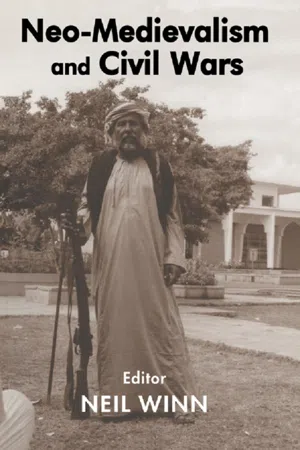
Neo-Medievalism and Civil Wars
About this book
Since 1989 the concept of 'civil war' has taken on new salience in international relations. Significant inquiries into inter-ethnic violence emphasising studies of political community, identity, sovereignty, and political organisation have dominated the study of civil war in the past decade. Processes of social denationalisation of national identit
Information
Neo-Medievalism in Africa: Whither Government-to-Government Relations Between Africa and the European Union?
In spite of decolonisation and increasing economic globalisation, relations between sub-Saharan Africa and Europe continue to be built on bilateral government-to-government contacts and agreements. The incorporation of the former European colonial powers into the European Community did not fundamentally alter this pattern even though the introduction of the Lomé Conventions broadened the linkages which the African states could seek in Europe. The govemment-to-government system of agreement was also carried on into the current Cotonou Agreement between the European Community and Africa.1 The most important relationship between the two parties, that surrounding development aid, is similarly fundamentally a government-to-government arrangement.
This study questions whether the government-to-government system with aid as its pivotal instrument is still adequate to meet the development challenges of contemporary sub-Saharan Africa. The government-to-government system presupposes that the African governments are sovereign and thus capable of controlling their territories. Also, it presupposes that the governments enjoy a minimum of popular legitimacy. Considering the situation in many African societies where sub-regional actors challenge the authority of the central governments either directly by waging war or indirectly via all sorts of illegal activities such as trafficking in drugs, arms and human beings, it is highly questionable to assume that the African state is capable and in control of its territory.
This analysis has a dual aim.
The first is to examine if it is reasonable and adequate to claim that the state is not necessarily the most important actor in international affairs in several African countries.
The second aim is to analyse the European Union’s (EU’s) policy responses to the challenges stemming from the general occurrence of weak governments that are increasingly challenged by sub-national actors. The central argument of this study is that, because the relationship between the European Union and the countries in sub-Saharan Africa is still based on government-to-government contacts, the policy initiatives of the EU have not been adequate in relation to addressing the new challenges coming from weak states and disintegrating countries. It is argued that if sub-national actors and local strongmen in reality are in control of territories and people and if civil war, instability and criminal activities are the order of the day, then traditional diplomacy combined with ‘old fashioned’ development aid channelled through the state are hardly the most relevant instruments.
For the purposes of this discussion ‘adequate’ refers to whether policy responses affect the relevant actors and attack the core of a given problem. Thus if the main actors are sub-national strongmen then it is not adequate to deal only with the formal government institutions located in the capitals. Likewise, it is not an adequate policy merely to issue statements and declarations unless they are followed by serious policy initiatives.
The first part of the empirical analysis argues that the situation in many African societies resembles what Hedley Bull describes as ‘new medievalism’ characterised by ‘a structure of overlapping authorities and criss-crossing loyalties’ where the states are no longer ‘sovereign in the sense of being supreme over a given territory’.2 The argument is made that many African countries have ended up in situations where the subnational actors outside the control of the governments have been pursuing their own more or less ‘private’ foreign policy.3 The increasing privatisation of Africa’s foreign relations is illustrated by the growth in mercenaries/private military companies in sub-Saharan Africa and by the conspicuous growth in crime in various fields. Bull also stresses that if modern states share their loyalties with sub-state or sub-national authorities then the whole concept of sovereignty has ceased to be applicable and instead a neo-medieval form of political order might emerge.4
In relation to sub-Saharan Africa, the views of Bull are not necessarily unique. Others have argued along similar lines. For example Robert Jackson5 claims that the states in Africa have to be described as ‘negatively sovereign’ and thus as ‘quasi states’ because they are unable to control their own territory and also because they lack positive support from their citizens. In his brilliant book on Africa in the international system, Christopher Clapham is basically in agreement with Jackson on these issues.6
The structure of this essay is as follows.
First there is a brief introduction to the theoretical framework used for interpreting the current situation in Africa and the framework for analysing the EU’s policies towards sub-Saharan Africa.
The second main section gives a presentation of indicators supporting the argument that the situation in large parts of sub-Saharan Africa can be described as neo-medieval. The emphasis is on a description of the consequences of the numerous civil wars and of the closely related conspicuous growth in criminal and illicit activities.
The third main section contains an analysis of the EU’s responses to the challenges coming from the new medievalism in Africa based on the hypothesis that these responses are not necessarily adequate. The focus is on the initiatives of the Union in relation to conflict management and conflict prevention, including the policy towards the increasing use of mercenaries in civil wars in Africa. Attention is also given to the Union’s responses to the conspicuous growth in illegal economic transactions, which to a large extent are tied to the disintegration of certain states in the region. The focus is on trafficking in drugs and small arms, and in particular on migration and trafficking in human beings.
THE THEORETICAL FRAMEWORK
By way of introduction, it is necessary to establish that in general terms, analyses of Africa’s international relations, including the relationship between the EU and Africa, are remarkably absent in the theoretical literature on international relations.7 The most obvious explanation for this theoretical lacuna is probably the widespread lack of interest in Africa among the rich nations.8
In a recent book Georg Sørensen proposes a theoretical framework that includes both of the main parties analysed here, namely sub-Saharan Africa and the EU. Sørensen suggests that both entities can considered as ‘ideal types’ in Weber’s sense, with the African state being the ‘the ideal type of the post-colonial state’. As such it is different from the other types of states found in the current international system.9 The other type of state is the EU, which is also considered as an ideal type called the ‘post-modern state’. It is a basic argument of Sørensen that none of the different theoretical schools dealing with international relations has understood that these different types of state face very different security dilemmas on account of their different domestic situations.
In line with the mainstream academic literature on the African state, Sørensen argues that the states in sub-Saharan Africa have basically survived because they have been protected by the strong international norms on sovereignty, even though they have been unable to control their domestic environment, let alone protect their borders against external threats. The strong international norms on sovereignty have meant that the domestic degrees of freedom have been quite remarkable. Therefore, the state elites could be selfseeking predators…to the extent that domestic chaos and violent conflict could go to any extreme without paying the ultimate price: termination of the state’.10
Moreover, and this is important for this study, ‘experience has shown that it is extremely difficult to increase the external pressure on the elites in Africa in order to make them engage in the creation of effective states with capacities for delivering security and other political goods for their citizens’.11
If strong states such as those in the ‘post-modern’ EU have any substantial interests in Africa worth mentioning they are to support the international norms upholding the existing borders of the weak states. This is because the borders ‘are the containment barriers behind which problems of violent conflict, disintegration and fragmentation are held in check, if not always completely then at least sufficiently to avoid serious threats to the international order’.12 In that sense, ‘elements of the conventional security dilemma are still in place, (…) because post-modern states may be exposed to security threats (…) from turmoil in weak, postcolonial states’.13
With these general ideas as the starting point, it is pertinent to present some additional theoretical reflections on state and politics in Africa. There is a strong trend in the academic debate that emphasises the value of making an analytical distinction between formal or ‘observable’ aspects of African public policy and informal and less observable aspects. The specificity of African politics is contained in the argument that the state can be characterised as a ‘shadow state’ indicating that some decisions are made behind the scenes or in the ‘shadows’ of the formal state institutions. Other decisions are taken in the open where it is at least in theory possible to follow what happens. In more recent debates the dichotomy has been presented through the analogy of the ‘veranda’ where important events take place and the real, significant decisions are made, and the ‘air conditioned room’ where the not-so-important events take place and less important decisions are taken.14 Typically, aid donors and other foreign policy officials from abroad operate in the air conditioned room.
It is one of the theoretical assumptions of this study that it is appropriate to apply the distinction between formal and informal activities to the study of Africa’s international relations. It implies that development aid, trade, Foreign Direct Investments (FDIs), debt and traditional diplomacy are located among the formal aspects of African foreign relations, but these activities may not necessarily be as important as the informal aspects such as smuggling of diamonds and precious metals, and trafficking in drugs and human beings. The violent conflicts in Africa are almost without exception informal wars that do not involve formal armies from different states. And finally, a phenomenon such as the international border belongs to the formal aspects of African social reality, whereas in ‘real life’ borders are not significant to people.
Concerning the European side of the equation, there is no doubt that Sørensen is right when he emphasises the limited interest of the EU in sub-Saharan Africa. Nevertheless, the Union has policies towards the region. In order to understand these policies and in particular to understand the restrictions on making common and effective European policies towards Africa, it is necessary to recall Sørensen’s point that the EU is a unique type of state. In spite of the fact that the EU is ‘actor sui generis’, it is still not a ‘state’ in a narrow sense, meaning that the so-called ‘European’ decisio...
Table of contents
- Cover
- Halftitle
- Title
- Copyright
- Contents
- Introduction: New Forms of Political Organisation, Community, Sovereignty and Identity: Civil Wars, the New Diplomacy and International Relations
- Terrorism and Neo-Medievalism
- Image and Intervention, Leadership and Legitimacy: the Dynamics of Euro-Atlantic Engagement with Challenges to International Peace and Security
- The End of the ‘Official Doctrine’: The New Consensus on Britain and Bosnia
- Civil War as Race War: How the German Far Right Perceives the War in the Balkans
- Neo-Medievalism in Africa: Whither Government-to-Government Relations Between Africa and the European Union?
- A New Medievalism?—The Case of Sri Lanka
- Conclusion: Neo-Medievalism, Civil Wars and the New Diplomacy
- Abstracts
- Biographical Notes
- Index
Trusted by 375,005 students
Access to over 1.5 million titles for a fair monthly price.
Study more efficiently using our study tools.
Frequently asked questions
Yes, you can cancel anytime from the Subscription tab in your account settings on the Perlego website. Your subscription will stay active until the end of your current billing period. Learn how to cancel your subscription
No, books cannot be downloaded as external files, such as PDFs, for use outside of Perlego. However, you can download books within the Perlego app for offline reading on mobile or tablet. Learn how to download books offline
Perlego offers two plans: Essential and Complete
- Essential is ideal for learners and professionals who enjoy exploring a wide range of subjects. Access the Essential Library with 800,000+ trusted titles and best-sellers across business, personal growth, and the humanities. Includes unlimited reading time and Standard Read Aloud voice.
- Complete: Perfect for advanced learners and researchers needing full, unrestricted access. Unlock 1.5M+ books across hundreds of subjects, including academic and specialized titles. The Complete Plan also includes advanced features like Premium Read Aloud and Research Assistant.
We are an online textbook subscription service, where you can get access to an entire online library for less than the price of a single book per month. With over 1.5 million books across 990+ topics, we’ve got you covered! Learn about our mission
Look out for the read-aloud symbol on your next book to see if you can listen to it. The read-aloud tool reads text aloud for you, highlighting the text as it is being read. You can pause it, speed it up and slow it down. Learn more about Read Aloud
Yes! You can use the Perlego app on both iOS and Android devices to read anytime, anywhere — even offline. Perfect for commutes or when you’re on the go.
Please note we cannot support devices running on iOS 13 and Android 7 or earlier. Learn more about using the app
Please note we cannot support devices running on iOS 13 and Android 7 or earlier. Learn more about using the app
Yes, you can access Neo-Medievalism and Civil Wars by Neil Winn in PDF and/or ePUB format, as well as other popular books in Politics & International Relations & 20th Century History. We have over 1.5 million books available in our catalogue for you to explore.