- 320 pages
- English
- ePUB (mobile friendly)
- Available on iOS & Android
eBook - ePub
About this book
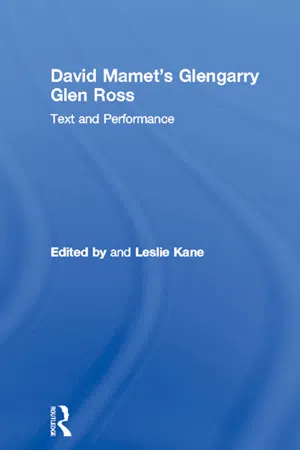
The 12 original and two classic essays offer a dialectic on performance and structure, and substantially advance our knowledge of this seminal playwright. The commentaries examine feminism, pernicious nostalgia, ethnicity, the mythological land motif, the discourse of anxiety, gendered language, and Mamet's vision of America, providing insights on the theatricality, originality, and universality of the work. Although the dominant focus is on Glengarry Glen Ross, several essays look at the play against the background of Mamet's Edmund, Reunion, and American Buffalo, whereas others find fascinating parallels in Emerson, Baudrillard, Conrad, Miller, and Churchill. The book also includes an interview with Sam Mendes, the director of the highly acclaimed 1994 revival of Glengarry Glen Ross in London, conducted specifically for this collectio. A chronology of major productions and the most current and comprehensive bibliography of secondary references from 1983-1995 complete the volume.
Information
1 NEGATIVE CREATION
THE DETECTIVE STORY IN GLENGARRY GLEN ROSS
Murder is negative creation, and every murderer is therefore the rebel who claims the right to be omnipotent.
—W. H. Auden1
The detective story in Glengarry Glen Ross is literally marginalized: the office break-in occurs in the interval between the play’s two acts, and the investigation in act 2 is conducted in a room off-stage by a detective who barely appears. Criticism of the play has tended to enforce this marginalization. When noted at all, the robbery itself tends to be seen either as peripheral, or metonymically, as “merely an objectification of the crimes daily perpetrated in the name of business,”2 and therefore as having little significance in itself. It has also been noticed that the crime story provides Mamet with the kind of linear plot structure he was beginning to favor, but this too has generally been little valued: “It is difficult to understand his anxiety to work within conventional forms,”3 writes one critic, while another states that in Glengarry Glen Ross “conventional ‘plot’ … is a red herring for a more significant underlying structure of interrelationship between characters.”4
A frequent consequence of this devaluation of “conventional” plot is that the play’s tensions are collapsed into commonplaces and its suggestiveness seen to reside in something as vague as the “metaphysical source for the crisis in decent human relations.”5 By contrast, the dramatist himself tends both to speak of this play in quite concrete terms (although his insistence that he was simply trying to “write about my experiences in a realestate office”6 has been described as “calculatedly disingenuous”7), and to insist upon its heterogeneity. He has described it as “a bastard play. It’s formally a gang comedy in the tradition of The Front Page or Man in White. And the first act is episodic, although like a detective story, almost gothic. The second act is a very traditional formal last act of a comedy drama.” For the playwright himself, then, the detective element is at least as prominent in the first act as in the second, although he is careful to note that “Glengarry really isn’t a ‘whodunnit,’ it is a gang comedy.”8
In describing elements of the play in terms of the detective story, while rejecting the term “whodunnit,” Mamet was perhaps consciously drawing a distinction between, on the one hand, the American “hard-boiled” crime story, in which he already had an interest through having worked on a screenplay based on James M. Cain’s The Postman Always Rings Twice, and on the other hand, that form of detective novel, predominantly associated with English writers such as Agatha Christie, in which the unmasking of the murderer is of paramount importance. Despite Mamet’s distinction, however, certain features of the whodunnit are deliberately introduced into the play’s second act, for example the emphasis on exposing the culprit and the linear progression of events, both of which are of greater importance in the “English” than in the “American” subgenre. The foregrounding of this particular kind of plot can be dismissed as merely “conventional” because it appeals to a perception of order that is increasingly difficult to maintain yet continues to exert a powerful ideological appeal. The combination of detection and linear sequence, then, carries with it further ideological associations traceable to the whodunnit: the fixing of guilt onto named individuals (and the consequent affirmation of the innocence of the rest of us), and the appeal to a nostalgic, pastoral, and comic order.9 In its residual pastoralism, in particular, the play is related intertextually to both English and American literary traditions and conventions. The names of the properties sold in Mamet’s real estate office—”Glengarry Highland,” “Glen Ross Farms,” “Homestead” (3–7)—conflate the appeal of romantic Scottish detachment and a specifically American, Jeffersonian vision of the farm as idealized family retreat; but of course it is precisely this ideology of innocent rural detachment that makes the imaginary properties commercially valuable, and thereby reinstates them into the structure from which they ostensibly offer an escape.
This reappropriation shows that it is precisely because the innocent worldview of the whodunnit is not only untenable, but actually exemplifies the world of vicious financial extortion to which it appears to offer an alternative, that the play has to reject it. Unlike the whodunnit, the detective element in this play does not finally impose a form upon otherwise seemingly inchoate experience. Instead, like the burglary committed between the play’s two acts, it represents a disruption of normal business, foregrounding the structure of repression by which the office operates while refusing either the characters or the audience the Aristotelian consolation of catharsis.10 Despite the naming of the burglar, the play finally resists closure, so that submerged tensions become apparent without being exorcised: tensions between employers, employees, and clients (realistically), between parents and children (metaphorically), and between different literary and dramatic forms (generically). The play suggests that capitalism is fraud and that the true relation of employer to employee is that of parent to child, but because neither the bosses nor the salesmen can afford to acknowledge this openly these thoughts are driven underground, only to reemerge, like the Freudian unconscious, in the language and structure of everyday life.
The “bastard” nature of the detective story in Glengarry Glen Ross, then, exposes a formal and ideological tension between that form’s subgenres: between on the one hand the “classical” variety (linear, comic, pastoral, communal, and English), and on the other hand its “hard-boiled” descendant (circular or unresolved, tragic, urban, individualistic, and American). This particular struggle enacts at the level of genre various other tensions expressed in the play, all of which may be, and frequently are, characterized by the metaphor of something or someone struggling to break free of the authority of the parent. Consequently, although at a realistic level the salesmen are thieves, at a deeper psychic and metaphorical level the crime they really want to commit is murder. Crime in this play represents a necessarily futile attempt by the child to establish itself by killing the parent.
The air of criminality is pervasive. According to Mamet, in the sales parlance of the real estate office in which he worked an appointment between salesman and client “was called a lead—in the same way that a clue in a criminal case is called a lead—i.e. it may lead to the suspect, the suspect in this case being a prospect.”11 Early in the first scene the connection is established as Williamson describes his job, in which he is “hired to watch the leads” (6), in terms befitting Dashiell Hammett’s Sam Spade; and as in the “hard-boiled” school of crime fiction that Hammett helped to initiate, the language and role-playing of the office tend to erode simple distinctions between detective, criminal and victim.
The related blurring of the line between business and crime is repeated in Mamet’s later screenplays for The Untouchables and Things Change, which seem on occasion to express a measured admiration for the Mafia hierarchy precisely because it embodies the values of American capitalism, without the hypocrisy of official business exposed in the response of an audience of businessmen to American Buffalo, who “were angry because the play was about them.”12 The connection is an open secret. In Glengarry Glen Ross crime is simultaneously what Mitch and Murray strive to keep hidden (it disrupts their world) and what most precisely expresses their ethos (business as crime). The detritus-strewn set of the second act encapsulates this contradiction, as Roma tries to conduct business as usual while the police conduct a criminal investigation in the next room. When the truth can no longer be hidden the embarrassment emerges in Williamson’s wonderfully understated explanation that “[w]e had a slight burglary last night” (55). Because crime is simultaneously omnipresent and forbidden it is never fully demystified, and the salesmen’s fantasies of escape can only be fantasies of further criminal action. They are thereby caught in a network of relationships that has already defined the range of possibilities open to them.
In this way the play begins to explore tensions between freedom and constraint, and between present experience and formative myth, which are particularly focused on this question of crime: whether crime offers the possibility of freedom and represents the eruption of social energy, or whether on the contrary the world is so systematically criminal that it has prefigured and provided for every attempt to escape from it. Like a latter-day Hamlet, for example, Moss knows that the “hard part” of “[g]oing to business for yourself” is “[j]ust the act” (15). Moreover, he shares with Hamlet an ill-concealed death wish directed against the father, in his case the bosses. This revelation, and its immediate containment, emerges as he describes to Aaronow his plan for the downfall of Mitch and Murray:
Moss: Someone should stand up and strike back.
Aaronow: What do you mean?
Moss: Somebody …
Aaronow: Yes … ?
Moss: Should do something to them.
Aaronow: What?
Moss: Something. To pay them back. (Pause.) Someone, someone should hurt them. Murray and Mitch.
Aaronow: Someone should hurt them.
Moss: Yes.
Aaronow: (Pause.) How?
Moss: How? Do something to hurt them. Where they live.
Aaronow: What? (Pause.)
Moss: Someone should rob the office. (17)
The first part of this exchange unmistakably intimates a threat of physical violence, especially in the context of criminal resentment already established in the previous scene between Levene and Williamson, and Aaronow’s characteristic uncertainty as to what is happening around him intensifies this air of menace. The less drastic proposition Moss finally puts, however, is in keeping with a pattern repeated throughout the play, whereby significant action is promised only to be retracted; other examples include the threats to defect to Jerry Graff, Levene’s sale of land to the Nyborgs, and Roma’s offer of friendship to Levene at the end of the play. In each case the promise signals an attempt to escape from the constraints imposed by the office, and in each case it fails.
Robbery, the alternative means of escape Moss finally proposes, is in fact no escape at all, since it merely repeats the same course of action pursued by others and which at a different level the salesmen are already pursuing themselves. In remarking how difficult it is to “act,” Moss ironically indicates that they are like actors constantly repeating a role scripted for them in advance. This accounts in part for the atavistic quality of their language and actions: they reenact crimes so ancient, so formative, so paradigmatic, that they have already passed into myth. They are a “dying breed” in a “fucked-up world” with “no adventure,” a world of “clock watchers, bureaucrats, office holders” (62), in contrast to whom the salesmen think of themselves as buddy pioneers at the frontier: “a man who’s your ‘partner’ depends on you … you have to go with him and for him … or you’re shit, you’re shit, you can’t exist alone …” (58).
Given this self-image it is peculiarly appropriate that the salesmen should be recast within a detective story, for like them the lone private eye of the “hard-boiled” crime stories of Dashiell Hammett and Raymond Chandler is heir to the tradition of the pioneering frontiersman. In The Pursuit of Crime, Dennis Porter has argued that the private eyes of the American detective story—Hammett’s Sam Spade and Continental Op, or Chandler’s Philip Marlowe, for instance—represent neither the police nor the criminals, but are instead populist heroes, acting as “urban frontiersmen who because of sociopolitical circumstances have some of the characteristics of social bandits,” while also resembling “the Indian scouts and gun-slinging cowboys of frontier myth.”13 These populist heroes share with Mamet’s salesmen such characteristics as a potential for bigotry, misogyny, and xenophobia, anti-intellectualism, and a distrust of institutional power (whether governmental, financial, or criminal). In discussing the elements of crime and detection in the play it is important to stress their relation to these specifically American literary antecedents, because in drawing on them the characters reveal not only a desire for significant individual action but also their actual enslavement to a caricature constructed for them in advance and expressed as myth.
Mamet’s view of American myth is decidedly lacking in nostalgic illusion. The problem confronted by his salesmen is different from that confronted by the cowboys of Arthur Miller’s The Misfits, whose worldview has been superseded. The problem for Mamet is that the myth was always corrupt and that the distinction Roma draws between the salesmen and the “office holders” li...
Table of contents
- Cover
- Halftitle
- Title
- Copyright
- Dedication
- Contents
- General Editor’s Preface
- Preface
- Acknowledgments
- Introduction
- Chapter 1: Negative Creation: The Detective Story in Glengarry Glen Ross
- Chapter 2: “By Indirections Find Directions Out”: Uninflected Cuts, Narrative Structure, and Thematic Statement in the Film Version of Glengarry Glen Ross
- Chapter 3: The Discourse of Anxiety
- Chapter 4: How to Do Things with Salesmen: David Mamet’s Speech-Act Play
- Chapter 5: Men Among the Ruins
- Chapter 6: Levene’s Daughter: Positioning the Female in Glengarry Glen Ross
- Chapter 7: “You’re Exploiting My Space”: Ethnicity, Spectatorship, and the (Post)colonial Condition in Mukherjee’s “A Wife’s Story” and Mamet’s Glengarry Glen Ross
- Chapter 8: The Marxist Child’s Play of Mamet’s Tough Guys and Churchill’s Top Girls
- Chapter 9: “Be What You Are”: Identity and Morality in Edmond and Glengarry Glen Ross
- Chapter 10: David Mamet, Jean Baudrillard and the Performance of America
- Chapter 11: Visions of a Promised Land: David Mamet’s Glengarry Glen Ross
- Chapter 12: Things (Ex)change: The Value of Money in David Mamet’s Glengarry Glen Ross
- Chapter 13: Pernicious Nostalgia in Glengarry Glen Ross
- Chapter 14: A Japanese Glengarry Glen Ross
- Chapter 15: A Conversation: Sam Mendes and Leslie Kane
- Bibliography of Glengarry Glen Ross, 1983–1995
- Contributors
Trusted by 375,005 students
Access to over 1.5 million titles for a fair monthly price.
Study more efficiently using our study tools.
Frequently asked questions
Yes, you can cancel anytime from the Subscription tab in your account settings on the Perlego website. Your subscription will stay active until the end of your current billing period. Learn how to cancel your subscription
No, books cannot be downloaded as external files, such as PDFs, for use outside of Perlego. However, you can download books within the Perlego app for offline reading on mobile or tablet. Learn how to download books offline
Perlego offers two plans: Essential and Complete
- Essential is ideal for learners and professionals who enjoy exploring a wide range of subjects. Access the Essential Library with 800,000+ trusted titles and best-sellers across business, personal growth, and the humanities. Includes unlimited reading time and Standard Read Aloud voice.
- Complete: Perfect for advanced learners and researchers needing full, unrestricted access. Unlock 1.5M+ books across hundreds of subjects, including academic and specialized titles. The Complete Plan also includes advanced features like Premium Read Aloud and Research Assistant.
We are an online textbook subscription service, where you can get access to an entire online library for less than the price of a single book per month. With over 1.5 million books across 990+ topics, we’ve got you covered! Learn about our mission
Look out for the read-aloud symbol on your next book to see if you can listen to it. The read-aloud tool reads text aloud for you, highlighting the text as it is being read. You can pause it, speed it up and slow it down. Learn more about Read Aloud
Yes! You can use the Perlego app on both iOS and Android devices to read anytime, anywhere — even offline. Perfect for commutes or when you’re on the go.
Please note we cannot support devices running on iOS 13 and Android 7 or earlier. Learn more about using the app
Please note we cannot support devices running on iOS 13 and Android 7 or earlier. Learn more about using the app
Yes, you can access David Mamet's Glengarry Glen Ross by Leslie Kane in PDF and/or ePUB format, as well as other popular books in Literature & Literary Criticism for Women Authors. We have over 1.5 million books available in our catalogue for you to explore.