- 443 pages
- English
- ePUB (mobile friendly)
- Available on iOS & Android
eBook - ePub
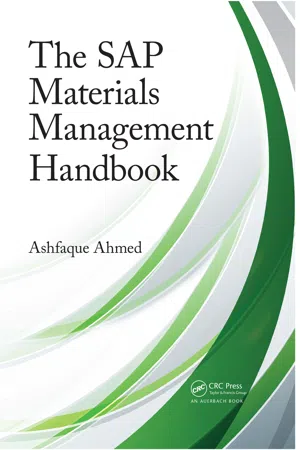
The SAP Materials Management Handbook
About this book
Although tens of thousands of global users have implemented Systems, Applications, and Products (SAP) for enterprise data processing for decades, there has been a need for a dependable reference on the subject, particularly for SAP materials management (SAP MM).Filling this need, The SAP Materials Management Handbook provides a complete understandi
Information
Chapter 1
Introduction to SAP Materials Management and Navigation
Introduction
If you are pursuing to become a SAP materials management (SAP MM) consultant, you may already know something about SAP. So we will quickly and briefly go over what is SAP and move over to SAP MM, and discuss some preliminary points about it. Later we will see some advance topics related to customizing SAP MM. Finally, we will see some business scenarios related to MM and understand how SAP MM is used to solve these scenarios.
I welcome you to this edition of text on SAP MM. You are going to read and learn a lot about SAP MM. But first we will learn what is SAP all about and some basic understanding about SAP MM as well as how to navigate SAP screens as a user and as a business analyst.
What Is SAP?
SAP stands for Systems, Applications, and Products for enterprise data processing. In 1972, five former IBM employees formed this company in Germany. The company name is SAP AG and the product that was developed is called SAP. Initially, SAP application was built to run on IBM mainframe computers, and this release of the application was termed as SAP R/1. Then in 1978, SAP AG launched R/2 version of its product. Finally, in 1992, SAP released its R/3 version. There was a fundamental shift with this release. While earlier versions of SAP were built to run on IBM mainframes, SAP R/3 was built to run on UNIX platforms; hence, there was a paradigm shift from the mainframe era to the client–server one. Since then SAP AG has kept releasing many versions of its product catering to different technologies and different businesses. In 1999, SAP AG introduced mySAP.com, a technological initiative to join the era of Internet and client independent computing.
SAP AG has also been kept adding new functionalities to its product. Initially, there was only accounting package in its product. Later it added advanced financial features. For order and front office management, it introduced sales and distribution (SD) module to its product. Later it introduced the feature to take care of back office work related to supply chain management such as inventory management, shipment management, and warehouse management (WM). Similarly, it added mobile platform to integrate mobile devices to the backbone application so that users can use mobile devices to process transactions online.
SAP AG also developed the modules for human resource management, customer relationship management, advance planning and optimization, components for mobile integration and operation, and so on over the years as technology and customer requirements evolved from time to time.
Importance of Enterprise Resource Planning
In any enterprise that deals with procuring, processing, production, or distribution of materials, transactions such as purchase order, purchase requisition, contracts, inventory count, inventory valuation, vendor management, and material requirement planning take place.
These transactions can be done using a paper and a pencil if the operations involved may be very small. For instance, a small retail shop may have 500 items, and every week it needs to order 70 items from its supplier. In this case, these transactions can easily be taken care of by using a paper and a pencil. Now assume that the owner of this shop expands, and suddenly now there are three shops located at different parts of the city. The number of items increased to 5000 and the number of items on orders to suppliers also increased to 700 per week. In this case, a small software package can be used to take care of these transactions.
Now assume that this retail store chain expands again over the years. There are 30 stores located at different parts of the state. There are 7000 items on orders per week. How will the management of the retail store chain handle these increased transactions? Maybe they will go for a larger software package to take care of the larger number of transactions. In fact, nowadays there are global business houses that are so large that the number of transactions for their different business units runs in billions per day. The organization structures at these houses also tend to be very complex. There may be many legal business units which are, for all purposes, separate business units from each other. Yet, because of the same ownership, they do business with each other differently than they do business with other business houses. Then these global business houses operate in many countries. Each country has its own legal and commercial requirements.
Despite all these complex issues, a business house needs to have a system that can tie all of its diverse operations together. Thus, running the business becomes easier. The top management can make decisions instantly based on the information they get from such a system that provides revenue, expenses, and future commitments, and all such information. The top management of a global enterprise may need all these information from all of its global operations. This information is current, instant, and available at a touch of a button. These global business houses also need to provide legally binding information to governments and public on a quarterly or a yearly basis about their business operations. It is simply impossible to provide these pieces of information without the help of a good enterprise software application that helps these business houses to do instant transactions, and at the same time make available information about these transactions.
SAP is one of such an enterprise system. This system is known as enterprise resource planning (ERP) system. In fact, SAP is the most successful of these ERPs.
What Is SAP MM?
SAP ERP consists of financial, logistics, and human capital management core areas. SAP MM is part of the SAP ERP logistics system, which consists of SAP production planning (SAP PP), SAP plant maintenance (SAP PM), SAP WM, SAP SD, SAP logistics execution (SAP LE), and SAP MM. SAP MM covers the areas of purchase and inventory management.
To fulfill these tasks associated with purchase and inventory management, SAP MM needs master data to be defined for materials, vendors, plants, storage locations, and purchase organization. These master entities need to be configured in conjunction with the client and company codes, which are two top-level organization entities in SAP.
Apart from these master data, SAP also needs to create master data for
- Linking vendor to materials
- Creating a list of all available sources of supply of materials so that sourcing for these materials can be optimized
SAP purchase management deals with the transactions associated with creation and maintenance of purchase documents. The set of purchase documents contain transaction data. SAP needs master data to produce this transaction data.
In essence, SAP MM is all about purchase transactions, inventory management transactions and the transaction data being generated during these transactions.
SAP Is Not Easy
If you think that learning SAP is easy, you are mistaken. SAP is one of the most complex software applications, and thus, it is difficult to learn. For an end user, it may be a complex and difficult product, but for a SAP consultant, it is even harder.
Compl...
Table of contents
- Cover
- Half Title
- Title Page
- Copyright Page
- Table of Contents
- Preface
- Author
- 1 Introduction to SAP Materials Management and Navigation
- 2 Business Mapping in SAP Materials Management and Job Advice
- 3 SAP MM Masters and Organizational Structure
- 4 SAP MM Purchasing Management
- 5 SAP MM Inventory Management
- 6 Customizing in Material Masters
- 7 SAP MM Customizing—MRP
- 8 SAP MM Customizing—Purchasing
- 9 SAP MM Customizing—Inventory Management
- 10 Business Scenarios
- Index
Trusted by 375,005 students
Access to over 1.5 million titles for a fair monthly price.
Study more efficiently using our study tools.
Frequently asked questions
Yes, you can cancel anytime from the Subscription tab in your account settings on the Perlego website. Your subscription will stay active until the end of your current billing period. Learn how to cancel your subscription
No, books cannot be downloaded as external files, such as PDFs, for use outside of Perlego. However, you can download books within the Perlego app for offline reading on mobile or tablet. Learn how to download books offline
Perlego offers two plans: Essential and Complete
- Essential is ideal for learners and professionals who enjoy exploring a wide range of subjects. Access the Essential Library with 800,000+ trusted titles and best-sellers across business, personal growth, and the humanities. Includes unlimited reading time and Standard Read Aloud voice.
- Complete: Perfect for advanced learners and researchers needing full, unrestricted access. Unlock 1.5M+ books across hundreds of subjects, including academic and specialized titles. The Complete Plan also includes advanced features like Premium Read Aloud and Research Assistant.
We are an online textbook subscription service, where you can get access to an entire online library for less than the price of a single book per month. With over 1.5 million books across 990+ topics, we’ve got you covered! Learn about our mission
Look out for the read-aloud symbol on your next book to see if you can listen to it. The read-aloud tool reads text aloud for you, highlighting the text as it is being read. You can pause it, speed it up and slow it down. Learn more about Read Aloud
Yes! You can use the Perlego app on both iOS and Android devices to read anytime, anywhere — even offline. Perfect for commutes or when you’re on the go.
Please note we cannot support devices running on iOS 13 and Android 7 or earlier. Learn more about using the app
Please note we cannot support devices running on iOS 13 and Android 7 or earlier. Learn more about using the app
Yes, you can access The SAP Materials Management Handbook by Ashfaque Ahmed in PDF and/or ePUB format, as well as other popular books in Computer Science & Information Management. We have over 1.5 million books available in our catalogue for you to explore.