eBook - ePub
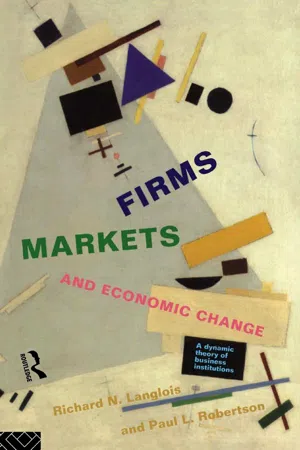
Firms, Markets and Economic Change
A dynamic Theory of Business Institutions
- 200 pages
- English
- ePUB (mobile friendly)
- Available on iOS & Android
eBook - ePub
Firms, Markets and Economic Change
A dynamic Theory of Business Institutions
About this book
Traditonal western forms of corporate organization have been called into question by the success of Japanese keiretsu. Firms, Markets and Economic Change draws on industrial economics, business strategy, and economic history to develop an evolutionary model to show when innovation is best undertaken. The authors argue that innovation is a complex p
1
INTRODUCTION
ON BUSINESS INSTITUTIONS
The recent awards of Nobel Prizes to Ronald Coase and Douglass North are but one indication of a growing theoretical interest within economics in the nature and role of social institutions. Indeed, there has already appeared a large body of literature bearing the flag of the New Institutional Economics (Langlois 1986a, 1993). This book is intended as a contribution in this developing tradition, albeit a contribution with a focus on one specific set of social institutions: what we call business institutions.
By using the term business institutions, we intend to stress that our concern extends beyond business organisation—which connotes the idea of the business firm—to encompass a wide variety of structures, including those institutions generally described as markets. Business institutions are, of course, in part a matter of legal institutions, and we certainly find occasion to discuss the notion of property-rights. But by business institutions we mean more than an explicit (or even implicit) legal framework. In the broader theory of social institutions, the fundamental concept of an institution ultimately boils down to the idea of recurrent patterns of behavior—habits, conventions, and routines. In this book, we take a similar perspective, in that the most elemental form of a business institution for us is a productive routine, a habitual pattern of behavior embodying knowledge that is often tacit and skill-like. Nelson and Winter (1982) used the idea of routines as the basis of their evolutionary theory of industry structure and economic growth. But to the extent that the New Institutional Economics has focused on issues of organizational form, it has done so through the lens of the transaction-cost economics pioneered by Coase (1937) and honed today by Williamson (1985) and others. One way to understand our project in this volume is to see it as an attempt to carry evolutionary economics more forcefully into the traditional bailiwicks of transaction-cost theory by presenting and applying an evolutionary theory of economic capabilities.1
Business institutions are more than just a theoretical concern. Much of the present-day debate over industrial policy is implicitly a debate over organizational patterns and structures. Although the discussion often turns to issues of legal regime and government policy, much of it also centers on business institutions in our sense: What are the patterns of organization most conducive to innovation and economic growth? Are large vertically integrated firms superior to networks of “flexibly specialized” firms—or vice-versa? Do the patterns of organization in Japan, for example, confer advantages over patterns of institutions elsewhere? We offer this book as a step toward creating the kind of conceptual apparatus necessary for clarifying these and similar issues.
The approach we take has strong antecedents. We consider ourselves within the broad current of economics that runs from Adam Smith to Alfred Marshall and Joseph Schumpeter.2 The reader will encounter those names frequently in what follows. We are also indebted to a number of present-day writers, including but not limited to G.B.Richardson, Edith Penrose, Alfred Chandler, Richard Nelson and Sidney Winter, Brian Loasby, David Teece, and Morris Silver. But, although this rather unusual practice of giving credit to the past denies us some of the rhetoric of novelty, we do not thereby wish to renounce all claims to originality.
OVERVIEW OF THE THEORY
Present-day transaction-cost economics tends to see business institutions— and the firm in particular—as optimal responses to incentive problems.3 The importance of coordinating resources is recognized in such concepts as “asset specificity,” but the principal focus of transaction-cost theory is on aspects of behavior that inhibit markets from providing effective coordination. In terms of the game-theoretic imagery of the New Institutional Economics (Langlois 1986a, 1993), we might say that mainstream transaction-cost theory explains the firm as the solution of a prisoner’s-dilemma-like game. In a prisoner’s dilemma, the fundamental problem the players face is less one of information than one of incentives. And the measure of a governance structure (to use Williamson’s terminology) lies in its ability to align incentives and overcome “opportunism.” In this formulation, the raison d’être of the firm does not lie in coordination as such, but in its ability to provide coordination when divergent incentives between buyers and sellers and between agents and principals impede the smooth operation of markets.
Transaction-costs theorists, however, do not give close consideration to why coordination is necessary. The efficient coordination of resources not only permits operational efficiency in the production and distribution of goods and services along existing lines, but it is also vital for strategic uses that require new, and not always readily evident, combinations of resources. The value of business institutions—firms prominently among them—is that they can supply this coordination function as well as (or perhaps rather than) merely an incentivealignment function. To put it another way, business institutions may also arise as solutions to coordination games. In a world of fundamental uncertainty, in which capabilities and knowledge differ among actors, this, rather than incentive questions, may be the central role of such institutions.
To see why this may be so, let us return to the idea of productive routines. The repertoire of routines of an organization (or network of organizations) constitutes the capabilities that organization (or network) possesses. Those business institutions that can create and utilize superior capabilities tend to perform better. As Schumpeter (1950) maintained, this process in which new capabilities emerge and are tested is the competitive process.4 Such a process is necessarily complex and historically contingent, but there are a few theoretical generalizations one can make about which types of business institutions will be most likely to succeed under various circumstances.
One of the principal determinants of the appropriate form of business institution is the nature of the economic change that the institution must confront. The second critical factor is the existing structure of relevant capabilities, including both the substantive content of those capabilities and the organizational structure under which they are deployed in the economy.
One pattern typical in the history of business institutions emerges when a systemic innovation offers the potential to create new value through, for example, an improvement in the non-price characteristics of a product (which may sometimes mean a “new” product); a reduction in price; or an increase in the return to the input suppliers. To be successful, such a systemic innovation requires simultaneous change in several stages of production.5 But this may render some existing assets obsolete and, at the same time, call for the use of capabilities not previously applied in the production of the product. If, in addition, the existing capabilities are under separate ownership—or, to put it loosely and somewhat inaccurately, the existing production system is coordinated through market mechanisms— then we arrive at one important rationale for the institution of the business firm. Under this scenario, the business firm arises because it can more cheaply redirect, coordinate, and where necessary create the capabilities necessary to make the innovation work. Because control of the necessary capabilities in the firm would be relatively more concentrated than in a market-based organizational structure, such a firm could overcome not only the recalcitrance of assetholders whose capital would be the victim of creative destruction, but also the “dynamic” transaction costs6 of informing and persuading new inputholders with necessary capabilities.
This scenario accurately describes the situation surrounding the creation and growth of many of the enterprises Alfred Chandler chronicled in The Visible Hand (1977). With the lowering of transportation and communications costs in the America of the nineteenth century, there arose profit opportunities for those who could create mass markets and take advantage of economies of scale in mass production. Examples range from steel and farm machinery to cigarettes and branded goods. In all these cases, profitable improvements in product attributes and costs7 required the creative destruction of existing decentralized systems of production and distribution in favor of systems involving significantly different capabilities. Gustavus Swift’s creation of the system of refrigerated meat-packing (Chandler 1977, pp. 299– 302) was a systemic innovation that rendered obsolete the older network of live-animal distribution. Swift was forced to integrate into both refrigerated railroad cars and wholesale distribution in order to overcome the opposition of vested interests and to persuade others in the chain of production of the value of his innovation (Silver 1984, pp. 28–29).
This picture of the rationale for the firm is what we might legitimately call a strategic, entrepreneurial, or Schumpeterian theory of vertical integration. The superiority of centralized control of capabilities lies in the ability to redeploy those capabilities in the service of an entrepreneurial opportunity when such redeployment would otherwise be costly. The firm overcomes the “dynamic” transaction costs of economic change. It is in this sense that we may say the firm solves a coordination problem: it enables complementary input-holders to agree on the basic nature of the system of production and distribution of the product. It provides the structure in a situation of structural uncertainty.
A number of writers, with Schumpeter himself in the lead, have taken this picture of the firm to imply the superiority of the firm—especially the large vertically integrated firm—in most if not all times and places. In fact, however, the scenario we just depicted is by no means the only important one, let alone the only possible one. In the Swift example, the superiority of the firm rested on its ability cheaply to redeploy, coordinate, and create necessary capabilities in a situation in which (1) the entrepreneurial opportunity involved required systemic change and (2) the necessary new capabilities were not cheaply available from an existing decentralized or market network. In situations, however, in which one or both of these conditions is missing, the benefits of the firm are attenuated, and its rationale slips away. This in fact is the expected outcome in a dynamic situation. Both the levels of transaction costs and the relative value of capabilities held by firms may be expected to decrease over time because they are underpinned by knowledge. People may find ways of eliminating impediments to the smooth operation of markets, and other firms can acquire once-tacit capabilities and routines through trial-and-error experimentation. Thus, while we can expect to find capabilities clustered within firms during the early stages of a systemic innovation, specialization of functions may increase as the innovation matures.
Moreover, in many circumstances change—even sometimes rapid change —may proceed in an autonomous rather than a systemic fashion. A prime example of this occurs when the attributes buyers desire can be provided in the form not of a preset package but of a modular system. Stereo systems and IBM-compatible personal computers are prominent examples, and we examine these in detail below; but there are many others as well, including cases in the realm of process technology (Langlois 1992c). For present purposes, the key feature of a modular system is that the connections or “interfaces” among components of an otherwise systemic product are fixed and publicly known. Such standardization creates what we might call external economies of scope that substitute in large part for centralized coordination among the wielders of complementary capabilities. This allows the makers of components to concentrate their capabilities narrowly and deeply and thus to improve their piece of the system independently of others.
Moreover, in highly developed economies, a wide variety of capabilities may be available for purchase on ordinary markets, in the form either of contract inputs or finished products. At the same time, it may also be the case that the existing network of capabilities that must be creatively destroyed (at least in part) by entrepreneurial change is not in the hands of decentralized input-suppliers but is in fact concentrated in existing large firms. The unavoidable flip-side of seeing firms as possessed of capabilities —and therefore as accretions of habits and routines—is that such firms are quite as susceptible to institutional inertia as is a system of decentralized economic capabilities. Even though firms may have a strategic decision-making function, they may yet be unable to reorient themselves in the face of rapid change. Economic change has in many circumstances come from small innovative firms relying on the capabilities available in the market rather than existing firms with ill-adapted internal capabilities.
PLAN OF THE BOOK
In what follows, we develop the ideas touched on here. Our approach is to mix together theory, economic history, and applications to policy, as we believe there is more to gain from a conversation among these modalities than there is from their strict separation. Nonetheless, some chapters are clearly mostly theory; others are heavily economic history; and others address the debate over industrial policy quite centrally.
In Chapters 2 and 3 we develop an evolutionary theory of the firm. Chapter 2 develops the theory of economic capabilities alluded to above. Although influenced by the work of economists, the capabilities approach finds a more welcome home in the literature of strategic management. Chapter 2 spends a considerable amount of time addressing that literature and connecting our ideas to it. Chapter 3 is the central theoretical chapter of the book. It sets out the theory of dynamic transaction costs and shows how they, and the changing value of capabilities, provide an explanation of the changing value of vertical integration.
Chapters 4 and 5 are the most deeply historical. Chapter 4 enlarges upon the dynamic theory of the firm in Chapter 3 by confronting it with a detailed history of integration and disintegration in the pre-war American automobile industry. One of the claims of Chapter 3 is that transaction costs are fundamentally a shortrun phenomenon. By looking at the automobile industry over a number of decades, Chapter 4 is able to follow the ebb and flow of transaction costs and to examine how historical sequences of events—rather than just transaction costs seen ex visu of a given point of time8 —shape the organizational structures of an industry. Chapter 5 is a mix of history and theory. It develops the theory of modular systems, and then applies that theory through detailed case studies of the early stereo-components industry and the microcomputer industry. Chapters 3 and 4 concentrate heavily, but by no means exclusively, on the causes of vertical integration and thus on the firm as a business institution. Chapter 5 is a kind of counterpoint, focusing in a complementary way on the nature and role of “external” rather than internal capabilities in economic growth.
Chapters 6 and 7 introduce industrial-policy issues into the mix. Chapter 6 uses both theory and history to examine the nature and causes of institutional inertia. Building on the institutional theory developed earlier, this chapter draws on such ideas as punctuated equilibria and population dynamics to explain the sources of inertia, and it adduces four hypotheses about when particular types of organizational structures will be able to appropriate the gains from innovation.
Finally, Chapter 7 turns directly to the industrial-policy debate. As we suggested above, a central aspect of that debate is that between proponents of large vertically integrated firms on the one hand and advocates of networks of small specialized producers on the other. This chapter argues that neither institutional structure is the panacea its enthusiasts claim. The menu of institutional alternatives is in fact quite large, and both firms and networks—of which there is more than one kind—can be successful, growth-promoting adaptations to the competitive environment. Industrial structures vary in their ability to coordinate information flows necessary for innovation and to overcome power relationships adverse to innovation. The relative desirability of the various structures depends on the nature and scope of technological change in the industry and on the effects of various product life-cycle patterns. The principal policy conclusion of this analysis is that the government’s role ought to be facilitating rather than narrow and prescriptive, allowing scope for firms to develop organizational forms that are best adapted to their particular environments.
2
CAPABILITIES, STRATEGY AND THE FIRM
Holmstrom and Tirole (1989, p. 65) have recently outlined criteria that a theory of the firm must meet, criteria that apply to other types of organizations as well. In their view, such theories need to address two main questions. First, the theory must account for the purpose of organizations, or why they exist at all. Second, the theory must explain the boundaries of the organization—its scale and scope. In Chapters 2 and 3, we develop a dynamic evolutionary model to address these questions.
Our basic argument is that firms and other types of organizations consist of two distinct but changing parts. The first part, the intrinsic core, comprises elements that are idiosyncratically synergistic, inimitable, and noncontest-able. That is, the capabilities in the intrinsic core cannot be duplicated, bought, or sold, and they combine to generate unique outcomes that are more valuable than the outcomes that the core elements could produce separately. The remainder of the organization consists of ancillary capabilities that are contestable and may not be unique.
The boundaries of the organization—the extent to which ancillary capabilities will be internalized or bought through the market—depend (1) on the strength of the organization’s own capabilities relative to those that can be purchased, i.e., on relative production costs and (2) on the respective transaction and governance costs involved in making or buying the capabilities. In any case, however, both the intrinsic core and the ancillary capabilities that comprise an organization, and the prevailing levels of transaction costs, may be expected to change over time because they are underpinned by knowledge. Thus in the long run, the boundaries of the firm may alter as the organization itself, and other organizations, learn in ways that change the relative values of ancillary capabilities and levels of transaction and governance costs. Moreover, the instrinsic core capabilities of an organization may erode in the long run as other firms acquire through trial-and-error search knowlege that was formerly tacit or proprietary.
As our principal focus is on privately owned, for-profit organizations, we will generally use the word “firm.” Much of the discussion that follows, however, is equally applicable to organizations in general.
CLASSICAL AND NEOCLASSICAL THEORIES
Many writers have noted that the main thrust of economic theory long ago shifted away from the concerns of Adam Smith and the classicals.9 The “marginalist” or neoclassical theory that emerged after 1873 was designed not to understand the springs of ...
Table of contents
- Cover Page
- Title Page
- Copyright Page
- Figures and Tables
- Acknowledgments
- 1 Introduction
- 2 Capabilities, Strategy and the Firm
- 3 A Dynamic Theory of the Boundaries of the Firm
- 4 Vertical Integration in the Early American Automobile Industry
- 5 External Capabilities and Modular Systems
- 6 Inertia and Industrial Change
- 7 Innovation, Networks and Vertical Integration
- 8 Conclusion
- Notes
- Bibliography
Trusted by 375,005 students
Access to over 1.5 million titles for a fair monthly price.
Study more efficiently using our study tools.
Frequently asked questions
Yes, you can cancel anytime from the Subscription tab in your account settings on the Perlego website. Your subscription will stay active until the end of your current billing period. Learn how to cancel your subscription
No, books cannot be downloaded as external files, such as PDFs, for use outside of Perlego. However, you can download books within the Perlego app for offline reading on mobile or tablet. Learn how to download books offline
Perlego offers two plans: Essential and Complete
- Essential is ideal for learners and professionals who enjoy exploring a wide range of subjects. Access the Essential Library with 800,000+ trusted titles and best-sellers across business, personal growth, and the humanities. Includes unlimited reading time and Standard Read Aloud voice.
- Complete: Perfect for advanced learners and researchers needing full, unrestricted access. Unlock 1.5M+ books across hundreds of subjects, including academic and specialized titles. The Complete Plan also includes advanced features like Premium Read Aloud and Research Assistant.
We are an online textbook subscription service, where you can get access to an entire online library for less than the price of a single book per month. With over 1.5 million books across 990+ topics, we’ve got you covered! Learn about our mission
Look out for the read-aloud symbol on your next book to see if you can listen to it. The read-aloud tool reads text aloud for you, highlighting the text as it is being read. You can pause it, speed it up and slow it down. Learn more about Read Aloud
Yes! You can use the Perlego app on both iOS and Android devices to read anytime, anywhere — even offline. Perfect for commutes or when you’re on the go.
Please note we cannot support devices running on iOS 13 and Android 7 or earlier. Learn more about using the app
Please note we cannot support devices running on iOS 13 and Android 7 or earlier. Learn more about using the app
Yes, you can access Firms, Markets and Economic Change by Richard N. Langlois,Paul L. Robertson in PDF and/or ePUB format, as well as other popular books in Economics & Business General. We have over 1.5 million books available in our catalogue for you to explore.