A Q&A Approach to Organic Chemistry is a book of leading questions that begins with atomic orbitals and bonding. All critical topics are covered, including bonding, nomenclature, stereochemistry, conformations, acids and bases, oxidations, reductions, substitution, elimination, acyl addition, acyl substitution, enolate anion reactions, the Diels–Alder reaction and sigmatropic rearrangements, aromatic chemistry, spectroscopy, amino acids and proteins, and carbohydrates and nucleosides. All major reactions are covered. Each chapter includes end-of-chapter homework questions with the answer keys in an Appendix at the end of the book. This book is envisioned to be a supplementary guide to be used with virtually any available undergraduate organic chemistry textbook. This book allows for a "self-guided" approach that is useful as one studies for a coursework exam or as one reviews organic chemistry for postgraduate exams.
Key Features:
Allows a "self-guided tour" of organic chemistry
Discusses all important areas and fundamental reactions of organic chemistry
Classroom tested
Useful as a study guide that will supplement most organic chemistry textbooks
Assists one in study for coursework exams or allows one to review organic chemistry for postgraduate exams
Includes 21 chapters of leading questions that covers all major topics and major reactions of organic chemistry
Organic chemistry is the science that studies molecules containing the element carbon. Carbon can form bonds to other carbon atoms or to a variety of atoms in the periodic table. The most common bonds observed in an organic chemistry course are C—C, C—H, C—O, C—N, C—halogen (Cl, Br, I), C—Mg, C—B, C—Li, C—S, and C—P.
1
Orbitals and Bonding
This chapter will introduce the carbon atom and the covalent bonds that join carbon atoms together in organic molecules. The most fundamental properties of atoms and of covalent bonds will be introduced, including hybridization, electronic structure, and a brief introduction to using molecular orbital theory for bonding.
1.1 ORBITALS
1.1.1 Atomic Orbitals
What is the electronic structure of an atom?
A given atom has a fixed number of protons, neutrons, and electrons, and the protons and neutrons are found in the nucleus. The electrons are located at discreet energy levels (quanta) away from the nucleus. The nucleus is electrically positive, and electrons are negatively charged.
What is the Schrödinger wave equation?
The Schrödinger equation, Hψ = Eψ, is a linear partial differential equation that describes the wavefunction or state function of a quantum-mechanical system. The motion of an electron is expressed by a wave equation, which has a series of solutions and each solution is called a wavefunction. Each electron may be described by a wavefunction whose magnitude varies from point to point in space. The equation is a partial differential equation that describes how the wavefunction of a physical system changes over time.
What are atomic orbitals?
An atomic orbital is a mathematical function that describes the wave-like behavior of either one electron or a pair of electrons in an atom. If certain simplifying assumptions are made, it is possible to use the Schrödinger equation to generate a different wavefunction for electrons with differing energies relative to the nucleus. A particular solution to the so-called Schrödinger wave equation, for a given type of electron, is determined from the Schrödinger equation, and a solution for various values of ψ that correspond to different energies shows the relationship between orbitals and the energy of an electron. The wavefunction is described by spatial coordinates ψ(x,y,z), and using Cartesian coordinates a point is defined that describes the position of the electron in space.
What is a node?
A node is derived from a solution to the Schrödinger equation where the wavefunction changes phase, and it is taken to be a point of zero electron density.
What is the Heisenberg uncertainty principle?
The Heisenberg uncertainty principle states that the position and momentum of an electron cannot be simultaneously specified so it is only possible to determine the probability that an electron will be found at a particular point relative to the nucleus. The probability of finding the electron in a unit volume of three-dimensional space is given by |ψ(x,y,z)|2, or |ψ|2dτ, which is the probability of an electron being in a small element of the volume dτ. This small volume can be viewed as a charge cloud if it contains an electron, and the charge cloud represents the region of space where we are most likely to find the electron in terms of the (x,y,z) coordinates. These charge clouds are orbitals.
What is a s-orbital?
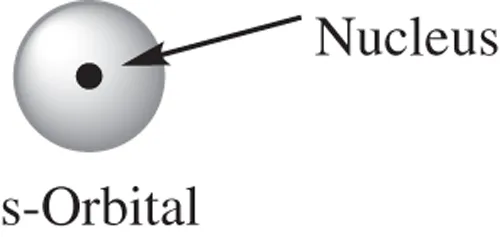
Different orbitals are described by their distance from the nucleus, which formally corresponds to the energy required to “hold” the electron. One solution to the Schrödinger equation is symmetrical in that the wave does not change phase (zero nodes; a node is the point at which the wave changes its phase). This corresponds to the first quantum level and known as a s-atomic orbital. The 1s-orbital represents the first energetically favorable level where electrons can be held by the nucleus. The space in which the electron may be found is spherically symmetrical in three-dimensional space. All spherically symmetrical orbitals are referred to as s-orbitals. The nucleus is represented by the “dot” in the middle of the sphere.
What is a p-orbital?
When the solution for the Schrödinger equation has one node (the wave changes phase once), electron density is found in two regions relative to the node. When the space occupied by this electron is shown in three-dimensional space, it is a p-orbital with a “dumbbell” shape. In the (x,y,z) coordinate system, the single node could be in the x, the y, or the z plane and all three are equally likely. Therefore, three identical p-orbitals must be described: px, py, and pz relative to the nucleus, as shown. Identificatio...
Table of contents
Cover
Half-Title
Title
Copyright
Contents
Preface
Common Abbreviations
Author
A Q&A Approach to Organic Chemistry
A Q&A Approach to Organic Chemistry
Appendix: Answers to End of Chapter Problems
Index
Trusted by 375,005 students
Access to over 1.5 million titles for a fair monthly price.
Study more efficiently using our study tools.
Frequently asked questions
Yes, you can cancel anytime from the Subscription tab in your account settings on the Perlego website. Your subscription will stay active until the end of your current billing period. Learn how to cancel your subscription
No, books cannot be downloaded as external files, such as PDFs, for use outside of Perlego. However, you can download books within the Perlego app for offline reading on mobile or tablet. Learn how to download books offline
Perlego offers two plans: Essential and Complete
Essential is ideal for learners and professionals who enjoy exploring a wide range of subjects. Access the Essential Library with 800,000+ trusted titles and best-sellers across business, personal growth, and the humanities. Includes unlimited reading time and Standard Read Aloud voice.
Complete: Perfect for advanced learners and researchers needing full, unrestricted access. Unlock 1.5M+ books across hundreds of subjects, including academic and specialized titles. The Complete Plan also includes advanced features like Premium Read Aloud and Research Assistant.
Both plans are available with monthly, semester, or annual billing cycles.
We are an online textbook subscription service, where you can get access to an entire online library for less than the price of a single book per month. With over 1.5 million books across 990+ topics, we’ve got you covered! Learn about our mission
Look out for the read-aloud symbol on your next book to see if you can listen to it. The read-aloud tool reads text aloud for you, highlighting the text as it is being read. You can pause it, speed it up and slow it down. Learn more about Read Aloud
Yes! You can use the Perlego app on both iOS and Android devices to read anytime, anywhere — even offline. Perfect for commutes or when you’re on the go. Please note we cannot support devices running on iOS 13 and Android 7 or earlier. Learn more about using the app
Yes, you can access A Q&A Approach to Organic Chemistry by Michael B. Smith in PDF and/or ePUB format, as well as other popular books in Scienze fisiche & Chimica. We have over 1.5 million books available in our catalogue for you to explore.