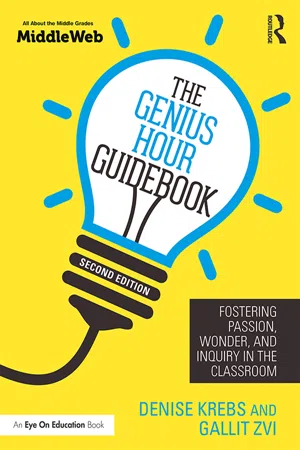
Promote your students' creativity and get them excited about learning! In the second edition of this popular, practical book, authors Denise Krebs and Gallit Zvi show you how to implement Genius Hour, a time when students can develop their own inquiry-based projects around their passions and take ownership of their work. Brought to you by MiddleWeb and Routledge Eye On Education, the book takes you step-by-step through planning and teaching Genius Hour. You'll learn how to guide your students as they:
? inspire learning and brainstorm wonders;
? develop inquiry questions based on their interests;
? conduct research and experiments about their topic of choice;
? create presentations to teach their fellow students in creative ways; and
? present their finished product for a final assessment.
This edition includes new chapters on managing your classroom projects and recommended books. Throughout the book you will find voices from the Genius Hour community sharing real-life stories and inspiration. Appendices contain handy FAQs and ready-made lessons and resources. In addition, a companion website, www.geniushourguide.org, offers bonus materials and regular updates to support you as you implement Genius Hour in your own classroom.
There exists empirical evidence proving that students who are given the freedom to explore areas based on their personal interests, and who are accompanied in their learning by a supportive, understanding facilitator, not only achieve superior academic results but also develop socially and grow personally.
Renate Motschnig and Andreas Holzinger1
Genius Hour is a precious time, loved by all our students. It is when they are allowed to develop their own inquiry question—about whatever it is that they want to explore. Students develop these questions based on their interests, passions, or even based on something that they are wondering about. For us, it is student-centered learning at its best. Students love it because it gives them the opportunity to learn about the things that they personally wonder about. Often this leads to passion projects where students are empowered to take action in their community or create a product or embark on their own special process of discovery. It is truly personalized learning and so vital because, as one of our students, Morgan, pointed out, “You don’t want to learn your teacher’s passion, you want to learn your own passion.”
Genius Hour provides students time to play with their learning, just like they did when they were in kindergarten. Those young students have no problem asking question after question, as they are truly curious about the world. We want our students to get back in touch with their younger, more inquisitive selves, and we want to guard and nurture their creativity. They can do work important to them without fear of “getting it wrong.” Genius Hour allows students to become fearless learners, improving the world.
Genius Hour celebrates their curiosity and gives students time to play with their learning again, with time to explore and create. It is time set aside during the school week. When Denise taught junior high, students came for 45-minute classes each day. She gave them 20% of the class time each week to work on their Genius Hour projects. Teachers, like Gallit, in self-contained classrooms, might arrange a block of time once a week for Genius Hour. Currently, Gallit opts for an hour to an hour-and-a-half on Thursday afternoons.
During Genius Hour, all the kids are excited and student engagement is at its highest. Some students are huddled around a laptop researching a country they are interested in, others are creating websites or slideshows on an area of interest and some are out in the hallway filming movies. Some aren’t using technology at all, but, rather, are building and creating things with their hands. No matter what they are working on, the common thread is that it is something they are passionate about and/or wonder about.
Students wanted to learn about architecture and built an amazing Keva block structure
How We Got Started
So how did we first discover the possibilities of Genius Hour? This idea came to Denise’s attention when Angela Maiers (@AngelaMaiers) tweeted out the idea as she listened to a talk by Daniel Pink. Denise tweeted “I want to hear more!” in response to Angela’s tweet “LOVE this! We need to have a ‘genius hour’ in school—for teachers and students! #authorspeak11.”2
In a subsequent search, Denise found Daniel Pink’s blog post about Genius Hour in a corporate setting. In his blog,3 he tells of Jen Shefner at the Columbia Credit Union and how each week her “employees can take a Genius Hour—60 minutes to work on new ideas or master new skills. They’ve used that precious sliver of autonomy well, coming up with a range of innovations including training tools for other branches.”
Denise was quick to agree with Pink and came up with a plan to give her 7th and 8th graders their very own Genius Hour. She shared her decision in her own blog, asking others to share their experiences with the #geniushour hashtag.4 Word started to spread. Gallit is ever so grateful that her teaching partner at the time, Hugh McDonald (@hughtheteacher), retweeted Denise’s blog because that is how she “met” Denise. Soon after, Gallit began Genius Hour with her class of 4th and 5th graders and was immediately sold! Gallit also blogged about her experiences with Genius Hour5 and word continued to spread. (Can you tell we are huge fans of Twitter, blogging and sharing?)
The rest, as they say, is history. The two of us have been incorporating Genius Hour into our classrooms ever since and haven’t looked back. Genius Hour has evolved well since those first blog posts we wrote. Since then, we have learned so much. In early 2011, we founded the #geniushour chat on Twitter, which we co-moderate. It is still growing strong—a monthly time when educators gather to have a structured chat about different themes in Genius Hour. We also curate the Genius Hour Guide companion site.6
Why Genius Hour Is Worth It
But why spend time doing all of this? Aren’t we expected to “cover” enough? How is there time? To answer that question, we first turn to one of our mentors, Sir Ken Robinson. If you haven’t yet watched Sir Ken Robinson’s TED Talk about how schools kill creativity, you really should. Here’s the link: https://tinyurl.com/TEDcreativity.
Robinson does a fantastic job articulating what so many of us feel. We know something is missing in the way we do school . . . and he helps us articulate it. We completely agree with him when he argues that students need to be given opportunities to be creative, and that this is just as important as reading, writing and all the must-haves that we would never dream of overlooking. His point that schools often take the creativity right out of kids is sadly true. A teacher-centered curriculum does not give all students enough time to explore their own passions, wonders and curiosities.
This is why we love Genius Hour so much. It celebrates and gives students that time to be creative, to give it a go, as Robinson says.
Another mentor and inspiration for Genius Hour is the previously mentioned Daniel H. Pink. His blog post about Genius Hour in the business place, his book Drive and his TED Talk all cite evidence that support Genius Hour in the classroom. Watch his TED Talk here: https://tinyurl.com/TEDmotivation.
We do Genius Hour in the classroom because human motivation does not come from the teacher telling students what they must learn and then rewarding them with smiley faces and good grades. Indeed, according to Daniel Pink and educational researchers like Alfie Kohn, rewards have an adverse effect on motivation. Teachers know that student motivation is enhanced when autonomy, purpose and mastery are present in the classroom. Motivation comes with autonomy, when students are entrusted with choice and the freedom to make decisions r...
Table of contents
Cover
Half Title
Series Page
Title Page
Copyright Page
Dedication
Table of Contents
Companion Website
About the Authors
To the Reader
Foreword
Acknowledgments
1. Genius Hour and Why Students Need It
2. Introducing Genius Hour to Your Class
3. The Launch: Diving In and Letting Go
4. Great Picture Books for Genius Hour Kids
5. Loosening Deadlines and Sharing Passions
6. Managing the Genius Hour Classroom and Projects
7. Helping Kids Make Their Learning Visible
8. Teaching about Self-Assessment and Feedback
9. What Can We Do to Improve the World?
10. Adding All Our Voices to the Genius Hour Movement
Epilogue: Connecting with the Authors
Afterword
Appendix A: FAQs
Appendix B: Genius Hour Resources and Lesson Plans
Appendix C: Genius Hour Reading List for Educators
Trusted by 375,005 students
Access to over 1.5 million titles for a fair monthly price.
Study more efficiently using our study tools.
Frequently asked questions
Yes, you can cancel anytime from the Subscription tab in your account settings on the Perlego website. Your subscription will stay active until the end of your current billing period. Learn how to cancel your subscription
No, books cannot be downloaded as external files, such as PDFs, for use outside of Perlego. However, you can download books within the Perlego app for offline reading on mobile or tablet. Learn how to download books offline
Perlego offers two plans: Essential and Complete
Essential is ideal for learners and professionals who enjoy exploring a wide range of subjects. Access the Essential Library with 800,000+ trusted titles and best-sellers across business, personal growth, and the humanities. Includes unlimited reading time and Standard Read Aloud voice.
Complete: Perfect for advanced learners and researchers needing full, unrestricted access. Unlock 1.5M+ books across hundreds of subjects, including academic and specialized titles. The Complete Plan also includes advanced features like Premium Read Aloud and Research Assistant.
Both plans are available with monthly, semester, or annual billing cycles.
We are an online textbook subscription service, where you can get access to an entire online library for less than the price of a single book per month. With over 1.5 million books across 990+ topics, we’ve got you covered! Learn about our mission
Look out for the read-aloud symbol on your next book to see if you can listen to it. The read-aloud tool reads text aloud for you, highlighting the text as it is being read. You can pause it, speed it up and slow it down. Learn more about Read Aloud
Yes! You can use the Perlego app on both iOS and Android devices to read anytime, anywhere — even offline. Perfect for commutes or when you’re on the go. Please note we cannot support devices running on iOS 13 and Android 7 or earlier. Learn more about using the app
Yes, you can access The Genius Hour Guidebook by Denise Krebs,Gallit Zvi in PDF and/or ePUB format, as well as other popular books in Education & Education General. We have over 1.5 million books available in our catalogue for you to explore.