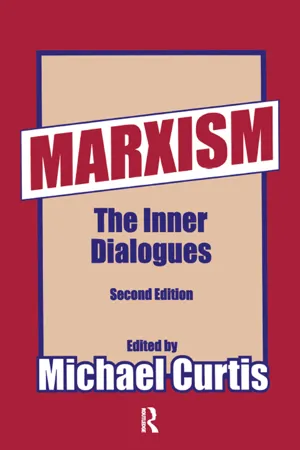
This volume, which initially appeared in 1970, constitutes a major set of statements by leading social scientists, historians, and philosophers to explain the continuing impact of Marxism 150 years after its emergence. The second edition is graced with a stunning new 50 page essay by the editor on the Asiatic mode of production-what has been called the Achilles heel of Marxism by some and its limiting case by others., Marxism: The Inner Dialogues covers a wide range of basic issues and problems arising from what has been said for, against, and about Marxism. This is a rich and systematic collection of writing by the foremost authorities on the subject in the world. The book provides the most inclusive and lasting analysis of Marxist thought available. Professor Curtis has confronted current problems in Marxist studies in the context of the classic concerns of western thought., In addition to new material, the book includes discussions of the meaning fulness of Marxist theory, Marxist doctrine as ideology, the unity or lack thereof in Marxism, claims to the true inheritance of Marx, alienation in Marxist thought, the ethical bases of Marxism, the sociological worth of Marxist analysis, the validity of the dialectic, the materialist conception of history, Marxism and economic analysis, political theory and the proletariat, socialism and state power, and Marxist doctrine and modernization., Marxism: The Inner Dialogues, with contributions from major figures such as George Lichtheim, Lewis Coser, T.B. Bottomore, Daniel Bell, Alasdair Maclntyre, Oskar Lange, Ralf Dahrendorf, Seymour Martin Lipset, and Robert Tucker, among others, provides a highly useful compendium that can be extremely valuable in courses in general political theory and the theories driving modern social movements.
- 386 pages
- English
- ePUB (mobile friendly)
- Available on iOS & Android
eBook - ePub
About this book
Information
PART ONE
Political Theory, Social Science, or Ideology?
From Theory to Ideology
ALL political theory has been a response to, or a reflection of, the problems confronting a society, the manner in which social relations are organized, and the way in which power is exercised. Marxism is no exception. It is a theory influenced by a humanistic Western tradition, the political echoes of the French Revolution, the revolutionary struggles of the mid-nineteenth century, and the growth of industrialism. It was one wave, and potentially the most significant wave, in the current of socialist and communist doctrines which began to swell after the third decade of the nineteenth century.
Marxism is also a complex theory which has been subject to multiple interpretations for reasons both internal and external to itself. As a doctrine Marxism is not always completely consistent, nor is it always easily comprehensible. Marx, as Elie Halévy once wrote, spoke in the language of the German philosophers of liberty, and this language, which contains phrases such as the “integral development of the individual” or the “free development of each with the free development of all,” has raised problems of elucidation. In addition, it has become difficult to separate the “true” or “classical” Marxism of Marx and Engels from the interpretations provided by their disciples, who have emphasized particular aspects of the original doctrines.
Marxism is also a theory that stresses the need for activism and revolutionary change, and thus forms an unusual combination of social science, philosophical reflection, and polemical advocacy. But Marx’s empirical research and historical analyses do not always bear out his sweeping generalizations on political or social matters.
In his article in Part I, George Lichtheim discusses, among other things, the relevance of Marxism to the contemporary world, the connection between socialism and technology, the utility of Marxism for societies at early stages in the process of industrialization, and the relation of Marxism to totalitarian systems.
The major problem external to the logic of the doctrine itself arises from the fact that Marxism has become the formal philosophical basis of the political regimes where Communist parties or their allies have captured power. Marxism has therefore become both a supposed guide to action and the defense of the nature of the regime. In Communist countries, understanding of Marxism is inseparable from indoctrination and from acceptance of the actions of the regime.
The existence of Communist systems, ostensibly grounded in Marxist theory, has resulted in an ambiguous relationship between that theory and Communist practice. Many, like Lewis Feuer and Irving Howe, were distressed and disillusioned by the experience of Stalinism in the Soviet Union, and have suggested that theory has been abused and transformed into ideology. This ideology has served the regime by pretending to aid practical activity and by claiming omniscience about the course of history.
Marxism, like all other ideas, is perplexed by the problem of consciousness. Marx himself spoke of ideology as “false consciousness”—the distorted view of material conditions taken by a consciousness which was unaware of real relationships. He argued the need for true consciousness which would enable men to understand their position. In Capital, Marx wrote that consciousness may not be able to appreciate “the internal essence and internal form of the capitalist process of production,” and that “conceptions formed about the laws of production in the heads of the agents of production and circulation will differ widely from these real laws and will be merely the conscious expression of the apparent movements.”
Marxism cannot escape from the problem that individuals may not be able to perceive their true situation or the rationality of history. Nor can it resolve the dilemma that forms of consciousness are said to be related to changing historical situations and ideas shaped by material conditions, while at the same time Marxism is held to be objective analysis, if not the fixed truth. Ironically, Marxism has itself become the tool by which political actions can be defended and rule justified in the Communist world.
1
On the Interpretation of Marx’s Thought
George Lichtheim
A CONSIDERATION of the phenomenon called “Marxism” has an obvious starting point in Marx’s own reflections on the subject of intellectual systematizations. According to him, they were either “scientific” (in which case they entered into the general inheritance of mankind), or “ideological,” and then fundamentally irrelevant, for every ideology necessarily misconceived the real world, of which science (Wissenschaft) was the theoretical reflection. Yet it is a truism that Marxism has itself in some respects acquired an ideological function. How has this transmutation come about, and what does it tell us about the theoretical breakthrough which Marx effected and which his followers for many years regarded as a guarantee against the revival of “ideological” thinking within the movement he had helped to create?
Regarded from the Marxian viewpoint, which is that of the “union of theory and practice,” the transformation of a revolutionary theory into the ideology of a postrevolutionary, or pseudorevolutionary, movement is a familiar phenomenon. In modern European history—to go back no further—it has furnished a theme for historical and sociological reflections at least since the aftermath of the French Revolution. Indeed, there is a sense in which Marx’s own thought (like that of Comte and others) took this experience as its starting point. In the subsequent socialist critique of liberalism, the latter’s association with the fortunes of the newly triumphant bourgeoisie furnished a topic not only for Marxists. But it was the latter who drew the conclusion that the “emancipation of the working class” had been placed upon the historical agenda by the very success of the liberal bourgeoisie in creating the new world of industrial capitalism. Insofar as “Marxism,” during the later nineteenth century, differed from other socialist schools, it signified just this: the conviction that the “proletarian revolution” was an historical necessity. If then we are obliged to note that the universal aims of the Marxist school, and the actual tendencies of the empirical workers’ movement, have become discontinuous (to put it mildly), we shall have to characterize Marxism as the “ideology” of that movement during a relatively brief historical phase which now appears to be closed. The phase itself was linked to the climax of the “bourgeois revolution” in those European countries where the labor movement stood in the forefront of the political struggle for democracy, at the same time that it groped for a socialist theory of the coming postbourgeois order. Historically, Marxism fulfilled itself when it brought about the upheaval of 1917–18 in Central and Eastern Europe. Its subsequent evolution into the ideology of the world communist movement, for all the latter’s evident political significance, has added little to its theoretical content. Moreover, so far as Soviet Marxism and its various derivations are concerned, the original “union of theory and practice” has now fallen apart.
This approach to the subject is not arbitrary, but follows from the logic of the original Marxian conception of the practical function of theory. It was no part of Marx’s intention to found yet another political movement, or another “school of thought.” His prime purpose as a socialist was to articulate the practical requirements of the labor movement in its struggle for emancipation. His theoretical work was intended as a “guide to action.” If it has ceased to serve as such, the conclusion imposes itself that the actual course of events has diverged from the theoretical model which Marx had extrapolated from the political struggles of the nineteenth century. In fact it is today generally agreed among Western socialists that the model is inappropriate to the postbourgeois industrial society in which we live, while its relevance to the belated revolutions in backward preindustrial societies is purchased at the cost of growing divergence between the utopian aims and the actual practices of the communist movement. From a different viewpoint the situation may be summed up by saying that while the bourgeois revolution is over in the West, the proletarian revolution has turned out to be an impossibility: at any rate in the form in which Marx conceived it in the last century, for the notion of such a revolution giving rise to a classless society has now acquired a distinctly utopian ring. Conversely, the association of socialism with some form of technocracy—understood as the key role of a new social stratum in part drawn from the industrial working class, which latter continues to occupy a subordinate function—has turned out to be much closer than the Marxist school had expected. In short, the “union of theory and practice” has dissolved because the working class has not in fact performed the historic role assigned to it in Marx’s theory, and because the gradual socialization of the economic sphere in advanced industrial society has gone parallel with the emergence of a new type of social stratification. On both counts, the “revisionist” interpretation of Marxism—originally a response to the cleavage between the doctrine and the actual practice of a reformist labor movement—has resulted in the evolution of a distinctively “post-Marxian” form of socialist theorizing, while the full doctrinal content of the original systematization is retained, in a debased and caricatured form, only in the so-called “world view” of Marxism-Leninism: itself the ideology of a totalitarian state-party which has long cut its connections with the democratic labor movement. While the Leninist variant continues to have operational value for the communist movement—notably in societies where that movement has taken over the traditional functions of the bourgeois revolution—the classical Marxian position has been undercut by the development of Western society. In this sense, Marxism (like liberalism) has become “historical.” Marx’s current academic status as a major thinker in the familiar succession from Hegel (or indeed from Descartes-Hobbes-Spinoza) is simply another manifestation of this state of affairs.1
While the interrelation of theory and practice is crucial for the evaluation of Marx—far more so than for Comte who never specified an historical agent for the transition to the “positive stage”—it does not by itself supply a criterion forjudging the permanent value of Marx’s theorizing in the domains of philosophy, history, sociology, or economics. In principle there is no reason why his theoretical discoveries should not survive the termination of the attempt to construct a “world view” which would at the same time serve as the instrument of a revolutionary movement. This consideration is reinforced by the further thought that the systematization was after all undertaken by others—principally by Engels, Kautsky, Plekhanov, and Lenin—and that Marx cannot be held responsible for their departures from his original purpose, which was primarily critical. While this is true, the history of Marxism as an intellectual and political phenomenon is itself a topic of major importance, irrespective of Marx’s personal intentions. Moreover, it is arguable that both the “orthodox” codification undertaken by Engels, and the various subsequent “revisions,” have their source in Marx’s own ambiguities as a thinker.
So far as Engels is concerned, the prime difficulty arises paradoxically from his lifelong association with Marx. This, combined with his editorial and exegetical labors after Marx’s death, conferred a privileged status upon his own writings, even where his private interests diverged from those of Marx, e.g., in his increasing absorption in problems peculiar to the natural sciences. While Engels was scrupulous in emphasizing his secondary role in the evolution of their common viewpoint,2 he allowed it to be understood that the “materialist” metaphysic developed in such writings as the Anti-Dühring was in some sense the philosophical counterpart of Marx’s own investigations into history and economics. Indeed his very modesty was a factor in causing his quasiphilosophical writings to be accepted as the joint legacy of Marx and himself. The long-run consequences were all the more serious in that Engels, unlike Marx, lacked proper training in philosophy and had no secure hold upon any part of the philosophical tradition, save for the Hegelian system, of which in a sense he remained a lifelong prisoner. The “dialectical” materialism, or monism, put forward in the Anti-Duhring, and in the essays on natural philosophy eventually published in 1925 under the title Dialectics of Nature, has only the remotest connection with Marx’s own viewpoint, though it is a biographical fact of some importance that Marx raised no objection to Engels’s exposition of the theme in the Anti-Dühring. The reasons for this seeming indifference must remain a matter for conjecture. What cannot be doubted is that it was Engels who was responsible for the subsequent interpretation of “Marxism” as a unified system of thought destined to take the place of Hegelianism, and indeed of classical German philosophy in general. That it did so only for German Social Democracy, and only for one generation, is likewise an historical factum. The subsequent emergence of Soviet Marxism was mediated by Plekhanov and Lenin, and differs in some respects from Engels’s version, e.g., in the injection of even larger doses of Hegelianism, but also in the introduction by Lenin of a species of voluntarism which had more in common with Bergson and Nietzsche than with Engels’s own rather deterministic manner of treating historical topics. In this sense Leninism has to be regarded as a “revision” of the orthodox Marxism of Engels, Plekhanov, and Kautsky. The whole development has obvious political, as well as intellectual, significance. I have dealt with it at some length elsewhere, and must here confine myself to the observation that Soviet Marxism is to be understood as a monistic system sui generis, rooted in Engels’s interpretation of Marx, but likewise linked to the pre-Marxian traditions of the Russian revolutionary intelligentsia. Unlike “orthodox” Marxism, which in Central Europe functioned for a generation as the “integrative ideology” of a genuine workers’ movement, Soviet Marxism was a pure intelligentsia creation, wholly divorced from the concerns of the working class. Its unconscious role has been to equip the Soviet intelligentsia (notably the technical intelligentsia) with a cohesive world view adequate to its task in promoting the industrialization and modernization of a backward country. Of the subsequent dissemination and vulgarization of this ideology in China and elsewhere, it is unnecessary to speak.
In the light of what was said above about the transformation of Marxism from a revolutionary critique of bourgeois society into the systematic ideology of a nonrevolutionary, or postrevolutionary, labor movement in Western Europe and elsewhere, this contrasting, though parallel, development in the Soviet orbit presents itself as additional confirmation of our thesis. The latter assigns to Marxism a particular historical status not dissimilar from that of liberalism: another universal creed which has evolved from the philosophical assumptions and hypotheses of the eighteenth-century Enlightenment. The universal content is, however differently distributed. Liberalism was from the start markedly reluctant to disclose its social origins and sympathies, whereas Marxism came into being as the self-proclaimed doctrine of a revolutionary class movement. The humanist approach was retained in both cases, but whereas liberal philosophy in principle denies any logical relation between the social origin of a doctrine and its ethico-political content, Marxism approached the problem by constituting the proletariat as the “universal” class, and itself as the theoretical expression of the latter’s struggle for emancipation: conceived as synonymous with mankind’s effort to raise itself to a higher level. Hence, whereas for contemporary liberalism the unsolved problem resides in the unacknowledged social content of its supposedly universal doctrine, the difficulty for Marxism arises from the failure of the proletariat to fulfill the role assigned to it in the original “critical theory” of 1843–48, as formulated in Marx’s early writings and in the Communist Manifesto. Whereas liberalism cannot shake off the death-grip of “classical,” i.e., bourgeois economics—for which the market economy remains the center of reference—Marxism (at any rate in its communist form) is confronted with the awkward dissonance between its universal aims and the actual record of the class upon whose political maturity the promised deliverance from exploitation and alienation is held to depend. There is the further difference that the Marxian “wager” on the proletariat represents an “existential” option (at any rate for intellectuals stemming from another class), whereas liberalism—in principle anyhow—claims to be in tune with the common-sense outlook of educated “public opinion.” This divergence leads back to a consideration of the philosophical issues inherent in the original codification of “orthodox Marxism.”…
The difference between idealism and materialism was seen by Engels to lie in the former’s claim to the ontological pre-eminence of mind or spirit, whereas natural science was supposed by him to have established the materiality of the world in an absolute or ultimate sense. The resulting medle...
Table of contents
- Cover
- Half Title
- Title Page
- Copyright Page
- Dedication
- Table of Contents
- Preface
- Introduction
- Part One Political Theory, Social Science, or Ideology?
- Part Two Marx: Moralist and Humanist
- Part Three Classic Marxist Themes: Philosophy, History, and Economics
- Part Four Class Conflict, Revolution, and Political Power
- Selected Bibliography
- Index
Trusted by 375,005 students
Access to over 1.5 million titles for a fair monthly price.
Study more efficiently using our study tools.
Frequently asked questions
Yes, you can cancel anytime from the Subscription tab in your account settings on the Perlego website. Your subscription will stay active until the end of your current billing period. Learn how to cancel your subscription
No, books cannot be downloaded as external files, such as PDFs, for use outside of Perlego. However, you can download books within the Perlego app for offline reading on mobile or tablet. Learn how to download books offline
Perlego offers two plans: Essential and Complete
- Essential is ideal for learners and professionals who enjoy exploring a wide range of subjects. Access the Essential Library with 800,000+ trusted titles and best-sellers across business, personal growth, and the humanities. Includes unlimited reading time and Standard Read Aloud voice.
- Complete: Perfect for advanced learners and researchers needing full, unrestricted access. Unlock 1.5M+ books across hundreds of subjects, including academic and specialized titles. The Complete Plan also includes advanced features like Premium Read Aloud and Research Assistant.
We are an online textbook subscription service, where you can get access to an entire online library for less than the price of a single book per month. With over 1.5 million books across 990+ topics, we’ve got you covered! Learn about our mission
Look out for the read-aloud symbol on your next book to see if you can listen to it. The read-aloud tool reads text aloud for you, highlighting the text as it is being read. You can pause it, speed it up and slow it down. Learn more about Read Aloud
Yes! You can use the Perlego app on both iOS and Android devices to read anytime, anywhere — even offline. Perfect for commutes or when you’re on the go.
Please note we cannot support devices running on iOS 13 and Android 7 or earlier. Learn more about using the app
Please note we cannot support devices running on iOS 13 and Android 7 or earlier. Learn more about using the app
Yes, you can access Marxism by Catherine Paradeise in PDF and/or ePUB format, as well as other popular books in Politics & International Relations & Political Philosophy. We have over 1.5 million books available in our catalogue for you to explore.