This ground-breaking book proves that Project Based Learning (PBL) does work in early childhood classrooms. Most common understandings of PBL in Pre-K through 2nd grade are rife with assumptions, misconceptions, and perceived barriers that have prevented its widespread implementation. Implementing Project Based Learning in Early Childhood breaks down these barriers, offering teachers and leaders at various stages of PBL implementation the tools, resources, instructional strategies, and suggestions needed to dispel the myths and discover the truth.
Full of practical approaches and strategies, chapters encourage you to consider your current practices from new perspectives while "Reflect and Connect" sections provide opportunities to think through your questions, make connections to your current practices, and plan your next steps. Educators will gain a deep understanding of PBL in early childhood and build their confidence to engage all students in high quality Project Based Learning from the beginning of the school year to the end.
Project Based Learning seems too open-ended and unstructured.
Where would I even start?
One of the most common misconceptions early childhood educators have about Project Based Learning (PBL) is that it seems far too unregulated and student-driven to implement with young children. Many teachers assume that PBL is a chaotic free-for-all, and if the teaching is scattered and inconsistent, then the learning must be superficial. This assumption holds primarily true with those unfamiliar with the complex and essential theory that creates the conditions for teaching and learning in a PBL unit: constructivism. Constructivism is a learning theory based on the premise that learners generate meaning triggered by interactions with the world around them (Brooks, 2013; Narayan, Rodriguez, Araujo, Shaqlaih, & Moss, 2013; Woolfolk, 2013). Project Based Learning is a pedagogical approach to instruction that combines the theoretical principles of how children learn best (knowledge construction) with the premises of learner-centered practices. PBL is based on the constructivist belief that the most effective form of learning occurs when knowledge is constructed, meaning that through social interactions with others, students build upon their existing wealth of experiences and knowledge in order to create new understandings. This differs fundamentally from more traditional philosophies that view children as empty vessels, needed to be filled in by knowing, experienced adults. And the way that teachers accomplish this, traditionally, is by systematically covering grade-level content. Thus, we believe that it is important to begin your Project Based Learning journey here, appreciating the key ideas about constructivism, so that you can create and sustain the conditions for successful PBL in your classroom.
Constructivism offers teachers a value system that guides the choices and decisions we make in our classrooms, just as our personal values guide us in our lives outside of school. Perhaps constructivism is brand new to you, or maybe you remember reading about constructivism in your teacher training program, but you can't quite remember all the tenets of social constructivism. Maybe you have experience with components of Project Based Learning but haven't considered the connection to constructivism. No matter where you are on this spectrum, it is important to have a familiarity with the five basic constructivist principles, defined below, and how they lay the groundwork for the implementation of PBL.
A good place to start in terms of developing a solid understanding of social constructivism is by reading the following statements by Brooks (2013):
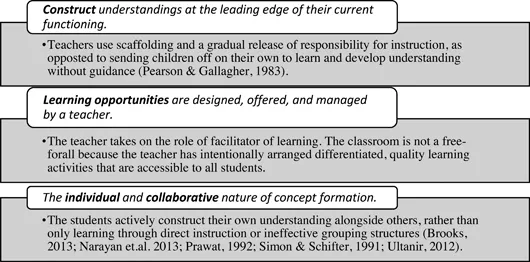
The goal of education rooted in constructivist learning theory is to offer students opportunities to construct understandings at the leading edge of their current functioning. These opportunities are designed, offered, and managed by a teacher with understandings of how people forge new concepts, including both the individual and collaborative nature of concept formation.
(p. 271)
Based on this definition alone, it is easy to see why some teachers have the perception that PBL is open-ended and unstructured. Words like “construct,” “opportunities,” “individual,” and “collaborative” are certainly a part of constructivism and PBL. However, without a strong understanding of what they mean in context, misinterpretation is bound to occur, especially when teachers try to use strategies in their practice without fully understanding the theory and research behind them.
Developing a conceptual understanding in tandem with opportunities for practical applications of learning is essential for both students and teachers in Project Based Learning. To effectively, thoroughly, and purposefully implement Project Based Learning in your classroom, it is essential to first have a basic understanding of the principles of constructivism.
Now reread the statement strands by Brooks that have been highlighted in Figure 1.1, this time reading between the lines to uncover some of the principles of constructivism.
Figure 1.1 Brooks statement chunked and highlighted
These principles are not merely educational guides; they are values – values that will guide your instructional decisions, inspire the classroom culture you create, the experiences you plan, and the conversations you have with children. Teaching through PBL draws on a belief of constructivism and the values we find in the principles. As you approach implementing PBL, consider the fact that our teaching experiences go far deeper than just transmitting content and skills to children. Every interaction we have, each lesson we plan is a reflection of what we believe about children. Our classrooms are more than just “learning spaces.” They are places where the values we hold about children are evident during each interaction, each unit, each minute, and each day. They reflect who we are as educators. And these constructivist principles, as revealed through PBL, allow teachers to approach teaching and learning in ways that empower children, allow them to be a part of their own learning process in community with others, and realize the meaning and relevance of their learning. The projects in which children engage during PBL tell stories about how teachers view children, and also, how children see themselves.
The five principles of constructivist learning theory, shown in Table 1.1, provide teachers with a solid foundation for developing a classroom where PBL can thrive (Driscoll, 2005). More important than memorizing the key features of constructivism – as important as they are – is being able to identify how the principles underscore everything we do when designing, developing, and implementing projects with young children.
Table 1.1Principles of Constructivism
Principle 1
Embed learning in complex, realistic, and relevant learning environments.
Principle 2
Provide for social negotiation and shared responsibility as part of learning.
Principle 3
Support multiple perspectives and use multiple representations of content.
Principle 4
Encourage ownership in learning.
Principle 5
Nurture self-awareness and an understanding that knowledge is constructed.
The principles of constructivism represent the values and beliefs that guide our instructional decisions as we create the conditions for deep learning. It is our role, as teachers, to take the specifics of each principle and arrange meaningful and relevant experiences where students learn in collaboration with their peers. Conversely, traditional teaching practices rely on the teacher to transmit the knowledge to students and then check to see what they learned. Project Based Learning encourages students to draw on their prior knowledge and experiences to construct knowledge and become independent learners who are capable of taking an active role in their learning throughout a project.
Principles and values such as these can have a profound impact on our teaching. When we strive to hold those beliefs at the center of our work (as Project Based Learning demands that we do), we empower young children to move through life knowing they have a role to play, not just “when they grow up,” but as young learners. We want our students to know they can contribute to the world around them now, as members of their classroom community, and also as members of the wider community outside of their classroom walls. Understanding the individual principles and where they naturally overlap will help you plan, create, and sustain an environment in your own classroom that fosters student growth through PBL.
In this chapter, we introduce each of the constructivist learning principles with a theoretical lens sharply focused on early childhood Project Based Learning and specifically, on Sara's Outdoor Classroom project. We will take you behind the scenes of the planning and preparation that goes into a project and you will see firsthand how the constructivist principles informed Sara's instructional decisions. By focusing on what these principles look like in the context of a project, we hope to deepen your understanding of constructivism and help you make connections to your own teaching, thereby setting the stage for implementing Project Based Learning in your own classroom. Included in each section are also examples for how each principle informs curriculum, instruction, and other classroom decisions in a more general context. We also suggest specific “Quick Strategies” for implementation and applications of the principles as the basis for the rest of the book. Chances are that as you view the principles of constructivism through an early childhood lens, you'll recognize aspects that are familiar to you, even if you are teaching in a more traditional environment.
The Outdoor Classroom Project: Constructivist Principles in Practice
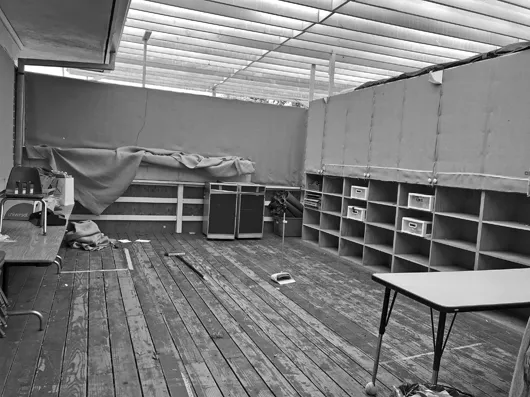
Two weeks before the first day of school, Sara visited her new TK classroom to begin making plans for the year. The space was relatively small, but adjacent to that room was an empty outdoor area that had previously been used for storage and as a holding space for children during carpool (Figure 1.2). Sara could immediately see its potential. Knowing that the physical environment of the classroom would reflect her values as a teacher and that her students would need more space to learn, she immediately had a thought: “This should be our first project.”
Figure 1.2 Two weeks before the first day of school
Sara's first teaching decision – the idea that four-year-olds would have an instrumental role in designing and creating their own learning environment – embodies all five constructivist principles in one single thought. Sara knew the small indoor classroom would be inadequate for the developmental requirements of four- and five-year-olds in terms of movement and variety, so the outdoor classroom needed to be created for practical use. The empty, adjacent classroom provided a realistic, relevant, and complex problem for the students to solve. Sara also knew the TK learning goals could be integrated into a project like this one because she had spent time looking at both the foundational skills for the end of pre-school (preschool learning foundations) as well as the Common Core State Standards for kindergarten in her previous teaching roles as a TK teacher. She knew that the specific grade-level standards, when connected to authentic purposes, could serve as a strong foundation for students' realistic and relevant learning.
This project would require children to take an active, shared role in their community by negotiating their wishes and their needs when making decisions together. The Outdoor Classroom project would engage children's multiple perspectives and use multiple representations of content, as children would need to offer design suggestions based on their backgrounds and prior experiences. They would need to represent their ideas in a variety of ways that would honor their diverse learning community. By beginning the year with this project, Sara would be honoring and valuing students' ideas and experiences all the while learning more about them throughout the project. This project would support children's self-awareness and an understanding of how learning is constructed by asking them to take initiative in their learning when considering what they wanted and needed for the space. Collaboratively creating a physical space would provide the children with an opportunity to literally see their learning throughout the entirety of the project. Finally, and perhaps most importantly, the project would give children ownership over their learning. The classroom they created would be a place they learned and played each day. Knowing they had a major role in creating the space would foster a sense of pride, ownership, and commitment to keeping the space organized for optimal use.
Although Sara could have designed and set up the space before the children arrived, she decided the creation of the outdoor classroom was an authentic context for teaching social and emotional competencies, as well as academic standards. Sara began developing her project idea and decided “How can we ...
Table of contents
Cover
Half Title
Series Page
Title Page
Copyright Page
Dedication
Contents
Meet the Authors
List of Illustrations
Acknowledgments
Introduction
The Stages of Early Childhood Project Based Learning
1. Constructivism in Practice: Creating the Conditions for Project Based Learning in an Early Childhood Classroom
2. Learner-Centered Teaching Practices
3. Project Planning: An Integrated Approach
4. Research Redefined: Sustained Inquiry in Early Childhood PBL
5. Purposeful Literacy in Early Childhood PBL
6. Embedding Social and Emotional Learning Into Project Based Learning: Developing Independence and Collaboration
7. Reflection, Feedback, and Revision: Taking an Active Role in the Learning Process
8. Sharing Our Learning: Assessment and Public Products in Early Childhood PBL
Conclusion: Reaching Success
Appendix A: Project Planner
Appendix B: Additional Resources
Trusted by 375,005 students
Access to over 1.5 million titles for a fair monthly price.
Study more efficiently using our study tools.
Frequently asked questions
Yes, you can cancel anytime from the Subscription tab in your account settings on the Perlego website. Your subscription will stay active until the end of your current billing period. Learn how to cancel your subscription
No, books cannot be downloaded as external files, such as PDFs, for use outside of Perlego. However, you can download books within the Perlego app for offline reading on mobile or tablet. Learn how to download books offline
Perlego offers two plans: Essential and Complete
Essential is ideal for learners and professionals who enjoy exploring a wide range of subjects. Access the Essential Library with 800,000+ trusted titles and best-sellers across business, personal growth, and the humanities. Includes unlimited reading time and Standard Read Aloud voice.
Complete: Perfect for advanced learners and researchers needing full, unrestricted access. Unlock 1.5M+ books across hundreds of subjects, including academic and specialized titles. The Complete Plan also includes advanced features like Premium Read Aloud and Research Assistant.
Both plans are available with monthly, semester, or annual billing cycles.
We are an online textbook subscription service, where you can get access to an entire online library for less than the price of a single book per month. With over 1.5 million books across 990+ topics, we’ve got you covered! Learn about our mission
Look out for the read-aloud symbol on your next book to see if you can listen to it. The read-aloud tool reads text aloud for you, highlighting the text as it is being read. You can pause it, speed it up and slow it down. Learn more about Read Aloud
Yes! You can use the Perlego app on both iOS and Android devices to read anytime, anywhere — even offline. Perfect for commutes or when you’re on the go. Please note we cannot support devices running on iOS 13 and Android 7 or earlier. Learn more about using the app
Yes, you can access Implementing Project Based Learning in Early Childhood by Sara Lev,Amanda Clark,Erin Starkey in PDF and/or ePUB format, as well as other popular books in Education & Classroom Management. We have over 1.5 million books available in our catalogue for you to explore.