eBook - ePub
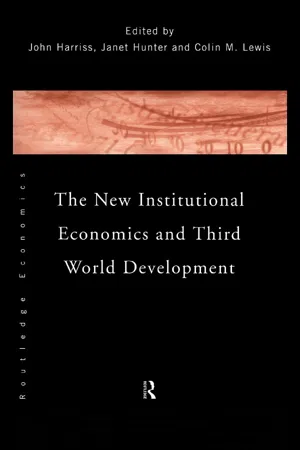
The New Institutional Economics and Third World Development
- 376 pages
- English
- ePUB (mobile friendly)
- Available on iOS & Android
eBook - ePub
The New Institutional Economics and Third World Development
About this book
The new institutional economics is one of the the most important new bodies of theory to emerge in economics in recent years. The contributors to this volume address its significance for the developing world. The book is a major contribution to an area of debate still in its formative phase. The book challenges the orthodoxies of development, espec
1
INTRODUCTION
Development and significance of NIE
John Harriss, Janet Hunter and Colin M.Lewis
The importance of the new institutional economics (NIE) has been confirmed by the award of the Nobel Prize for Economics first in 1991 to Ronald Coase, whose seminal papers on ‘The Nature of the Firm’ (1937) and on ‘The Problem of Social Cost’ (1960) are widely referred to here, and then in 1993 to Douglass C.North, who contributes the following chapter in this book. The ‘new institutionalism’ is important for perhaps three reasons above all. First, it is an emerging body of theory which starts out within the frame of neo-classical economics, but offers answers to what have otherwise remained as puzzles in neo-classical theory. One of these puzzles, which, as Toye explains in his chapter, ‘acted as a catalyst of the NIE’, is the problem of the existence of the firm as an administrative and financial organisation—to which Coase offered an answer in his essay of 1937. So the NIE is important as a major development within the dominant paradigm of modern economics. Second, it is important in the context of economic policy in the 1990s because it has challenged the dominant role ascribed to the market by the orthodoxies of the last ten years or so. Thus, as Bates puts it in his chapter in this book, ‘[Those] who had emphasised the importance of market failure in development economics find in the new institutionalism new justification for their interventionist beliefs.’ However, the NIE does not simply reintroduce the state and revive the sterile confrontation between ‘state’ and ‘market’. Rather—as Toye explains—it shows that neither state nor market is invariably the best way in which to organise the provision of goods and services. Also, it offers ‘a set of tools to inform institutional design’. Herein lies much of the importance of the new institutionalism for the study of development. Third, its significance for development studies relates to another factor which underlies the contemporary prominence of NIE. In a period in which ‘grand theory’ in the social sciences has generally been on the retreat, it claims to offer just such a grand theory of social and economic change—a theory of development in terms of appropriate institutional change (which fosters further economic growth). The NIE is, moreover, a body of economic theory which ascribes an important role to ideas and ideologies, and one which is accessible to other social scientists, seeming to open up the terrain of genuinely inter- (not just ‘multi-’) disciplinary enquiry. This aspect is reflected in the fact that contributions to this book have been written by political scientists and historians as well as by economists. Among other things, the NIE provides scholars with a means of dealing rather more rigorously with the issue of distinguishing between the real world and individuals’ and groups’ perceptions of it. The question of ‘mental models’ plays a prominent part in the historical chapters, and suggests the possibility that the NIE can go a considerable way toward bridging a very real gulf between the perfectly rational actors of neoclassical theory and the often seemingly irrational decisions of economic actors in history—a problem which scholars such as Scott attempted to address through the concept of the moral economy of the peasant (Scott 1976). Mental models, however, offer another perspective on how to deal with market interaction and transaction costs. Phrases such as ‘market failure’ and ‘market imperfections’ dominate the study of late-developing economies. They also feature largely in—and are fundamental to—the NIE, given the focus on production externalities, public goods, imperfect information and the free-rider problem. Institutions, for economic historians such as North, are the way in which economies cope with ‘market failure’. Thus, by attempting to incorporate the concepts of public/rational choice into economic decision-making, NIE not only tries to suggest something about the relationship between the individual and the collective in rational decision-making, but also appears to offer an explanation as to why the evolutions of individual countries differ from each other. And this, perhaps, is the fundamental dilemma of the scholar of economic change—to find a position on the spectrum which at one end argues that the development of every economy is unique, and at the other argues, like Marx or Rostow, that there is a universality about economic development, from which economies are incapable of deviating.
WHAT IS THE ‘NIE’ AND WHY IS IT SIGNIFICANT IN MODERN ECONOMICS?
North (Ch. 2, this volume) tells us that NIE
builds on, modifies, and extends neo-classical theory to permit it to come to grips and deal with an entire range of issues heretofore beyond its ken. What it retains and builds on is the fundamental assumption of scarcity and hence competition—the basis of the choice theoretic approach that underlies micro-economics.
Thus the NIE retains the neo-classical axioms of methodological individualism but rejects certain very restrictive assumptions in the notion of ‘the market’ that is central to neo-classical economics: namely, the conception of the market:
as an abstract realm of impersonal economic exchange of homogeneous goods by means of voluntary transactions on an equal basis between large numbers of autonomous, fully-informed entities with profit-maximising behavioural motivations and able to enter and leave freely.
(Harriss-White, Ch. 6 this volume)
The NIE starts from the reality that information is rarely complete, and that individuals have different ideas (or mental models) of the way in which the world about them works. Transactions thus have costs associated with them which are assumed not to exist in the neo-classical model: these are the costs of finding out what the relevant prices are, of negotiating and of concluding contracts, and then of monitoring and enforcing them. Institutions are broadly defined as means of reducing these information and transaction costs.
North also argues that institutions are formed precisely to reduce uncertainty in human exchange. Institutions—notably property rights in the North view—are thus crucial determinants of the efficiency of markets. He attributes this basic insight to Coase, who argued that the existence of ‘real-world’ firms’ actual administrative organisations—as opposed to the abstraction of ‘the firm’ as an economic actor in general equilibrium theory— stems from the fact that they allow for the reduction of information and transaction costs. This leads to the recognition, uncomfortable for some economists, that markets are only one type of social device for settling the terms of transactions, and that the performance of markets may be judged against that of other devices. To summmarise, the NIE is a development of neo-classical economics to include the role of transaction costs in exchange and so to take account of institutions as critical constraints on economic performance.
North adds yet another aspect that is of central importance. This is that the NIE modifies the ‘rationality postulate’ of neo-classical economics which maintains that values are given and constant and that individual economic agents select the most efficient means of maximising rationally chosen ends. North, however, argues here that individuals make choices on the basis of their mental models. Drawing on Boyd and Richerson (1985), North has shown that these are in part culturally derived, differ widely, are not easily changed and give rise not to the one determinate position of general equilibrium theory but potentially to multiple equilibria (North 1990a:37). As the chapters by Clarence-Smith and Greenhill—on cocoa production and the Brazilian coffee trade respectively—show, mental models can sustain systems that are anything but efficient.
A further perspective on the origins and significance of the NIE is suggested by Bates. He, possibly echoing Toye, who refers to the over-arching concern in classical economics with the problem of the reconciliation of private passions and public interests, maintains that the key argument of the new institutionalism is the claim ‘that institutions provide the mechanisms whereby rational individuals can transcend social dilemmas’. By ‘social dilemmas’ he refers to those kinds of problems which arise when choices made by rational individuals yield outcomes that are socially irrational. This is a real-world problem quite beyond the definitional framework of the abstract world of general equilibrium theory. Bates also alludes to ways in which institutions such as property rights resolve problems of market failure (for example, those arising from production externalities), how non-market institutions resolve problems that undermine the creation or the maintenance of public goods, and how information costs give rise to different types of contracts. For Bates, then, the ‘core logic’ of the new institutionalism is that ‘Rational individuals, confronted with the limitations of individually rational behaviour, create institutions that, by creating new incentives or by imposing new constraints, enable them to transcend these limitations’ (Ch. 3, this volume).
WHAT IS ‘NEW ABOUT NIE?
The NIE is ‘new’ because there is an older school of institutionalism in economics. Rutherford argues that the old institutionalism was largely rooted in North American traditions associated with, amongst others, the work of Thorstein Veblen, John R.Commons, Clarence Wendell and Allan Grunchy. This approach pointed to a dichotomy between business and industry and between institutional and technical aspects of an economy. It sought to analyse societal and organisational constraints on, or reactions to, innovation and the diffusion of new technology. As implied above, questioning assumptions of equilibrium embedded in orthodox theory, the old institutional economics (OIE) maintained that economics systems evolved as a result of adjustments to existing institutions provoked by technical change (Rutherford 1994:1– 3). In his chapter in this book, Stein provides a direct account of the origins of NIE. He shows that older institutionalists like Commons and Veblen ‘reject the emphasis on rational-maximising self-seeking behaviour of individuals which is at the heart of both neo-classical economics and new institutionalism’. More controversially, Stein asserts that institutions are less instrumental and should be envisaged more as settled habits of thought common to the generality of man. As indicated, North inclines to these ideas in his chapter when he refers to the enduring qualities of the different mental maps with which individuals confront the world, and argues (problematically for Stein) that the NIE refutes the postulate of instrumental rationality. Although Toye refers in his note 4 to the emphasis in this older school on descriptive ‘realism’, and is critical of its lack of a theoretical framework, Stein finds more insight in the OIE than the NIE in his critique of structural adjustment policies in Africa. He argues that the latter is flawed because of its ‘capture’ by neo-classical theory, and that this’…limits its understanding of how capitalism operates and by implication how to design institutions to build markets in African countries’. Stein is critical of the NIE focus on firms as transaction-costs minimisers, and the failure to provide an adequate explanation of firm-level innovation. On the other hand, he argues that a differentiation between types of capitalismbased on the organisation of firms, in part founded on an attempt to take account of response to innovation, constitutes the strength of the OIE. This, of course, may be disputed and it remains unclear whether the OIE offers a convincing theoretical explanation for the occurrence of innovation. Moreover, as manifest in the implicit tension between chapters by Handoussa and Stein in this volume, the specifics of the links between NIE and OIE are a subject of continuing debate.
In sum, the OIE may be presented as descriptive, holistic and behaviourist and the NIE as formalist and reductionist. In ideological terms, the former can be depicted as collectivist and lacking technical rigour, the latter as anti-interventionist and excessively devoted to highly mathematical rational choice modelling. Nevertheless, institutionalists—old and new—are concerned with the determinants of change over time. In neo-Schumpeterian fashion, NIE presents change as evolutionary while attaching greater importance to the role of the individual, thereby acknowledging a larger debt to classical economics. This accounts for its emphasis on legal systems, property rights and organisations. Hence, too, the importance attached to public choice theory and the empowerment of the individual agent, and to rent-seeking behaviour and distributive coalitions, processes that reduce or increase transaction costs and positively or adversely affect income distribution and therefore impact on economic efficiency. Thus, as indicated above, whereas classical theory seeks to analyse an economy at a particular moment and takes little cognizance of peculiarities of time and place, institutionalists examine process and seek to explain why some economies have advanced and others have not. This is an aspect of the approach that has always commended institutionalism to historians. Moreover, it is an explicit incorporation of the political and the social into analyses of the formation of institutions that has generated interest in institutional economics amongst social scientists. These characteristics, given the multi-disciplinarity of a large part of the existing literature, also point to the relevance of NIE for future research on Third World development.
THIRD WORLD DEVELOPMENT
Proponents of both OIE and NIE have drawn on the development experience of areas of the Third World. James Street has attempted to establish parallels between old-school US institutionalism and Latin American structuralism associated with the writing of Raúl Prebisch, approaches which, according to Street, are particularly appropriate to the study of sub-Saharan Africa and Latin America (Street and James 1982). Though the technological process was paramount for old institutionalists, while structuralism centred on the mechanics of exchange, both were concerned with the impact of these conditions on the frameworks within which development occurred. Post-Second World War Africa and Latin America were presented as ‘frontier’ regions of rapid population growth and physical space, where imported technology wouldinteract with existing cultures to produce growth-oriented institutions. In less optimistic vein, for North Third World countries provide examples of antidevelopment frameworks. Statist regulation, ill-defined property rights and other constraints restrict rather than stimulate economic activity. These conditions result in rent-seeking and redistribution, not rising productivity. Organisations that operate within Third World institutional frameworks are not inefficient; they are efficient at making a society more unproductive (North 1990a:9).
Arguably, it is the focus upon the interaction between institutions and organisations in some of the most recent NIE writing that makes the NIE approach especially relevant for students of long-run Third World development. If some exponents of the ‘old’ institutionalism were particularly exercised by the impact of technical change on institutions (defined as regulatory systems of formal laws, informal conventions and norms of behaviour) and early ‘new’ institutionalists were primarily interested in the behaviour of organisations (that is, individual agents, groups, firms, businesses, collective bodies and so forth), recent contributors have stressed the inter-dynamics between institutions and organisations. In quite different ways Haber and Khan show how distinct institutional arrangements can shape organisational behaviour and how alternative sets of organisational responses may impact on institutions. Consequently, while it may be argued that to a large extent growth is institutionally path determined, agents being conditioned by prevailing cultural norms and possibly deflected from behaviour that is optimal or maximising, this does not preclude individual organisations acting as agents for institutional change. Similarly, novel productivity-enhancing institutions can emerge almost spontaneously, triggered by minimal individual initiatives, and are not invariably rooted in collective behavioural change. This implies a greater recognition of cultural— institutional—diversity and the prospect of positive institutional change resulting from a range of individual actions, presuming that action to be largely driven by optimising rationality. This points to the need for further research on market formation (or failure)—in particular the creation of a framework for individual maximisation, the role of the state in setting and policing the game rules and the influence of interest groups—organisations— in shaping institutions in the Third World. Two of the chapters in this book examine a particular organisation—the plantation—in terms of the interplay between organisations and institutions. Clarence-Smith demonstrates that the survival of cocoa plantations was largely due to the existence of dominant interests able to exert political influence, rather than to economic rationality in a sector of agriculture where the economics of production might well have dictated sharecropper rather than estate operation. Similarly, in Brazil, planter power ensured that the response to market failure was official action in support of rent-seeking rather than measures ‘to improve the working of the markets’ (Greenhill). This analysis is extended by Haber in his analysis of regulatory regimes and the provision of industrial finance.
Many chapters in this book illustrate the contribution of NIE to the understanding of development. Booth and Brett offer particular insights into the role of institutions in shaping patterns of economic activity in the long-run in Africa and Asia. They confirm Bates’s general argument that the new institutionalism offers ways of understanding the economic significance of features of Third World societies and cultures that market-based reasoning might misunderstand or ignore, for example different forms of contracts, aspects of which are also described in the Toye chapter. The NIE also expands the menu of policy alternatives, offering positive guidelines for policy interventions overlooked by orthodox economists. Here the NIE merges with a wider body of thought, which includes public choice theories, to which Gyimah-Boadi refers in his review of explanations for the success of the Rawlings regime in Ghana. This literature has given rise to a new vein of thinking about the design of institutions and organisations for development. As North writes below, ‘We simply don’t know how to transform ailing economies into successful ones but some fundamental characteristics of institutions suggest some clues.’ The ones which he draws out imply that the panaceas prescribed for the economies of Eastern Europe or Sub-Saharan Africa are unlikely to succeed. The problem of collective action has emerged as a major theme in the growing body of literature on institutional design, notably Wade (1988), Ostrom (1990), and more recently Ostrom et al. (1993). The last pays particular attention to the design of institutions ‘that motivate all actors in infrastructure development to keep transformation, coordination, and information costs down’ (Ostrom et al. 1993:220). Nevertheless, as Beatriz Armendariz and Francisco Ferreira argue, ‘institutions may…adapt sluggishly’, a process which in turn constrains the crisis-response capacity of organisations.
Yet it is possible, while arguing forcefully for the value of institutional analysis, to point to some problems with NIE as a means of analysing the micro-foundations of economies. Harriss-White demonstrates that the NIE is a relatively blunt instrument for the empirical analysis of ‘real institutionalised markets’ (as opposed to the theoretical abstraction of neoclassical theory). By comparison with other approaches to empirical analysis she concludes, with Khan, that NIE suffers from problems both with theoretical consistency and with the derivation of an empirical methodology. The former include the tendency of NIE, also considered by Toye and by Bates, to tautology; ‘existing institutions minimise transaction costs because transaction cost minimisation is their function’. More than one of the chapters in this volume conclude that some of the propositions derived from the NIE approach to the analysis of markets, including property rights, are too indeterminate to bear empirical investigation, and express concern that insufficient effort has been put into the actual measurement of transaction costs.
While the use of the conventional de-institutionalised conception of ‘the market’ as a basis for policy advocacy can result in unintended outcomes, it is also important, as Bates argues, to be aware of the ways in which NIE approaches may provide misleading or biased analyses for policy purposes. Bates takes as an example the case which, under the NIE approach, can be made for the benefits of marketing boards in Africa. However, as he points out, policy advocacy based on these arguments alone would reflect only a partial view—one whic...
Table of contents
- COVER PAGE
- TITLE PAGE
- COPYRIGHT PAGE
- ILLUSTRATIONS
- CONTRIBUTORS
- PREFACE AND ACKNOWLEDGEMENTS
- 1. INTRODUCTION: DEVELOPMENT AND SIGNIFICANCE OF NIE
- PART I: NIE: HISTORY, POLITICS AND DEVELOPMENT
- PART II: NIE: THEORY AND POLICY
- PART III: NIE: INSTITUTIONS AND ORGANISATIONS
- PART IV: NIE: INSTITUTIONS, ORGANISATIONS AND THE STATE
- BIBLIOGRAPHY
Trusted by 375,005 students
Access to over 1.5 million titles for a fair monthly price.
Study more efficiently using our study tools.
Frequently asked questions
Yes, you can cancel anytime from the Subscription tab in your account settings on the Perlego website. Your subscription will stay active until the end of your current billing period. Learn how to cancel your subscription
No, books cannot be downloaded as external files, such as PDFs, for use outside of Perlego. However, you can download books within the Perlego app for offline reading on mobile or tablet. Learn how to download books offline
Perlego offers two plans: Essential and Complete
- Essential is ideal for learners and professionals who enjoy exploring a wide range of subjects. Access the Essential Library with 800,000+ trusted titles and best-sellers across business, personal growth, and the humanities. Includes unlimited reading time and Standard Read Aloud voice.
- Complete: Perfect for advanced learners and researchers needing full, unrestricted access. Unlock 1.5M+ books across hundreds of subjects, including academic and specialized titles. The Complete Plan also includes advanced features like Premium Read Aloud and Research Assistant.
We are an online textbook subscription service, where you can get access to an entire online library for less than the price of a single book per month. With over 1.5 million books across 990+ topics, we’ve got you covered! Learn about our mission
Look out for the read-aloud symbol on your next book to see if you can listen to it. The read-aloud tool reads text aloud for you, highlighting the text as it is being read. You can pause it, speed it up and slow it down. Learn more about Read Aloud
Yes! You can use the Perlego app on both iOS and Android devices to read anytime, anywhere — even offline. Perfect for commutes or when you’re on the go.
Please note we cannot support devices running on iOS 13 and Android 7 or earlier. Learn more about using the app
Please note we cannot support devices running on iOS 13 and Android 7 or earlier. Learn more about using the app
Yes, you can access The New Institutional Economics and Third World Development by John Harriss,Janet Hunter,Colin Lewis in PDF and/or ePUB format, as well as other popular books in Economics & Business General. We have over 1.5 million books available in our catalogue for you to explore.